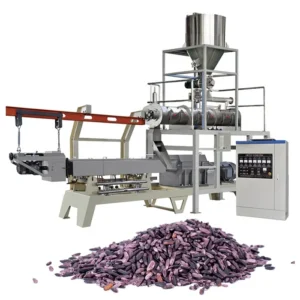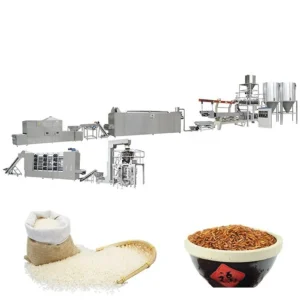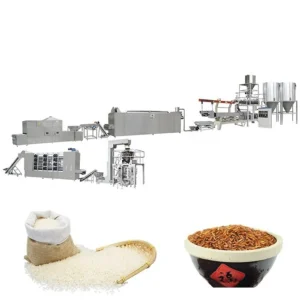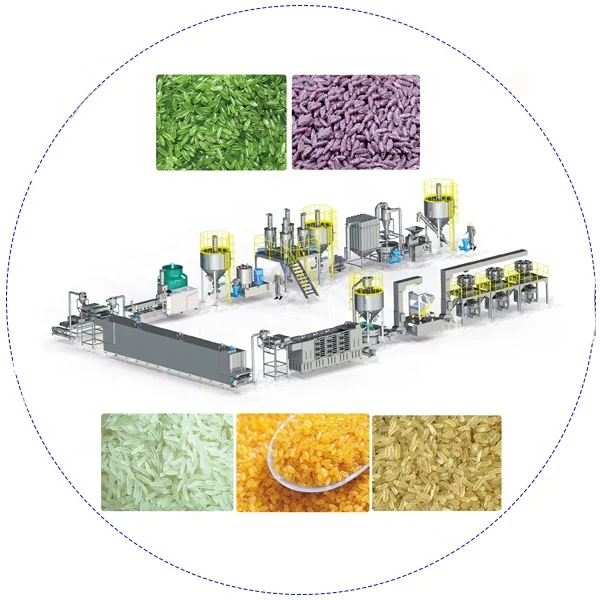


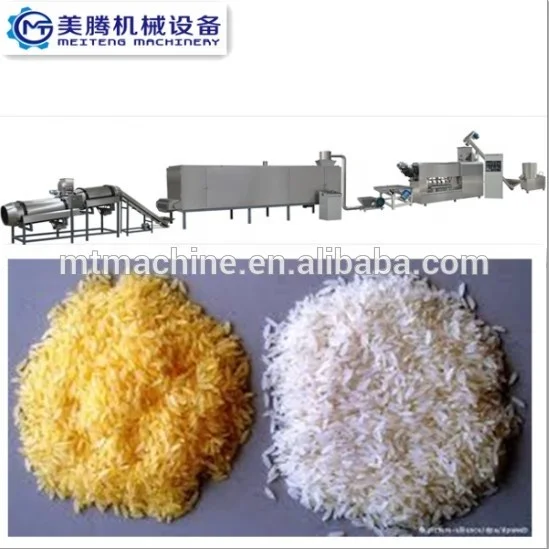

Fortified Rice Production Line Turnkey, Twin-Screw Extruder, 110 kW Main Drive — engineered for continuous extrusion of rice flour and corn flour with micronutrient premixes into reconstituted grain kernels. Co-rotating sectional screw modules control gelatinisation, de-gassing and forming in a single pass, while multi-stage drying (low-temperature dryer + baked oven + cooling dryer) holds final moisture within specification before packing. – Throughput across every station is matched under one supplier, and trial runs on your actual formulation are completed in-house before shipment.
Description
Integrated Extrusion-to-Packing Layout — every station from batching through drying is sized to sustain the extruder’s actual throughput on your specific rice flour formulation rather than a generic nameplate figure.
Technical Specifications
| Parameter | Value |
|---|---|
| Product Type | Artificial Rice Extrusion Production Line |
| Extruder Configuration | Twin-screw, co-rotating sectional modules |
| Output Capacity | 400–500 kg/h (basis not stated in source — capacity subject to raw material formulation, moisture content, and rice grain dimensions) |
| Extruder Main Drive Power | 110 kW (frequency control) |
| Feeder Drive Power | 1.5 kW (frequency control) |
| Cutting Drive Power | 2.2 kW (frequency control) |
| Lubrication Oil Pump Power | 0.75 kW |
| Screw Effective Length | 2500 mm |
| Mixing Machine Power | 15 kW |
| Mixing Batch Capacity | 130–150 kg/batch (verify against final catalog) |
| Mixing Tank Wall Thickness | 1.5 mm stainless steel |
| Stainless Steel Cover Thickness | 1.2 mm |
| Vibrating Screen Power | 0.2 kW |
| Cooling Dryer Power | 2.2 kW |
| Dryer Heating Source | Electric (gas / diesel / steam available on request) |
| Line Sequence | Mixing → Extrusion → Vibrating Cooling Screen → Low Temperature Dryer → Baked Oven → Cooling Dryer → Packing |
| Certification | CE |
Application Suitability
| Application | Material or Output |
|---|---|
| Fortified rice for food aid and nutrition programmes | Rice flour, corn flour, micronutrient premix (vitamins, minerals) |
| Artificial rice kernels for health food markets | Blended grain flours with customizable nutrient profiles |
| Reconstituted rice from milling by-products | Rice powder and corn powder with starch-binding additives |
| Infant nutrition rice cereal base | Pre-gelatinised rice flour with iron and B-vitamin fortification |
Why Nominal Line Capacity Misses the Real Output on Fortified Rice
A rated throughput means nothing until it is validated on your exact flour blend and micronutrient premix.
I spent years on the assembly floor before moving into technical sales here in Shandong, and one project stays with me. A buyer ordered a line rated at 500 kg/h for fortified rice, but his proprietary flour mix had lower starch content and weaker binding properties than the standard test material. Actual sustained output settled around 300 kg/h, throwing the dryer and cooler schedules completely off balance. The whole line rhythm broke down. Since that project, every fortified rice production line turnkey order I handle starts with a trial run on the customer’s actual raw material before the contract is finalised [NEED_CITE: raw material variability in extrusion output].
How Co-Rotating Twin-Screw Geometry Shapes the Rice Kernel
The co-rotating sectional screw modules inside the extruder give operators independent control over transport, mixing, gelatinisation, de-gassing and forming within one continuous barrel. For a fortified rice production line turnkey project, this matters because micronutrient premixes must disperse evenly through the starch matrix before the die plate cuts each kernel. Frequency control on the 110 kW main drive lets you adjust screw speed without changing the feeder or cutter rate, so you can fine-tune shear and residence time to match the exact gelatinisation window of your rice flour blend.
Managing Moisture from Die Face to Packing Bag
Freshly extruded rice kernels carry surface moisture that must drop in stages to prevent cracking, case-hardening, or secondary damp absorption in the bag. This line sequences a vibrating cooling screen first, then a low temperature dryer, a baked oven, and a final cooling dryer before packing. That multi-stage path gives each kernel time to release internal moisture gradually rather than shocking the surface with high heat. The dryer heating source defaults to electric, with gas, diesel, or steam options available to match whatever utility infrastructure your facility already has in place [NEED_CITE: industrial dryer heating options for food extrusion lines].
Reading the Specs That Actually Govern Kernel Quality
The 2500 mm screw effective length sets the residence time window: longer residence allows more complete starch gelatinisation, which directly improves kernel shape retention after drying. The 15 kW mixer with 130–150 kg batch capacity must cycle fast enough to keep the twin-screw extruder fed continuously; otherwise the feeder runs starved and kernel density fluctuates. Frequency control on the feeder and cutter drives means you can adjust feed rate and cut length independently of screw speed, giving you a wider process window when switching between, say, a pure rice flour recipe and a corn-rice blend. The 1.5 mm stainless steel mixing tank wall resists corrosion from acidic vitamin premixes that would pit thinner gauge steel over time.
The Hidden Cost of an Undersized Dryer
When the dryer cannot remove moisture as fast as the extruder produces wet kernels, product piles up on the belt, residence time in the drying zone increases unpredictably, and some kernels over-dry while others remain too moist. In a fortified rice line, uneven moisture means inconsistent nutrient retention and kernel breakage downstream [NEED_CITE: moisture uniformity in extruded grain products]. Buyers who focus only on extruder nameplate capacity and treat the dryer as an afterthought often discover the bottleneck weeks after commissioning, when the line cannot sustain its rated output during continuous shifts.
What We Build Into Every Fortified Rice Line
Throughput matching across every station eliminates the scenario where the extruder outpaces the dryer or the cooler cannot keep up with the oven. Screw configuration and die design are specified to your target rice grain dimensions and flour composition, not copied from a generic template. An in-house testing workshop allows trial runs on your actual raw material before the equipment leaves the factory, so process parameters are established before installation begins. Twin-screw expertise extends across grain-based applications, meaning the same engineering team that configured your rice line understands how corn flour, tapioca starch, or millet flour behave under different shear profiles. Pre-sales consultation covers line layout, utility planning, and phased installation scheduling so that foundation work and electrical drops are ready when the machines arrive.
Documentation & Verification
- Line layout drawing showing throughput balance between extruder, dryer, and cooling stations
- Screw and die configuration record matched to your rice grain target dimensions
- Trial run report on your flour formulation with density, shape retention, and moisture data
- Electrical schematic with voltage and frequency confirmed for your destination facility
- Operation and maintenance manual with wear parts list and replacement intervals
Installation, Commissioning & Support
- Foundation plan accounts for the 2500 mm extruder barrel length and multi-stage dryer footprint
- Electrical drop sized for 110 kW extruder main drive plus auxiliary motors on dedicated circuits
- Frequency-controlled drives commissioned on-site with operator language set before production trials
- Dryer heating source configured and tested against your facility’s available utility supply
- Wear parts inventory including screw sections and die plates supplied for first replacement cycle
What to Include With Your Inquiry
Send your rice flour specification sheet, including starch content, particle size distribution, and the exact micronutrient premix formulation you plan to use. Confirm your target daily output, available workshop floor area, and ceiling height so we can draft a line layout that fits your space. Specify your local voltage and frequency, preferred control language, and whether your facility uses electric, gas, diesel, or steam heating.
Frequently Asked Questions
Q: How is the line’s output capacity verified against my specific raw material and formulation?
A: We run your actual rice flour blend and micronutrient premix through the extruder in our testing workshop before shipment. The trial run measures sustained throughput, kernel density, shape retention, and exit moisture. Those results define the process parameters written into your commissioning protocol, so the line is tuned to your material from day one.
Q: What screw configuration and die design will be matched to my target rice grain shape and density?
A: The co-rotating twin-screw assembly is built from sectional modules selected for your flour’s gelatinisation behaviour and desired kernel geometry. Die aperture and land length are sized to produce the exact grain length and cross-section you specify. A configuration record documenting every module position is provided with your documentation package.
Q: Can the dryer heating type be switched between electric, gas, diesel or steam to suit my factory utilities?
A: Yes. The dryer defaults to electric heating elements, but gas burners, diesel-fired heat exchangers, or steam coils can be fitted during build. You confirm your available utility at the quotation stage so the correct heating system is installed and tested at the factory before dispatch.
Q: How do you ensure throughput is balanced between the extruder, dryer and cooling stages to avoid bottlenecks?
A: Each station is sized against the extruder’s validated output on your material, not a generic nameplate figure. Belt width, dryer length, oven zone count, and cooler capacity are all calculated from the trial run data. The line layout document shows the matched throughput at every station for your review before production begins.
Related products
-

Automatic Iron Fortified Baby Rice Cereal Nutrition Powder Making Machine 500kg/h PLC Controlled
¥8,238.27 Add to cart -

High Precision Automatic 500kg/h Baby Food Nutrition Powder Rice Extrusion Processing Line
¥9,500.00 Add to cart -
High Productivity New Condition Safe Healthy and Nutritious Baby Food Meal Replacement Powder Production Line
¥30.00 Select options This product has multiple variants. The options may be chosen on the product page -
500kg/h Automatic PLC Controlled Nutrition Baby Food Extruder Machine for Rice Cereal Processing
¥9,500.00 Add to cart