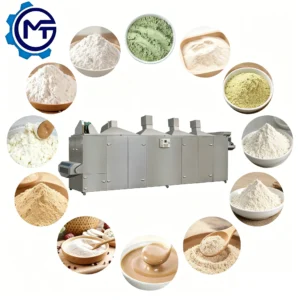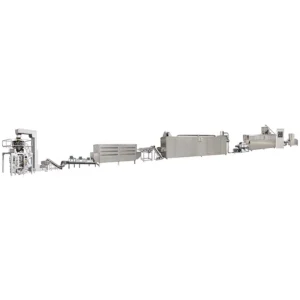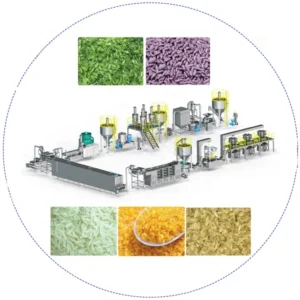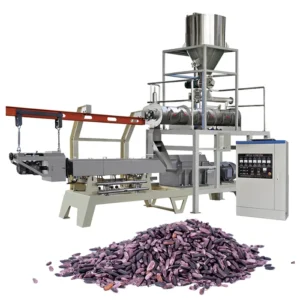
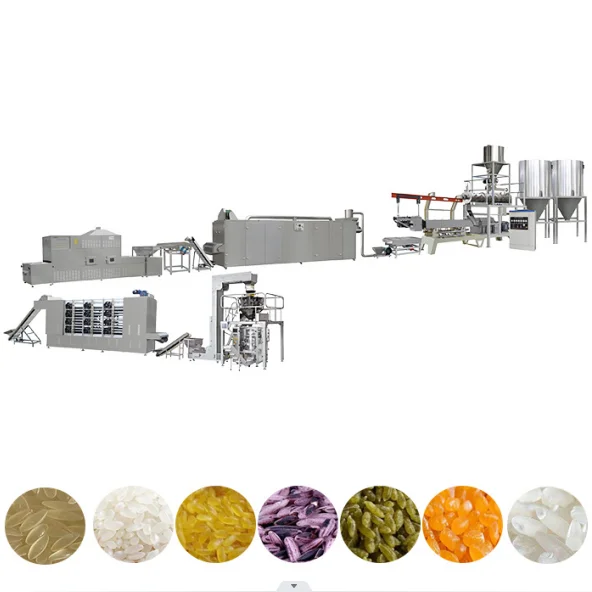

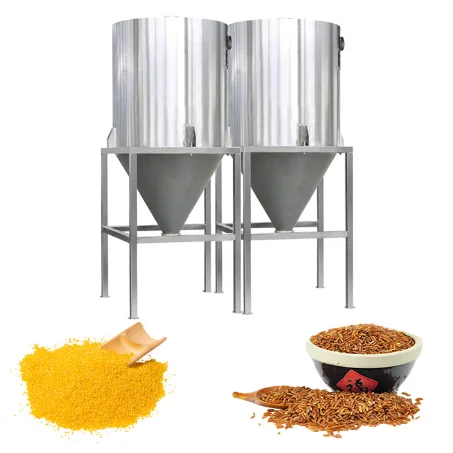

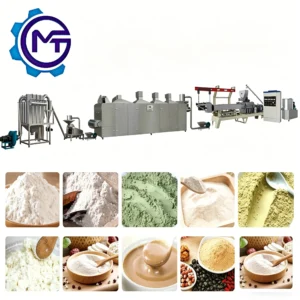
MT65 Fortified Rice Processing Line, Twin-Screw Extruder, 85 kW Installed Power — turnkey layout from mixing through extrusion, drying, roasting and packing under one supplier.
- Screw configuration and die design matched to your raw material and target kernel density
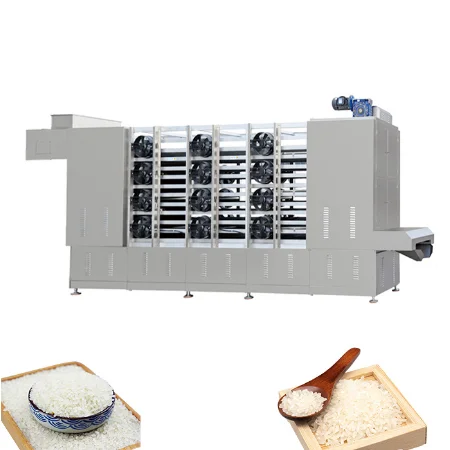
- Circulation drying oven with frequency-controlled mesh belt for uniform moisture reduction
- Stations throughput-matched to prevent bottlenecks across the full line
Trial runs on your actual raw material in our testing workshop before shipment ensure the line holds capacity on your recipe, not just on paper.
Description
Throughput-Matched Stations — Every section from mixing through packing is sized to the extruder’s real output on your raw material, eliminating the bottleneck guesswork that plagues multi-vendor lines.
Technical Specifications
| Parameter | Value |
|---|---|
| Product Type | Fortified Rice Processing Line |
| Screw Type | Twin-screw extrusion with single or double screw feeding system options |
| Installed Power | 85 kW (MT65) / 120 kW (MT70) / 180 kW (MT75) / 235 kW (MT85) / 260 kW (MT95) |
| Power Consumption | 60 kW (MT65) / 85 kW (MT70) / 135 kW (MT75) / 165 kW (MT85) / 195 kW (MT95) |
| Output Capacity | 80–100 kg/h (MT65) to 800–1000 kg/h (MT95) (basis not stated in source) |
| Overall Dimensions | 28×1.2×2.2 m (MT65) up to 36×3.5×4.3 m (MT95) |
| Control System | Frequency speed controlling |
| Drying Oven Heating Source | Electric or gas |
| Drying Oven Feature | Circulation drying process with frequency motor controlling mesh belt speed |
| Assembly State | Turnkey line with all stations included |
| Basic Materials | Broken rice, corn, millet, wheat, oats, buckwheat, beans, starch; vitamins and minerals as additives |
| Final Products | Artificial rice, fortified rice kernels |
Application Suitability
| Application | Material or Output |
|---|---|
| Nutrition programme fortified rice supply | Broken rice and rice bran base with micro-nutrient premix for food aid distribution |
| Value-added artificial rice production | Milled grain fractions reformed into whole kernels with natural viscosity and elasticity |
| Instant fortified rice porridge manufacturing | Pre-cooked extruded rice kernels blended with vitamins for retail and institutional markets |
| Infant and clinical nutrition rice base | Finely milled starch materials with controlled gelatinisation for easy-digestion applications |
Why Nominal Capacity Claims Derail Fortified Rice Projects
A rated output means nothing until it runs on your exact formulation and moisture content.
I have walked into facilities where the fortified rice processing line turnkey package was quoted at a headline capacity figure, but once the buyer’s specific vitamin premix and broken rice blend hit the barrel, actual throughput dropped noticeably. The extruder ran fine — the dryer could not keep up with the volume, and kernels backed up on the cooling conveyor. Capacity must be verified station by station against your material before any production commitment is made. [NEED_CITE: impact of raw material moisture and composition on extrusion throughput]
How Screw Configuration Shapes Kernel Density and Texture
The twin-screw extrusion stage is where the fortified rice processing line turnkey project succeeds or fails. Screw element arrangement — the ratio of kneading blocks to conveying elements — determines shear intensity and residence time inside the barrel. For a dense, natural-feeling rice kernel, the configuration must generate enough shear to fully gelatinise the starch without over-expanding the dough at the die face. Die diameter and land length then lock in the final kernel dimensions. Each screw and die combination is specified to the buyer’s raw material blend and target kernel density, not copied from a generic template.
Matching Dryer and Roaster Throughput to the Extruder
Extruders push product continuously, but drying and roasting are batch-paced by belt speed and residence time. If the circulation drying oven is undersized relative to the extruder output, moisture reduction becomes uneven — kernels on the top of the bed dry faster than those buried underneath. The frequency-controlled mesh belt on this line allows operators to adjust travel speed in real time, matching the upstream flow. The high-temperature roasting stage that follows requires its own capacity calculation, factoring in the thermal load of the specific grain formulation. [NEED_CITE: thermal load calculation for grain drying in extrusion lines]
Reading the Power and Dimension Data Correctly
The installed power range — from 85 kW on the MT65 to 260 kW on the MT95 — reflects motor sizing for the extruder drive, not total line consumption. Power consumption figures are lower because they account for typical operating load rather than peak draw. When planning your electrical infrastructure, the total connected load across all stations (mixer, extruder, dryer, roaster, cooler, packing) will exceed the extruder’s individual figure. The dimensional footprint spans from 28 metres in length for the smallest configuration to 36 metres for the highest-capacity setup. Ceiling clearance must accommodate the 4.3-metre height on the larger models, and floor loading calculations should account for the dryer and roaster when fully loaded with product.
The Cost of Skipping a Pre-Shipment Trial Run
Buyers who accept a line without a trial run on their own raw material discover formulation problems during commissioning — the worst possible time. The vitamin premix may not distribute evenly through the barrel, or the broken rice flour may require a different moisture adjustment than the supplier assumed. Resolving these issues on-site delays production start-up and burns through raw material while operators experiment with barrel temperature profiles and screw speeds. [NEED_CITE: pre-shipment trial testing protocols for food extrusion equipment]
What You Get from a Single-Source Turnkey Build
The line layout and capacity calculation are produced against your target output before the quotation is issued, not after. Screw configuration and die design are documented for your specific raw material and kernel specification. The in-house testing workshop runs your actual material before shipment, generating a trial run report that becomes part of the delivery package. Pre-sales engineering consultation covers utility planning, phased installation scheduling, and operator training — the same team that designed the line handles commissioning on your floor.
Documentation & Verification
- Line layout with capacity calculation matched to your target output across all stations
- Screw and die configuration record specific to your raw material formulation
- Trial run report generated on your raw material in the testing workshop
- Electrical schematic confirming voltage, frequency, and control language before production
- Factory test record documenting run parameters before crating and dispatch
Installation, Commissioning & Support
- Floor plan and utility drop locations provided based on the 28 to 36 metre line footprint
- Dedicated circuit requirements specified for the 85 kW to 260 kW extruder drive motors
- Modular station assembly with on-site mechanical and electrical connection sequence
- First-run parameter setting covering barrel temperature zones and frequency speed calibration
- Operator training on screw changeover, die maintenance, and mesh belt tension adjustment
- Wear parts list covering screws, dies, and dryer belt segments for first replacement planning
What We Need to Size Your Line
Share the base grain materials you plan to use, the specific vitamin or mineral premix formulation, and your target hourly output so we can calculate matched station capacities. Confirm your facility’s voltage and frequency, along with the HMI language your operators require. Let us know your available floor length and ceiling height so the layout fits without compromise.
Frequently Asked Questions
Q: How is line capacity verified on my actual raw material before shipment?
A: Your raw material is shipped to the testing workshop where the twin-screw extruder runs it through a full production cycle. The trial run report documents throughput, kernel density, moisture content after drying, and any screw or die adjustments made. This report accompanies the machine documentation, so commissioning starts from a proven baseline rather than guesswork.
Q: How do you match dryer and roaster capacity to extruder output?
A: Each station’s throughput is calculated against the extruder’s verified output on your material. The circulation drying oven’s mesh belt speed and residence time are set so kernels reach target moisture before entering the high-temperature roaster. No station is sized on a generic assumption — the layout document shows the matched capacity across every stage.
Q: What voltage, frequency, and HMI language options are confirmed before production?
A: Your facility’s electrical supply specifications are confirmed in writing before the electrical schematic is drawn. The control system, frequency drives, and HMI interface language are all built to your confirmed requirements. This avoids the situation where a line arrives on-site and cannot be powered or operated in a language your team understands.
Q: What does on-site installation and operator training look like?
A: Installation follows the modular station sequence laid out in the project schedule, covering mechanical assembly, electrical connection, and utility hook-up. Commissioning begins with dry runs, then progresses to production runs with your material. Operator training covers daily start-up and shutdown, screw and die changeover, dryer belt maintenance, and troubleshooting common process deviations.
Q: Which spare wear parts should be ordered with the initial line?
A: The wear parts list included in your documentation identifies screws, dies, and dryer mesh belt segments as the primary consumables. Ordering one full screw and die set plus replacement belt sections with the initial shipment ensures your first changeover is planned and stocked, rather than improvised under production pressure weeks after start-up.
Related products
-

High Quality Automatic PLC Controlled 500kg/h Twin Screw Extruder Machine for Baby Rice Nutrition Powder
¥8,238.27 Add to cart -
500kg/h Automatic PLC Controlled Nutrition Baby Food Extruder Machine for Rice Cereal Processing
¥9,500.00 Add to cart -

Compact Automatic Baby Cereal Nutrition Powder Production Line with 500kg/h Capacity and PLC Control
¥9,500.00 Add to cart -
Fully Automatic 500kg/h Baby Cereal Nutrition Powder Extrusion Drying Line with PLC Control
¥9,500.00 Add to cart