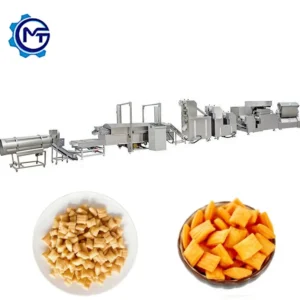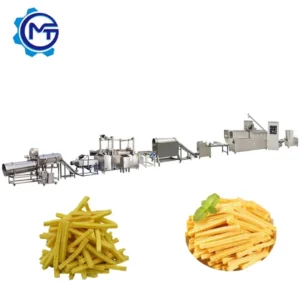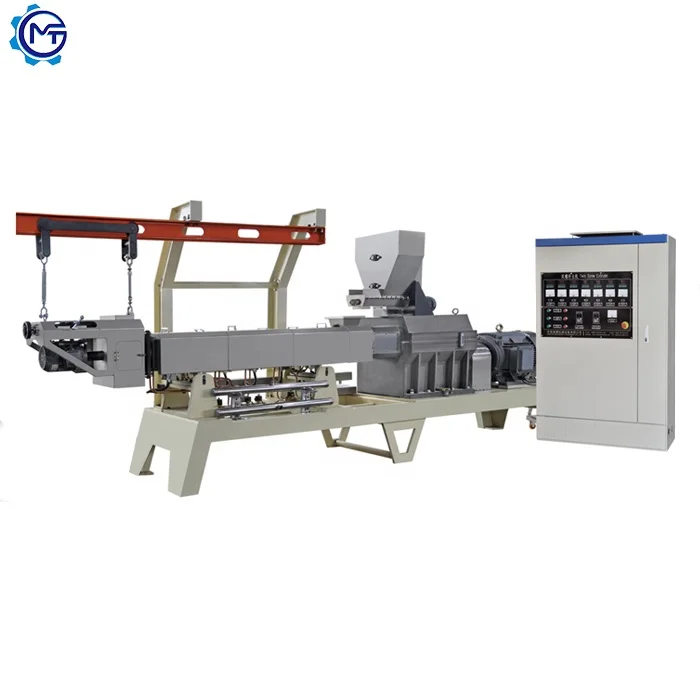


MT100/MT120 Fried Rice Puffed Snacks Line, Single-Screw Extruder, 50–70 kW — engineered as a complete turnkey project from mixer through automatic fryer and flavoring to cooling.
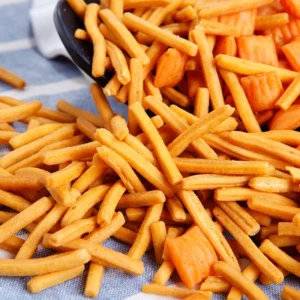
- Adjustable die configuration produces screw shell, round tube, square tube, ring, and cartoon shapes from wheat flour, corn starch, or potato starch formulations
- Multiple energy options (electricity, gas, diesel, steam) configurable to your facility’s utility infrastructure, with voltage and frequency confirmed before production
Every station is throughput-matched under one supplier, and we run trial tests on your actual raw material in our workshop before shipment.
Description
Integrated Line Engineering — every station from mixer to cooling is throughput-matched so the fryer never starves and the extruder never chokes on a bottleneck.
Technical Specifications
| Parameter | Value |
|---|---|
| Model | MT100/MT120 |
| Product Type | Fried Rice Puffed Snacks Production Line |
| Extruder Type | Single-screw extruder |
| Raw Materials | Wheat flour, corn starch, potato starch |
| Output Capacity | 120 kg/h (basis not stated in source — confirm raw material formulation, moisture content, product shape) |
| Total Power | 50–70 kW (electric heating); 50–60 kW (gas or diesel heating) |
| Voltage & Frequency | Three-phase 380V/50Hz; Single-phase 220V/50Hz (customizable to local voltage) |
| Overall Dimensions (L×W×H) | 12000–26000 × 1200 × 2200 mm |
| Construction Material | Food-grade stainless steel 201/304 |
| Energy Options | Electricity, gas, diesel, steam |
| Electrical Components | Siemens (China-made) or China top-brand motors; Delixi or Delta inverters |
| Line Stations | Mixer → Screw conveyor → Single-screw extruder → Pulling and cutting machine → Automatic fryer → Automatic flavoring line → Cooling |
| Die Configuration | Adjustable dies for multiple shapes (screw shell, round tube, square tube, ring, cartoon shapes) |
| Assembly State | Complete line |
| Warranty | One year |
| Standards | CE, ISO 9001 |
Application Suitability
| Application | Material or Output |
|---|---|
| Golgappa and pani puri production | Wheat flour and starch blends, thin-walled hollow shapes requiring secondary puffing in hot oil |
| Rice puffed snack manufacturing | Rice flour and corn starch formulations, light-density crisps with uniform oil absorption |
| Pasta-type snack shapes | Potato starch and wheat flour mixes, extruded into screw shells, tubes, and rings before frying |
| Cartoon-shaped snack formats for children’s market | Multi-grain starch blends, die-cut into novelty shapes with consistent frying expansion |
What "120 kg/h on Paper" Leaves Out When Sourcing a Fried Rice Puffed Snacks Line
A capacity number means nothing unless it is tied to your exact raw material formulation and moisture content.
I have seen buyers sign off on a line rated at a nominal throughput, only to discover during commissioning that their high-rice-flour recipe produces a denser pellet than the test material the factory used. The extruder pushes product at the rated speed, but the fryer cannot keep up because denser pellets require longer residence time in oil. The result is a line that runs, but never at the output you planned your business around. A Fried Rice Puffed Snacks Line turnkey project must be validated on your actual formulation before the machines leave the factory floor [NEED_CITE: industrial extrusion throughput validation methods].
Throughput Matching Across Every Station in the Line
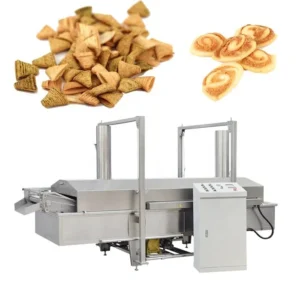
The single-screw extruder sets the pace, but the pulling and cutting machine, automatic fryer, and flavoring drum each have their own cycle limits. On a Fried Rice Puffed Snacks Line turnkey installation, we calculate the residence time in the fryer based on pellet density and wall thickness, then size the fryer belt length and oil volume to match. If the flavoring drum cannot tumble the fried output fast enough, product backs up and cools before seasoning adheres properly.
Die Selection and Product Shape Flexibility
The adjustable die plate on this extruder allows switching between screw shells, round tubes, square tubes, rings, and cartoon shapes without changing the barrel or screw assembly. Shape choice affects more than appearance — a hollow tube fries faster and absorbs less oil than a solid-core pellet of the same diameter. We specify the die geometry based on the texture and oil content your market expects, not on what happens to be in the factory’s standard inventory [NEED_CITE: extrusion die geometry and oil absorption in fried snacks].
Reading the Specs That Actually Matter
The 50–70 kW total power range with electric heating reflects the combined load of barrel heaters, fryer elements, and conveyor motors. Buyers operating in regions with unstable grids should consider the gas or diesel heating option, which drops the electrical demand to the 50–60 kW range and shifts the thermal load to burners. The stainless steel 201/304 construction covers all food-contact surfaces; the choice between 201 and 304 depends on your local humidity and washdown chemistry. The 12000–26000 mm overall length reflects line configuration variability — a longer cooling conveyor or an additional flavoring station extends the footprint. Siemens or equivalent motors paired with Delixi or Delta inverters give local electricians components they can source and replace without waiting for international shipments.
The Cost of Skipping a Pre-Shipment Trial Run
An old-timer I worked with early in my career always said the worst phone call is the one that comes after the containers are opened. I once watched a customer run a high-rice-flour formula on a line we had tuned for corn grits — the puffed snacks came out dense and hard after frying, and the whole first batch was scrapped. A trial run on your actual raw material catches these mismatches while the screw configuration and barrel temperature profile can still be adjusted at the factory, not in your facility with an engineer on a plane ticket [NEED_CITE: pre-shipment trial run practices in food extrusion].
Why Buyers Choose This Turnkey Integration
The line is engineered as a single project under one supplier, so throughput is calculated across every station rather than assembled from separate vendors who each guarantee only their own machine. Screw configuration and die design are specified to your raw material and target product shape, not copied from a generic catalog build. An in-house testing workshop allows trial runs on your actual formulation before shipment, catching density and expansion issues early. Voltage, frequency, and control language are confirmed in writing before production begins, preventing the commissioning delays that happen when a 380V machine arrives at a 440V facility. The documentation package includes a line layout with capacity calculations, electrical schematics, and a trial run report tied to your specific recipe.
Documentation & Verification
- Line layout showing throughput matched across mixer, extruder, fryer, and cooling stations
- Screw and die configuration record specific to your target snack shape and formulation
- Electrical schematic with voltage and frequency confirmed to your local grid specification
- Trial run report on your raw material documenting expansion, density, and frying behavior
- CE declaration of conformity and ISO certificate for customs and regulatory clearance
Installation, Commissioning & Support
- Foundation must support the 12000–26000 mm line length with level concrete and drainage for washdown
- Dedicated three-phase circuit sized for the 50–70 kW electric heating load or gas supply for burner option
- Line ships in modular sections for container loading and reassembles on-site with bolted connections
- First startup includes barrel temperature profiling and fryer oil temperature calibration to your recipe
- Operator training covers die changeover, screw cleaning, and inverter parameter adjustment
- Wear parts list includes replacement screws, die plates, and fryer belt sections for first-year maintenance
Before You Send an Inquiry
To configure a line that actually holds its rated output on your recipe, we need your raw material formulation with moisture percentages, the specific snack shapes you plan to produce, your target daily output, and your facility voltage and frequency. Let us also know whether your workshop has gas supply available or if electric heating is your only option.
Frequently Asked Questions
Q: How is the line’s output capacity verified before shipment?
A: We run your actual raw material formulation through the extruder and fryer in our testing workshop. The trial run report documents throughput, pellet density, expansion ratio, and frying behavior so you see real production data — not a nominal number based on a generic test recipe — before the line ships.
Q: How do you confirm voltage and frequency match our facility?
A: We request your local grid specification during the inquiry stage and confirm it in writing on the electrical schematic before production begins. The line ships with motors, inverters, and heating elements rated for your exact voltage and frequency, eliminating rewiring delays during commissioning.
Q: What does the installation and commissioning schedule look like?
A: The line arrives in modular sections that reassemble on prepared foundations. Our engineers oversee mechanical assembly, electrical connection, barrel temperature profiling, and fryer calibration. Operator training covers die changeover, cleaning procedures, and control system operation before handover.
Q: How do you ensure the fryer capacity matches the extruder output?
A: We calculate fryer belt length, oil volume, and residence time based on your pellet density and wall thickness from the trial run. The automatic fryer is sized so that every pellet receives consistent oil exposure without backing up or cooling before it reaches the flavoring drum.
Q: Can we send our raw material for a trial run before the line ships?
A: Yes, we encourage it. Send a representative sample of your formulation and we will extrude, fry, and flavor a test batch in our workshop. You receive the trial run report with product samples so you can evaluate shape, texture, and oil content before committing to shipment.
Related products
-
New Automatic Portable High Productivity Frying Salad Sticks Chips Snacks Food Production Line
¥100.00 Select options This product has multiple variants. The options may be chosen on the product page -
Automatic Fried Crispy Bugles Snacks Food Making Machines Wheat Flour Sala Food Extruder
¥100.00 Select options This product has multiple variants. The options may be chosen on the product page -
Hot Selling Puffed Ball Snacks Food Processing Line Fried Snacks Processing Line Corn Puff Snacks Machine
¥100.00 Select options This product has multiple variants. The options may be chosen on the product page -
Double Screw Extruder Corn Flour Puffs Snack Nacho Chips Tortilla Doritos Making Machine Savory Snack Production Line
¥50.00 Select options This product has multiple variants. The options may be chosen on the product page