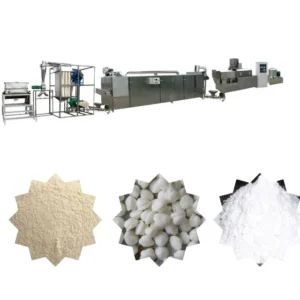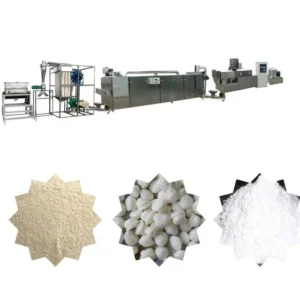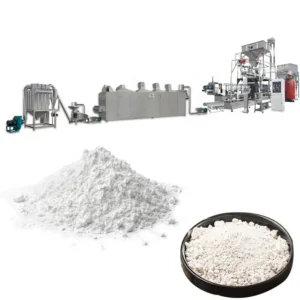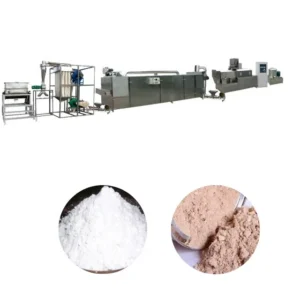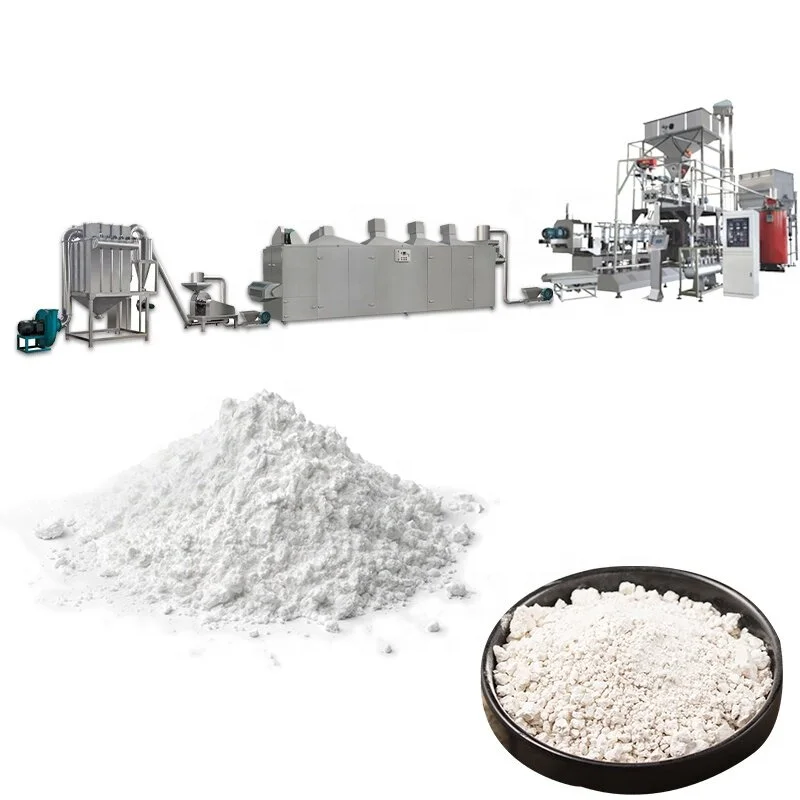


Modified Starch Processing Line, Twin-Screw Extruder, 80–500 kg/h, CE Certified — complete turnkey layout from batching through extrusion, drying, conditioning and grinding under one supplier.
- Screw configuration and die design matched to your starch type and target gelatinisation profile
- Full line throughput balanced across every station to eliminate bottlenecks
- Multiple energy options (electricity, gas, diesel, steam) fitted to your plant utilities
Trial runs on your raw material are completed in our testing workshop before shipment, with a full report provided.
Description
Integrated Line Layout Engineering — we match throughput across mixing, extrusion, drying, and grinding stations so the modified starch line runs without bottlenecks, rather than assembling isolated machines from separate vendors.
Technical Specifications
| Parameter | Value |
|---|---|
| Product Type | Modified Starch Production Line |
| Process Flow | Mixer → Screw Conveyor → Twin Screw Extruder → Air Conveyor → Dryer → Air Conveyor → Conditioning → Conveyor → Grinder |
| Extruder Type | Twin-screw |
| Capacity Range | 80–500 kg/h (basis not stated in source — confirm raw material type, moisture content, and target modification degree) |
| Raw Materials | Wheat flour, corn starch, potato starch |
| Frame Material | Stainless steel 201 |
| Contact Parts Material | Food grade stainless steel 304 |
| Mixer Motor | 4.0 kW |
| Mixer Output | 3.0–4.0 kg/batch |
| Mixer Dimensions | 1.2 × 0.9 × 1.4 m |
| Screw Conveyor Motor | 1.1 kW |
| Screw Conveyor Output | 0–150 kg/h |
| Screw Conveyor Dimensions | 2.5 × 0.6 × 2.3 m |
| Extruder Barrel Material | 45 steel (screw element) |
| Energy Source Options | Electricity, gas, diesel, steam |
| Total Power (Electric) | approx. 100 kW (source value — verify against manufacturer catalog) |
| Total Power (Gas/Diesel) | approx. 50–60 kW (source value — verify against manufacturer catalog) |
| Motor Brand | Siemens (China-made) or China top brand |
| Inverter Brand | Delixi or Delta |
| Voltage & Frequency | Three phases 380V/50Hz, single phase 220V/50Hz (customizable to local voltage per country) |
| Die Configuration | Interchangeable dies for different product shapes |
| Assembly State | Complete line (mixing through grinding) |
| Standards | CE |
Application Suitability
| Application | Material or Output |
|---|---|
| Construction adhesive manufacturing | Modified starch with controlled viscosity and gelling properties from corn or potato starch |
| Food ingredient processing | Gelatinised and denatured starch for functional food applications using wheat flour or corn starch |
| Paper and industrial starch production | Modified starch with specific rheological profiles from wheat, corn, or potato base materials |
What "80–500 kg/h" Actually Means for Your Starch
Capacity is meaningless unless verified against your specific raw material and the modification degree your market requires.
A modified starch processing line turnkey package quoted at a nominal output assumes a standard feedstock and a standard gelatinisation target. In reality, switching from corn starch to tapioca starch with a different oxidant ratio changes the residence time, shear demand, and barrel temperature profile. I have stood on factory floors where the extruder could not sustain the quoted throughput because the screw combination was configured for a material the buyer never intended to use [NEED_CITE: twin-screw extrusion throughput dependence on raw material and screw profile]. When this happens, the entire line downstream — dryer, conditioning, grinder — runs below capacity or backs up.
Matching Throughput Across Every Station on the Modified Starch Line
The defining requirement of a modified starch processing line turnkey project is that no single station limits the rest. The mixer must deliver batches at intervals matching the extruder feed rate. The dryer must handle the moisture load exiting the extruder at full output. The grinder must process conditioned material without creating a backlog. When each station is specified in isolation, mismatches appear only during commissioning — and resolving them on-site costs time that a phased installation schedule cannot absorb.
Phased Installation and the Commissioning Sequence
A complete starch modification project requires staged delivery: foundation and utility preparation, then mechanical installation of the extruder and dryer, followed by electrical integration and control calibration. Each phase has dependencies — the steam supply must be validated before dryer commissioning, and the grinder alignment must be confirmed before full-line throughput tests. Skipping or compressing these stages leads to incomplete parameter records and operators who have never seen the line run at target conditions [NEED_CITE: phased installation sequencing for food processing lines].
Reading the Specifications That Matter for Starch Modification
The twin-screw configuration is central to starch gelatinisation and denaturation. The screw elements, arranged in mixing and conveying zones, control shear intensity and residence time — both of which determine the degree of molecular breakdown and the final viscosity profile. Barrel zones with independent temperature control allow a graduated thermal profile: preheating, gelatinisation, and reaction zones each serve different functions. The 45 steel screw elements resist the abrasion common in starch processing. Energy source selection — electricity, gas, diesel, or steam — affects the dryer’s thermal response and the utility infrastructure the buyer must prepare. The inverter brand (Delixi or Delta) governs motor speed precision, which directly influences feed consistency and residence time stability.
The Hidden Cost of Misconfigured Starch Lines
When a modified starch processing line turnkey project skips the material-specific screw and die configuration, the consequences compound. The extruder may physically run, but the starch achieves incomplete gelatinisation, leaving downstream products with inconsistent viscosity. The dryer then works harder to remove residual moisture, increasing thermal load and cycle time. The grinder receives material that has not been properly conditioned, accelerating wear on screens and hammers. These issues are not apparent during a factory test run on generic feedstock — they surface only when the buyer’s actual material enters the line [NEED_CITE: starch gelatinisation variability in twin-screw extrusion with different feedstocks].
Why Source This Line from a Single Supplier
Complete throughput matching — the mixer, screw conveyor, extruder, dryer, conditioning unit, and grinder are specified together so output rates align at every junction, eliminating the bottleneck risk that arises when stations are sourced from different vendors.
Screw configuration matched to your feedstock — screw elements and die design are selected based on the buyer’s specific starch type (wheat, corn, or potato) and the target gelatinisation or denaturation profile, rather than a generic build.
In-house testing before shipment — the line runs on the buyer’s actual raw material in a dedicated testing workshop, producing a trial run report that documents throughput, product quality, and parameter settings before the machines leave the factory.
Utility and voltage planning for the destination market — voltage, frequency, and energy source are confirmed before production begins, preventing the commissioning delays that occur when a 380V/50Hz machine arrives at a site running different power standards.
Single-source documentation and accountability — layout drawings, capacity calculations, electrical schematics, and maintenance manuals come from one supplier, so there is no ambiguity about which vendor is responsible when stations interact during operation.
Documentation & Verification
- Line layout showing throughput match from mixer through grinder
- Capacity calculation document based on your starch type and target modification
- Screw and die configuration record matched to your raw material
- Trial run report on your actual feedstock before shipment
- Electrical schematic with voltage and frequency for your destination market
- CE declaration of conformity for the complete line
Installation, Commissioning & Support
- Foundation planning for extruder and dryer footprint with utility routing for steam, gas, or electric supply
- Dedicated electrical circuits sized to the total connected load with voltage and frequency confirmed pre-shipment
- Phased mechanical assembly starting with extruder barrel alignment and progressing through conveyor and dryer integration
- First-run parameter calibration including screw speed, barrel zone temperatures, and dryer retention time on your starch
- Operator training covering screw element replacement, die changeover, and daily inspection of wear parts
- Wear parts list with reorder intervals for screw elements, dies, and grinder screens
What to Include in Your Inquiry
To generate an accurate line configuration, we need your target starch base material (wheat, corn, potato, or other), the modification type and end-use application, and your target daily output. Provide your site voltage, frequency, and preferred energy source, along with available floor space and ceiling height. If you can send a sample of your raw material, a trial run in the testing workshop will confirm screw configuration and throughput before the quotation is finalised.
Frequently Asked Questions
Q: How is line capacity verified against my specific starch raw material and target modification degree?
A: We run a trial using your actual raw material in our testing workshop before shipment. The trial documents throughput, gelatinisation degree, and product quality under specific screw configurations and barrel temperatures. This report becomes the baseline for commissioning at your site, ensuring the quoted capacity is achievable with your feedstock rather than a generic test material.
Q: What screw configuration and barrel temperature profile is needed for my gelatinisation target?
A: Screw elements are arranged in mixing, conveying, and shear zones matched to your starch type. Barrel zones are set to a graduated thermal profile — preheating, gelatinisation, and reaction — based on the degree of molecular modification your application requires. This configuration is documented and confirmed during the pre-shipment trial run.
Q: How is throughput matched between the extruder, dryer, and grinding station to avoid bottlenecks?
A: Each station is specified as part of the complete line. The mixer batch cycle, screw conveyor feed rate, extruder output, dryer capacity, and grinder throughput are calculated together so no station limits the others. The line layout document shows these matched rates for your review before production begins.
Q: Can voltage, frequency, and control language be confirmed for my country before production starts?
A: Yes. Electrical specifications including voltage, frequency, and control panel language are confirmed during the proposal stage. The electrical schematic reflects your site’s power standards, and the inverter and motor specifications are selected accordingly before manufacturing begins.
Q: Is a trial run on my raw material performed before shipment, and what does the report cover?
A: A trial run is conducted on your supplied raw material in the testing workshop. The report covers actual throughput, product viscosity and gelatinisation measurements, screw and die configuration used, barrel temperature settings, and dryer parameters. This ensures product development starts before installation rather than after.
Related products
-
Pregelatinized Low-Cost Modified Starch Line – High-Efficiency Automated Starch Processing Machine
¥65.00 Select options This product has multiple variants. The options may be chosen on the product page -
Modified and Pregelatinized Starch Processing Equipment – Pregelatinized Corn Cassava Modified Starch Puffing Machine
¥65.00 Select options This product has multiple variants. The options may be chosen on the product page -
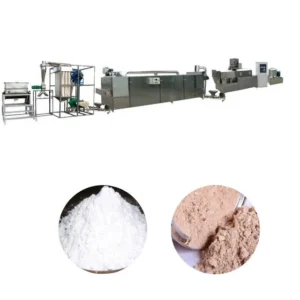
Cassava Corn Potato Flour Starch Production Line – Industrial Pregelatinized & Modified Extrusion Machinery
¥65.00 Select options This product has multiple variants. The options may be chosen on the product page -
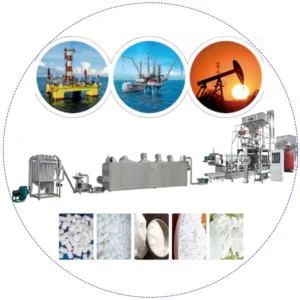
Cassava & Pregelatinized Corn Starch Extrusion Equipment – CE Certified Industrial Twin-Screw Modified Starch Line
¥65.00 Select options This product has multiple variants. The options may be chosen on the product page