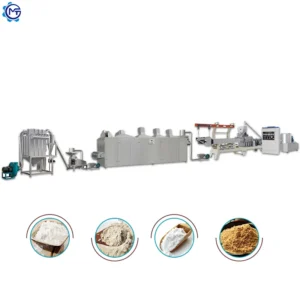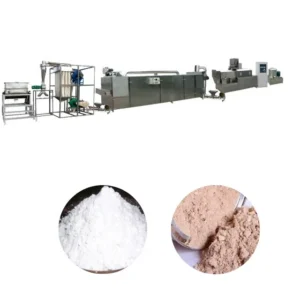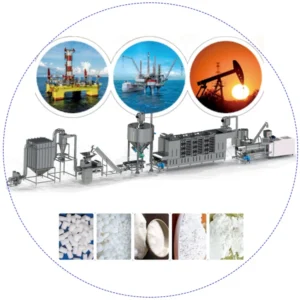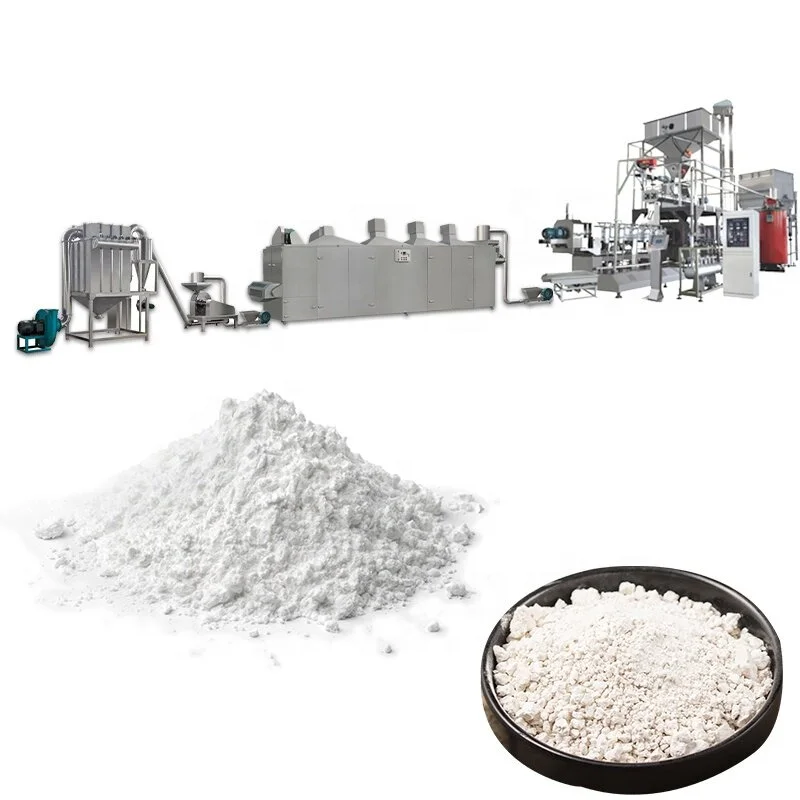


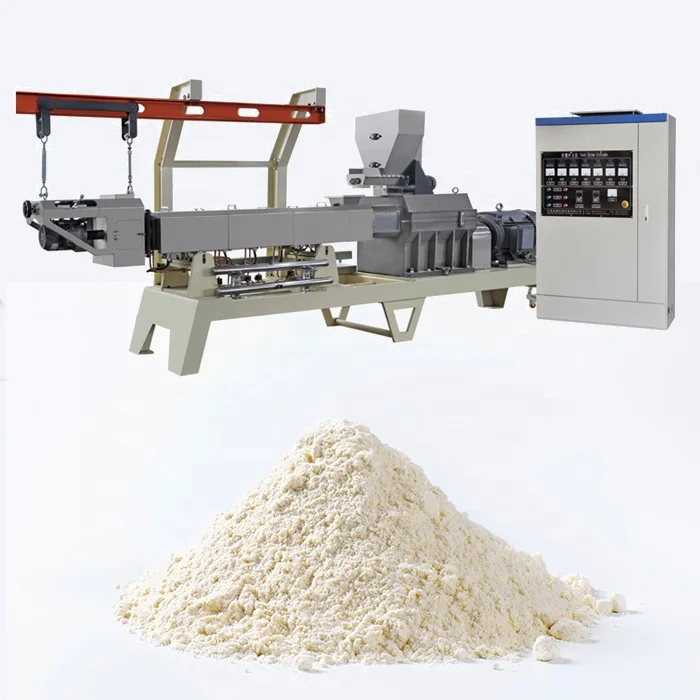

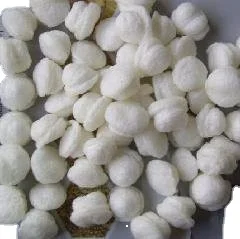
Modified Starch Processing Line, twin-screw extrusion, 80–500 kg/h capacity range — engineered as a complete turnkey project from batching through extrusion, drying, conditioning and grinding.
Our layout matches throughput at every station so the dryer and grinder never bottleneck the extruder. Screw configuration and die design are specified to your raw material — corn, cassava, wheat or potato starch — and target modification degree.
- Energy options include electric, gas, diesel or steam heating to fit your facility utility plan
- Trial runs on your actual raw material completed in our testing workshop before shipment
Every line ships with a full capacity calculation document, screw configuration record, and electrical schematic confirmed to your local voltage — backed by on-site installation and operator training from one accountable supplier.
Description
End-to-end throughput matching — every station from the mixer to the grinder is sized against the same capacity target so the modified starch processing line turnkey holds its output without bottlenecking at drying or conditioning.
Technical Specifications
| Parameter | Value |
|---|---|
| Product Type | Modified Starch Production Line |
| Screw Type | Twin-screw extruder |
| Capacity Range | 80–500 kg/h (basis not stated in source — confirm raw material type and moisture content) |
| Raw Materials | Wheat flour, corn starch, potato starch, cassava starch |
| Frame Material | Stainless steel 201 |
| Key Contact Material | Food grade stainless steel 304 |
| Voltage & Frequency | Three phase 380V/50Hz; Single phase 220V/50Hz (customizable to local voltage) |
| Rated Power | Approx. 100 kW (electric heating); 50–60 kW (gas or diesel heating) (rated or peak not specified in source) |
| Energy Options | Electricity, gas, diesel, or steam |
| Motor Brand | Siemens (made in China) or China top brand |
| Inverter | Delixi or Delta |
| Mixer Motor | 4.0 kW |
| Mixer Dimensions | 1.2 × 0.9 × 1.4 m |
| Mixer Batch Output | 3.0–4.0 kg/time |
| Screw Conveyor Motor | 1.1 kW |
| Screw Conveyor Dimensions | 2.5 × 0.6 × 2.3 m |
| Screw Conveyor Output | 0–150 kg/h |
| Line Stations | Mixer → Screw Conveyor → Twin Screw Extruder → Shift → Air Conveyor → Dryer → Air Conveyor → Conditioning → Conveyor → Grinder |
| Assembly State | Complete line with supporting equipment |
| Standards | CE; ISO |
| Warranty | One year warranty and life-time technical guidance support |
Application Suitability
| Application | Material or Output |
|---|---|
| Pregelatinised starch for food processing | Corn starch, cassava starch |
| Modified starch for paper manufacturing | Wheat flour, potato starch |
| Industrial-grade modified starch | Corn starch, wheat flour |
| Food-grade pregelatinised starch | Cassava starch, potato starch |
What "80–500 kg/h" Leaves Out When Sourcing a Modified Starch Processing Line Turnkey
Capacity means nothing unless every downstream station can keep up with the extruder.
A twin-screw extruder running at its rated output is only the starting point. If the dryer cannot remove moisture fast enough, or the grinder chokes on throughput that exceeds its design, the entire modified starch processing line slows to match the weakest link. I have seen cassava starch lines where the extruder was pushing material faster than the dryer could handle, forcing operators to throttle feed rates and lose hours of production every shift. [NEED_CITE: throughput matching principles in continuous food processing lines]
The honest approach is to calculate capacity at each station against the actual raw material — its moisture content, gelatinisation temperature, and expansion behaviour — then size the dryer, conditioner, and grinder to match.
Station-by-Station Throughput Engineering
A modified starch processing line turnkey succeeds when every transition point is calculated. The mixer batches at 3.0–4.0 kg per cycle, feeding the screw conveyor rated at 0–150 kg/h. From there, material enters the twin-screw extruder where screw configuration and barrel temperature profile determine gelatinisation degree and modification extent. The shift station and air conveyor must transfer product without moisture condensation, which would undo the extrusion work. Each of these transitions is where poorly matched lines lose capacity.
Dryer and Grinder Sizing Against Actual Moisture Load
The dryer station carries the heaviest thermal load on the line. Starch exiting the extruder carries significant moisture that must be reduced to a target level before grinding. If the dryer is undersized, product residence time drops and output moisture climbs above specification. The grinder then faces material that is tougher to reduce, increasing motor load and wear on screens. Energy options across the line — electricity, gas, diesel, or steam — let facility planners match utility supply to the dryer’s thermal demand rather than forcing a single heating method. [NEED_CITE: starch moisture reduction targets for industrial applications]
Screw Configuration and Die Design for Starch Modification
The twin-screw extruder is where chemical and physical modification occurs. Screw element arrangement — kneading blocks, reverse elements, conveying sections — controls shear intensity and residence time inside the barrel. Different starches respond differently: cassava starch gelatinises at lower temperatures than corn starch, and potato starch has a higher peak viscosity that demands careful temperature ramping. Die design influences product density and the particle size distribution after grinding. These parameters are set during trial runs on the buyer’s actual raw material, not copied from a generic build.
When Station Mismatching Becomes Visible on the Floor
Bottlenecks reveal themselves gradually. Operators notice the extruder running below capacity because the dryer cannot accept more feed. The grinder motor trips intermittently. Product moisture readings drift outside specification, triggering rework or rejection. These problems compound across shifts and erode the line’s economic case. A modified starch processing line turnkey built with matched stations avoids this cascade. [NEED_CITE: consequences of undersized downstream equipment in extrusion lines]
Engineering Accountability Under One Supplier
Sourcing a complete line from a single supplier means one party owns the layout, the throughput calculation, and the commissioning result. The line layout document shows capacity at each station against the target output. Screw and die configuration records are matched to the buyer’s raw material and target starch specification. Voltage and frequency are confirmed against the local grid before production begins, so the control panel arrives ready to run. Trial runs on the buyer’s actual starch are conducted in the testing workshop before shipment, catching configuration issues at the factory rather than on the buyer’s floor.
Documentation & Verification
- Line layout showing throughput calculation across mixer, extruder, dryer, and grinder
- Screw and die configuration record matched to your starch raw material
- Trial run report on customer raw material conducted before shipment
- Electrical schematic with voltage and frequency confirmed for local grid
- CE declaration of conformity and ISO certificate
- Operation and maintenance manual with wear parts list
Installation, Commissioning & Support
- Foundation requirements calculated against overall line weight and vibration from the 4.0 kW mixer
- Dedicated electrical circuit sized for approximately 100 kW total load with electric heating
- Complete line arrives as assembled stations requiring utility connection and alignment
- First-run parameter setting including barrel temperature profile and screw speed for your starch type
- Operator training covering feed rate adjustment, moisture monitoring, and emergency shutdown
- Wear parts list covering screws, dies, and dryer screens with replacement intervals
What to Include in Your Inquiry
To size a modified starch processing line turnkey accurately, provide the raw material type — corn, cassava, wheat, or potato starch — along with its moisture content and any pre-treatment it receives. Specify the target modification type and the end-use application, whether food-grade or industrial. Include your facility’s available voltage, frequency, and preferred energy source for the dryer. If you have existing upstream or downstream equipment that the new line must integrate with, note the connection points and throughput of that equipment.
Frequently Asked Questions
Q: How is the capacity of each station verified to match the quoted line output?
A: Each station — mixer, extruder, dryer, conditioner, grinder — is calculated against the same throughput target based on the buyer’s raw material. The line layout document shows the capacity figure at each point. Trial runs in the testing workshop confirm that the actual output matches the calculation before the line ships.
Q: What raw material tests are run before shipment and what does the trial report cover?
A: The buyer’s starch sample is run through the extruder with the specified screw configuration. The trial report documents gelatinisation degree, product moisture after drying, particle size after grinding, and any adjustments made to barrel temperature or screw speed during the test.
Q: How is voltage, frequency and control language confirmed for the target country?
A: The electrical schematic is reviewed with the buyer before production begins. Local voltage and frequency are confirmed — the line supports three phase 380V/50Hz or single phase 220V/50Hz and can be customised. Control panel labels and the operation manual are prepared in the agreed language.
Q: What does the installation and commissioning schedule look like for a complete starch line?
A: Stations arrive as assembled units requiring utility connection, alignment, and calibration. Commissioning covers first-run parameter setting for the buyer’s starch type, throughput verification at each station, and operator training. The schedule depends on line size and site readiness.
Q: How are wear parts such as screws and dies supplied and what is the replacement lead time?
A: A wear parts list is provided with the line documentation, covering screws, dies, and other consumable components. Replacement parts are manufactured to the same specification as the originals. Buyers are advised to order an initial spare set before the first replacement is due to avoid production interruption.
Related products
-
Automatic Pregelatinized Starch Processing Machine – Large-Scale New Condition Modified Starch Production Line
¥65.00 Select options This product has multiple variants. The options may be chosen on the product page -
Pre-gelatinized Starch Production Line – Modified Starch Integrated Puffing Equipment
¥65.00 Select options This product has multiple variants. The options may be chosen on the product page -
Modified Starch for Construction Adhesives Production – Custom Built Double Screw Extruder Line
¥65.00 Select options This product has multiple variants. The options may be chosen on the product page -
High-Efficiency Customizable Modified Starch Production Line – Automatic Corn Pellet Adhesive Making Equipment
¥65.00 Select options This product has multiple variants. The options may be chosen on the product page