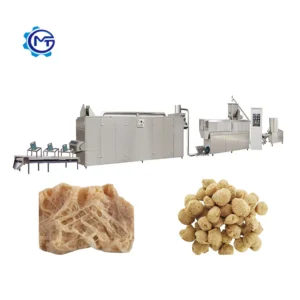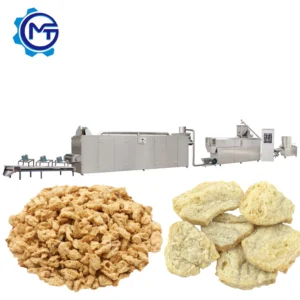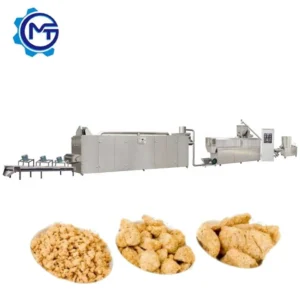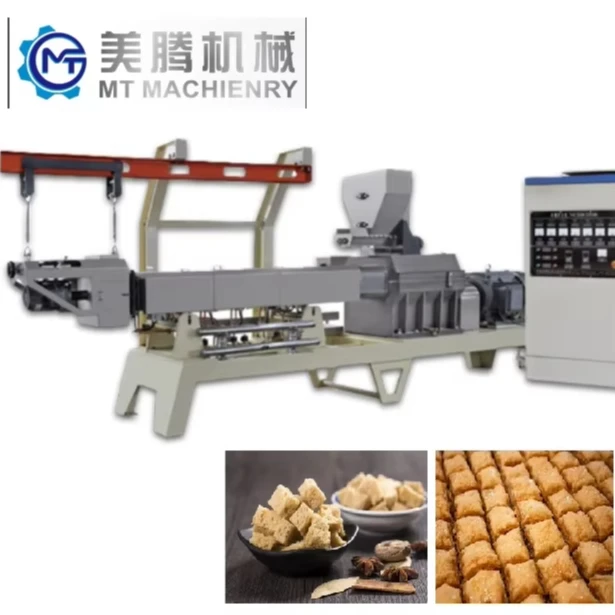
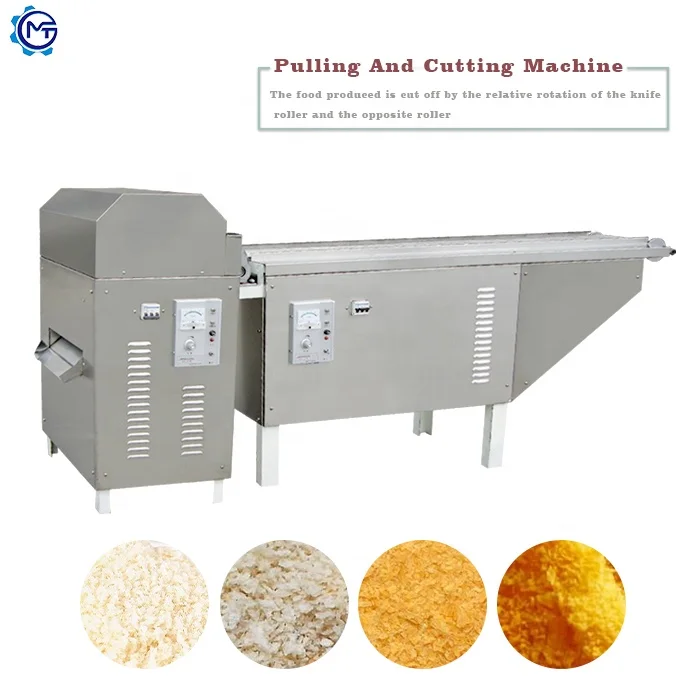



MT65 / MT70 / MT75 / MT85 Twin Screw Extruder, PLC and MCC Control, CE Certified — designed for texturized vegetable protein and plant-based meat production from defatted soya flour.
- Screw configuration and die geometry specified to your raw material formulation, controlling fiber structure, density and expansion across soya nuggets, chunks and TVP formats
- Multi-layer dryer with selectable fuel source and adjustable drying time matched to extruder output, preventing downstream bottlenecks
Complete line from mixing through packing under one supplier, with in-house trial runs on your raw material before shipment and throughput matched across every station.
Description
Integrated Line Throughput Match — every station from batching to packing is specified as a single system, so extruder output is never bottlenecked by downstream dryer or cooling capacity.
Technical Specifications
| Parameter | Value |
|---|---|
| Product Type | Twin Screw Extruder for Texturized Vegetable Protein (TVP) Production Line |
| Model | MT65 / MT70 / MT75 / MT85 |
| Screw Type | Twin Screw |
| Main Motor Power | 22 kW / 30 kW / 45 kW (model dependent) |
| Installed Power Range | 84 kW – 210 kW (model dependent) |
| Power Consumption Range | 59 kW – 140 kW (model dependent) |
| Output Capacity (MT65) | 100-150 kg/h (basis not stated in source — confirm raw material formulation / moisture content) |
| Output Capacity (MT70) | 150-200 kg/h (basis not stated in source — confirm raw material formulation / moisture content) |
| Output Capacity (MT75) | 150-200 kg/h (basis not stated in source — confirm raw material formulation / moisture content) |
| Output Capacity (MT85) | 250-300 kg/h (basis not stated in source — confirm raw material formulation / moisture content) |
| Screw Length | 1050 mm / 1520 mm (source value — verify against manufacturer catalog) |
| Heating Power | 10 kW / 14 kW (model dependent) |
| Control System | PLC and MCC control |
| Line Stations | Mixer → Screw Conveyor → Twin Screw Extruder → Air Conveyor → Multi-layer Dryer → Cooling Machine |
| Mixer Capacity Options | 20-30 kg / 70-80 kg / 170-180 kg |
| Mixer Power Options | 4 kW / 7.5 kW / 15 kW |
| Dryer Type | Multi-layer, double pitch roller chain drive, round-trip drying |
| Dryer Fuel Options | Fuel / Gas / Electricity (buyer selectable) |
| Die Configuration | Interchangeable moulds for soya nuggets, TVP/TSP, soya chunks |
| Standards | CE (since 2014), ISO certified |
Application Suitability
| Application | Material or Output |
|---|---|
| Texturized vegetable protein production | Defatted soya flour, low-temperature soya flakes |
| Soya nuggets and soya chunks | Soya protein isolate and concentrate blends |
| Plant-based meat analogues | Pea protein, soya protein, wheat gluten blends |
| Layer fiber structure protein blocks | High-protein formulations for meat substitute industry |
| Maigre snacks and vegetarian products | Legume and grain protein blends |
| Cereal and snack production (via screw adjustment) | Corn, rice, oat and multi-grain formulations |
Why Your Raw Material Formulation Must Come Before the Line Quotation
A plant based meat processing line turnkey project quoted on nominal capacity often cannot hold that output when the buyer’s actual protein blend enters the barrel.
I spent years in the testing workshop before moving into turnkey project coordination, and the pattern is consistent across every TVP production line turnkey project I have overseen. A client sends a sample of defatted soya flour, the line gets configured around that sample, and everything tests well at the factory. Then the buyer’s first commercial batch arrives on site with a slightly different protein content or particle size distribution, and the fiber structure collapses inside the barrel. The screw combination and temperature profile that worked during the trial run no longer produce the layered texture the market demands. Two weeks of on-site re-tuning follow before the line can be handed over. [NEED_CITE: protein functionality variation between soya flour batches]
Barrel Temperature Zones and Protein Denaturation Control
TVP extrusion depends on precise thermal management across the barrel sections. The heating system delivers controlled energy to each zone, allowing operators to set a temperature gradient that governs how the protein unfolds and realigns under shear. When the gradient is too flat, the protein denatures uniformly and the output lacks the fibrous, meat-like internal structure. When the gradient is steep, the outer layer of the melt can scorch while the core remains under-processed. The plant based meat processing line turnkey configuration includes independent zone control so that each section of the barrel can be adjusted to match the thermal sensitivity of the specific protein source being processed.
Screw Profile Selection for Fiber Alignment
The twin-screw configuration generates the shear and residence time necessary to unfold globular proteins and then re-align them into continuous fiber strands. Screw elements are selected and sequenced to create zones of high shear for initial protein disruption, followed by lower-shear conveying sections that allow the fibers to orient along the flow direction before exiting the die. Changing the screw profile — swapping kneading blocks for different stagger angles or adjusting the ratio of conveying to shearing elements — is what allows the same extruder platform to produce dense soya chunks or lighter, more open nugget structures. [NEED_CITE: twin screw extrusion shear and residence time principles for protein texturization]
Reading the Specification Sheet Against Your Production Reality
The installed power range across the MT65 through MT85 models spans from 84 kW to 210 kW, but the figure that matters more for daily operation is power consumption, which sits between 59 kW and 140 kW depending on model. The gap between installed and consumed power reflects the motor headroom available when the barrel fills with a higher-viscosity formulation — a blend with more wheat gluten, for example, will draw closer to installed capacity than a straight soya flour run. The mixer capacity options of 20-30 kg, 70-80 kg, and 170-180 kg are matched to extruder throughput so that batch intervals remain consistent and the extruder never starves. The multi-layer dryer uses a double pitch roller chain drive for smooth product transport, and its selectable fuel source — electricity, gas, or liquid fuel — lets the buyer align drying energy with local utility costs and availability.
The Hidden Cost of Unmatched Line Stations
When the dryer capacity is specified independently from the extruder output, the result is a bottleneck that surfaces only after installation. The extruder runs at its tested rate, but wet TVP product piles up at the dryer infeed because the belt length and air volume were sized for a lower throughput. Product sits in the cooling conveyor longer than intended, moisture content drifts outside specification, and the downstream packing station receives an inconsistent feed. I have seen this pattern force buyers to run the extruder below its actual capability just to keep the rest of the line balanced, effectively paying for capacity they can never use. [NEED_CITE: consequences of unbalanced production line station throughput]
Why Procurement Through One Line Builder Changes the Outcome
The complete plant based meat processing line turnkey project is engineered as a single system rather than assembled from separate vendors. Mixer batch size, screw conveyor rate, extruder throughput, dryer belt length and layer count, and cooling conveyor speed are all calculated together so that no station constrains another. The screw configuration and die geometry are specified to the buyer’s actual raw material and target product format — not copied from a generic build. An in-house testing workshop runs trial production on the buyer’s own protein blend before shipment, generating real output data and fiber structure samples. The PLC and MCC control architecture is programmed with the confirmed voltage, frequency, and operator language before the line leaves the factory. CE and ISO certifications are held across the product range, supporting import compliance in regulated markets.
Documentation & Verification
- Line layout drawing showing station-by-station throughput calculation for your target TVP format
- Screw and die configuration record matched to your specific protein blend and moisture content
- Trial run report produced on your raw material in the in-house testing workshop before dispatch
- Electrical schematic confirming voltage, frequency, and control language for your facility
- Operation and maintenance manual covering screw changeover and dryer adjustment procedures
- Factory test record documenting power draw, barrel temperatures, and product samples from the test run
Installation, Commissioning & Support
- Floor space planning based on overall line dimensions up to 45000 × 1500 × 3500 mm for the MT85 configuration
- Dedicated electrical circuit sized to the installed power of the selected model, up to 210 kW
- Multi-layer dryer fuel connection specified to buyer’s chosen energy source — gas, electricity, or liquid fuel
- On-site screw combination and temperature profile fine-tuning using the buyer’s first commercial raw material batch
- Operator training covering PLC interface navigation, die changeover, and dryer temperature adjustment
- Wear parts inventory list specifying screw elements, die plates, and mixer blades with recommended stock quantities
What We Need to Configure Your Line
To move from inquiry to a firm line proposal, share your primary protein source — defatted soya flour, pea protein, or a blend — along with the target product format such as nuggets, chunks, or layered fiber blocks. Specify the daily or hourly output target and the moisture content range of your incoming raw material. Confirm the available voltage and frequency at your facility, the preferred control language for the PLC interface, and whether you would like a trial run on your raw material at the testing workshop before shipment.
Frequently Asked Questions
Q: What does the in-house trial run on my raw material actually test?
A: The trial run feeds your actual protein blend through the extruder at the testing workshop, documenting barrel temperature settings, screw speed, moisture addition rate, and the resulting product density and fiber structure. You receive a written report with process parameters, product samples, and measured throughput data so you can evaluate output before the line ships.
Q: How do you ensure the dryer does not bottleneck the extruder?
A: Dryer belt length, layer count, and air volume are calculated from the extruder’s confirmed output on your raw material, not from a generic rating. The round-trip drying path and adjustable temperature zones are sized so that product residence time matches the moisture removal requirement at full extruder throughput.
Q: What utility connections does the facility need before installation?
A: The main electrical supply must support the installed power of the selected model, up to 210 kW. The dryer requires either a gas line, liquid fuel supply, or dedicated electrical circuit depending on buyer selection. Compressed air and water connections are specified in the line layout document provided before shipment.
Q: How does screw configuration change when switching between soya nuggets and TVP chunks?
A: The kneading block sequence, stagger angle, and die plate geometry are all adjusted. Soya nuggets typically require a higher-shear screw profile and a die with smaller openings, while TVP chunks use longer conveying sections and larger die apertures. The configuration record provided with the line documents the exact element arrangement for each product format.
Q: What does the commissioning period cover once the line is installed?
A: Commissioning includes mechanical alignment verification, electrical continuity checks, initial run-in with the buyer’s raw material, fine-tuning of screw speed and barrel temperatures, dryer adjustment, and operator training on the PLC control interface and routine maintenance procedures.
Related products
-
Vegetable Meat Making Machine Textured Soybean Protein Maker
¥30.00 Select options This product has multiple variants. The options may be chosen on the product page -
Soybean Protein Making Machine Automatic Soy Chunk Production Line
¥30.00 Select options This product has multiple variants. The options may be chosen on the product page -
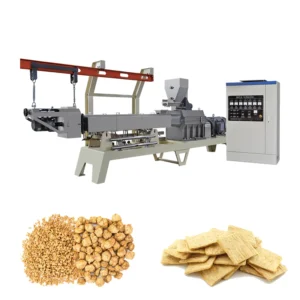
New Condition Soybean Protein Machine for Soy Chunks Production Textured Vegetable Protein Production Line
¥30.00 Select options This product has multiple variants. The options may be chosen on the product page -
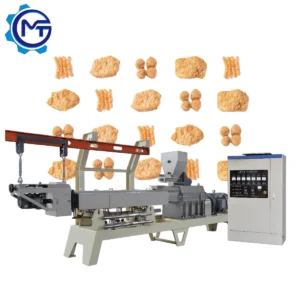
Textured Soy Protein Production Line for Vegetarian Meat Nugget Manufacturing
¥8,238.27 Select options This product has multiple variants. The options may be chosen on the product page