

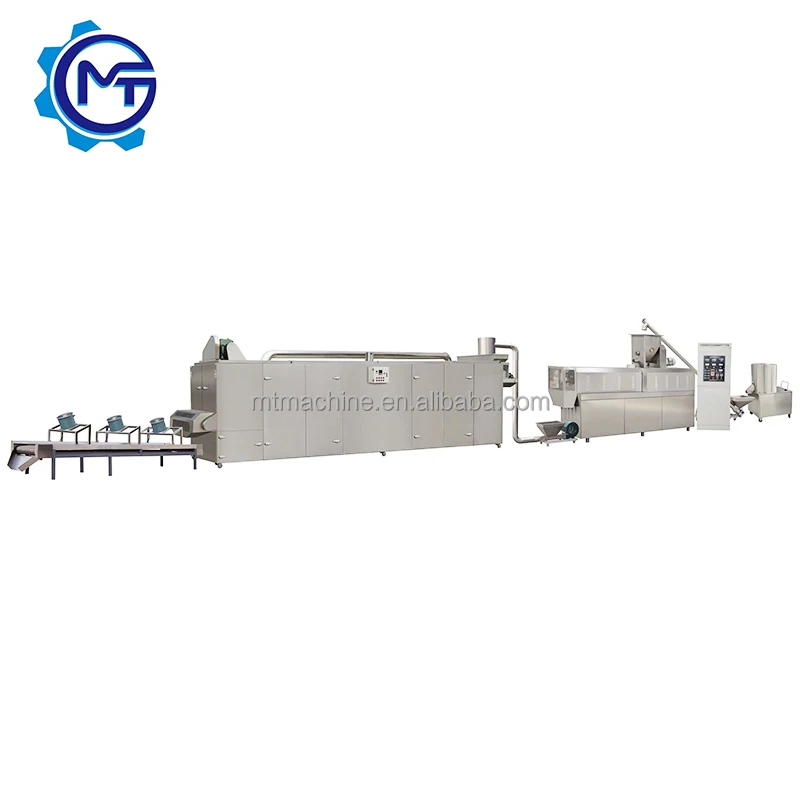
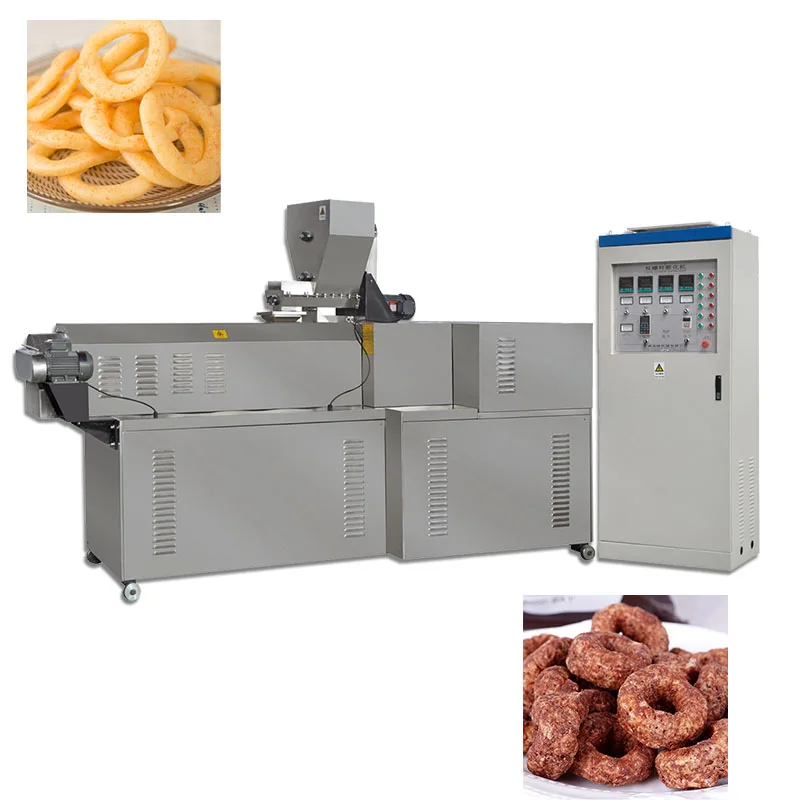
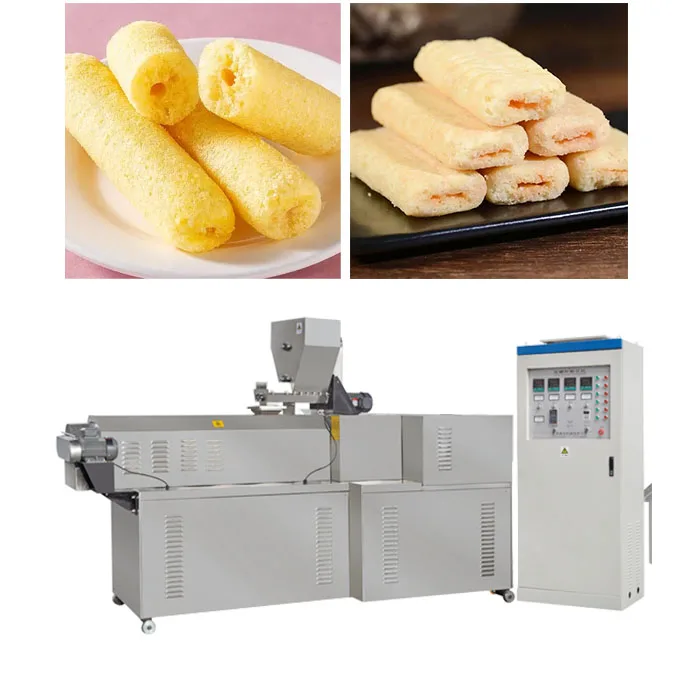
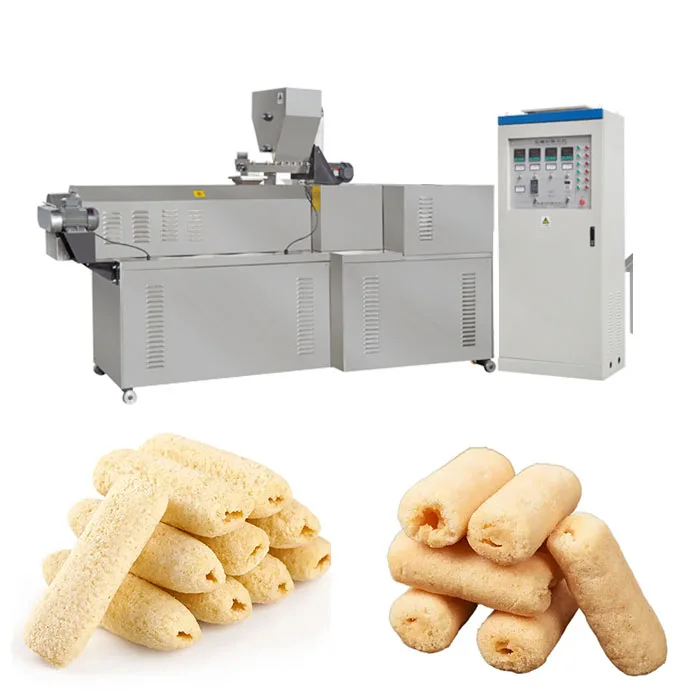
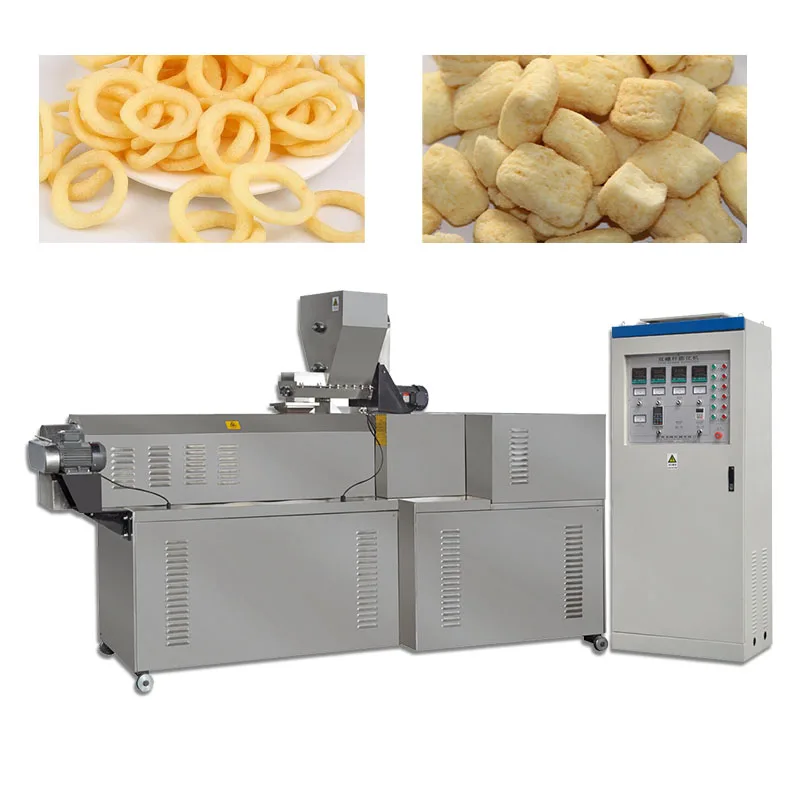
MT65 / MT70 / MT85 Twin-Screw Snack Food Extrusion Line, Interchangeable Dies, PLC Control — engineered as a single-supplier turnkey project where every station from mixing through extrusion, shaping, frying, seasoning to packing is throughput-matched. Screw configuration and die design are specified to the buyer’s actual formulation and target snack format, covering puffed balls, core-filled pillows and shaped extrusions across corn, rice and wheat-based recipes.
- Three model tiers from pilot-scale to mid-volume production with voltage and frequency configurable before build
- In-house testing workshop trial runs on buyer’s raw material before shipment, with full line layout and capacity calculation documentation provided
Description
Throughput-Matched Integration — Every station from the mixer through the twin-screw extruder, multi-functional cutting shaper, fryer, eight-square seasoner and packing machine is engineered as one coordinated project, so no single unit restricts the output of the entire twin-screw snack food extrusion turnkey production line.
Technical Specifications
| Parameter | Value |
|---|---|
| Product Type | Twin-Screw Snack Food Extrusion Line |
| Model Options | MT65 / MT70 / MT85 |
| Screw Type | Twin-screw (double-screw) |
| Installed Power (MT65) | 84 kW |
| Installed Power (MT70) | 132 kW |
| Installed Power (MT85) | 239 kW |
| Output Capacity (MT65) | 120–150 kg/h (basis not stated in source — confirm raw material type, moisture content and product format) |
| Output Capacity (MT70) | 200–250 kg/h (basis not stated in source — confirm raw material type, moisture content and product format) |
| Output Capacity (MT85) | 500–700 kg/h (basis not stated in source — confirm raw material type, moisture content and product format) |
| Overall Dimensions (MT65) | 21000 × 1200 × 2200 mm |
| Overall Dimensions (MT70) | 23000 × 1500 × 2300 mm |
| Overall Dimensions (MT85) | 28000 × 3500 × 2500 mm |
| Voltage & Frequency | Three-phase 380V/50Hz; Single-phase 220V (customizable per buyer requirement) |
| Line Stations | Mixer → Twin-screw Extruder → Multi-functional Cutting Shaper → Automatic Fryer → Eight-square Seasoner → Packing Machine |
| Die Configuration | Interchangeable moulds for ball, stick, wheel, ring, tube, flower and animal shapes |
| Raw Materials Processed | Corn flour, rice powder, wheat flour |
| Product Formats | Puffed snacks, core-filled snacks (chocolate-filled bar, cream-filled pillow, rice cake, cereal bar, sheet snacks) |
| Assembly State | Complete turnkey line |
| Certification | CE, ISO |
Application Suitability
| Application | Material or Output |
|---|---|
| Puffed corn ball snacks | Corn flour formulations at varying moisture levels |
| Shaped extruded snacks (sticks, rings, wheels) | Corn, rice and wheat flour blends through interchangeable dies |
| Core-filled bars and pillows | Chocolate or cream filling injected into cereal-based shells |
| Breakfast cereal and rice cakes | Rice powder and wheat flour processed through dedicated die plates |
| Pilot-scale product development | Small-batch trials on MT65 before scaling to MT70 or MT85 |
Why Nominal Capacity Figures Mislead Snack Producers
A rated output number means nothing until it is verified against your specific flour blend, moisture percentage and target snack density.
Snack food plant buyers regularly receive quotations listing a headline capacity figure with no reference to the raw material or product format used to derive it. I have walked into facilities where the extruder ran at full spec but the fryer downstream could not keep pace, leaving trays of半成品 cooling on the floor because nobody calculated throughput station by station. The twin-screw snack food extrusion turnkey production line must be balanced on the buyer’s actual formulation, not a catalogue benchmark. [NEED_CITE: throughput balancing methodology across extrusion line stations]
Station-by-Station Throughput Matching
The twin-screw snack food extrusion turnkey production line begins with a mixer sized to feed the extruder without starving or flooding the barrel. The multi-functional cutting shaper must accept the extrudate strand at the speed the screws deliver it, and the automatic fryer must have enough belt length and oil volume to handle the continuous flow. When each station is selected independently from separate vendors, mismatched capacities create idle time at some stations and overflow at others. Engineering the full sequence under one supplier eliminates that gap.
Die Selection and Snack Format Flexibility
Interchangeable moulds allow the same extruder to produce balls, sticks, wheels, rings, tubes, flowers and animal shapes without replacing the barrel or screw assembly. Core-filled formats require a co-extrusion die and a filling pump synchronized to the extruder output rate. Switching from a puffed corn ball to a cream-filled pillow involves changing the die plate and adjusting the cutting shaper timing, tasks that take considerably less downtime than swapping screw elements. [NEED_CITE: die changeover procedures on twin-screw extruders]
Reading the Specification Sheet for What It Omits
Installed power across the three tiers — 84 kW for the MT65, 132 kW for the MT70 and 239 kW for the MT85 — tells you the electrical demand but not how that energy translates into barrel temperature profiles or screw shear. The overall dimensions reveal floor space requirements, yet the MT85 line spans 28 meters in length and 3.5 meters in width, meaning ceiling height and column spacing must accommodate the full footprint before the foundation is poured. Voltage confirmation at three-phase 380V/50Hz or single-phase 220V must happen before production starts, because rewiring a control cabinet on site delays commissioning by weeks. Raw material declarations list corn flour, rice powder and wheat flour, but the screw configuration and barrel heating zones must be set to the gelatinisation temperature of whichever starch dominates your recipe.
The Cost of Skipping a Trial Run
When a line ships without a trial run on the buyer’s own raw material, the first production test happens after installation, with the supplier’s engineer already on a return ticket. Texture deviations, density problems and expansion inconsistencies surface only then, requiring screw element swaps or die modifications that should have been resolved in the factory. [NEED_CITE: importance of pre-shipment trial runs in food extrusion]
Why Procurement Consolidation Matters Here
MT Machinery engineers every station from batching to packing under one project scope, which means throughput calculations are not passed between vendors who each optimize their own unit. Screw configuration and die design are specified to your raw material and target snack format before metal is cut. An in-house testing workshop allows trial runs on your flour blend before the line ships, so product development starts weeks earlier than it would if testing began only after installation. CE and ISO certification documentation accompanies each shipment, satisfying import requirements without last-minute scrambling for compliance paperwork. The electrical schematic and voltage confirmation are locked in before production, preventing the on-site rewiring delays that stall commissioning schedules.
Documentation & Verification
- Line layout drawing showing station spacing and utility connection points for your floor plan
- Capacity calculation document matching throughput across mixer, extruder, fryer and seasoner
- Screw and die configuration record specific to your raw material and snack format
- Trial run report produced on your flour blend in the testing workshop before dispatch
- Electrical schematic with confirmed voltage, frequency and control language
- CE declaration of conformity and ISO certificate for customs and regulatory clearance
Installation, Commissioning & Support
- Foundation must accommodate the MT85 line’s 28-meter length and 239 kW total connected load
- Three-phase 380V/50Hz supply requires a dedicated circuit breaker sized to the extruder’s motor rating
- Line arrives in modular sections; rigging plan must account for the tallest station clearance
- Commissioning includes screw speed calibration, barrel zone temperature mapping and fryer oil temperature profiling
- Operator training covers die changeover, cutting shaper timing adjustment and seasoner drum speed setting
- Wear parts list identifies screw elements, die plates and fryer belt sections for first-year spares inventory
What to Prepare Before Requesting a Quotation
Share your primary flour type and any minor ingredients, along with the moisture percentage you plan to run. Provide the ceiling height, column spacing and door dimensions of the target workshop so the layout fits before the line ships. Specify the local voltage and frequency, and confirm the language your operators will need on the control interface.
Frequently Asked Questions
Q: How is line-wide output capacity verified against my specific raw material before quotation?
A: We calculate throughput at each station — mixer, extruder, cutting shaper, fryer, seasoner and packing — based on your flour type, moisture content and target snack density. The capacity figure we quote is tied to those parameters, not a generic catalogue rating, and we document the calculation in the proposal.
Q: What does the turnkey project scope include for layout and commissioning?
A: The scope covers line layout design matched to your workshop dimensions, utility planning for power and ventilation, a phased installation schedule and on-site commissioning. We confirm voltage, frequency and control language before production so that electrical work is complete when the line arrives.
Q: How is screw and die configuration selected for my snack format?
A: Screw elements and die plates are chosen based on your raw material’s gelatinisation behaviour and the target product shape. The interchangeable mould system lets you switch between puffed, shaped and core-filled formats on the same extruder, and reconfiguration for future products involves die changes rather than full barrel replacements.
Q: Can I run a trial with my raw material before the line ships?
A: Yes. Our in-house testing workshop accepts your flour blend for trial runs before dispatch. We document expansion ratio, texture and density in a trial run report, and any screw or die adjustments needed are made in the factory rather than during on-site commissioning.
Q: How do you prevent one station from bottlenecking the rest of the line?
A: Each station is selected and sized as part of one integrated project. The fryer belt length, seasoner drum volume and packing machine speed are all calculated against the extruder’s verified output on your material, so no single unit restricts overall throughput.
Related products
-

Puff Corn Snacks Food Line Puffed Rice Ball Production Making Equipment Machines
¥10,565.00 Select options This product has multiple variants. The options may be chosen on the product page -

Sweet Puffed Rice Making Machine Stainless Steel Extruded Puff Snacks Ball Food Produce Machinery
¥7,580.00 Select options This product has multiple variants. The options may be chosen on the product page -

Crunchy Puffed Snack Breakfast Cereal Corn Flakes Making Machine
¥1,000.00 Select options This product has multiple variants. The options may be chosen on the product page -

Automatic Puffed Food Snack Machine Electric Corn Puffs Snacks Making Machinery New Condition Flavorful Puff Snack Production
¥7,550.00 Select options This product has multiple variants. The options may be chosen on the product page


