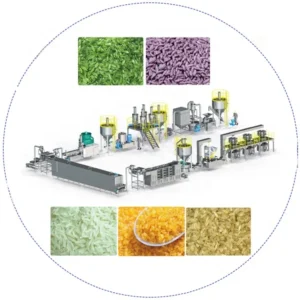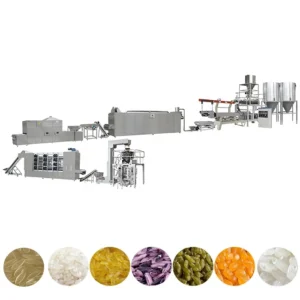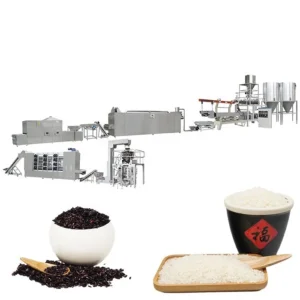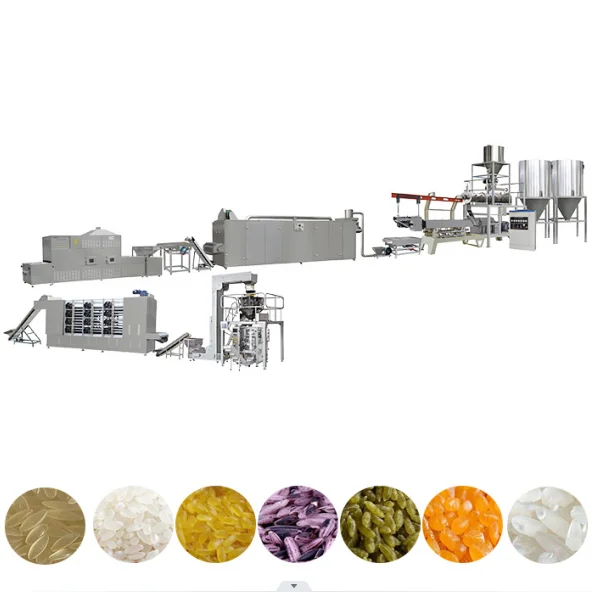


MT65, MT70, MT85, MT75, MT95 Artificial Nutritional Fortified Rice Production Line, Twin-Screw Extruder, CE & ISO Certified — complete turnkey layout from mixing through extruding, drying, roasting, cooling to packing.
- Screw configuration and die design matched to your raw material formula and target rice kernel shape
- Circulation drying with frequency-controlled mesh belt speed for consistent moisture control
- Line throughput balanced across every station to eliminate bottlenecks
Engineers run trial production on your actual raw material in our testing workshop before shipment, so capacity claims are verified — not theoretical.
Description
Turnkey Line Integrity — Every station from mixing to packing is throughput-matched on your actual recipe, validated with raw material trials before the line ships.
Technical Specifications
| Parameter | Value |
|---|---|
| Product Type | Artificial Nutritional Fortified Rice Production Line |
| Model | MT65 / MT70 / MT85 / MT75 / MT95 |
| Installed Power | MT65: 85 kW; MT70: 120 kW; MT85: 235 kW; MT75: 180 kW; MT95: 260 kW |
| Power Consumption | MT65: 60 kW; MT70: 85 kW; MT85: 165 kW; MT75: 135 kW; MT95: 195 kW |
| Output Capacity | MT65: 80–100 kg/h; MT70: 100–120 kg/h; MT85: 200–300 kg/h; MT75: 300–500 kg/h; MT95: 800–1000 kg/h (basis not stated in source — confirm raw material composition, moisture content, and pellet format) |
| Overall Dimensions (L×W×H) | MT65: 28 × 1.2 × 2.2 m; MT70: 30 × 1.5 × 2.2 m; MT85: 34 × 3.5 × 4.3 m; MT75: 32 × 3.5 × 4.3 m; MT95: 36 × 3.5 × 4.3 m |
| Extruder Type | Twin-screw extruder |
| Control System | Frequency speed controlling; automatic lubricating and cooling system |
| Feeding System | Single or double screw feeding system selected based on material characteristics |
| Dryer Heating Source | Electric or gas |
| Dryer Feature | Circulation drying with frequency motor-controlled mesh belt speed |
| Line Stations | Mixing → Extruding → Vibrating → Low temperature drying → Cooling → High temperature roasting → Cooling → Packing |
| Assembly State | Complete turnkey production line |
| Certification | CE, ISO |
Application Suitability
| Application | Material or Output |
|---|---|
| Nutritional fortified rice for government food programmes | Broken rice, rice bran, corn, millet blended with vitamin and mineral premix |
| Artificial instant rice for retail and food service | Wheat, oats, buckwheat, bean flour, starch base with micronutrient addition |
| Value-added rice kernel from milling by-products | Rice bran and broken rice reconstituted into uniform fortified kernels |
| Infant and weaning nutrition rice base | Pre-gelatinised starch and cereal blends with heat-sensitive nutrient inclusion |
What "Rated Capacity" Means When Your Recipe Changes the Rules
A line rated at 300 kg/h on standard corn grits may deliver half that on a high-whey-protein fortified rice formulation.
I spent years on the assembly floor tightening bolts on extruders, and I have watched a line that looked perfect on paper stall the moment the buyer’s actual recipe hit the barrel. High protein and high fat content change melt viscosity inside the extruder, alter residence time, and shift the entire drying curve downstream. When the extruder output drops, the dryer runs half-empty, the roaster cycles shorten, and packing speed overshoots what the cooling conveyor can supply. That cascade of mismatches is exactly what a fortified rice production line turnkey project must eliminate before the first container is loaded [NEED_CITE: raw material composition effects on twin-screw extrusion throughput].
Throughput Matching Across Every Station
A turnkey line is only as reliable as its slowest station. On a fortified rice production line turnkey project, the mixer batch size must align with the extruder’s continuous feed rate so that neither station idles waiting for the other. The vibrating conveyor spreads extrudate evenly onto the dryer belt, and the belt speed — controlled by a frequency motor — must match the moisture removal rate the circulation drying process can sustain. If one station is over-specced and another under-specced, the entire line operates below the nameplate capacity regardless of how powerful the extruder motor is.
Screw Configuration and Die Design for Your Formulation
The twin-screw extruder does not process every recipe identically. Screw element arrangement — conveying, kneading, and reverse-flight sections — determines shear intensity and residence time, which in turn govern starch gelatinisation and nutrient retention. A formulation heavy in legume flour demands a different screw profile than one based primarily on broken rice and starch. Die aperture shape and size define the final kernel geometry, whether the target is a slender grain or a rounded instant rice pellet. Meiteng specifies screw configuration and die design to each buyer’s raw material and target product, then validates the combination with a trial run in the in-house testing workshop before shipment [NEED_CITE: screw configuration impact on gelatinisation degree in food extrusion].
Reading the Power and Capacity Table Correctly
Installed power tells you the electrical infrastructure you need to prepare; power consumption tells you what the line draws under typical load. The MT85, for instance, carries 235 kW installed but consumes around 165 kW during steady-state operation — the gap covers startup surge and safety margin. Capacity figures across the MT65 through MT95 range are listed with a note that raw material composition, moisture content, and pellet format must be confirmed. This matters because a recipe with 30% added fat will plasticise the melt and reduce volumetric output compared to a lean starch-only blend. Overall dimensions grow from the compact 28-metre footprint of the MT65 to the 36-metre line length of the MT95, which directly affects your workshop layout and utility routing.
The Hidden Cost of Skipping the Trial Run
Lines assembled from separate vendors rarely undergo a full integrated trial before shipping. The extruder may run fine alone, but when connected to a dryer with insufficient belt area, moisture leaves the kernel unevenly, causing cracking during high-temperature roasting. Undersized cooling conveyors then deliver warm kernels to the packing station, where heat causes condensation inside the bag and shortens shelf life. These problems surface only after installation, when re-engineering means replacing equipment already bolted to the floor [NEED_CITE: post-installation line reconfiguration costs in food processing projects].
Why Source the Entire Line from One Supplier
Meiteng designs the full layout — mixing, extruding, drying, roasting, cooling, and packing — so that throughput is matched at every junction rather than negotiated between unrelated vendors. Screw configuration and die design are specified against your raw material data sheet, not copied from a generic build. The in-house testing workshop runs your actual formulation before the line ships, producing a trial run report that documents real output and product quality. Electrical schematics and voltage are confirmed against your facility’s supply before production begins, avoiding commissioning delays caused by mismatched frequency or control language. CE and ISO certification underpin the build, and the documentation package supports customs clearance and local regulatory filing.
Documentation & Verification
- Line layout drawing with capacity calculation for your target output and recipe
- Trial run report on your raw material documenting actual throughput and kernel quality
- Screw and die configuration record matched to your formulation
- Electrical schematic and voltage confirmation for your facility supply
- CE declaration of conformity and ISO certificate for import compliance
- Operation and maintenance manual with wear parts list and replacement intervals
Installation, Commissioning & Support
- Foundation and floor-load plan based on the selected model’s dimensions and weight
- Dedicated circuit sizing per the line’s installed power rating, up to 260 kW for the MT95
- Phased assembly sequence from extruder barrel alignment through dryer belt tensioning
- First-run parameter setting including barrel temperature profile and mesh belt speed calibration
- Operator training covering screw element inspection, die cleaning, and frequency drive adjustment
- Wear parts list with reorder lead times for screws, dies, and dryer belt sections
Before You Request a Quote
To scope a fortified rice production line turnkey project accurately, share your base raw material breakdown, the vitamin and mineral premix dosage, and the target kernel size and shape. Confirm your workshop length, ceiling height, and local voltage and frequency so the electrical package and line layout are correct from the start. If you have existing upstream milling or downstream packing equipment, note the interface points so the new line integrates without bottlenecks.
Frequently Asked Questions
Q: What raw material conditions must be confirmed before capacity figures are guaranteed?
A: Output capacity depends on the specific blend ratio of base cereals, added protein or fat percentage, initial moisture content, and the target kernel dimensions. Meiteng validates throughput by running your actual formulation in the testing workshop and issues a trial run report before the quotation is finalised, so the capacity figure you receive reflects your recipe, not a generic benchmark.
Q: How are screw elements and die plates matched to a fortified rice formulation?
A: The screw configuration — balancing conveying, kneading, and shear sections — is selected based on your raw material’s starch-to-protein ratio and the required gelatinisation degree. Die aperture geometry is designed to produce the target kernel shape and size. Both are recorded in the configuration document supplied with the line.
Q: How is voltage and control system language handled for export projects?
A: Before production begins, the electrical schematic is confirmed against your facility’s supply voltage and frequency. The control panel HMI language is set to your operator preference. This confirmation step prevents commissioning delays that arise when a machine built for one electrical standard arrives at a site running a different supply [NEED_CITE: voltage and frequency standards by export market].
Q: How do the drying and roasting stations stay synchronised with extruder output?
A: The circulation dryer uses a frequency-controlled mesh belt whose speed is set to match the extruder’s actual discharge rate. The roaster and cooling conveyors are sized to the same throughput so kernels move continuously without accumulating or starving any station, maintaining consistent moisture and colour across the batch.
Q: What does the on-site installation and training programme cover?
A: The installation team follows a phased schedule covering mechanical assembly, utility connection, and sequential station commissioning. Operator training includes barrel temperature profile management, screw and die changeover procedures, frequency drive adjustment, and routine maintenance intervals. A wear parts list with reorder references is provided for ongoing operation.
Related products
-
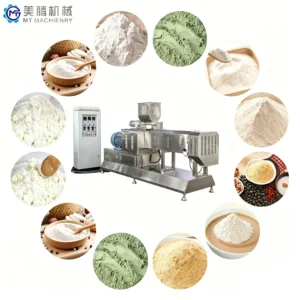
150-500kg/h Twin Screw Extruder Baby Rice Flour Making Machine
¥9,500.00 Select options This product has multiple variants. The options may be chosen on the product page -

Automatic Iron Fortified Baby Rice Cereal Nutrition Powder Making Machine 500kg/h PLC Controlled
¥8,238.27 Add to cart -
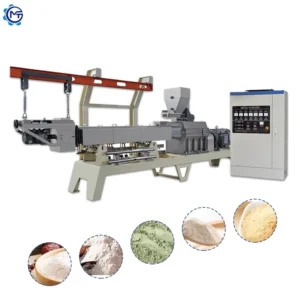
CE cerelac Instant Baby Food Porridge Making Machine Production Line
¥35,000.00 Select options This product has multiple variants. The options may be chosen on the product page -
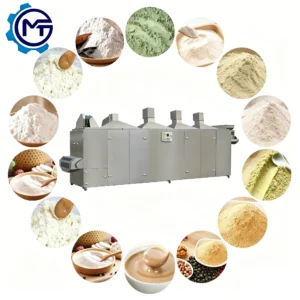
Full Automatic Complete Baby Food Nutrition Powder Porridge Processing Production Line for Infant Nutrition Factory
¥9,500.00 Add to cart