

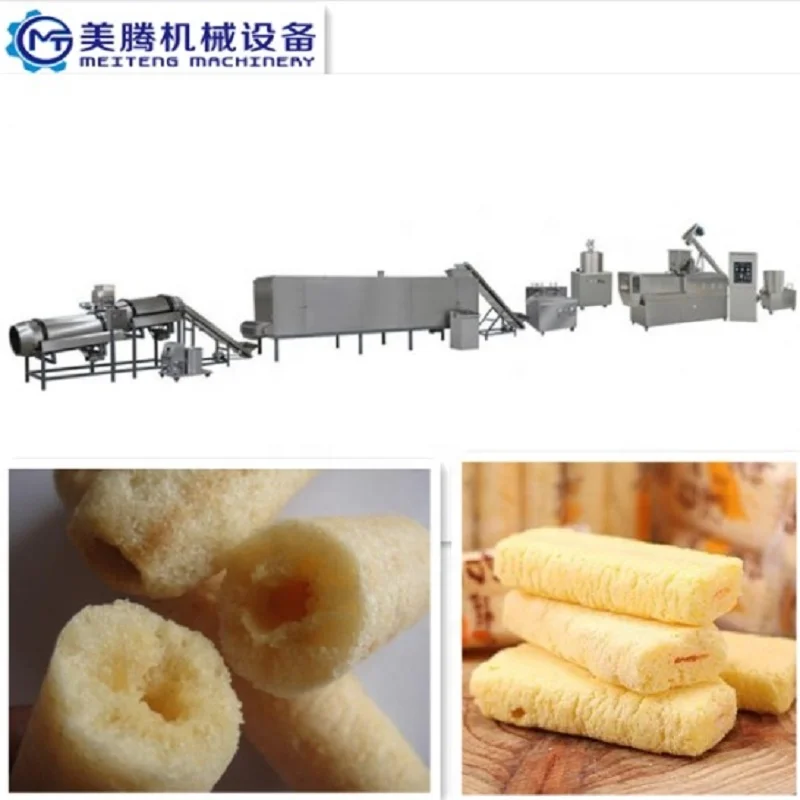
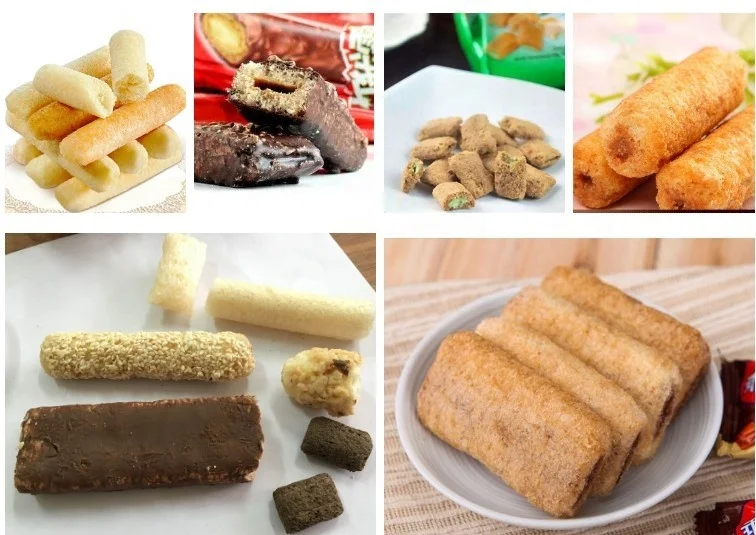
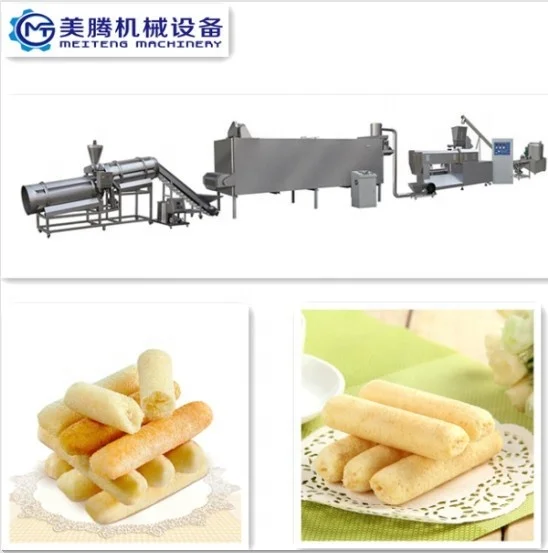
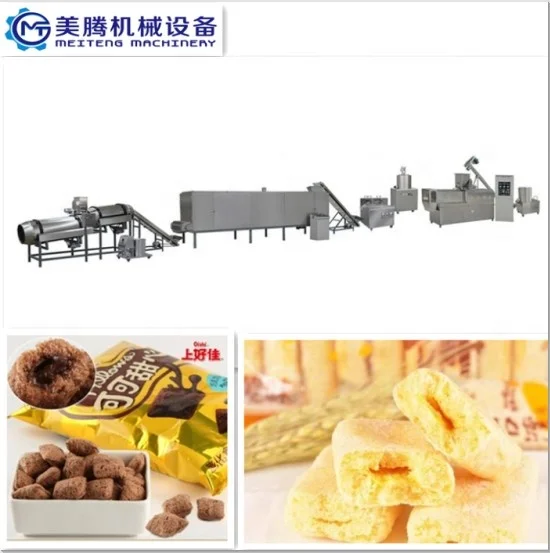
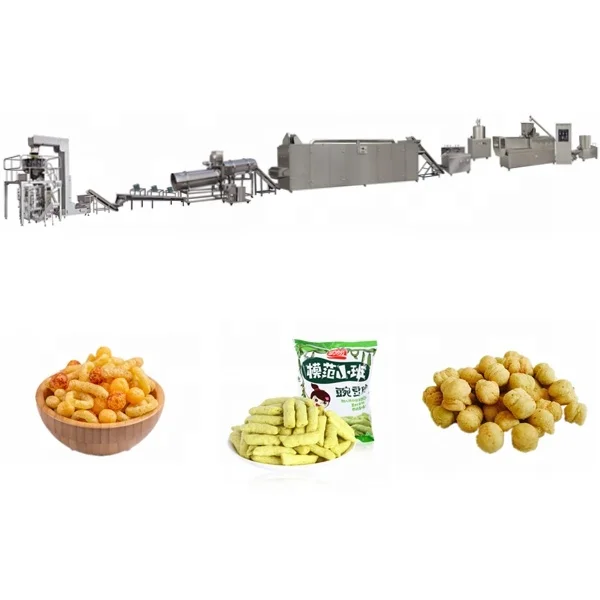
MT70 / MT85 / MT75 Twin Screw Extrusion Puffed Snack Production Line, Interchangeable Die System, Gas or Electric Dryer — complete turnkey layout from mixing through extrusion, drying, coating to packing. Screw configuration and die design matched to your cereal-based raw material and target snack shape, controlling expansion and density across ball, tube, ring and star formats. Every station throughput-matched so rated output holds on your actual recipe. In-house trial run on your raw material before shipment, with screw and die configuration record provided.
Description
Throughput-Matched Engineering — every station from the extruder barrel to the coating drum is balanced against your actual flour blend and moisture level, verified during an in-house trial run before the line ever ships.
Technical Specifications
| Parameter | Value |
|---|---|
| Product Type | Twin Screw Extrusion Puffed Snack Production Line |
| Models Available | MT70, MT85, MT75 |
| Screw Type | Twin Screw |
| Installed Power (MT70) | 130 kW |
| Power Consumption (MT70) | 95 kW |
| Output Capacity (MT70) | 100–120 kg/h (basis not stated in source — confirm raw material, moisture content, die configuration) |
| Overall Dimensions (MT70) | 21 × 1.5 × 2.2 m |
| Installed Power (MT85) | 180 kW |
| Power Consumption (MT85) | 120 kW |
| Output Capacity (MT85) | 200–300 kg/h (basis not stated in source — confirm raw material, moisture content, die configuration) |
| Overall Dimensions (MT85) | 25 × 1.5 × 2.2 m |
| Installed Power (MT75) | 220 kW |
| Power Consumption (MT75) | 130 kW |
| Output Capacity (MT75) | 300–500 kg/h (basis not stated in source — confirm raw material, moisture content, die configuration) |
| Overall Dimensions (MT75) | 28 × 1.5 × 2.2 m |
| Raw Materials | Corn, rice, wheat, oat, barley flour, and similar cereal bases |
| Line Stations | Mixing → Extruding → Drying → Coating / Flavouring → Cooling → Packing |
| Dryer Heating Source | Gas or Electric |
| Coating System | Double tumble sugar melting, elevator, coating drum, spraying nozzle |
| Die Options | Interchangeable dies for ball, tube, stick, ring, fruit loop, star, wheel, flower, heart shapes |
| Screw Feature | Automatic lubricating and cooling function |
| Assembly State | Complete turnkey line from batching to packing |
| Layout | Customizable to factory footprint |
| Certification | CE |
Application Suitability
| Application | Material or Output |
|---|---|
| Cheese ball and cheese ring production | Corn flour and rice flour blends with cheese seasoning |
| Fruit loop and multi-grain ring extrusion | Wheat, oat, and barley flour combinations |
| Tube and stick snack formats | Corn grits and rice-based recipes |
| Star, wheel, and heart-shaped novelty snacks | Cereal flour mixes with varying moisture content |
| Contract packing across short product runs | Rapid die changeover on a single extruder platform |
| Turnkey snack factory projects | Full-line build from raw material intake to final packing |
Why "Rated Capacity" Rarely Survives the First Production Run
A puffed snack production line turnkey is only as honest as the trial run that preceded it.
I spent years walking Middle Eastern factory floors where the extruder nameplate promised one number and the shift log recorded another. The gap almost never came from the machine being poorly built — it came from the screw profile and die geometry being selected for a generic recipe, not the buyer’s actual flour blend, particle size, and target moisture. Once the real raw material hit the barrel, expansion dropped, density shifted, and the downstream dryer suddenly had too much product to handle. A puffed snack production line turnkey that skips a pre-shipment trial on your exact recipe is a line whose true capacity you will discover the hard way. [NEED_CITE: impact of raw material variability on extrusion throughput]
Screw Configuration That Follows Your Recipe, Not a Template
The twin-screw platform across the MT70, MT85, and MT75 models allows screw element rearrangement to match the shear and residence time your specific cereal blend demands. A high-fat oat recipe behaves very differently from a lean corn grits mix, and the screw profile must reflect that difference. Each puffed snack production line turnkey ships with a documented screw and die configuration record, so the setup that produced acceptable product during the trial is the same setup installed on your floor.
Balancing the Dryer and Coating Drum to the Extruder Output
The most common bottleneck I have seen on snack lines is not the extruder — it is the dryer running out of belt length or the coating drum tumbling too slowly to keep pace. On this puffed snack production line turnkey, the dryer capacity and the double tumble coating system are sized to the selected extruder model, so product does not pile up on the conveyor between stations. Whether you choose gas or electric heating for the dryer depends on your local utility cost structure, and that choice is confirmed before production starts. [NEED_CITE: dryer sizing relative to extruder throughput in snack extrusion lines]
Reading the Spec Sheet Like a Process Engineer
The installed power figures — 130 kW on the MT70, 180 kW on the MT85, 220 kW on the MT75 — tell you the thermal and mechanical headroom available inside the barrel. Higher installed power allows more aggressive shear and greater moisture flash-off, which directly affects expansion ratio and final snack density. The automatic lubricating and cooling function on the screw shaft extends run time between maintenance stops and keeps barrel temperature stable across long shifts. Interchangeable dies mean a single extruder can switch from fruit loops to sticks within a changeover window, giving contract packers the flexibility to run short batches without dedicating a second machine. Line dimensions stretch from 21 m to 28 m depending on model, so factory floor planning must account for the full footprint including the mixer at the front end and the packing station at the tail.
The Hidden Cost of a Mismatched Line Layout
I once watched a snack line in the Gulf region where the extruder pushed product faster than the coating drum could season it. Half-finished cheese balls sat on the belt, cooling unevenly, absorbing moisture from the humid air, and arriving at the packing station with a texture the brand could not sell. The owner had purchased each station from a different vendor, and nobody had been responsible for the throughput math between them. When a puffed snack production line turnkey comes from a single supplier, that mismatch becomes the supplier’s problem to solve before the machines leave the factory, not yours to debug during commissioning. [NEED_CITE: throughput balancing across extrusion line stations]
Why Source the Entire Line From One Supplier
Complete line engineering under one roof means the mixing system, extruder, dryer, coating drum, cooler, and packer are all specified against the same capacity target rather than assembled from catalog pages. The in-house testing workshop runs your actual raw material through the selected model before shipment, producing a trial run report that documents texture, density, and sustained output. Screw configuration and die design are locked to your target product shape — whether that is a cheese ring, a fruit loop, or a star — rather than defaulted to a generic build. Pre-sales consultation covers line layout, utility planning, and phased installation scheduling so that the project timeline stays predictable. On-site commissioning includes operator training on the specific control interface your team will use every day. [NEED_CITE: turnkey project delivery standards for food extrusion lines]
Documentation & Verification
- Line layout and capacity calculation matched to your factory dimensions and target output
- Screw and die configuration record tied to your specific snack shape and recipe
- Electrical schematic confirming voltage, frequency, and control language before production
- Trial run report on your raw material documenting texture, density, and throughput
- CE declaration of conformity for market entry and customs clearance
- Operation and maintenance manual with wear parts list for your line configuration
Installation, Commissioning & Support
- Foundation and floor space planning based on the 21–28 m line length depending on model selected
- Dedicated power circuit sized to the installed power of up to 220 kW for the MT75
- Modular station delivery allowing phased assembly in facilities with limited ceiling height
- First-run parameter setting on your flour blend covering barrel temperature, screw speed, and moisture dosing
- Operator training on die changeover procedures across the full shape range from ball to flower
- Wear parts supply covering screws, dies, and spraying nozzles with documented replacement intervals
What We Need From You to Build the Right Line
Before we configure a puffed snack production line turnkey, share your primary cereal base, target snack shapes, and daily volume requirement. Tell us the available floor space and ceiling height, along with your local voltage and frequency so the electrical package is correct from day one. If you already run upstream milling or downstream packing equipment, let us know the interface points so the new line integrates without dead zones.
Frequently Asked Questions
Q: How is output capacity verified on my specific raw material and recipe before shipment?
A: Your flour blend is run through the selected extruder model in the in-house testing workshop. The trial run produces a report covering expansion ratio, snack density, and sustained throughput. This means you see real numbers on your own recipe before the line ships, not just a nameplate figure based on a generic cereal mix.
Q: What screw and die configuration is recommended for my target snack shape and density?
A: The screw element arrangement and die geometry are specified after reviewing your target shape, raw material, and desired crunch texture. A configuration record is documented and shipped with the line, ensuring the setup validated during the trial run is replicated on your factory floor.
Q: How is throughput balanced across the extruder, dryer, and coating stations to avoid bottlenecks?
A: Each station is sized against the extruder output of the selected model so that product flow remains continuous. The dryer belt length, coating drum volume, and cooler capacity are all calculated to prevent accumulation between stages, which is a common failure point on multi-vendor lines.
Q: What voltage, frequency, and control language options are confirmed before commissioning?
A: The electrical schematic is reviewed and confirmed with you before production begins. Voltage, frequency, and control interface language are matched to your local utility and operator team so that commissioning proceeds without rewiring or reprogramming delays on site.
Q: What does on-site installation, commissioning, and operator training include?
A: Engineers oversee station assembly, utility connections, and first-run calibration on your raw material. Operators receive hands-on training covering die changeover, screw lubrication checks, and coating system adjustment. A wear parts list and maintenance schedule are handed over for ongoing line upkeep.
Related products
-

Corn Puff Processing Line with Mixer Fryer Baking Oven Automatic High Productivity Grain Products Snack Making Machine
¥8,300.00 Select options This product has multiple variants. The options may be chosen on the product page -

Puffed Snack Food Machine Snack Food Machine Puffed Snack Machine
¥11,050.00 Select options This product has multiple variants. The options may be chosen on the product page -

Full Automatic Crispy Maize Chocos Corn Flakes Breakfast Cereals Processing Production Line Industrial Equipment
¥1,000.00 Select options This product has multiple variants. The options may be chosen on the product page -

Automatic Puffed Food Snack Machine Electric Corn Puffs Snacks Making Machinery New Condition Flavorful Puff Snack Production
¥7,550.00 Select options This product has multiple variants. The options may be chosen on the product page

