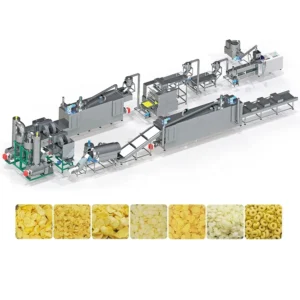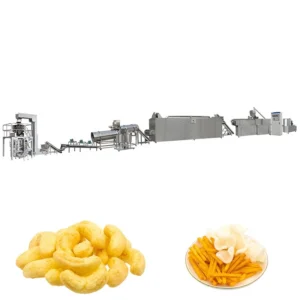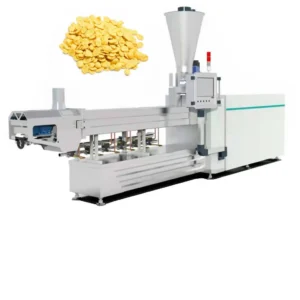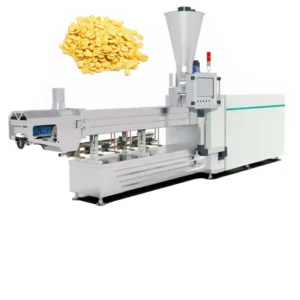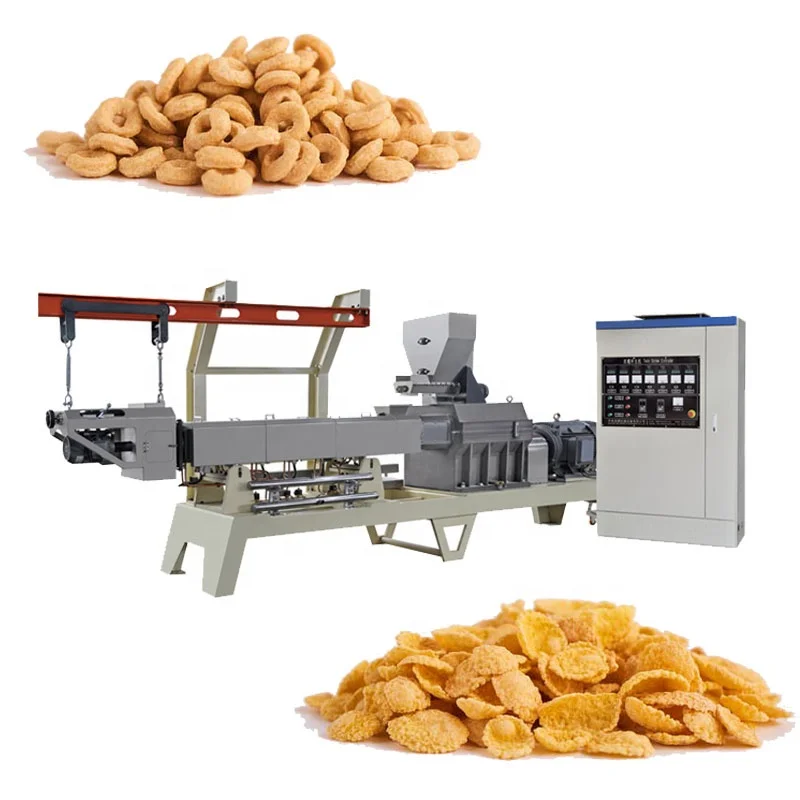
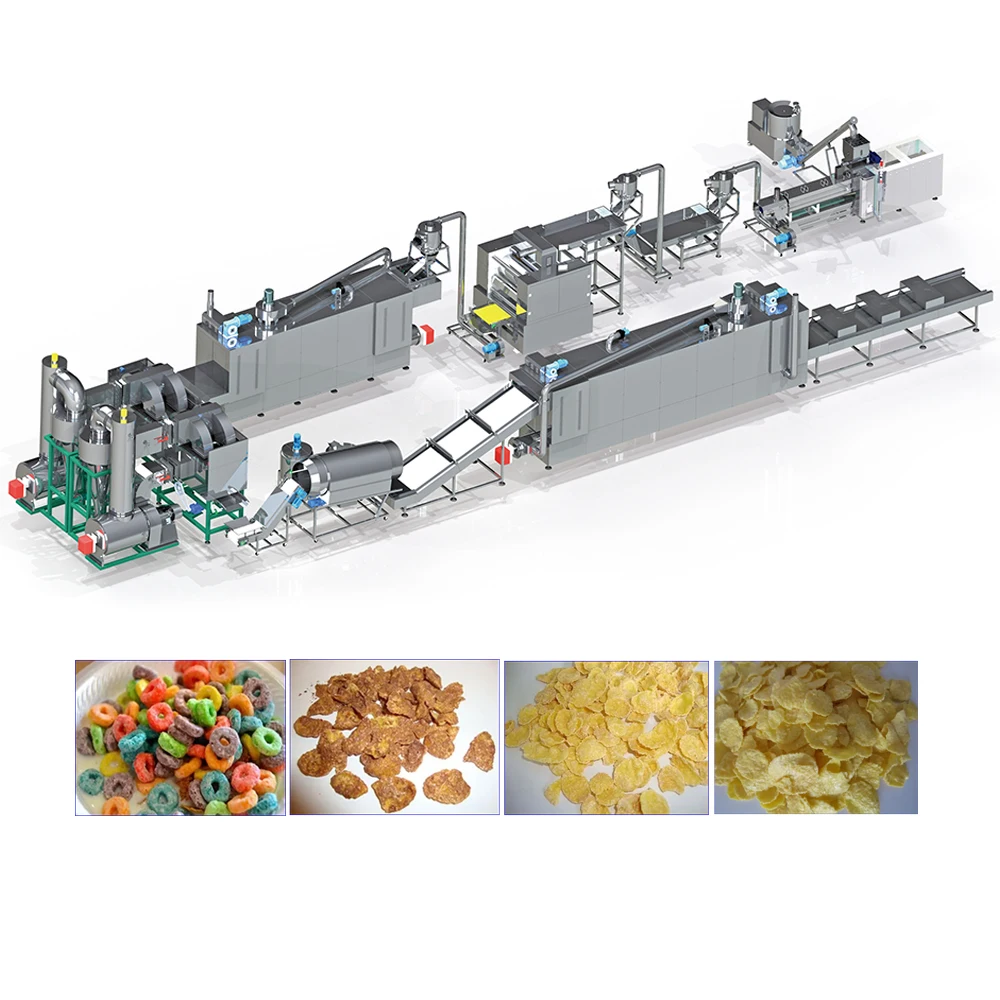


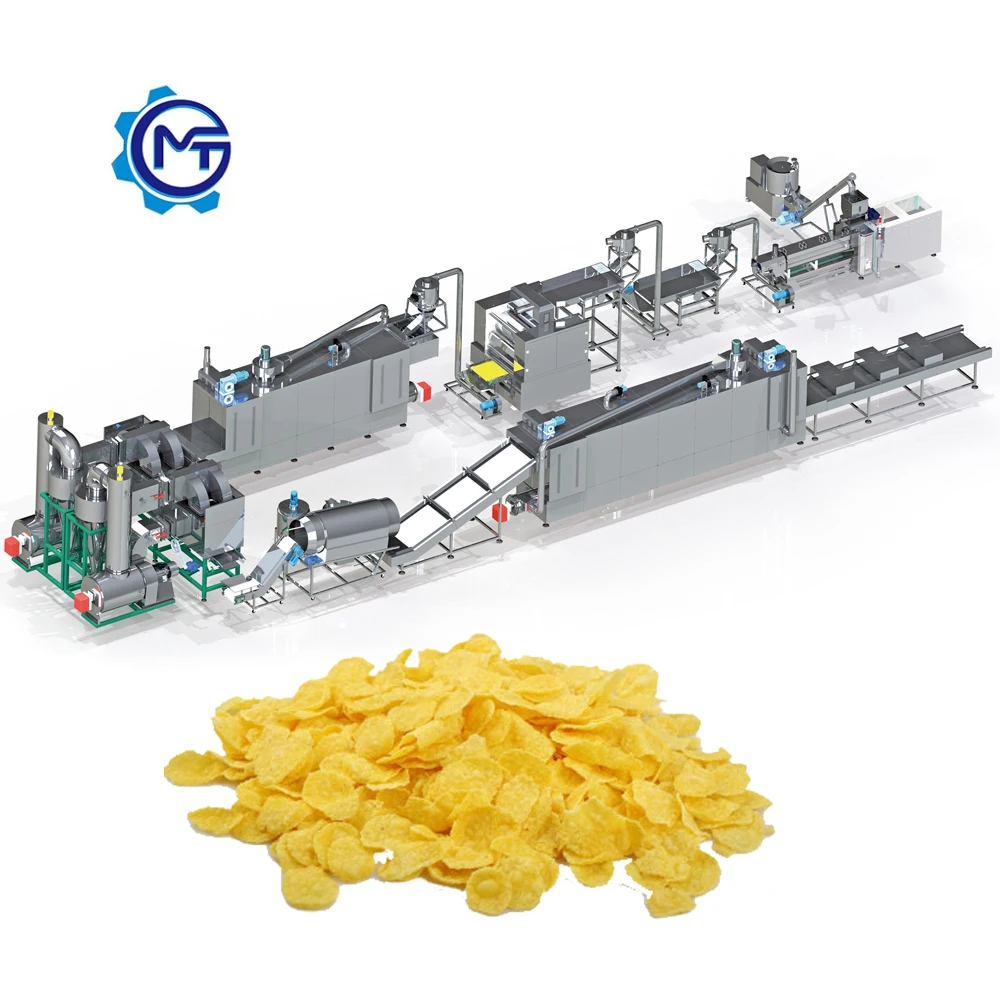
MT-65 Corn Flakes Production Line, Twin-screw Extruder, PLC Control — complete turnkey line from batching through extrusion, flake pressing, baking, and sugar coating.
- Co-rotating twin-screw extruder with sectional modules handles cooking and forming; press machine features adjustable roller gap and integrated cooling for consistent flake thickness
- Dual-side gas oven ensures uniform crispness across varying moisture levels; non-stop cutting system supports continuous operation
Backed by in-house trial runs on your raw material before shipment, matched throughput across every station, and full electrical schematic confirmation for your market.
Description
Throughput-Matched Line Design — Every station in the MT-65 corn flakes production line is sized to the same output target, eliminating the bottleneck effect common when extruders outpace their downstream dryers or coaters.
Technical Specifications
| Parameter | Value |
|---|---|
| Model | MT-65 |
| Extruder Type | Twin-screw (co-rotating, sectional modules) |
| Installed Power | 84 kW |
| Real Power Consumption | 59 kW |
| Output Capacity | 120–150 kg/h (basis not stated in source — confirm raw material and moisture) |
| Overall Dimensions (L×W×H) | 12000×1200×2200 mm |
| Control System | PLC with MCC interface |
| Mixer Power / Tank Size | 4 kW / φ600×500 mm |
| Corn Flakes Press Power | 16.12 kW |
| Press Roller Size | 510×310×1050 mm |
| Oven Dimensions (L×W×H) | 4500×1400×1800 mm |
| Oven Heating Method | Gas, dual-side baking |
| Sugar Spraying System Power | 28.75 kW |
| Extruder Self-Cleaning | Yes (twin-screw design) |
| Gearbox Lubrication | Oil forced automatic system |
| Cutting System | Non-stop continuous cutting |
| Certification | CE (since 2014), ISO |
Application Suitability
| Application | Material or Output |
|---|---|
| Traditional corn flakes | Corn grits with controlled moisture, baked to target crispness |
| Multigrain breakfast cereal | Corn flour, rice flour, wheat flour blends |
| Fortified flaked cereal | Grain base with soybean, peanut, or walnut inclusion |
| Sweetened flaked cereal | Base flakes with sugar spray coating |
What Capacity Claims Leave Out in a Corn Flakes Production Line Turnkey
A rated output figure means nothing if the oven cannot keep pace with the extruder at that volume.
I have seen lines where the twin-screw extruder was specified correctly for the raw material, but the high-temperature oven was sized for a lower throughput. The flakes pile up before baking, lose moisture unevenly, and arrive at the sugar spraying station already compromised. The corn flakes production line turnkey then never reaches its stated capacity because one undersized station holds back every other. That mismatch usually surfaces only after installation, when the buyer’s raw material is running through the equipment for the first time on site [NEED_CITE: throughput matching between extrusion and drying stages in cereal lines].
Matching Every Station to the Same Output Target
The corn flakes production line turnkey begins with a mixer that loads 10–30 kg per batch and feeds into the twin-screw extruder through a screw conveyor. The extruder cooks and forms the dough, which then passes through the corn flakes press machine where adjustable roller gap and an integrated cooling system control flake thickness. Each station is selected so its cycle time or continuous feed rate aligns with the extruder output on the specific grain blend and moisture level the buyer intends to run.
Climate-Aware Drying and Cooling Configuration
In a project I worked on in a high-humidity region, the cooling conveyor was specified for a temperate climate. The flakes absorbed ambient moisture after leaving the oven and clumped before reaching the packing station. Since then, every corn flakes production line turnkey I configure starts with a review of local temperature and humidity data. The oven’s gas-fired dual-side baking system and the sugar spraying system’s enclosed roller drum are then matched to those conditions so product stability holds through to packing [NEED_CITE: impact of ambient humidity on breakfast cereal cooling and packing quality].
Reading the Spec Sheet Against Your Raw Material
The MT-65 runs at an installed power of 84 kW with real consumption around 59 kW, and the overall line footprint sits at roughly 12 m in length. Those figures matter when planning utility connections and floor layout, but they do not tell you whether the screw configuration will gelatinise your particular corn grits at your target moisture. The twin-screw co-rotating sectional modules allow the screw profile to be rearranged — changing the kneading block sequence or adding de-gassing elements — so that residence time and shear match the starch behaviour of your raw material. The corn flakes press roller, measuring 510×310×1050 mm, then sets the flake geometry, and the gap adjustment determines whether the final product breaks cleanly or fractures into fines.
The Hidden Cost of Undersized Downstream Stations
When the sugar spraying system cannot coat flakes fast enough, the uncoated product backs up on the conveyor, cools below the sugar adhesion temperature, and generates waste that operators cannot rework into the line. The 28.75 kW spraying system with its φ600×2700 mm drum is dimensioned to handle the output of the MT-65, but only if the upstream oven delivers flakes at the moisture and temperature the coating process expects. If the oven is too small, the mismatch cascades downstream and the line never runs at its intended rate [NEED_CITE: downstream bottleneck effects in continuous breakfast cereal processing].
Why Source the Full Line from One Supplier
The batching-to-packing configuration means throughput calculations are performed across every station together, not quoted separately by different vendors who optimise for their own equipment. Screw and die configuration is specified to the buyer’s raw material before production begins, so the extruder ships with a screw profile already matched to the target flake density. An in-house testing workshop allows trial runs on the buyer’s actual corn grits or flour blend before the line is crated. PLC and MCC control documentation is prepared as a unified package, so voltage, frequency, and control language are confirmed once for the entire line rather than negotiated station by station. On-site commissioning follows a single schedule, with operator training covering the full sequence from mixer to packing.
Documentation & Verification
- Line layout drawing with station-by-station throughput calculation for your target capacity
- Screw and die configuration record matched to your corn grits or flour blend
- Trial run report on your raw material from the in-house testing workshop
- Electrical schematic with voltage and frequency confirmed for your market
- CE declaration of conformity and ISO certificate for the complete line
- Operation and maintenance manual covering every station from mixer to packing
Installation, Commissioning & Support
- Foundation plan reflecting the MT-65 line’s 12 m length and station-by-station load distribution
- Power supply layout confirming 84 kW installed capacity with dedicated circuits for extruder and oven
- Assembly sequence for the sectional twin-screw modules and press machine roller alignment
- First-run parameter setting on your raw material with PLC recipe storage for repeat batches
- Operator training on screw configuration changes and non-stop cutting system adjustments
- Wear parts list with lead times for screws, dies, and press roller surfaces
What to Include in Your Inquiry
To configure a line that matches your production reality, share the grain type and moisture content you plan to run, your target daily output in finished flakes, and the climate data for your factory location. Include your local voltage and frequency standard, the control language your operators will use, and whether you need the line to interface with existing packing equipment. If possible, send a sample of your raw material so a trial run can be performed before shipment.
Frequently Asked Questions
Q: How is throughput matched between the extruder, press, oven, and coating stations?
A: Each station is selected so its continuous feed rate or cycle time equals the extruder output on your specific raw material and moisture level. The calculation is performed across the full line, not per station, so no single unit becomes a bottleneck.
Q: What screw and die configuration is specified for my corn grits?
A: The twin-screw co-rotating modules are rearranged based on your raw material’s starch gelatinisation behaviour and your target flake density. A configuration record is documented and shipped with the machine so the profile can be reproduced or adjusted later.
Q: Can a trial run be done on my raw material before the line ships?
A: Yes. The in-house testing workshop runs your corn grits or flour blend through the extruder and press to verify flake thickness, texture, and output before dispatch. A trial run report is included in the documentation package.
Q: What voltage, frequency, and control language are confirmed before production?
A: The electrical schematic and PLC programming are prepared after confirming your local power standard and preferred operator language. This avoids commissioning delays caused by mismatched motor ratings or untranslated HMI screens.
Q: What does the installation and commissioning schedule look like?
A: The line arrives as a complete turnkey package. Commissioning follows a phased schedule covering mechanical assembly, utility connection, parameter tuning on your raw material, and operator training on the PLC interface and wear part replacement.
Related products
-
Hot Selling Automatic Corn Flakes Breakfast Cereal Production Line Making Machine
¥20,000.00 Select options This product has multiple variants. The options may be chosen on the product page -
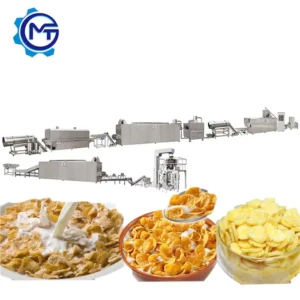
Automatic 500kg/h Corn Flakes Making Machine New Condition High Productivity Sweet Breakfast Cereal Processing Line From Factory
¥8,500.00 Select options This product has multiple variants. The options may be chosen on the product page -
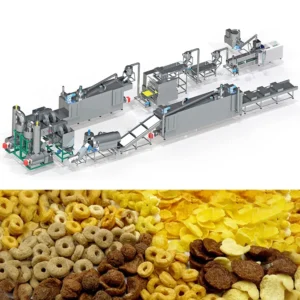
Automatic Instant Breakfast Cereals Snack Food Making Machine
¥10,000.00 Select options This product has multiple variants. The options may be chosen on the product page -
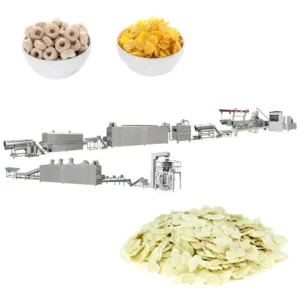
200kg/h Breakfast Cereal Extruder Making Machine Hot Sale Corn Flake Production Line
¥30,000.00 Select options This product has multiple variants. The options may be chosen on the product page