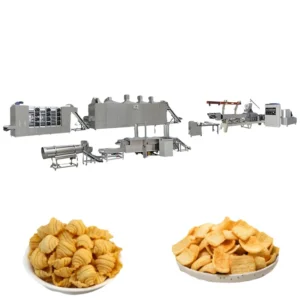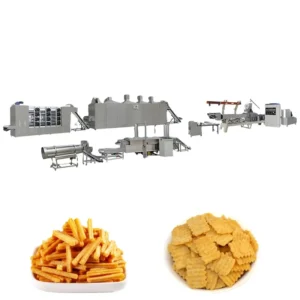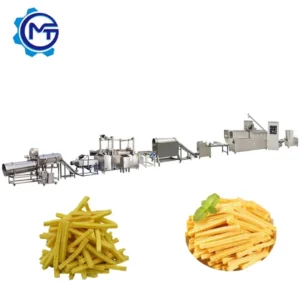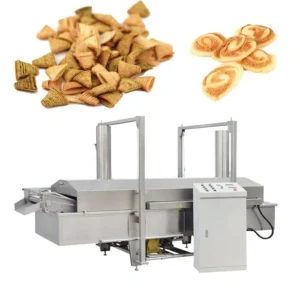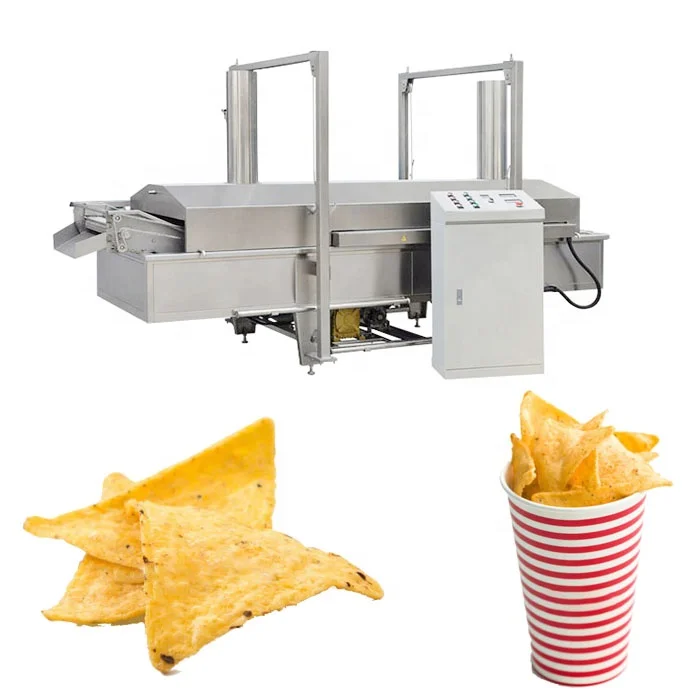
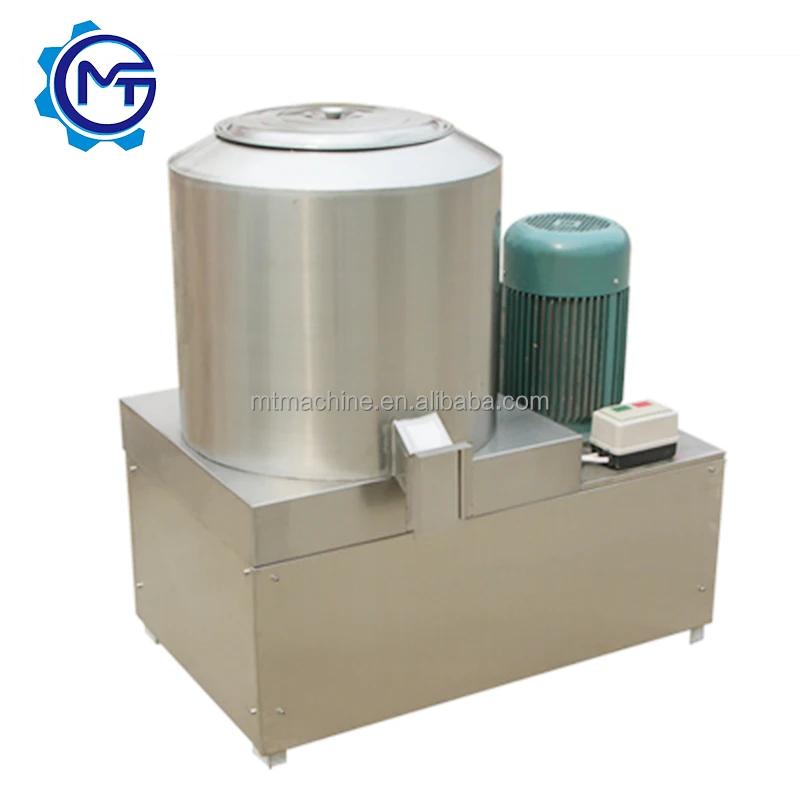
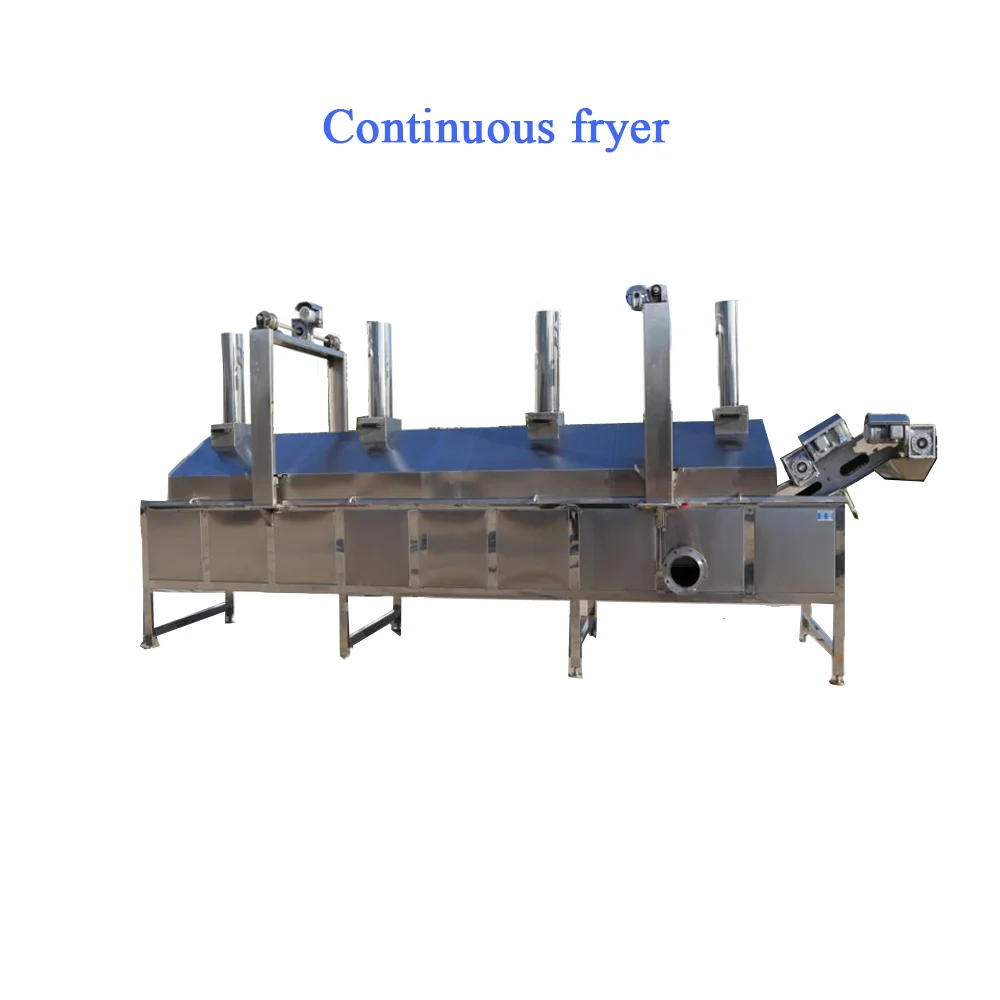


MT65 / MT70 / MT85 / MT75 / MT95 Fried Snack Production Line, Twin-Screw Extrusion, 304 Stainless Steel — configured for Bugles, corn chips, and tortilla chips with screw and die design matched to your raw material formulation and target product density. Station throughput from mixer through fryer and flavoring is balanced to prevent bottlenecks across the full line.
- Five capacity tiers available with verified installed and real power draw
- In-house testing workshop validates output on your actual raw material before shipment
Description
Turnkey Line Throughput Matching — Every station from the mixer through the fryer is sized to the extruder’s real output, so the fried snack production line turnkey runs without bottlenecks at any handoff point.
Technical Specifications
| Parameter | Value |
|---|---|
| Product Type | Fried Snack Production Line (Bugles / Corn Chips / Tortilla Chips) |
| Model Options | MT65 / MT70 / MT85 / MT75 / MT95 |
| Output Capacity | 120–150 kg/h (MT65) to 800–1000 kg/h (MT95) (basis to be confirmed: raw material formulation, moisture content, and product shape) |
| Installed Power | 142 kW (MT65) / 185 kW (MT70) / 240 kW (MT85) / 245 kW (MT75) / 370 kW (MT95) |
| Real Power Consumption | 100 kW (MT65) / 130 kW (MT70) / 180 kW (MT85) / 185 kW (MT75) / 280 kW (MT95) |
| Extruder Type | Twin-Screw Extruder |
| Overall Line Dimensions | 22,000 × 1,200 × 2,200 mm (MT65) to 30,000 × 1,500 × 2,800 mm (MT95) |
| Mixer Tank Volume / Output | 150 kg / 300–600 kg/h (basis to be confirmed) |
| Fryer Temperature Range | 0–260 °C |
| Fryer Capacity | 200–300 kg/h (basis to be confirmed: product shape and frying time) |
| Construction Material | 304 Stainless Steel (food-contact parts) |
| Process Flow | Powder Mixing → Twin-Screw Extrusion → Forming/Cutting → Frying → Flavoring/Seasoning → Drying |
| Key Features | CE certified, ISO certified, PLC and MCC control available, in-house testing workshop |
Application Suitability
| Application | Material or Output |
|---|---|
| Bugles and corn chip production | Corn flour, corn grits, and maize-based formulations at controlled moisture levels |
| Tortilla chip and triangle chip lines | Wheat flour and corn masa blends for flat-cut frying |
| Shaped pasta-based fried snacks | Rice flour, wheat flour, and starch blends for fish crisps, duck shapes, and Christmas tree formats |
| Rice crust and sala cracker production | Rice and grain formulations requiring specific gelatinisation and expansion profiles |
| Fortified snack formats for nutrition programs | Grain base blended with vitamin and mineral premixes, subject to formulation verification |
What "Nominal Capacity" Leaves Out on a Fried Snack Line
A quoted output figure means nothing until the mixer, extruder, fryer, and flavor drum are each verified to pass that volume on the buyer’s actual formulation.
I remember arriving at a site in West Africa where the fried snack production line turnkey had been specified on paper at a single number, but nobody had checked whether the fryer could keep up when the extruder ran at full screw speed. The extruder pushed out product faster than the oil bath could handle, moisture in the frying zone spiked, and the finished chips came out soft instead of crisp. The whole crew stood around waiting for the fryer to catch up, burning fuel and oil for a fraction of the expected output. That is the gap between a catalogue number and a line that actually holds throughput on your raw material [NEED_CITE: throughput verification across consecutive process stations in snack extrusion].
Screw Configuration Dictates What the Rest of the Line Must Handle
On a twin-screw extruder, the screw element arrangement and die geometry determine not only the shape of the extrudate but also its moisture content, density, and expansion ratio at the die face. Those three properties define exactly how much residence time the product needs in the fryer and at what oil temperature. When the screw profile is specified to the buyer’s corn flour blend rather than copied from a generic build, the extrudate enters the fryer in a predictable state, and the fryer capacity can be matched with confidence.
Why Station-by-Station Sizing Matters More Than Headline Numbers
Each transfer point between stations is where a poorly specified line fails. The mixer must deliver a consistent batch to the extruder hopper at a rate the extruder can absorb without surge feeding. The forming and cutting station must keep pace with the extruder’s continuous output, and the fryer must have sufficient belt area and oil volume to handle the mass flow without temperature drop. The fried snack production line turnkey approach sizes every station from one engineering calculation, not from five separate vendor catalogues [NEED_CITE: continuous process line throughput balancing principles].
Reading the Power and Dimension Specs
The installed power and real power figures differ meaningfully. Installed power is the sum of every motor and heater nameplate, while real power reflects what the line actually draws during steady-state operation. A buyer planning transformer capacity or generator backup needs the real power number, not the installed total. The overall line dimensions, ranging from 22 meters to 30 meters in length depending on the model tier, define the minimum workshop footprint before accounting for raw material staging, finished product cooling, and operator walkways. The twin-screw extruder at the core of each configuration provides the shear and mixing intensity necessary for full starch gelatinisation, which directly affects how uniformly the product fries and how consistently it holds its intended shape.
The Cost of a Mismatched Fryer
When the fryer is undersized relative to the extruder, oil temperature drops every time a new batch of extrudate enters the bath. The product absorbs excess oil instead of frying clean, the moisture target is missed, and shelf life suffers. On the flip side, an oversized fryer wastes thermal energy and accelerates oil degradation when it runs half-loaded. Either mismatch turns a supposedly complete line into a daily source of quality complaints and margin erosion [NEED_CITE: industrial fryer sizing relative to upstream extrusion output].
Why the Line Comes from One Engineering Source
Complete fried snack production line turnkey projects from this supplier are laid out with every station’s throughput calculated against the same raw material formulation, so the mixer, extruder, fryer, and flavor line are sized to one another rather than assembled from independent quotes. Screw configuration and die design are specified to the buyer’s target product shape, whether that is Bugles, corn chips, or small fish crisps. An in-house testing workshop runs trial batches on the buyer’s actual flour blend before the line ships, generating a trial run report that documents real output and product quality. Electrical schematics and voltage are confirmed before production begins, preventing commissioning delays caused by mismatched supply standards. Pre-sales consultation continues through on-site installation, operator training, and ongoing maintenance support, so the line does not become an orphan project after delivery.
Documentation & Verification
- Line layout drawing with station-by-station throughput calculation for your product shape
- Screw and die configuration record matched to your corn or wheat flour formulation
- Trial run report from in-house testing on your raw material before dispatch
- Electrical schematic with voltage and frequency confirmed to your local grid standard
- CE declaration of conformity and ISO certificate for customs and regulatory clearance
- Wear parts list covering screws, dies, and fryer mesh with replacement part numbers
Installation, Commissioning & Support
- Workshop length of 22 to 30 meters plus utility space must be prepared before equipment arrival
- Dedicated power circuit sized to the model’s real power draw, from 100 kW to 280 kW
- Equipment shipped in modular sections for assembly and alignment on your prepared floor
- First-run parameter setting covering barrel temperature profile, screw speed, and fryer temperature
- Operator training on daily cleaning, screw inspection intervals, and oil filtration routines
- Spare screw elements, die plates, and fryer belt sections identified and available for first replacement cycle
What We Need to Configure Your Line
Share your target product shape, the flour or grain formulation you plan to use, and the hourly output you need to meet your market commitment. Tell us your workshop dimensions, available voltage and frequency, and preferred control language so the electrical package is built correctly from the start. If you can send a sample of your raw material, we will run a trial in the testing workshop and return a report with actual throughput and product samples before you commit to the order.
Frequently Asked Questions
Q: How is output capacity confirmed for my specific flour formulation?
A: We run your raw material through the twin-screw extruder and fryer in our in-house testing workshop before shipment. The trial run produces a documented report showing actual throughput, product density, and frying results on your formulation, so the capacity figure you receive is based on real data rather than a generic catalogue value.
Q: What electrical and control options are confirmed before production starts?
A: Voltage, frequency, and control language are agreed during the specification phase. PLC and MCC control configurations are available, and the electrical schematic is reviewed and approved by the buyer before the line enters production, so there are no surprises at commissioning.
Q: How do you prevent the fryer from becoming a bottleneck?
A: The fryer capacity is calculated from the extruder’s verified output on your formulation, including the expected moisture content and frying time for your product shape. Both stations are sized from the same engineering basis, so mass flow is balanced across the transfer point.
Q: Can I send raw material for a trial before the line ships?
A: Yes. The testing workshop accepts customer raw material for full trial runs covering extrusion, forming, and frying. You receive a trial run report with throughput data and product samples, allowing you to evaluate quality before the equipment leaves the factory.
Q: What spare wear parts are included, and how are replacements handled?
A: A wear parts list is provided with the documentation package, covering screw elements, die plates, and fryer mesh. The initial spare set is identified during the quotation phase, and replacement parts are supplied against documented part numbers throughout the machine’s service life.
Related products
-
Puffed Octopus Snack Processing Line – Full-Automatic Fried Octopus Production Machinery
¥65.00 Select options This product has multiple variants. The options may be chosen on the product page -
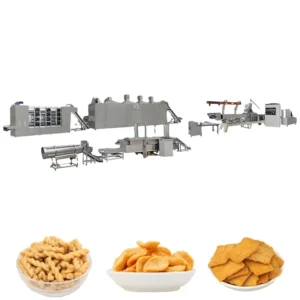
Doritos Chips Making Extruder Fried Corn Bugles Crispy Chips Process Machine Frying Salad Sticks Pellet Snacks Production Line
¥100.00 Select options This product has multiple variants. The options may be chosen on the product page -

New Automatic Bugles Puff Snack Production Line Price Corn Chips Making Machine Fried Maize Machine High Productivity Large
¥8,570.00 Select options This product has multiple variants. The options may be chosen on the product page -
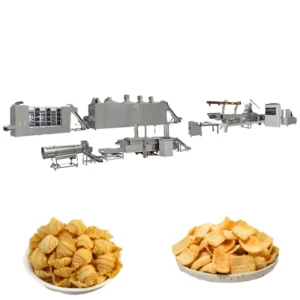
Hot Selling Puffed Ball Snacks Food Processing Line Fried Snacks Processing Line Corn Puff Snacks Machine
¥100.00 Select options This product has multiple variants. The options may be chosen on the product page