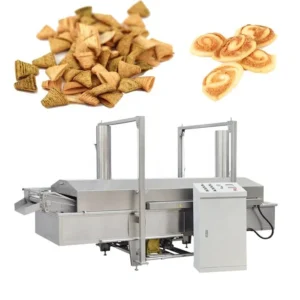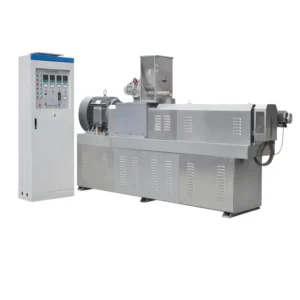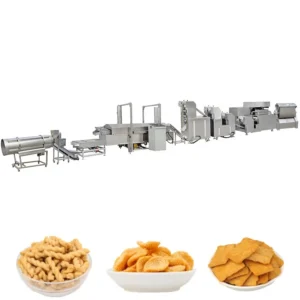
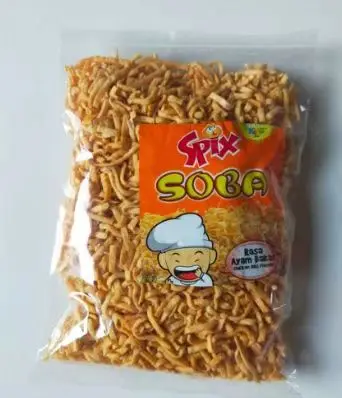

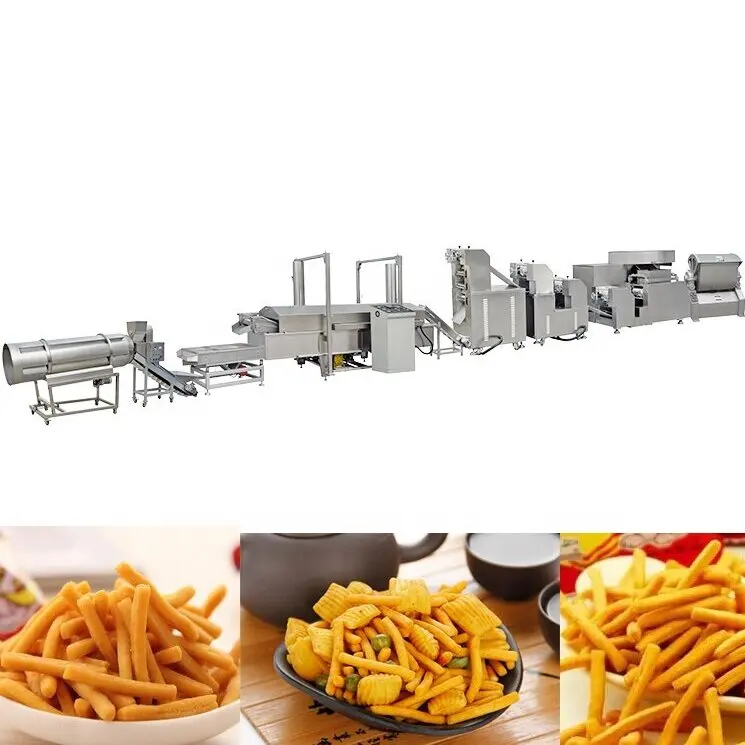
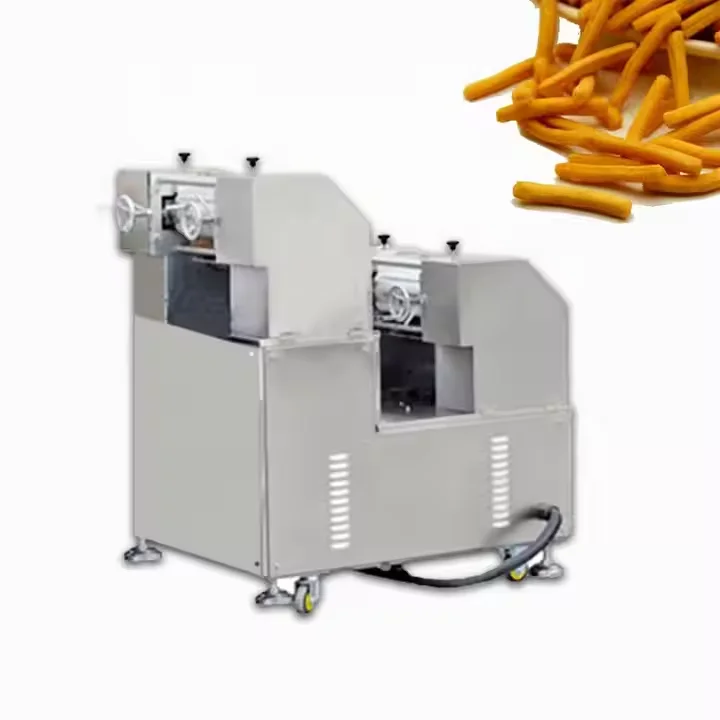
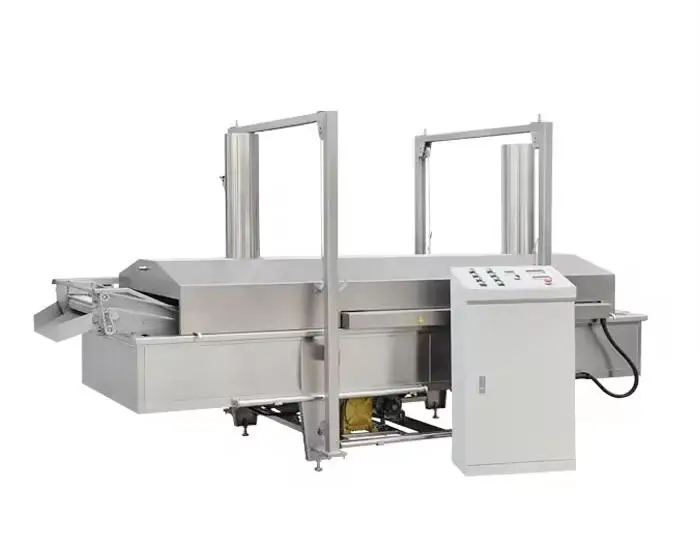
Continuous Deep Fryer, 380V, 60 kW Heating, PLC Temperature Control — integrated into a complete snack frying production line from extrusion through packing, with throughput matched at every station. Double-layer mesh belt with stepless speed regulation and built-in oil circulation filtration maintain consistent frying results while extending oil service life. Automatic lifting hood and bottom slag discharge enable rapid cleaning between product changeovers. Delivered with line layout, capacity calculation, and in-house trial run report on your raw material before shipment.
Description
Integrated Throughput Engineering — Every station from extrusion to packing is capacity-balanced and validated on your raw material before the turnkey snack frying production line leaves the factory, so rated output holds under actual conditions.
Technical Specifications
| Parameter | Value |
|---|---|
| Product Type | Continuous Deep Fryer for Snack Food Production Line |
| Rated Power | 60 kW (heating tube); 2.6 kW (drive and auxiliary) |
| Voltage & Frequency | 380V / 50Hz (configurable for target market) |
| Control System | PLC with automatic temperature control |
| Overall Dimensions (L×W×H) | 6700 × 2200 × 1200 mm |
| Net Weight | 2000 kg |
| Oil Capacity | 320 L |
| Output Capacity | 100–1000 kg/h (basis not stated in source — confirm product type, moisture content, frying time) |
| Heating Method | Electric heating or gas heating (options available) |
| Conveyor System | Double-layer mesh belt with frequency conversion stepless speed regulation |
| Oil Filtration | Built-in oil circulation filtration system |
| Slag Discharge | Bottom-mounted automatic slag discharge system |
| Lifting System | Automatic lifting of upper hood and mesh belt for cleaning |
| Material | Food-grade 304 stainless steel |
| Standards | CE, ISO |
Application Suitability
| Application | Material or Output |
|---|---|
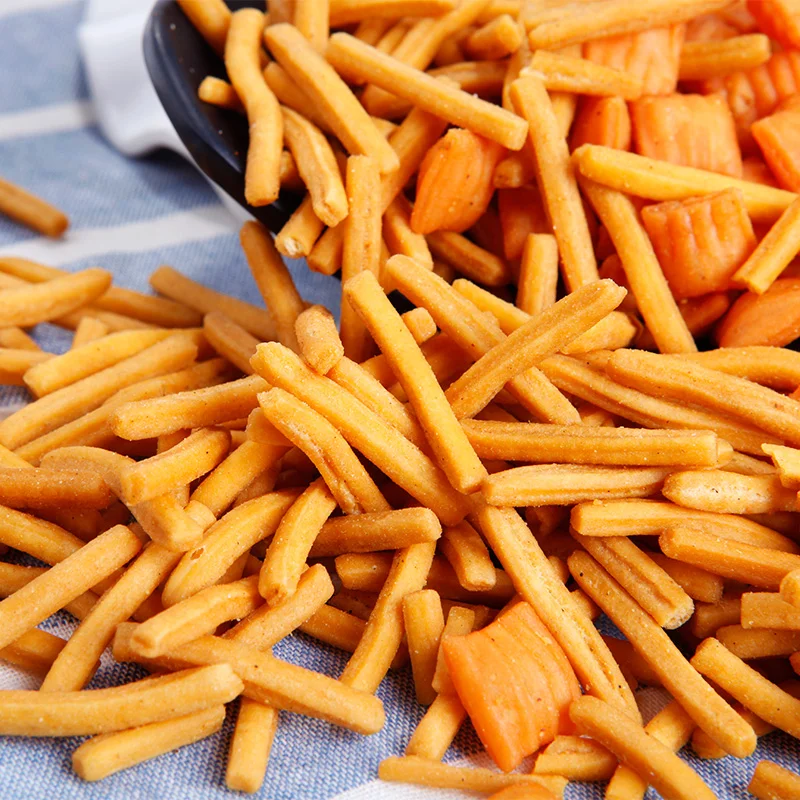
| Fried pellet chip production | 2D/3D pellet snacks from potato starch or corn flour dough |
| Corn-based extruded snack frying | Corn grits or corn meal extrudates with moisture below 12% pre-fry |
| Flavored fried snack finishing | Pre-dried kibble or formed snack pieces before seasoning drum |
| Breakfast cereal flake frying | Toasted corn flakes requiring secondary oil treatment for crispness |
What "Rated Capacity" Leaves Out When the Fryer Is Sourced Separately
A turnkey snack frying production line only delivers its stated throughput when every upstream and downstream station has been engineered as one system.
I have watched a snack line in Southeast Asia stall because the extruder pushed product faster than the standalone fryer could handle it. Oil temperature dropped each time the belt loaded up, moisture stayed too high going into the seasoning drum, and the whole line ran at roughly half its nameplate figure for the first three weeks. The fryer was spec’d in isolation and nobody checked the mass balance. [NEED_CITE: mass balance and throughput matching in continuous food processing lines] When you assemble a line from separate vendors, each one guarantees their own station — nobody owns the gap between them.
How Station-by-Station Balancing Eliminates Bottlenecks
The fryer must accept product at the exact rate the extruder and forming station deliver it, and pass it forward to the de-oiling and seasoning stations without accumulation or starvation. On this turnkey snack frying production line, the double-layer mesh belt speed is coordinated through PLC with the upstream conveyor feed rate and the downstream cooling belt, so product residence time in the oil stays within the window that gives the correct moisture drop and color.
Oil Temperature Stability Under Continuous Load
When cold product enters the fryer at a steady rate, the heating system must recover temperature before the next batch of product arrives. The 60 kW heating capacity and 320 L oil volume are sized to maintain thermal stability at the rated throughput range. If the extruder output were to exceed the fryer’s thermal recovery rate, oil temperature would sag and the final product would absorb excess oil — a common failure when fryers are chosen on belt width alone rather than thermal load calculation. [NEED_CITE: oil temperature recovery rate and product quality in continuous frying]
Reading the Specs That Actually Matter
The 6700 mm overall length defines the fry zone and the entry and exit conveyors — this determines maximum residence time at minimum belt speed, which sets the lower bound for products that need a longer fry. The stepless frequency conversion on the mesh belt means frying time is adjustable across a wide range, accommodating both thin pellet chips that need a short, high-temperature fry and denser corn snacks requiring longer exposure. PLC-controlled temperature coordination between the heating zones and belt speed ensures that a recipe change at the extruder is followed by a matching parameter shift at the fryer without manual intervention. The food-grade 304 stainless steel construction across all contact surfaces meets the hygiene standards required for export-market food safety audits.
The Cost of a Fryer That Does Not Match the Line
When the fryer is undersized, product piles up at the infeed and oil temperature collapses — the result is uneven color, high residual moisture, and seasoning that will not adhere properly downstream. When it is oversized relative to the extruder, oil sits at temperature with product gaps on the belt, accelerating oil degradation and raising operating cost per kilogram. Either mismatch forces the operator to throttle the entire line down to the weakest station. [NEED_CITE: oil degradation rates in continuous frying operations] These problems do not show up in the factory test where each machine runs alone — they only appear when the full line is running together.
Why Procuring the Full Line From One Source Matters
Throughput at every station is calculated against the same target product and raw material, so the extruder output, fryer thermal load, seasoning drum dwell time, and packing speed are all working from one set of numbers. Screw configuration and die design at the extruder are specified alongside fryer belt speed and oil temperature, because product density and moisture entering the oil determine the frying result. The in-house testing workshop runs your actual raw material through the complete sequence — extrusion, frying, de-oiling, seasoning — before the line ships. Electrical schematics confirm voltage, frequency, and control language for your facility before production starts, avoiding commissioning delays. CE and ISO certification covers the integrated line, not just individual machines.
Documentation & Verification
- Line layout drawing with throughput calculation across extruder, fryer, and packing stations
- Trial run report on your specific raw material with frying time and temperature recorded
- Electrical schematic with voltage and frequency confirmed for your local grid standard
- Screw, die, and fryer configuration record matched to your target product specification
- Factory test record showing continuous run at rated conditions before dispatch
Installation, Commissioning & Support
- The 6700 mm length requires floor space planning including upstream and downstream conveyor clearances
- 60 kW heating load demands a dedicated circuit with correct breaker rating at 380V
- Fully assembled unit arrives with hood and mesh belt in lowered position for transport, lifted on site
- PLC parameters for frying temperature and belt speed are set during commissioning using your raw material
- Mesh belt tension and tracking adjustment included in operator training at startup
- Wear parts list covers heating elements, mesh belt sections, and filtration media
What to Include in Your Inquiry
To scope a turnkey snack frying production line correctly, share your target product format and raw material composition, the upstream extruder output you are working from, and your local voltage and frequency standard. If you are integrating into an existing facility, provide available floor length and ceiling height so the layout accounts for entry and exit conveyors.
Frequently Asked Questions
Q: How is the fryer capacity verified against the extruder output to prevent line bottlenecks?
A: We calculate mass flow at every station using the same target product and raw material. The fryer belt speed and thermal recovery rate are matched to the extruder’s actual discharge rate, then validated during an in-house trial run on your raw material before shipment.
Q: What voltage, frequency, and control language options are confirmed before shipment?
A: The standard configuration is 380V/50Hz, but both voltage and frequency are configurable for your local grid. PLC interface language is set to match your operator team. All electrical parameters are documented in the schematic before production begins.
Q: Can the line layout be phased for installation in an existing factory with space constraints?
A: Yes. The 6700 mm fryer length plus upstream and downstream stations are mapped against your available floor plan. The layout can be configured in an L-shape or straight-line arrangement depending on building dimensions and existing equipment positions.
Q: What does the in-house trial run cover before delivery?
A: The trial runs your actual raw material through extrusion, frying, de-oiling, and seasoning. Frying temperature, belt speed, and residence time are recorded and adjusted until product moisture, color, and texture match your specification. A full report ships with the line.
Q: How are spare parts supplied after commissioning?
A: A wear parts list ships with the line covering mesh belt sections, heating elements, and filtration components. Replacement parts are available through ongoing supply support, and the parts list identifies intervals based on operating hours observed during the trial run.
Related products
-
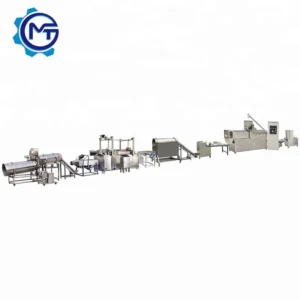
Fried Puffs Snack Food Making Machine Whole Line Solution Design by Factory Price Crispy Snack Machine
¥20.00 Select options This product has multiple variants. The options may be chosen on the product page -
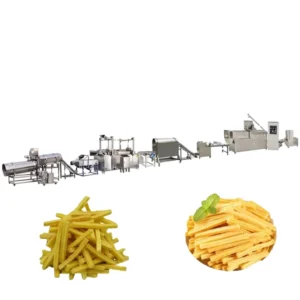
High-Yield Automated Fried Snack Production Line – Double Screw Salad Strips & Millet Crust Making Equipment
¥65.00 Select options This product has multiple variants. The options may be chosen on the product page -
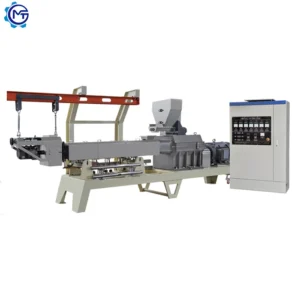
Industrial Wheat Flour Snacks Processing Equipment – Stainless Steel Fried Food Production Line
¥65.00 Select options This product has multiple variants. The options may be chosen on the product page -
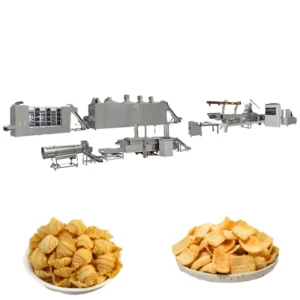
Hot Selling Puffed Ball Snacks Food Processing Line Fried Snacks Processing Line Corn Puff Snacks Machine
¥100.00 Select options This product has multiple variants. The options may be chosen on the product page