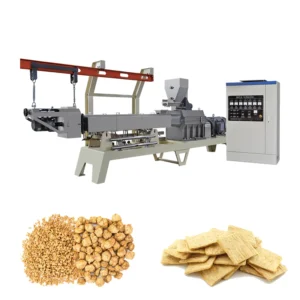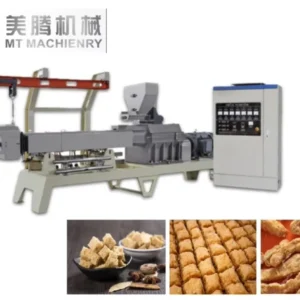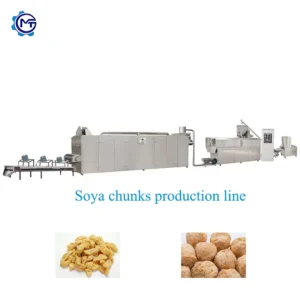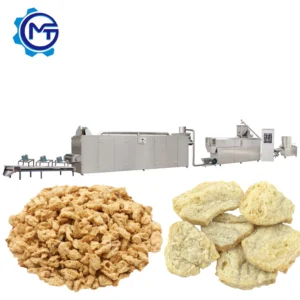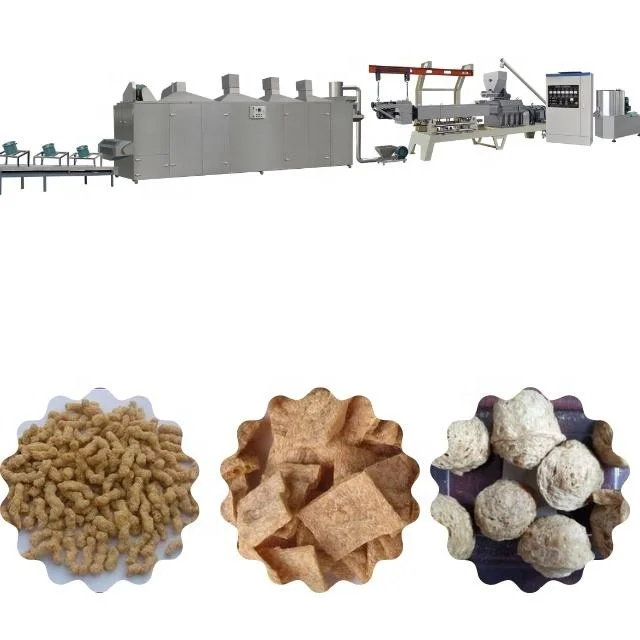


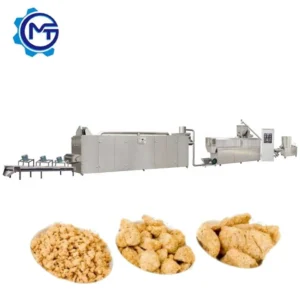
MT65 / MT70 / MT85 Plant Based Meat Processing Line, Twin-Screw Extruder, PLC & MCC Control — engineered for textured vegetable protein production from soybean and peanut meal.
- High-temperature, high-pressure twin-screw extrusion restructures globular protein into fibrous, meat-like texture
- Screw and die configuration matched to your raw material formulation and target fibre density
- Trial runs on your exact feedstock in our testing workshop verify throughput and product structure before shipment
Description
Engineered Line Throughput — Every station from batching to packing is capacity-matched on this plant based meat processing line, so the extruder output never waits on an undersized dryer or cooler.
Technical Specifications
| Parameter | Value |
|---|---|
| Product Type | Textured Vegetable Protein (TVP) / Plant-Based Meat Extrusion Line |
| Model | MT65 / MT70 / MT85 |
| Extruder Type | Twin-screw |
| Construction Material | Food-grade stainless steel contact surfaces |
| Control System | PLC and MCC automated control |
| MT65 Installed Power | 85 kW (Real Power: 65 kW) |
| MT65 Output | 150–200 kg/h (basis to be confirmed on raw material formulation and moisture content) |
| MT65 Dimensions | 18,000 × 1,300 × 2,300 mm |
| MT70 Installed Power | 120 kW (Real Power: 90 kW) |
| MT70 Output | 200–300 kg/h (basis to be confirmed on raw material formulation and moisture content) |
| MT70 Dimensions | 20,000 × 1,500 × 2,400 mm |
| MT85 Installed Power | 195 kW (Real Power: 165 kW) |
| MT85 Output | 600–800 kg/h (basis to be confirmed on raw material formulation and moisture content) |
| MT85 Dimensions | 24,000 × 3,500 × 4,300 mm |
| Powder Mixer Capacity | 300–600 kg/h (basis to be confirmed on batch material), 4 kW, 385 rpm, 10 min per batch |
| Dryer Effective Belt Length | 3.5 m, far infrared heating, 0.55 kW belt motor |
| Cooling Machine Capacity | 200–300 kg/h (basis to be confirmed on ambient and target discharge temperature) |
| Process Mechanism | High-temperature, high-pressure, high-shear extrusion for protein fibre restructuring |
| Certification | CE, ISO |
Application Suitability
| Application | Material or Output |
|---|---|
| Textured soybean protein (TSP/TVP) for meat analogues | Low-temperature soybean meal |
| Peanut-based structured protein | Peanut meal formulations |
| Plant-based ham and sausage ingredients | TVP granules and chunks with fibrous texture |
| Canned and quick-frozen vegetarian products | High-protein, low-cholesterol meat substitutes |
| Fast-food supply chain protein components | Extruded fibre structures matched to downstream forming |
What "Rated Capacity" Hides When Protein Content Shifts
A plant based meat processing line only holds its rated throughput if the raw material matches the assumptions behind the screw configuration.
I came back from a Middle East commissioning not long ago still running on the wrong sleep schedule, and the lesson from that trip was the same one I keep seeing: a buyer signs for a line based on sample capacity numbers, then their own soybean meal arrives with protein content several points lower than the test formulation. The extruder runs, but output drops well below what the contract stated, and the entire screw profile has to be reworked on-site. That is two weeks of lost production before the line ever ships product to customers. [NEED_CITE: typical protein content variation in commercial soybean meal batches]
How Shear and Temperature Restructure Protein Molecules
The core of this plant based meat processing line is the twin-screw extrusion zone, where globular protein molecules are subjected to high temperature, high pressure, and controlled shear forces. These conditions unfold the protein structure and realign it into chain-oriented fibrous formations that mimic the bite and tear of animal muscle tissue. The screw configuration determines how much shear energy the material receives at each barrel section, while the die geometry controls the final expansion and density of the extrudate.
Matching Screw Profile to Your Specific Feedstock
Every protein source behaves differently under extrusion. Low-temperature soybean meal has a different gelatinisation window than peanut meal, and even within soybean meal, the residual oil and fibre content shift the optimal barrel temperature profile. The screw elements are arranged in a sequence specific to your formulation — mixing zones, kneading blocks, and conveying sections placed to deliver the right mechanical energy at the right residence time. This is why we request your material test report before finalising the screw and die specification. [NEED_CITE: relationship between soybean meal protein dispersible index and extrusion texturisation]
Reading the Numbers That Actually Matter on a TVP Line
The installed power versus real power gap on each extruder model reflects the difference between peak motor capacity and sustained operational draw — the MT85, for instance, is rated at 195 kW installed but runs at 165 kW under normal production load. That distinction matters for your electrical infrastructure planning and transformer sizing. The powder mixer runs at 385 rpm with a ten-minute batch cycle, which sets the upstream feeding rhythm the extruder must match. The dryer uses far infrared heating across its 3.5-metre belt length, and its effective drying capacity must align with the extruder discharge rate and the target final moisture content of the TVP product. If the dryer cannot remove moisture fast enough, the product enters the cooling stage still too wet, compromising shelf stability and fibre integrity.
The Downstream Bottleneck Nobody Quotes For
A line is only as fast as its slowest station, and in TVP production the bottleneck is rarely the extruder itself. More often, it is a dryer that cannot keep up with the extruder discharge rate, or a cooler that receives product still carrying too much residual heat and moisture. When throughput is mismatched, the extruder must be throttled back, meaning you paid for capacity you cannot use. That mismatch also affects fibre quality — product sitting too long in a crowded dryer develops uneven moisture profiles, and some portions over-dry while others remain under-processed. [NEED_CITE: impact of post-extrusion moisture uniformity on TVP shelf life and rehydration behaviour]
Why Sourcing the Full Line From One Supplier Changes the Commissioning Outcome
The line layout is engineered so that the mixer batch cycle, extruder throughput, dryer belt speed, and cooler discharge rate are all calculated against one another before any machine is built. The screw and die configuration is specified against your actual raw material test report, not a generic catalogue build. Our in-house testing workshop runs your soybean or peanut meal formulation through the extruder before shipment, producing a trial run report that documents real output and fibre structure. Electrical schematics confirm voltage, frequency, and PLC control language for your facility before production begins. Every line ships with CE declaration and ISO documentation, along with a wear parts list so you know which screw elements and dies to reorder and when.
Documentation & Verification
- Line layout showing throughput calculation across mixer, extruder, dryer, cooler, and packing stations
- Trial run report produced on your soybean or peanut meal formulation in our testing workshop
- Screw and die configuration record matched to your raw material and target fibre texture
- Electrical schematic with confirmed voltage, frequency, and PLC language for your market
- CE declaration of conformity and ISO certificate included in shipment package
- Wear parts list with reorder intervals for screws, dies, and dryer belt components
Installation, Commissioning & Support
- Foundation and floor space planning based on the selected model footprint, up to 24,000 × 3,500 mm for the MT85 configuration
- Dedicated power circuit sizing per the confirmed real power draw and local voltage specification
- Assembly and alignment of extruder barrel sections, dryer belt, and cooling conveyor on-site
- First-run parameter setting including barrel temperature profile, screw speed, and die gap adjustment
- Operator training covering PLC interface navigation, batch changeover, and emergency stop procedures
- Spare screw elements and die plates supplied with initial shipment for first replacement cycle
What We Need to Build Your Line Configuration
To prepare a line proposal that reflects your actual production conditions, we need your raw material specification including protein content and moisture level, your target daily output, the voltage and frequency standard at your facility, and the PLC control language your operators will use. If you have existing upstream milling or downstream packaging equipment, share those specifications so we can match interface points.
Frequently Asked Questions
Q: How is line throughput verified on my specific soybean or peanut meal formulation before shipment?
A: We run your exact raw material through the extruder in our in-house testing workshop before the line ships. The trial run report documents the actual throughput, fibre structure, and density achieved, so you review real production data before the equipment leaves our factory.
Q: How do you match dryer and cooler capacity to the extruder output?
A: During the line layout phase, we calculate the moisture removal requirement and cooling load based on the extruder discharge rate and your target product moisture. The dryer belt length and heater configuration, along with cooler capacity, are specified to handle that load without creating a bottleneck.
Q: What screw and die configuration do you recommend for my target TVP fibre texture?
A: The screw element arrangement and die geometry are engineered after reviewing your raw material test report and target product specification. Kneading block placement, screw pitch, and die opening dimensions are all selected to produce the fibre alignment and chew density your market requires.
Q: How are voltage, frequency, and control language confirmed before production starts?
A: We request your facility electrical specification during the proposal stage. The electrical schematic is then drawn to your local voltage and frequency standard, and the PLC interface is programmed in your preferred language before the control cabinets are wired.
Q: What does on-site installation and operator training include?
A: Our engineers supervise equipment positioning, utility connections, and first-run commissioning. Training covers PLC operation, screw speed and temperature adjustment, batch changeover procedures, and routine maintenance schedules for wear parts including screw elements and die plates.
Related products
-
Dry Protein Drawing Equipment – Intelligent Puffing Machine for Cake Protein & Vegetarian Meat
¥65.00 Select options This product has multiple variants. The options may be chosen on the product page -
Vegetable Meat Making Machine Textured Soybean Protein Maker
¥30.00 Select options This product has multiple variants. The options may be chosen on the product page -
High Moisture Vegetarian Meat Extrusion Machine
¥9,500.00 Select options This product has multiple variants. The options may be chosen on the product page -
New Pea and Soybean Protein Production Line Equipment with Mechanical Extruder Food Grade Stainless Steel High Productivity
¥65.00 Select options This product has multiple variants. The options may be chosen on the product page