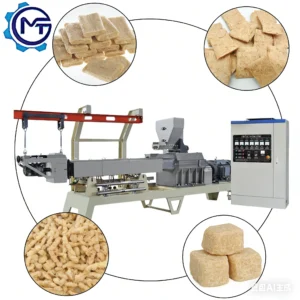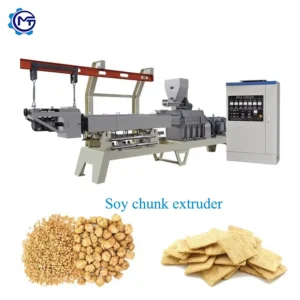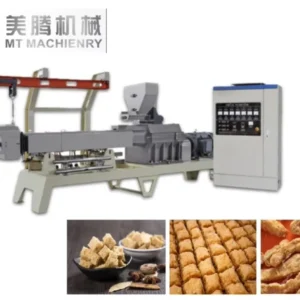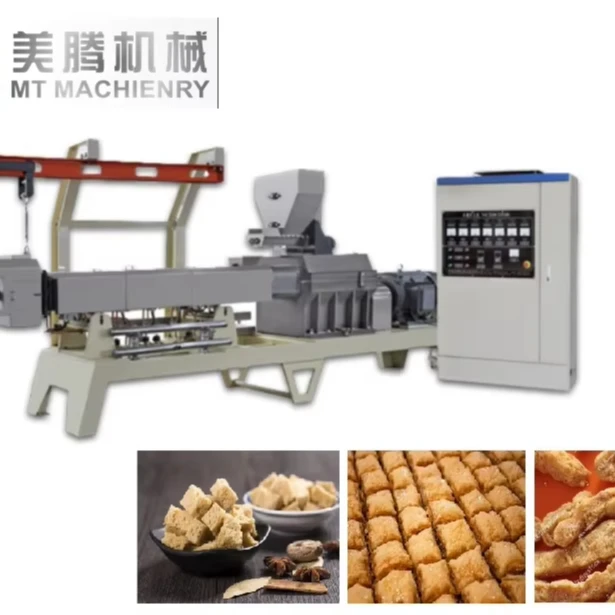
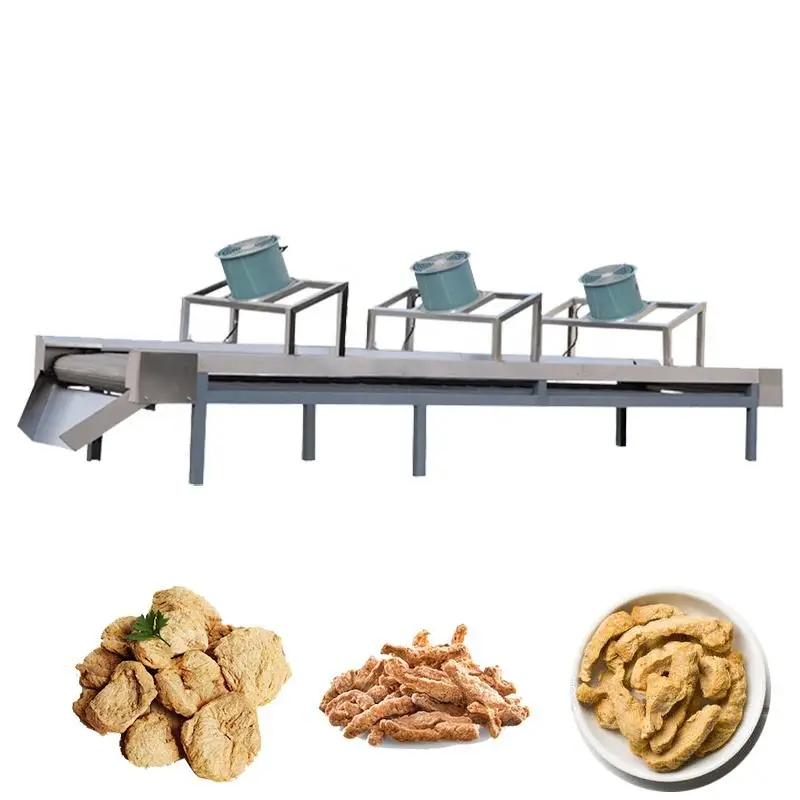
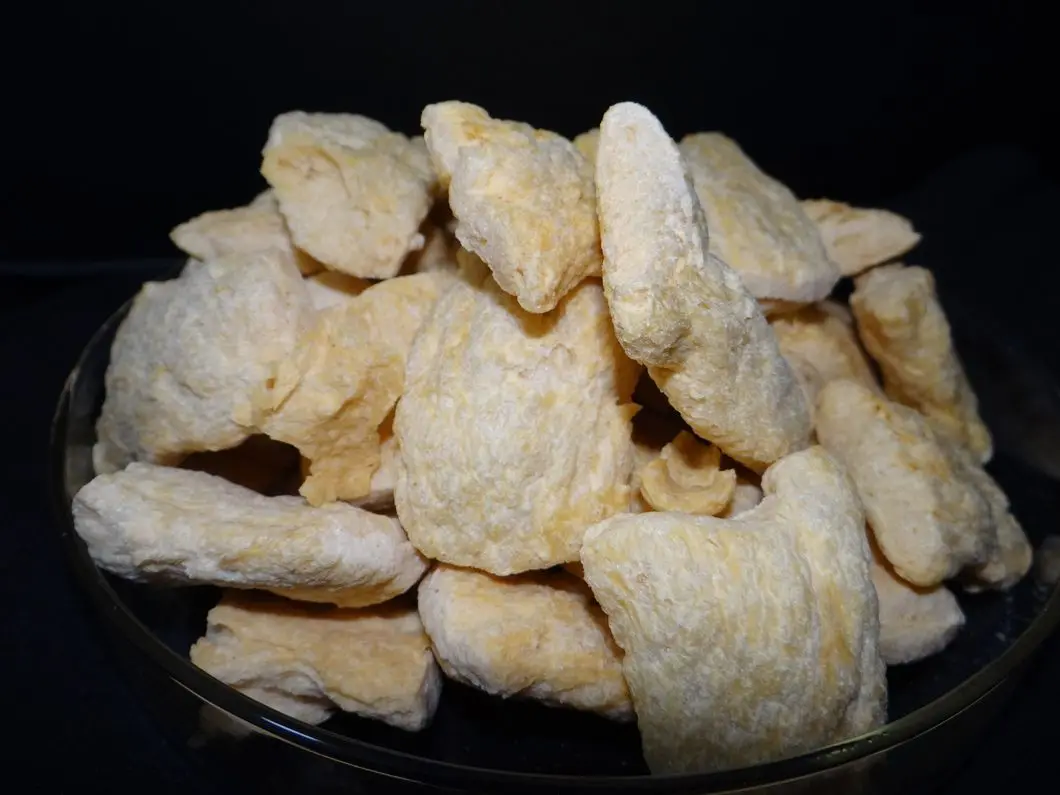
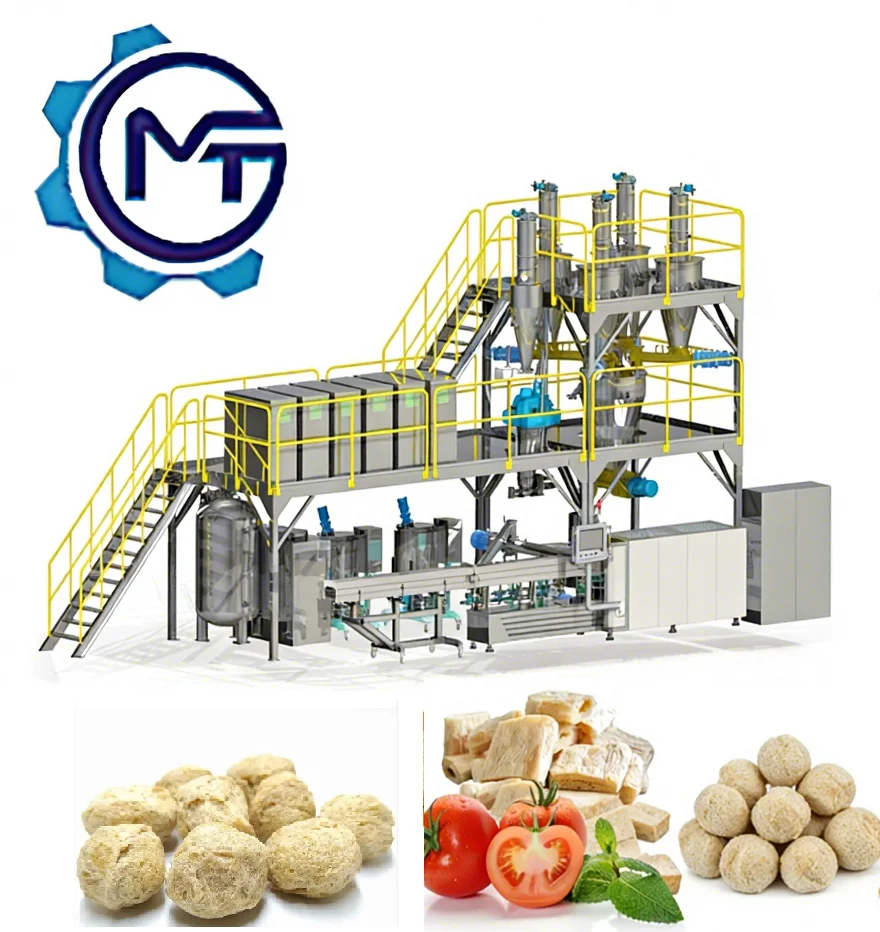
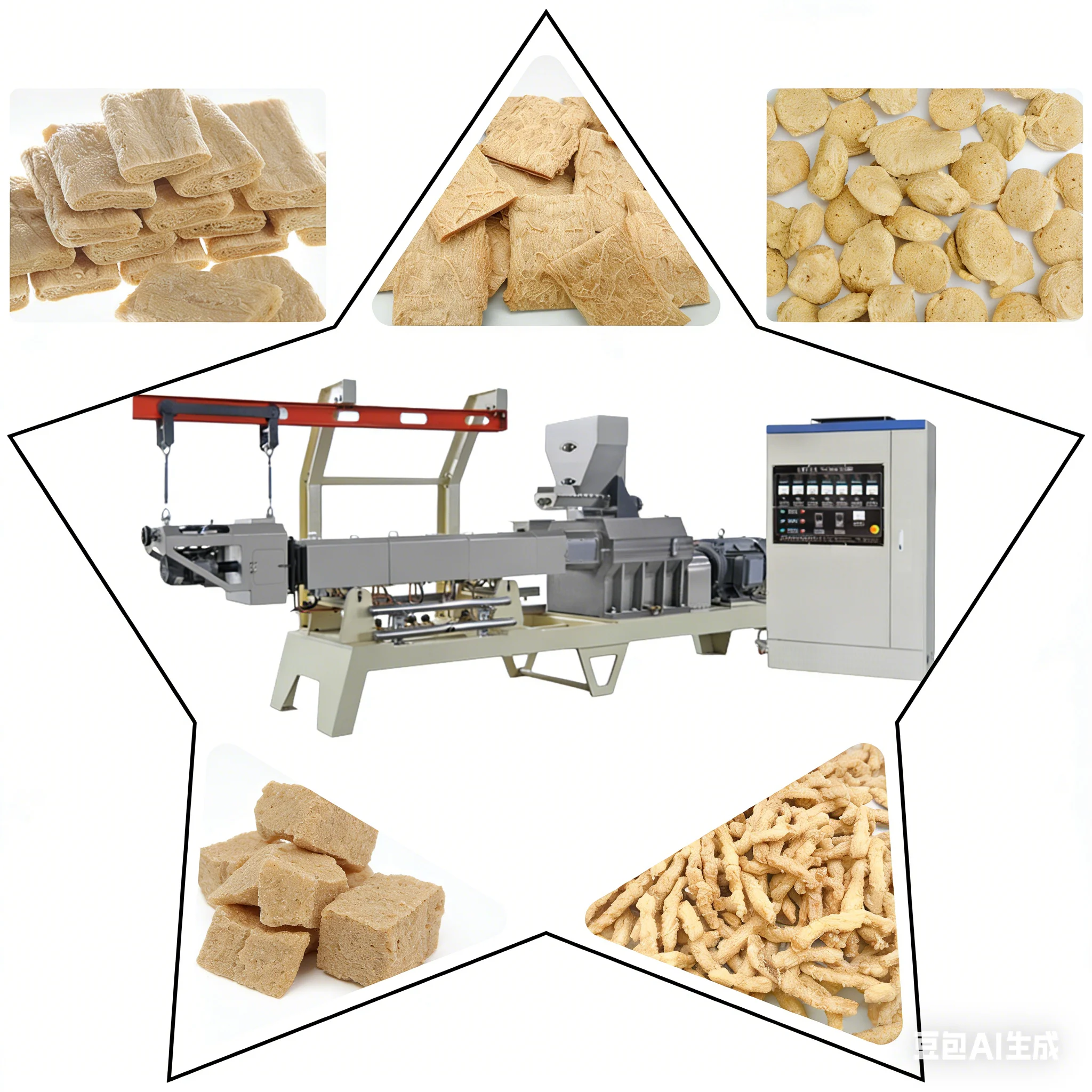
MT65 / MT70 / MT75 / MT85, Plant Based Meat Processing Line, Twin Screw Extruder — complete turnkey line from mixer through twin-screw extrusion to multi-layer dryer and cooling station.
- Screw configuration and die design specified to your raw material, whether defatted soya flour or low temperature soya flakes
- Multi-layer dryer with selectable fuel / gas / electricity heating, throughput matched to extruder output
- Adjustable die for soy nuggets, TVP chunks and high moisture vegetarian meat formats on the same platform
Validated with an in-house trial run on your actual raw material before shipment, so product development starts on day one of installation.
Description
Twin Screw Extruder for High Moisture Vegetarian Meat – Complete Line
Throughput-Balanced Extrusion — Every plant based meat processing line turnkey is validated with an in-house trial run on your specific defatted soya flour or low temperature soya flakes before dispatch, ensuring fiber texture holds up outside the test lab.
Technical Specifications
| Parameter | Value |
|---|---|
| Product Type | Twin Screw Extruder for High Moisture Vegetarian Meat / Textured Soy Protein Processing Line |
| Model Options | MT65 / MT70 / MT75 / MT85 |
| Installed Power | 84 kW (MT65) / 160 kW (MT70) / 190 kW (MT75) / 210 kW (MT85) |
| Power Consumption | 59 kW (MT65) / 120 kW (MT70) / 140 kW (MT75) / 140 kW (MT85) |
| Output Capacity | 100–150 kg/h (MT65, basis to be confirmed) / 150–200 kg/h (MT70 & MT75, basis to be confirmed) / 250–300 kg/h (MT85, basis to be confirmed) |
| Main Motor Power | 22 kW / 30 kW / 45 kW (rated or peak not specified) |
| Screw Length | 1050 mm / 1520 mm |
| Overall Dimensions (L×W×H) | 40000×1200×2200 mm (MT65) up to 45000×1500×3500 mm (MT85) |
| Heating Power | 10 kW / 14 kW |
| Feeding Motor | 0.75 kW |
| Rotary Cutting Motor | 0.75 kW |
| Pump Motor | 0.37 kW |
| Line Stations | Mixer → Screw Conveyor → Twin Screw Extruder → Air Conveyor → Multi-layer Dryer → Cooling Machine |
| Dryer Heating Source | Fuel / Gas / Electricity (selectable) |
| Mixer Options | Vertical, SS304 mixing ruler, 4–15 kW, 20–180 kg batch capacity |
| Standards | CE, ISO |
Application Suitability
| Application | Material or Output |
|---|---|
| Textured vegetable protein (TVP/TSP) production | Defatted soya flour, low temperature soya flakes |
| Soy nuggets and soy chunks for meat substitutes | Defatted soya flour, soybean dregs, peanut dregs |
| High moisture vegetarian meat analogues | Soy protein isolate blends, wheat-soy blends (requires custom screw configuration) |
| Plant-based ingredients for frozen food and fast food | TVP chunks, high moisture extrudate for slicing and forming |
What Your Protein Blend Demands From a Plant Based Meat Processing Line Turnkey
Fiber structure is defined by the screw configuration, not the motor rating.
I spent eight days on a factory floor watching a line produce what looked like wet breadcrumbs instead of shredded chicken. The extruder had been configured for standard defatted soya flour, but the buyer was running a pea-wheat protein blend. The barrel temperature profile and screw element spacing that worked perfectly on one recipe collapsed the fiber matrix on another. That plant based meat processing line turnkey sat idle until we rebuilt the screw stack section by section [NEED_CITE: protein hydration and shear behavior in twin-screw extrusion]. When buyers evaluate capacity figures alone, they miss the variable that actually determines whether the product reaches retail shelves or the waste bin.
Matching Screw Geometry to Protein Chemistry
High moisture vegetarian meat requires a fundamentally different screw profile than dry TVP chunks. The twin screw extruder must generate enough shear to align protein molecules into fibrous strands while maintaining a moisture content far above conventional extrusion levels. Die design controls the final cross-section and density of the extrudate, and even small changes in die land length alter fiber orientation. Each Meiteng line ships with a screw and die configuration record matched to the buyer’s specific raw material and target product.
Balancing Throughput Across Every Station
A plant based meat processing line turnkey only delivers its rated output when every station keeps pace. The multi-layer dryer must handle the full extruder discharge rate without bottlenecking or under-drying. The double pitch roller chain drive enables round-trip drying with adjustable residence time, and the heating source — fuel, gas, or electricity — is selected during layout planning to match local utility costs and available infrastructure. Cooling capacity downstream is sized to bring extrudate temperature to safe packing levels within the required window [NEED_CITE: thermal management in high moisture protein extrusion lines].
Reading the Spec Sheet for What Matters
Screw length of 1050 mm or 1520 mm directly influences material residence time inside the barrel. A longer screw section allows more gradual shear buildup, which is critical when working with heat-sensitive protein blends that degrade under aggressive thermal input. Installed power ranging from 84 kW on the MT65 to 210 kW on the MT85 determines the thermal and mechanical energy available for gelatinization and fiber formation. Main motor options at 22 kW, 30 kW, or 45 kW must be matched to the viscosity of the protein dough; undersized motors stall under high moisture loads, while oversized motors waste energy on low-resistance formulas. Heating power at 10 kW or 14 kW governs how quickly barrel zones reach set-point temperature during startup and product changeovers.
The Cost of Ignoring Configuration Details
When a textured soy protein production line is assembled from separate vendors, the extruder may run at full capacity while the dryer operates at partial load, forcing the buyer to throttle output or accept inconsistent moisture in the finished product. Generic screw configurations copied across different protein sources produce texture defects — spongy nuggets, collapsed fibers, or extrudate that disintegrates during hydration. Voltage and frequency mismatches discovered after installation delay commissioning and may damage motor windings before the first production run [NEED_CITE: voltage and frequency standards by export market]. These are not warranty issues; they are specification gaps that should have been closed before the deposit was wired.
Why This Line Is Configured Before It Is Quoted
Every textured soy protein production line from Meiteng starts with the buyer’s raw material sample running in the in-house testing workshop, not with a generic catalog layout. Throughput is calculated across every station — mixer batch cycle, extruder output, dryer residence time, cooling conveyor speed — so no single component bottlenecks the line. Screw configuration and die geometry are documented and locked to the buyer’s formula before production begins. Electrical schematics confirm voltage, frequency, and control language for the destination market prior to build. The vertical mixer with stainless steel 304 mixing ruler ensures batch consistency from the very first ingredient charge.
Documentation & Verification
- Line layout and capacity calculation with throughput balance across every station
- Trial run report on your defatted soya flour or protein blend before shipment
- Screw and die configuration record specific to your target fiber texture
- Electrical schematic confirming voltage, frequency, and control language for your market
- CE declaration of conformity and ISO certificate for customs clearance
- Operation and maintenance manual with wear parts list and replacement intervals
Installation, Commissioning & Support
- Foundation and utility planning based on overall line length up to 45000 mm and total installed power
- Dedicated electrical circuit design matching the selected model’s installed power and local voltage
- On-site assembly of multi-layer dryer with selectable fuel, gas, or electric heating source
- First-run parameter setting: barrel zone temperatures, screw speed, and die pressure for your protein blend
- Operator training covering screw element replacement, die changeover, and dryer chain tension adjustment
- Wear parts list covering screws, dies, and cutting blades with recommended replacement schedule
Starting Your Line Configuration
To move from inquiry to layout proposal, provide the specific protein source and moisture content of your raw material, the target product format (dry TVP chunks, soy nuggets, or high moisture vegetarian meat), and your required hourly output. Include the available floor space, ceiling height, and local voltage and frequency so the electrical design and line footprint can be finalized. If you are blending proteins — soy with pea, wheat, or other sources — share the exact ratio so the screw configuration can be set before the trial run.
Frequently Asked Questions
Q: How is line capacity verified on my specific raw material before shipment?
A: Your raw material sample runs through the twin screw extruder in our testing workshop before the line ships. We document output rate, fiber texture, and die pressure on your exact defatted soya flour or protein blend. The trial run report is shared for approval, and screw configuration is adjusted if results deviate from your target specification.
Q: How do you balance throughput between the extruder, dryer, and cooling stations?
A: Each station is sized during layout planning based on the extruder’s verified output on your material. The multi-layer dryer residence time and heating capacity are matched to handle full extruder discharge, and the cooling machine conveyor speed is set to bring product to packing temperature within the required window, preventing bottlenecks.
Q: What screw and die configuration works for high moisture vegetarian meat versus dry TVP?
A: High moisture vegetarian meat requires a screw profile that generates controlled shear for fiber alignment at elevated moisture levels, paired with a die that shapes the extrudate cross-section. Dry TVP chunks use a different screw element spacing and die land length to achieve rapid expansion and low-density structure. Both configurations are documented before build.
Q: What voltage, frequency, and control language will the line support?
A: Voltage and frequency are confirmed during the quotation stage based on your factory’s electrical supply. The control system language is specified before production so that operators can navigate settings in their working language from day one of commissioning.
Q: What does on-site installation and operator training cover?
A: Our technicians assemble the full line, set barrel temperature zones, calibrate the dryer chain drive, and run production trials on your material. Training covers daily startup and shutdown, screw and die changeover procedures, dryer temperature adjustment, and the recommended maintenance schedule for wear parts.
Related products
-
High Capacity Soy Protein Vegetarian Meat Processing Line
¥9,500.00 Select options This product has multiple variants. The options may be chosen on the product page -
New Pea and Soybean Protein Production Line Equipment with Mechanical Extruder Food Grade Stainless Steel High Productivity
¥65.00 Select options This product has multiple variants. The options may be chosen on the product page -

Vegetarian Meat Floss Production Line with Twin Screw
¥9,500.00 Select options This product has multiple variants. The options may be chosen on the product page -
Small Multifunctional Textured Soy Protein Machine – Soy Protein Production Line – Vegetarian Meat Processing Equipment
¥65.00 Select options This product has multiple variants. The options may be chosen on the product page