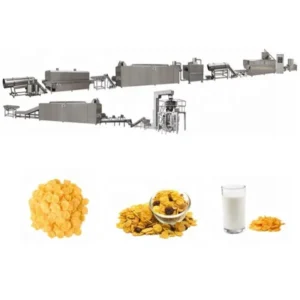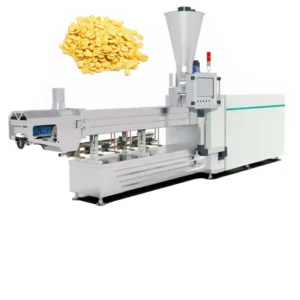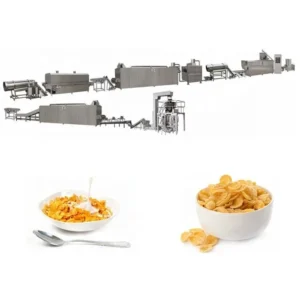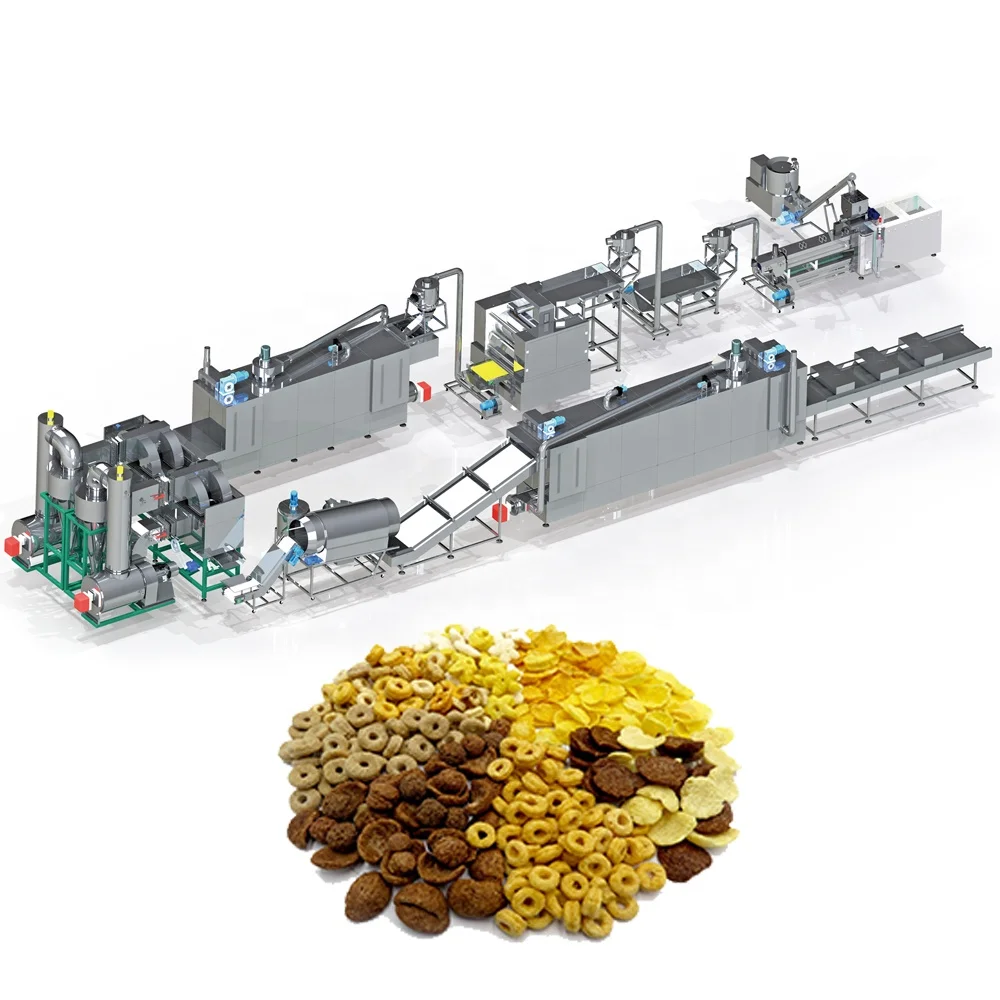
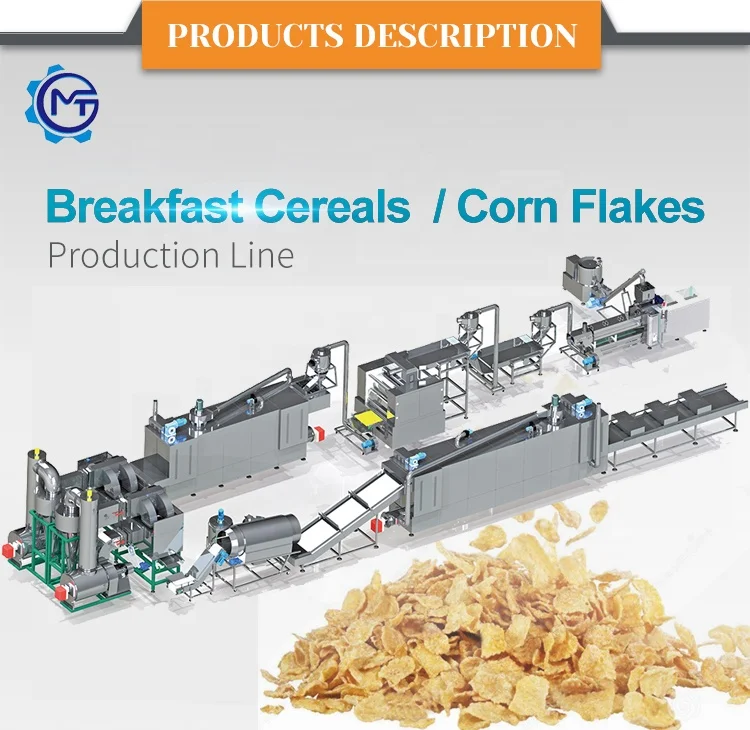
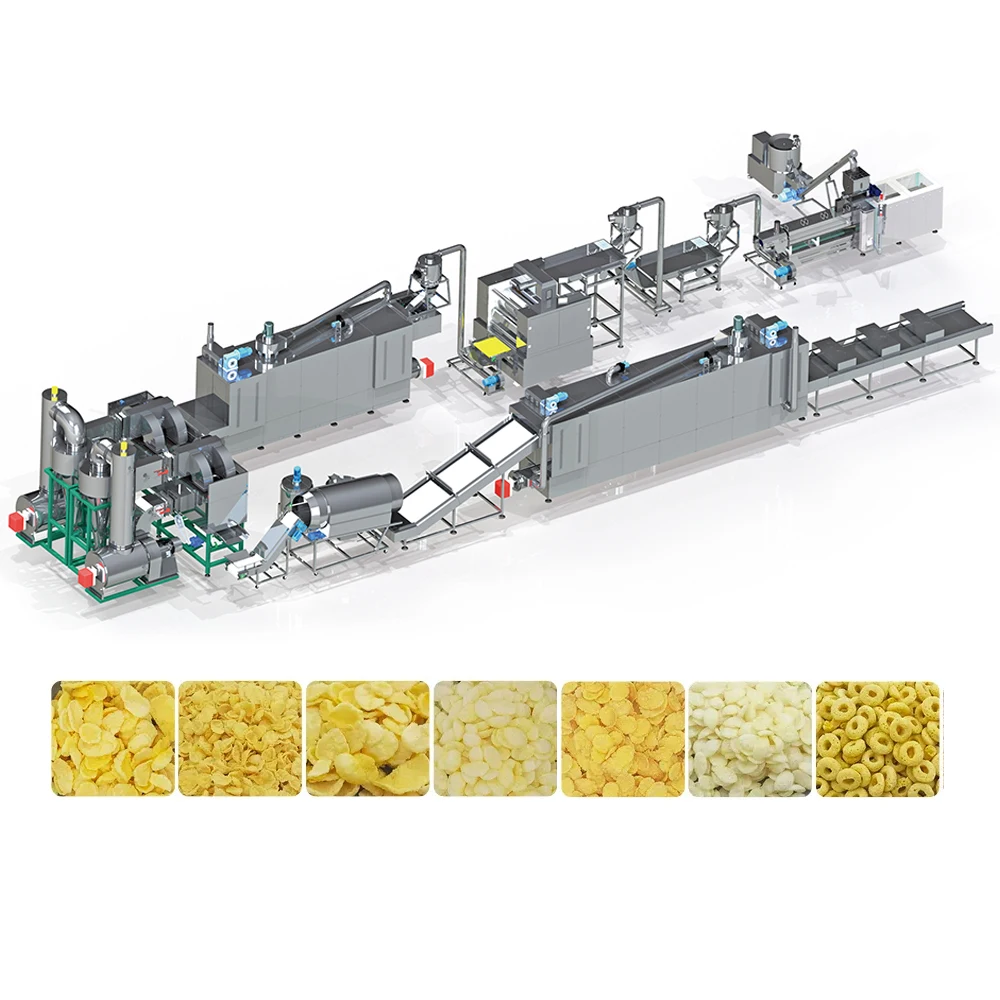
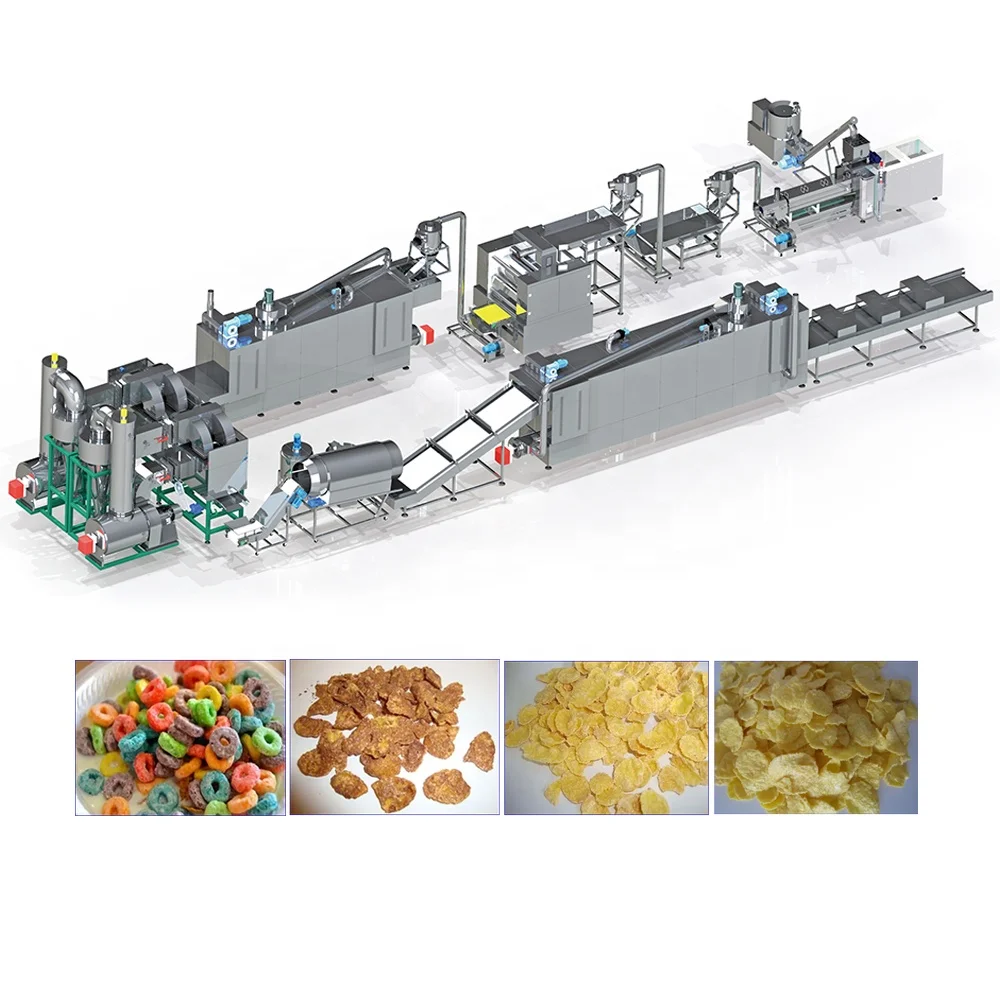
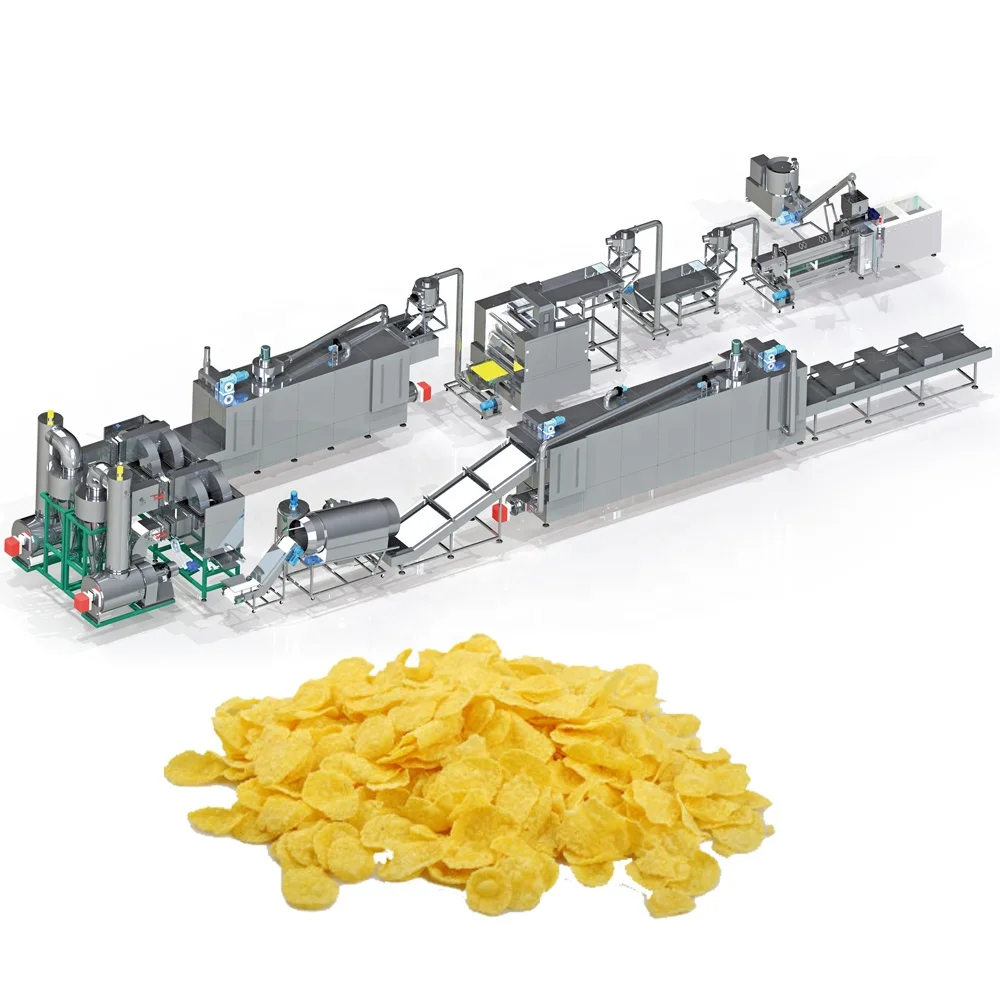
MT-65 Corn Flakes Production Line, Twin-Screw Extruder, 84 kW Installed Power — complete turnkey system from mixer through flake press, gas-fired oven and sugar spraying, with throughput matched at every station.
- Screw configuration and die design specified to your raw material and target flake density
- Adjustable roller gap on the corn flakes press for precise thickness control with integrated cooling
Layout, utility planning and on-site commissioning delivered under one supplier to prevent bottlenecks between stations.
Description
Complete Line Throughput Matching — we size the extruder, flake press, oven, and sugar coating system to the same throughput target before production begins, preventing mid-line bottlenecks that plague multi-vendor setups.
Technical Specifications
| Parameter | Value |
|---|---|
| Model | MT-65 |
| Product Type | Corn Flakes Production Line |
| Extruder Screw Type | Twin screw, co-rotating, sectional modules |
| Installed Power | 84 kW |
| Real Power | 59 kW |
| Output Capacity | 120–150 kg/h (basis not stated in source — confirm raw material, moisture, flake thickness) |
| Overall Dimensions | 12000 × 1200 × 2200 mm |
| Mixer Capacity | 10–30 kg/load |
| Mixer Power | 4 kW |
| Screw Conveyor Power | 0.75 kW |
| Corn Flakes Press Power | 16.12 kW |
| Press Roller Size | 510 × 310 × 1050 mm |
| High-Temperature Oven Dimensions | 4500 × 1400 × 1800 mm |
| Oven Heating | Gas-fired, dual-side baking |
| Oven Power | 3.75 kW |
| Sugar Spraying System Power | 28.75 kW |
| Sugar Spraying Roller Size | Ø600 × 2700 mm |
| Control System | Separate controller box |
| Extruder Self-Cleaning | Yes |
| Gearbox Lubrication | Oil forced automatic lubrication system |
| Contact Parts Material | Stainless steel |
| Warranty | 1 year |
| Certification | CE |
Application Suitability
| Application | Material or Output |
|---|---|
| Traditional corn flakes breakfast cereal | Corn grits, corn flour |
| Multi-grain flaked cereal | Rice flour, wheat flour blends |
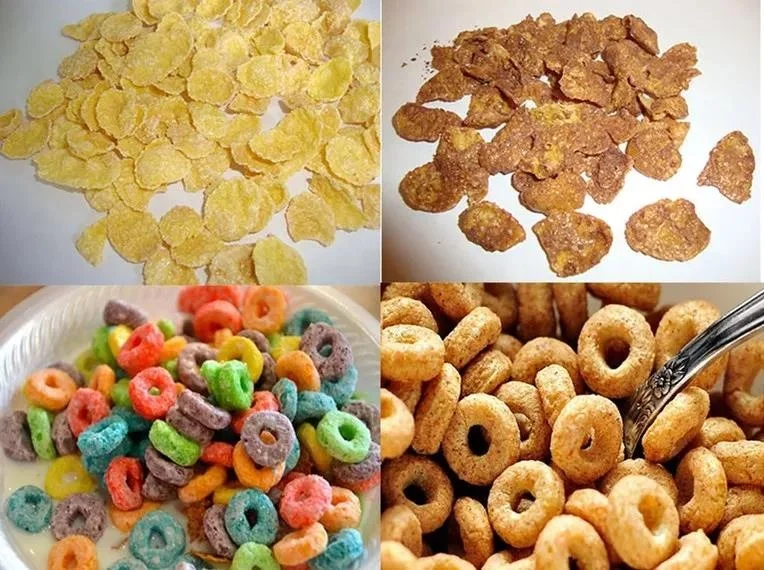
| Sugar-coated or honey-glazed flakes | Corn base with sugar spraying |
| Puffed corn snack formats | Corn flour, corn grits |
Why "Rated Capacity" Means Nothing Without a Line-Wide Calculation
A 150 kg/h extruder feeding a 100 kg/h oven is a 100 kg/h line.
When sourcing a corn flakes production line turnkey, buyers often focus on the extruder nameplate and assume downstream stations will keep pace. The reality in the workshop is different. An undersized flake press creates a backlog of hot, sticky pellets that clump before they reach the oven. An oven that cannot match extruder output forces operators to throttle the entire line back, wasting installed motor capacity and burning through electricity for nothing. [NEED_CITE: throughput mismatch between extrusion and drying stages in cereal production]. I have watched factories run a morning shift at full speed, then spend the afternoon clearing jams from a press that was specified by a separate vendor who never saw the extruder’s actual discharge rate.
Throughput Matching Across Every Station
A corn flakes production line turnkey must be engineered backward from the packing station, not forward from the mixer. The MT-65 twin-screw extruder delivers cooked, tempered corn dough at a rate that the downstream corn flakes press must accept continuously. The press roller gap, cooling circuit, and belt speed are set to flatten every pellet without queuing. The gas-fired oven then receives a steady curtain of flakes at a density that allows dual-side baking to reach the target moisture without scorching edges or leaving soft centers.
The Phased Installation Sequence
Turnkey projects succeed or fail on installation order. Utility drops — gas supply for the oven, three-phase power circuits, water for the press cooling system — must be roughed in before any machine is positioned. The mixer and screw conveyor go in first, followed by the extruder, press, oven, and sugar spraying system, each leveled and anchored before the next station is coupled. [NEED_CITE: industrial equipment installation sequencing standards]. Commissioning proceeds station by station: the extruder is dialed in on raw material before the press is engaged, and the oven temperature profile is mapped before sugar coating begins.
Screw Configuration and Die Geometry for Flake Stock
The twin-screw extruder on this line uses co-rotating sectional modules, meaning the screw elements can be rearranged to control residence time, shear intensity, and degree of starch gelatinisation. For corn flakes, the goal is a fully cooked but low-expansion dough — too much puff and the pellets will not flatten cleanly under the press rollers. The die orifice diameter and land length are matched to corn grits or corn flour feedstock so that each extrudate strand exits at the right moisture and temperature for immediate pressing. The forced automatic gearbox lubrication system keeps the drive train stable during long production runs, reducing unplanned stops.
The Cost of a Mismatched Press or Oven
When the flake press roller gap is too wide for the pellet diameter, the output is an uneven flake that toasts inconsistently in the oven — some pieces burn while others remain doughy. When the oven is undersized, operators slow the entire line and still get a moisture gradient across the belt width. [NEED_CITE: flake thickness tolerance requirements for breakfast cereal packaging]. The sugar spraying system compounds the problem: if flakes arrive at the coating drum at variable temperature, the sugar crystallizes unevenly, creating a gritty surface that consumers reject at first taste.
Why Source the Full Line From One Supplier
Every station on this corn flakes production line is specified against the same throughput target and raw material profile, so the extruder output, press capacity, oven belt speed, and sugar drum volume are calculated together rather than quoted in isolation. The screw and die configuration is documented against your specific corn grits or flour blend, not copied from a generic build. An in-house testing workshop runs your actual raw material before shipment, producing a trial report that confirms flake thickness, density, and bake behavior. CE-certified documentation accompanies every delivery, and electrical schematics are confirmed against your facility voltage before the control panel is wired.
Documentation & Verification
- Line layout showing station-by-station throughput calculation for your target corn flakes output
- Screw and die configuration record matched to your corn grits or flour blend specification
- Electrical schematic with voltage and frequency confirmed for your installation country
- Trial run report on your raw material conducted in the testing workshop before dispatch
- CE declaration of conformity with electronic edition certificates available
Installation, Commissioning & Support
- Foundation plan for the 12 m line footprint including gas supply routing for the oven
- Dedicated three-phase circuits for the 84 kW installed extruder load and 28.75 kW sugar system
- Station-by-station leveling and coupling sequence from mixer through packing interface
- First-run parameter setting including press roller gap calibration and oven temperature profiling
- Operator training covering screw module changes, press cooling maintenance, and self-cleaning cycles
- Wear parts list specifying screws, dies, and press rollers for first scheduled replacement
What We Need to Configure Your Line
To size this corn flakes production line turnkey accurately, share your primary raw material — corn grits, corn flour, or a multi-grain blend — along with the target flake thickness and whether you need sugar coating. Confirm your facility voltage, frequency, and available gas supply pressure for the oven. Let us know your daily production target so we can verify whether the MT-65 capacity range fits or whether a larger extruder model in the series is more appropriate for your throughput requirement.
Frequently Asked Questions
Q: How is output capacity verified before shipment?
A: Your raw material is run through the extruder, press, and oven in the in-house testing workshop. The trial report records actual throughput, flake thickness, moisture after baking, and sugar coating uniformity, so the rated capacity reflects your product rather than a generic benchmark.
Q: How are voltage and control language confirmed?
A: Before the control panel is wired, we request your facility electrical specification and operator language preference. The electrical schematic and separate controller box are built to match, avoiding commissioning delays caused by mismatched frequency or unlabeled interface elements.
Q: How is throughput matched between extruder, press, and oven?
A: Each station is sized against the same target output. The press roller width and speed, oven belt length and gas burner capacity, and sugar drum volume are all calculated from the extruder discharge rate, so no single station bottlenecks the line.
Q: What does on-site commissioning cover?
A: Engineers level and anchor each station, connect utilities, run raw material through the full sequence, and set press gap and oven temperature profiles. Operator training covers screw module swaps, self-cleaning procedure, press cooling system checks, and daily maintenance routines.
Q: How are spare wear parts managed?
A: The wear parts list specifies screws, dies, and press rollers for your configuration. We recommend stocking first-replacement sets before initial startup, so a worn roller or die does not force a production halt while waiting for international freight.
Related products
-
New Automatic Cornflakes Making Machine Oats Snack Food Chips Extruder Processing Line
¥30.00 Select options This product has multiple variants. The options may be chosen on the product page -
Complete Corn Flakes Production Line Breakfast Cereal Processing Machine Core Motor Component Cornflakes Processing Equipment
¥19,000.00 Select options This product has multiple variants. The options may be chosen on the product page -
Cereals Corn Flakes with Sugar Corn Flakes Extrusion Food Machine Breakfast Cereal Production Line
¥23,000.00 Select options This product has multiple variants. The options may be chosen on the product page -

Corn Flakes Production Line Breakfast Cereal Production Machine Line Corn Flake Making Machinery
¥59,800.00 Select options This product has multiple variants. The options may be chosen on the product page