

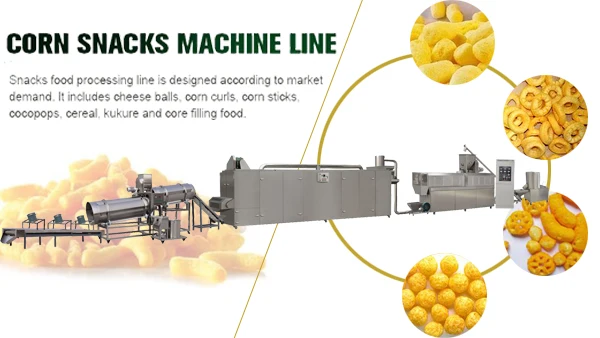
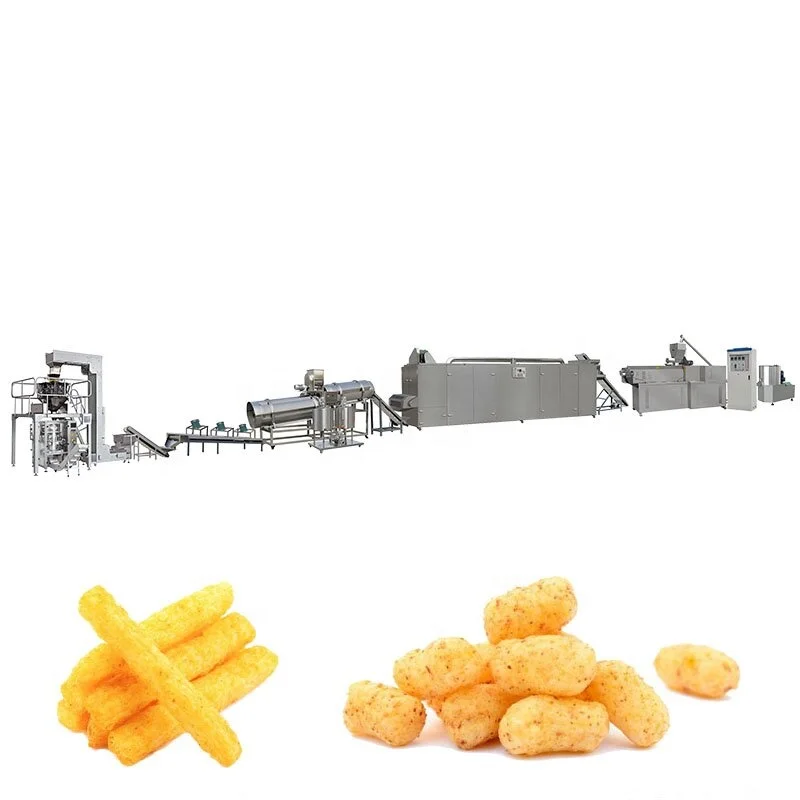
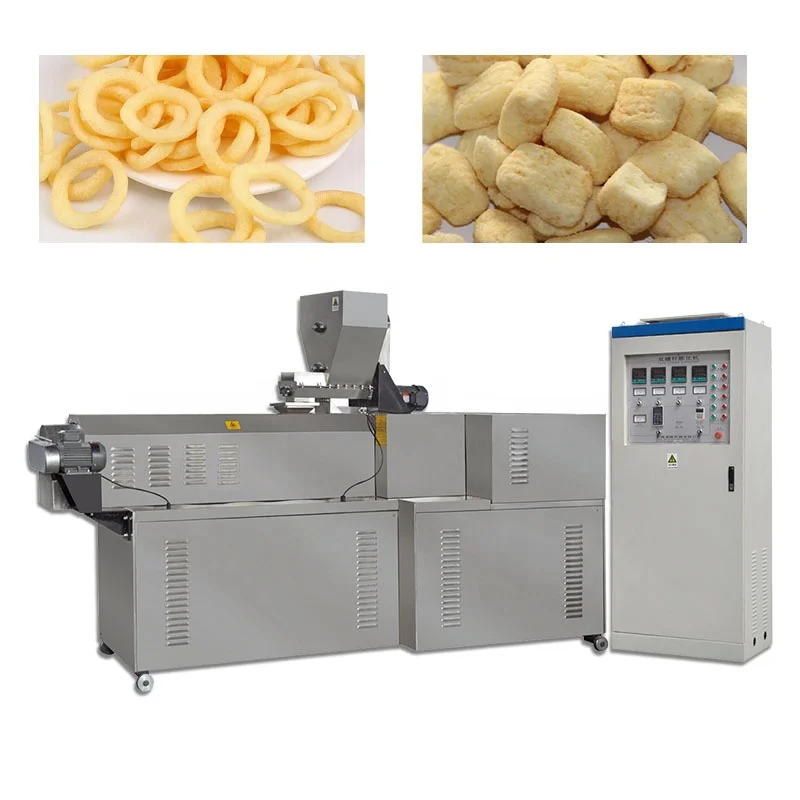
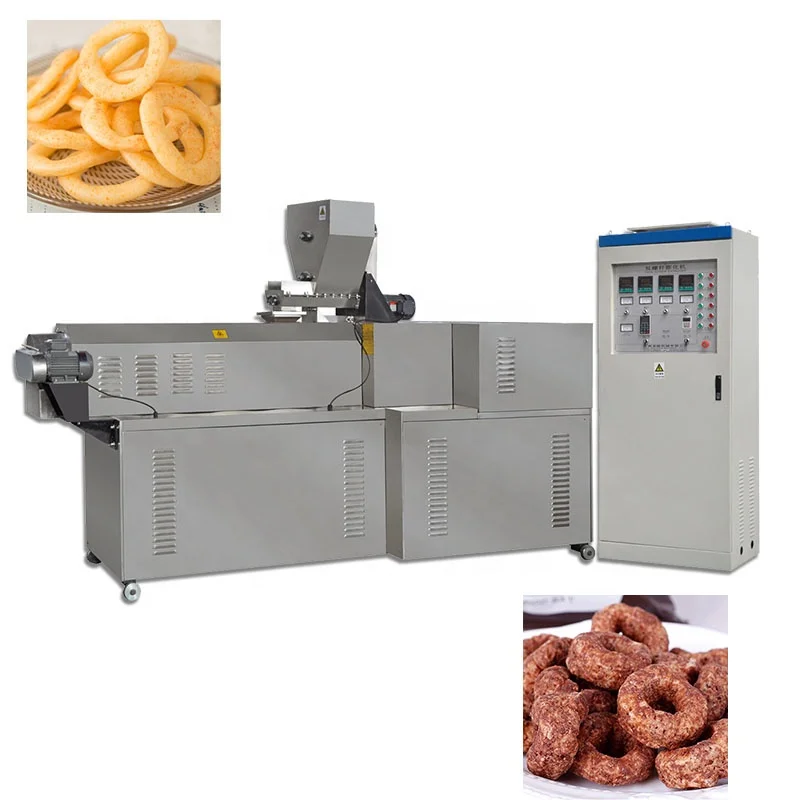
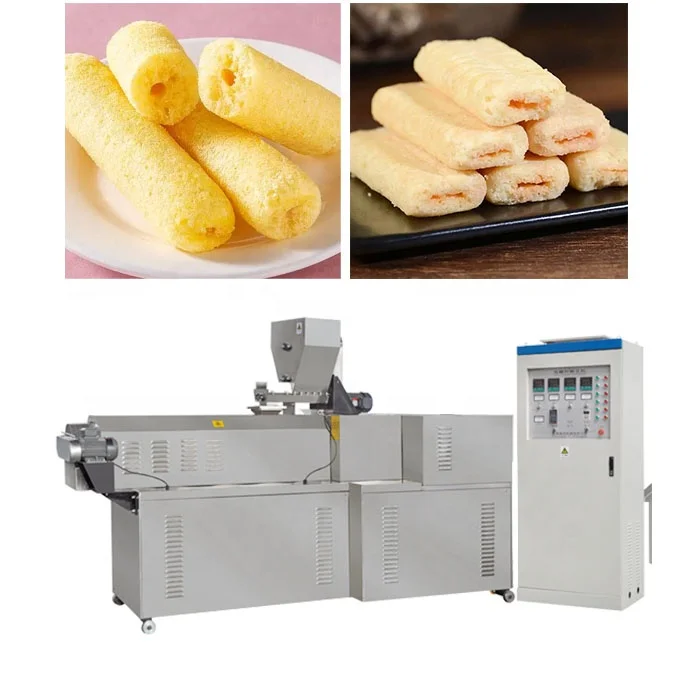
Throughput is matched across every station under one supplier, and an in-house trial run on your raw material is completed before shipment to confirm product texture and output.
Description
Complete Turnkey Line Integration — From batching to packing, every station is throughput-matched under one supplier to prevent the bottleneck effect common in multi-vendor snack extrusion projects.
Technical Specifications
| Parameter | Value |
|---|---|
| Product Type | Twin-Screw Extruded Puff Snack Production Line |
| Extruder Configuration | Twin-screw, configuration matched to raw material |
| Control System | Automated PLC and MCC control |
| Voltage & Frequency | 3-phase 380V/50Hz or customizable to local standard |
| Energy Source | Electricity, gas, diesel, or steam |
| Rated Power | Approx. 100 kW (electric) / 50–60 kW (gas or diesel) |
| Contact Material | Food-grade stainless steel 201/304 |
| Electrical Components | Siemens (China-made) or equivalent; Delixi or Delta inverters |
| Line Sequence | Mixer → Extruder → Vibrate Cooler → Roasting Machine (Dryer) → Packing Machine |
| Dryer Design | Multi-layer, length and layer count configured per product |
| Flavoring System | Semi-automatic or automatic; supports sugar, oil, and powder |
| Raw Materials | Corn, rice, millet, brown rice, buckwheat, and other cereals |
| Output Capacity | Basis to be confirmed depending on target format and moisture |
| Certification | CE, ISO |
Application Suitability
| Application | Material or Output |
|---|---|
| Puffed and extruded snack production | Corn puffs, cheese balls, various shaped snacks from corn or rice flour |
| Core-filled snacks | Chocolate-filled bars, cream-filled pillows, cereal bars |
| Fortified and artificial rice | Reconstituted rice, millet, brown rice with added vitamins and minerals |
| New product format launches | Snack manufacturers expanding into puffed or extruded categories |
Why "Nominal Capacity" Often Disappoints in Snack Extrusion Projects
The rated output of an extruded puff snack production line turnkey system is only valid when screw geometry and die design match the buyer’s actual flour blend and moisture content.
In my years planning lines here in Jinan, I have seen the same scenario repeat: a buyer receives a line quoted at a specific hourly output, but on their local corn or rice flour, the extruder simply cannot maintain that throughput. The expansion is weak, the texture is dense, and the dryer cannot keep up with the volume the extruder was supposed to deliver. This is not a machine defect — it is a specification mismatch. A twin-screw extruder relies on precise shear, pressure, and residence time to gelatinize starch, and those variables shift significantly when the protein content or particle size of the raw material changes [NEED_CITE: starch gelatinization behavior under varying protein ratios in twin-screw extrusion]. The only way to verify a capacity claim is to run the buyer’s own material through the screw profile that will ship with the machine.
Screw Geometry as the Foundation of Snack Texture
The twin-screw extruder at the heart of this line does not use a one-size-fits-all screw arrangement. The flight depth, kneading block angle, and L:D ratio are selected based on whether the target product is a light, highly expanded corn puff or a denser core-filled pillow. Starch gelatinization requires a specific combination of moisture, barrel temperature, and mechanical shear — and the screw profile governs how much of that shear is delivered. A configuration tuned for high-protein flour will differ from one built for pure corn grits, which is why the screw and die record is part of the project documentation.
Matching Dryer and Flavoring Stations to Real Extruder Output
A multi-layer roasting machine must handle the actual moisture load leaving the extruder, not a theoretical number from a generic quotation. When the dryer is undersized, product piles up and the entire extruded puff snack production line turnkey setup stalls. The same logic applies to the flavoring drum: if the seasoning system is rated for a lower throughput than what the extruder delivers, the coating coverage becomes inconsistent. Every station in this line — from the mixer through the vibrate cooler, dryer, and packing station — is sized to match the extruder’s verified output on the buyer’s material.
How Barrel Temperature Profiles and Die Design Shape the Final Product
Barrel zones are independently heated and monitored through the PLC, allowing operators to create a precise temperature gradient from the feed section to the die face. This gradient controls the rate of starch gelatinization and the expansion that occurs the moment the dough exits the die. The die geometry — including hole diameter, land length, and face profile — determines whether the product emerges as a sphere, tube, pillow, or ring. Switching between shapes requires a documented die change, and the die design is recorded alongside the screw configuration so that repeat orders produce identical results. The electrical schematic confirms voltage and frequency before production begins, ensuring that heating elements and motor drives perform as specified in the buyer’s local grid [NEED_CITE: industrial voltage and frequency standards for food processing equipment export markets].
What Happens When Configuration Is Left to Chance
I worked on a project last year where a customer’s corn flour had a higher protein content than the generic screw profile was designed for. The extruder ran, but expansion was poor and output dropped to roughly half the expected level. The line had to be stopped, the screw combination redesigned, and a new die machined before production could resume. That kind of delay costs weeks and erodes trust. When screw configuration is copied from a standard build without testing the actual raw material, the risk of underperformance is high, and the buyer often discovers the problem only after the line is installed and commissioned on-site [NEED_CITE: impact of raw material variability on extrusion line commissioning timelines].
Why Buyers Source This Line From a Single Equipment Supplier
The line layout and capacity calculation document shows throughput at every station, so the mixer, extruder, cooler, dryer, flavoring system, and packing machine are verified to work as one continuous flow. Screw and die configuration records specify the exact profile matched to the buyer’s flour blend, eliminating guesswork. The in-house testing workshop runs the buyer’s own raw material before shipment, producing a trial run report that confirms expansion, density, and output. Electrical schematics confirm voltage, frequency, and HMI language in writing before the line enters fabrication. CE and ISO certifications are held for the complete system, not just individual components.
Documentation & Verification
- Line layout and capacity calculation showing matched throughput across every station
- Screw and die configuration record specifying profile, L:D ratio, and die geometry for your flour blend
- Trial run report on your raw material conducted in the testing workshop before shipment
- Electrical schematic with confirmed voltage, frequency, and control language
- CE declaration of conformity and ISO certificate for the complete line
- Operation and maintenance manual with wear parts list
Installation, Commissioning & Support
- Foundation and floor space planned around the full line sequence from mixer to packing station
- Dedicated power circuit sized for the rated 100 kW electric or 50–60 kW gas/diesel configuration
- Phased installation with utility connections verified against the confirmed electrical schematic
- First-run commissioning with barrel temperature profile and screw speed dialed to your material
- Operator training covering PLC interface, die changes, and daily cleaning of food-grade contact surfaces
- Wear parts inventory including replacement screws, dies, and dryer belts identified before shipment
Preparing Your Project Inquiry
To move from concept to a confirmed line proposal, share your target snack format, the specific flour or cereal blend you plan to use, and your expected daily production volume. Include your local voltage, frequency, and preferred HMI language so the electrical design can be finalized early. If you have existing upstream or downstream equipment that must interface with this line, provide the connection dimensions and throughput rates.
Frequently Asked Questions
Q: How is the output capacity verified, and what is it based on?
A: Capacity is confirmed through a trial run in the testing workshop using your specific raw material and target product format. The trial run report documents the verified output, moisture content, and expansion level, so the figure quoted reflects your actual production conditions rather than a generic benchmark.
Q: How are screw configuration and die design determined for my flour blend?
A: The screw profile — including flight depth, kneading blocks, and L:D ratio — is selected based on your flour’s protein content, particle size, and starch behavior. Die geometry is matched to the target shape and density. Both are recorded in the project documentation before fabrication.
Q: What happens during the in-house trial run before shipment?
A: Your raw material is processed through the actual screw and die configuration that will ship with the line. Operators measure expansion, texture, moisture, and throughput. The results are documented in a trial run report shared with you before the equipment leaves the factory.
Q: How do you ensure downstream stations match the extruder’s real throughput?
A: The dryer length, layer count, flavoring drum capacity, and packing speed are all calculated from the verified extruder output on your material. The line layout document shows throughput at each station to confirm there are no bottlenecks.
Related products
-

Fully automatic puff snack processing line
¥8,500.00 Select options This product has multiple variants. The options may be chosen on the product page -

New Condition Automatic Corn Puff Snacks Food Extruder Cheese Ball Making Machine Plant
¥100.00 Select options This product has multiple variants. The options may be chosen on the product page -

Crunchy Puffed Snack Breakfast Cereal Corn Flakes Making Machine
¥1,000.00 Select options This product has multiple variants. The options may be chosen on the product page -

Automatic Puffed Food Snack Machine Electric Corn Puffs Snacks Making Machinery New Condition Flavorful Puff Snack Production
¥7,550.00 Select options This product has multiple variants. The options may be chosen on the product page


