

- Backed by in-house trial runs on your exact formulation before shipment, confirming real-world pellet density and output.
Description
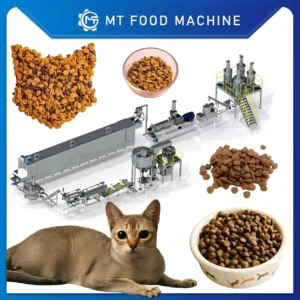
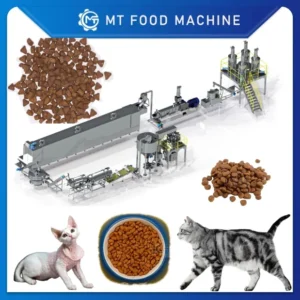
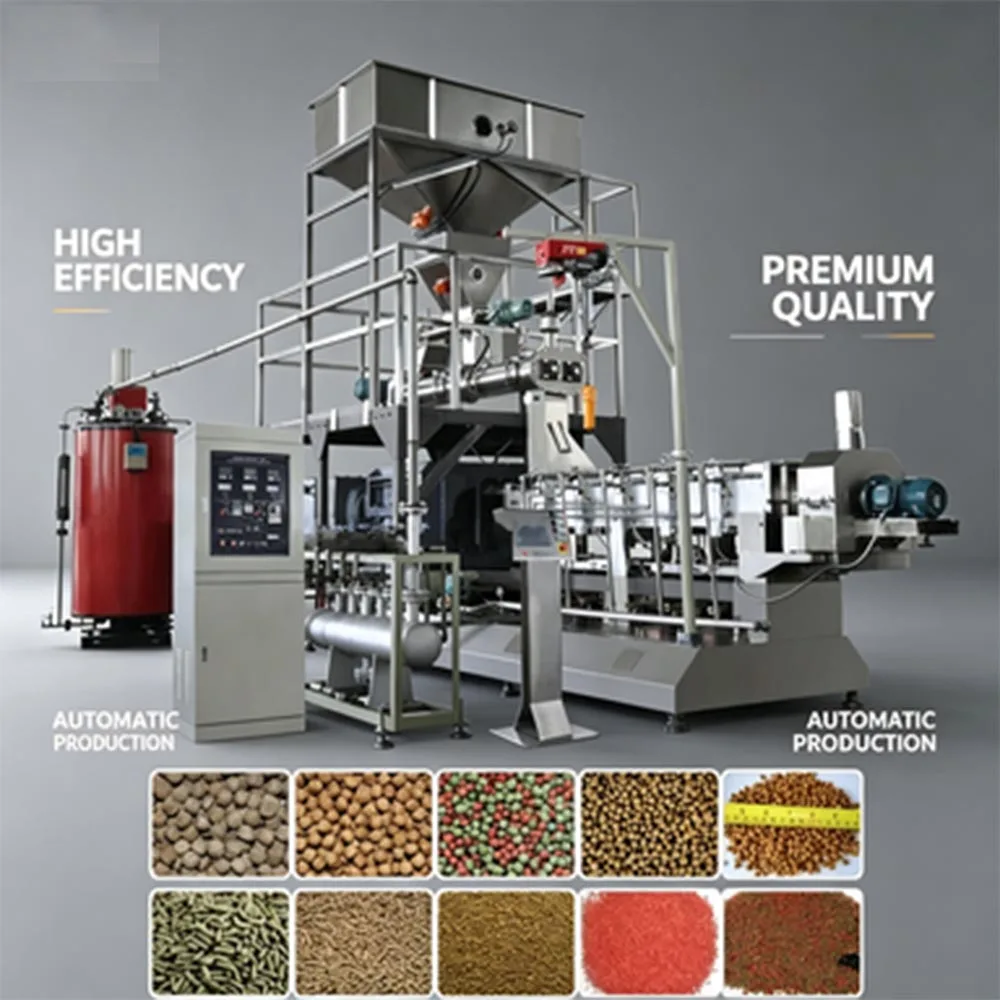
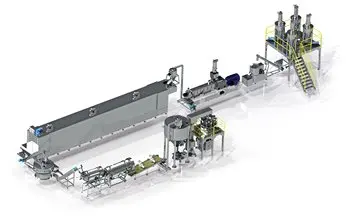
Capacity-Matched Stations — Every segment from batching through packing is sized to the same continuous throughput, preventing the dryer or coater from choking an otherwise capable extruder.
Technical Specifications
| Parameter | Value |
|---|---|
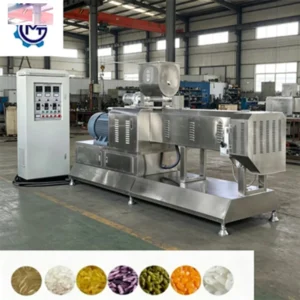
| Product Type | Twin Screw Floating Fish Feed Extruder Production Line |
| Output Capacity | 500 kg/h (based on floating fish feed pellets — confirm raw material formulation and moisture content) |
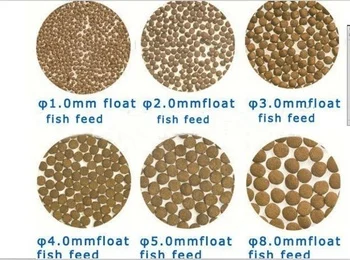
| Pellet Size Range | 0.5 mm – 12 mm (adjustable die configuration) |
| Screw Type | Twin Screw |
| Die Configuration | Interchangeable dies, pellet size 0.5–12 mm |
| Line Stations | Feeding, mixing, extruding, pelletizing (integrated in one line) |
| Control System | Simple control panel for parameter adjustment (PLC / MCC not specified in source) |
| Material of Construction | Stainless steel (main parts, corrosion-resistant) |
| Automation Level | Fully automatic, whole-process continuous operation |
| Voltage & Frequency | (basis to be confirmed per target market) |
| Rated Power (kW) | (basis to be confirmed) |
| Overall Dimensions | (basis to be confirmed) |
| Net Weight | (basis to be confirmed) |
| Standards & Certifications | (basis to be confirmed) |
Application Suitability
| Application | Material or Output |
|---|---|
| Floating pellet production for catfish and tilapia | High-starch formulations with controlled buoyancy |
| Sinking pellet production for bottom-feeding species | High-protein aquatic mixes requiring dense extrusion |
| Shrimp and crustacean feed | Fine-particle aquatic diets at 0.5–2 mm pellet range |
| Fingerling to grow-out feed stages | Multiple die changes on a single twin-screw extruder |
| Small and medium aquaculture feed factory output | Continuous runs on varied raw material blends |
Why "Rated Output" Means Nothing Without the Raw Material Context
The number on the nameplate only matters if it was measured on your exact formulation.
I once stood beside a floating fish feed line where the extruder hit its quoted capacity on a standard corn-based trial formula. The same machine, running the customer’s actual high-protein aquatic mix with different starch and moisture behaviour, dropped well below that figure and produced sinking pellets instead of floating ones. The screw and die configuration had to be reworked on-site while the entire plant sat idle. That is the kind of problem an aquatic feed production line turnkey project must address before the equipment ever leaves the factory [NEED_CITE: twin-screw extrusion behaviour across varying starch-protein ratios].
How the Turnkey Layout Eliminates Mid-Line Choke Points
When every station in an aquatic feed production line turnkey project is sourced from a single supplier, throughput matching becomes a design decision rather than a field improvisation. The mixer must discharge at a rate the extruder can accept continuously; the dryer must remove enough moisture so the coater receives pellets at the correct surface condition; the packing station must seal bags faster than the cooler discharges them. If any one of those links is undersized, the whole line runs at the speed of its weakest station.
Screw Profile and Die Selection Dictate Pellet Buoyancy
The difference between a floating pellet and a sinking pellet is not a single setting — it is the interaction of screw element arrangement, barrel temperature profile, die geometry, and moisture content at the die face. A twin-screw extruder allows the screw configuration to be reassembled from individual elements, giving the operator a way to tune shear and residence time for each new formulation [NEED_CITE: modular twin-screw element configuration for aquatic feed density control]. Interchangeable dies covering the 0.5–12 mm range mean one extruder can produce fingerling feed and grow-out pellets without a second machine.
Reading the Specs That Actually Matter
Output capacity figures must always be tied to a specific raw material and moisture level, because the same extruder running a high-fat shrimp diet behaves very differently from one running a starch-rich tilapia formula. The stainless steel construction on main contact parts is not just a hygiene feature — in a humid feed-mill environment it resists the corrosion that shortens service intervals on carbon steel machines. Pellet size range from 0.5 mm to 12 mm on interchangeable dies determines how many product SKUs a single line can cover. The control system governs how precisely barrel zone temperatures and screw speed can be held from batch to batch, which directly affects pellet density consistency. Automation level, listed here as fully automatic continuous operation, determines the labour requirement during long production runs and the degree of manual supervision needed at each station.
The Hidden Cost of Skipping the Trial Run
A line that ships without a trial run on the buyer’s own raw material forces all formulation adjustments into the commissioning window, compressing what should be a methodical tuning process into a few pressured days. Screw elements may need to be reordered, dies re-machined, and dryer retention time recalculated — all while the plant is supposed to be ramping toward commercial output [NEED_CITE: commissioning delays caused by untested raw material formulations in feed extrusion]. The cost of that delay is not just the engineering hours; it is the lost production revenue and the damaged confidence of the operations team.
What a Single-Supplier Turnkey Approach Actually Delivers
Throughput matching across every station is possible because the line is designed as one system, not assembled from independent vendors who each quote their own equipment in isolation. The screw configuration and die design are specified to the buyer’s raw material and target pellet buoyancy rather than copied from a generic build. An in-house testing workshop allows trial runs on the customer’s actual formulation before the line ships, generating a documented report that becomes the baseline for commissioning. Twin-screw expertise spanning pet food, aquatic feed, and snack applications means the same engineering team has seen how different starch and protein matrices behave under shear. Pre-sales consultation through to on-site installation and operator training keeps the same people involved from layout drawing to first commercial run.
Documentation & Verification
- Line layout and station-by-station capacity calculation for your pellet size range
- Screw and die configuration record matched to your aquatic feed formulation
- Trial run report on your raw material confirming pellet buoyancy and output rate
- Electrical schematic with confirmed voltage, frequency, and control language
- Operation and maintenance manual covering die changes and wear part replacement
- Factory test record documenting continuous run performance before dispatch
Installation, Commissioning & Support
- Foundation and floor loading plan based on the line’s overall dimensions and operating weight
- Dedicated electrical circuit sized to the extruder’s rated power and local voltage requirements
- Assembly sequence for fully automatic stations from feeding through packing
- First-run parameter setting for barrel temperatures, screw speed, and die pressure on your formulation
- Operator training on die changeover across the 0.5–12 mm pellet range
- Wear parts list covering screws, dies, and barrel liners with recommended reorder intervals
What to Include in Your Enquiry
To size an aquatic feed production line turnkey project correctly, we need to know your target species and whether the market requires floating or sinking pellets, your raw material formulation including protein and starch percentages, the daily output you plan to sustain, and the voltage and frequency standard at your plant. If you have existing upstream milling or downstream packing equipment, specify the interface points so the new line can be designed around them.
Frequently Asked Questions
Q: How is the 500 kg/h output verified, and on which formulation?
A: That figure is measured on a floating fish feed pellet formulation at a defined moisture content. Because different raw materials — high-protein shrimp diets versus starch-rich tilapia blends — change extrusion behaviour significantly, we run an in-house trial on your actual formulation and document the real output rate, pellet density, and buoyancy before the line ships.
Q: What screw and die configuration is used for floating versus sinking pellets?
A: Floating pellets require a screw profile that generates sufficient expansion at the die face, combined with a die geometry that locks in the air cell structure. Sinking pellets use a denser screw arrangement with higher shear to compress the formulation. Both configurations are documented and matched to your raw material before production begins.
Q: How do you prevent the dryer or coater from bottlenecking the extruder?
A: Every station in the aquatic feed production line turnkey project is sized to the same continuous throughput target during the layout phase. We provide a station-by-station capacity chart showing matched rates across mixing, extrusion, drying, coating, and packing so no single segment limits overall output.
Q: What electrical and control details are confirmed before the line ships?
A: Voltage, frequency, control language, and PLC or MCC brand preferences are confirmed during the specification stage. An electrical schematic is provided for review so that local wiring, breaker sizing, and control interface expectations are settled before the equipment arrives on site.
Q: What does the in-house trial run cover?
A: The trial run uses your raw material formulation to produce pellets across your target size range. You receive a report documenting output rate, pellet buoyancy, moisture content at each station, screw and die configuration used, and any adjustments recommended before commercial production begins.
Related products
-
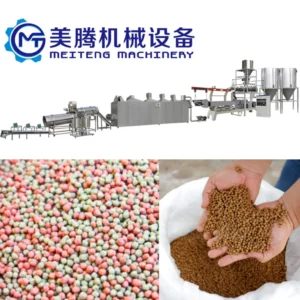
2-3t/h High Capacity Multi-Species Fish Feed Processing Line to Produce Fish Food
¥55,000.00 Select options This product has multiple variants. The options may be chosen on the product page -
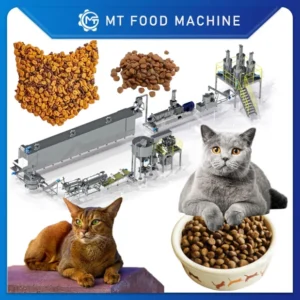
250-300kg/h Capacity PLC Controlled Multi-Species Cat Food Processing Line
¥35,000.00 Select options This product has multiple variants. The options may be chosen on the product page -
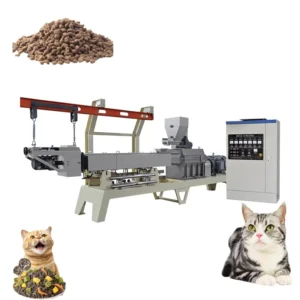
Premium Pet Food Processing Equipment Dog Cat Feed Making Machine
¥9,500.00 Select options This product has multiple variants. The options may be chosen on the product page -
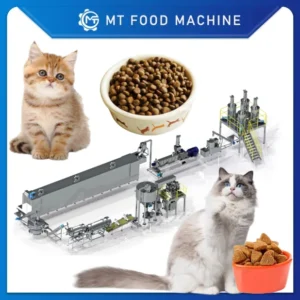
MT135 Brand 2.5-3.0t/h PLC Controlled Multi-Species Cat Food Processing Line
¥55,000.00 Select options This product has multiple variants. The options may be chosen on the product page