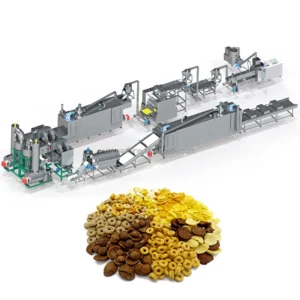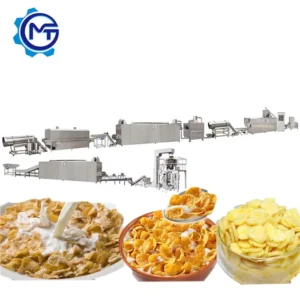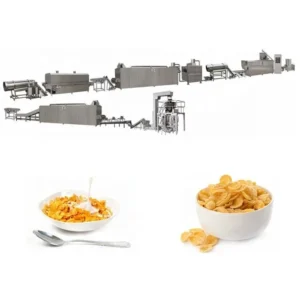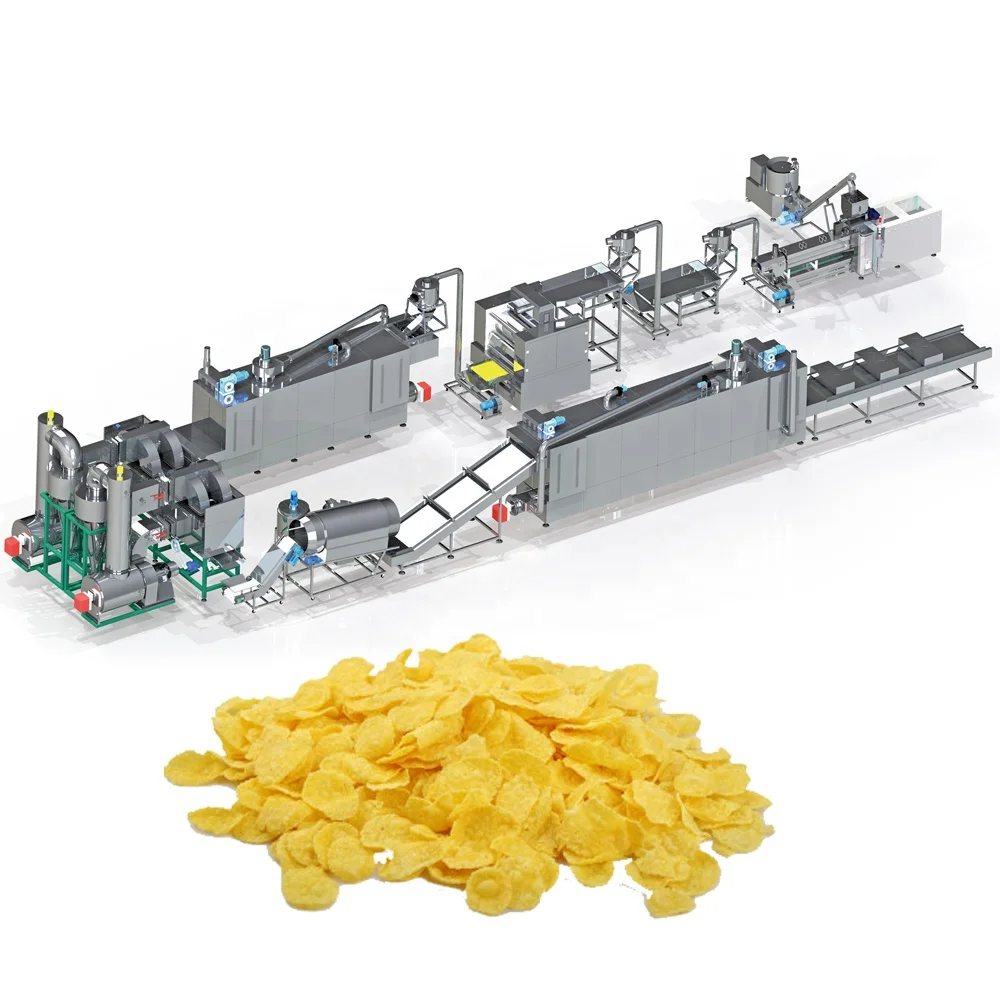


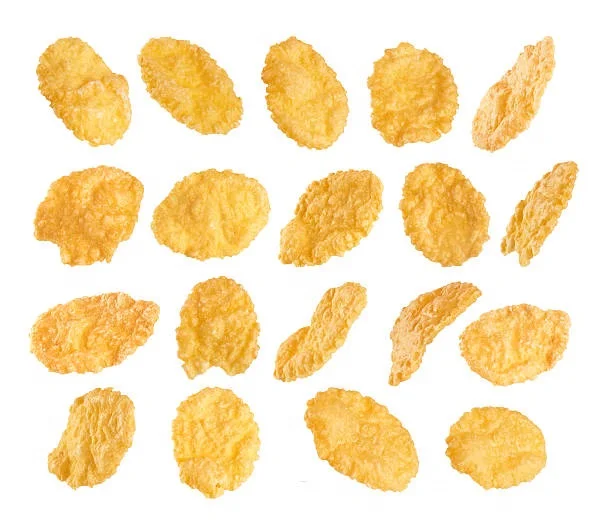


Complete Corn Flakes Production Line, up to 750 kg/hr, CE & ISO Certified — engineered as a turnkey project from batching through extrusion, flaking, toasting, coating and packing. Every station is throughput-matched to your corn grits and target flake density, with screw and die configuration specified to your raw material. Line layout is customized to your factory footprint, and pre-shipment trial runs in our testing workshop verify actual output before installation.
Description
Throughput-Matched Line Design — Every station on this corn flakes line is sized against the same throughput target so extruder, flaker and toaster never starve or choke each other during continuous runs.
Technical Specifications
| Parameter | Value |
|---|---|
| Product Type | Complete Corn Flakes Production Line |
| Output Capacity | up to 750 kg/hr (basis not stated in source — confirm raw material / moisture / product format) |
| Product Range | Natural corn flakes, sugar-coated flakes, various shaped breakfast cereals |
| Control System | Available with PLC or MCC control (confirm preference before quotation) |
| Line Layout | Engineered drawings tailored to specific factory dimensions |
| Motor | Robust drive motor (rated power to be confirmed per line configuration) |
| Voltage & Frequency | Configurable to local supply (confirm before production) |
| Standards | CE, ISO |
Application Suitability
| Application | Material or Output |
|---|---|
| Natural corn flakes production | Corn grits, maize flour |
| Sugar-coated breakfast flakes | Corn base with sugar syrup coating |
| Shaped cereal formats | Grain-based dough from extruder die |
| Fortified breakfast cereals | Corn or multi-grain blends with added nutrients |
What "750 kg/hr" Actually Means on Your Grain
Rated capacity only holds when the screw profile, barrel zones and moisture content match the exact corn grits you will feed. I have watched lines arrive on site, powered up, and immediately fall short of the nameplate number because the buyer’s local maize had a different particle size and fibre content than the grain used during the factory test. Gelatinisation drops, flakes leave the oven soft, and a week of re-profiling begins. [NEED_CITE: starch gelatinisation dependence on moisture and shear in cereal extrusion]
A turnkey corn flakes production line must therefore be validated on your actual raw material before it ships. Trial runs in our testing workshop expose the mismatch early, while adjustments cost days rather than weeks of lost production on your floor.
Engineered Layout That Fits Your Building
Factory ceilings, column spacing and utility drops vary from one plant to the next. The corn flakes production line turnkey layout is drawn against your specific floor plan, positioning the mixer, extruder, flaking rolls, dryer, toaster, coating drum and cooler so that material flow avoids cross-traffic and maintenance access remains open. [NEED_CITE: industrial equipment layout planning for food processing facilities]
Station-by-Station Throughput Balance
An extruder that pushes more mass than the flaker can roll creates a buffer pile that cools unevenly. A toaster that runs faster than the coater leaves flakes under-glazed. Each station on this corn flakes production line is calculated against the same hourly mass flow, so the line runs continuously without intermediate accumulation or starvation.
Reading the Specs That Matter
The control system choice — PLC or MCC — determines how recipe changes are stored and recalled across shifts; confirm the interface language before the panels are wired. Voltage and frequency must match your local grid because a motor wound for 50 Hz on a 60 Hz supply runs hotter and shortens bearing life. The product range covers natural flakes, sugar-coated variants and shaped formats, but die selection and flaker roll gap must be specified per format to hit the target bowl density. Barrel zone count and screw configuration govern residence time and shear, which in turn set the degree of starch gelatinisation — the single largest factor in whether the final flake snaps or bends in milk.
The Hidden Cost of Skipping the Trial Run
Buyers who waive the pre-shipment trial to save calendar time often spend multiples of that time on site chasing the right flake texture. Screw elements are swapped, barrel temperatures shifted, and moisture targets rewritten — all while the line is installed but not producing saleable product. [NEED_CITE: cost of commissioning delays in food processing capital projects] That lost ramp-up window is the hidden cost no quotation line item captures.
Why Source This Line Here
Single-supplier responsibility means the extruder, flaker, dryer, toaster and coater all carry one warranty and one commissioning schedule, eliminating finger-pointing between vendors. Screw configuration and die geometry are specified against your corn grits sample, not copied from a generic build. The in-house testing workshop runs your actual grain before the line ships, generating a trial report you can audit. Throughput calculations are documented station by station, so the capacity claim is traceable rather than verbal. Pre-sales engineering through on-site installation and ongoing maintenance is handled by the same technical team.
Documentation & Verification
- Line layout drawing scaled to your factory footprint and column grid
- Capacity calculation sheet showing station-by-station throughput match
- Trial run report produced on your corn grits sample before dispatch
- Screw and die configuration record tied to your target flake density
- Electrical schematic confirming voltage, frequency and control language
- CE declaration of conformity and ISO certificate
Installation, Commissioning & Support
- Foundation loads and floor flatness requirements mapped to extruder and flaker weight
- Dedicated circuit sizing confirmed against total line motor rating
- Modular shipping configuration allowing assembly through standard factory doors
- First-run parameter setting covering barrel temperatures and flaker roll gap
- Operator training on PLC or MCC interface with language matched to your crew
- Wear parts list specifying screw elements, die plates and flaker roll shells
What We Need From You
Send a representative sample of the corn grits or maize flour you plan to run, along with moisture data and target flake thickness. Confirm your available floor area, ceiling height and local voltage supply so the layout and electrical package are accurate from the first drawing.
Frequently Asked Questions
Q: How is line capacity verified against my specific corn grits and moisture content?
A: We run a trial on your actual raw material in our testing workshop before shipment. The test covers extrusion, flaking and toasting parameters, generating a report that documents throughput, flake density and moisture at each stage. Adjustments to screw configuration or barrel zones are made during this phase.
Q: What is the full station list and how is throughput matched?
A: The line typically includes batching, mixing, extrusion, flaking, drying, toasting, coating and cooling. Each station is sized so its maximum throughput equals or slightly exceeds the extruder output, preventing bottlenecks. The calculation sheet is provided with the quotation.
Q: How are voltage, frequency and control language confirmed before shipment?
A: We request your site electrical specification during the proposal stage. Motor windings, transformer taps and panel labels are set accordingly. PLC or MCC interface language is agreed in writing before the control cabinets are assembled.
Q: Can the layout fit my existing factory dimensions?
A: Yes. We work from your building drawing, noting column positions, door widths and utility drop points. The line layout is engineered to route material flow within those constraints while keeping maintenance access clear at every station.
Q: What does on-site installation and commissioning cover?
A: Our crew handles mechanical assembly, electrical termination, utility connection checks, first-run parameter tuning and operator training. Commissioning continues until the line produces flakes meeting your agreed density and moisture specification on your regular raw material.
Related products
-
Cereals Corn Flakes with Sugar Corn Flakes Extrusion Food Machine Breakfast Cereal Production Line
¥23,000.00 Select options This product has multiple variants. The options may be chosen on the product page -

Small Scale Breakfast Cereal Manufacturing Machine for Corn Flakes Process Line
¥45,000.00 Select options This product has multiple variants. The options may be chosen on the product page -

200kg/h Breakfast Cereal Extruder Making Machine Hot Sale Corn Flake Production Line
¥30,000.00 Select options This product has multiple variants. The options may be chosen on the product page -
Corn Flakes Machine Breakfast Cereal Corn Flakes Production Line Cornflakes Making Machine
¥85,800.00 Select options This product has multiple variants. The options may be chosen on the product page