

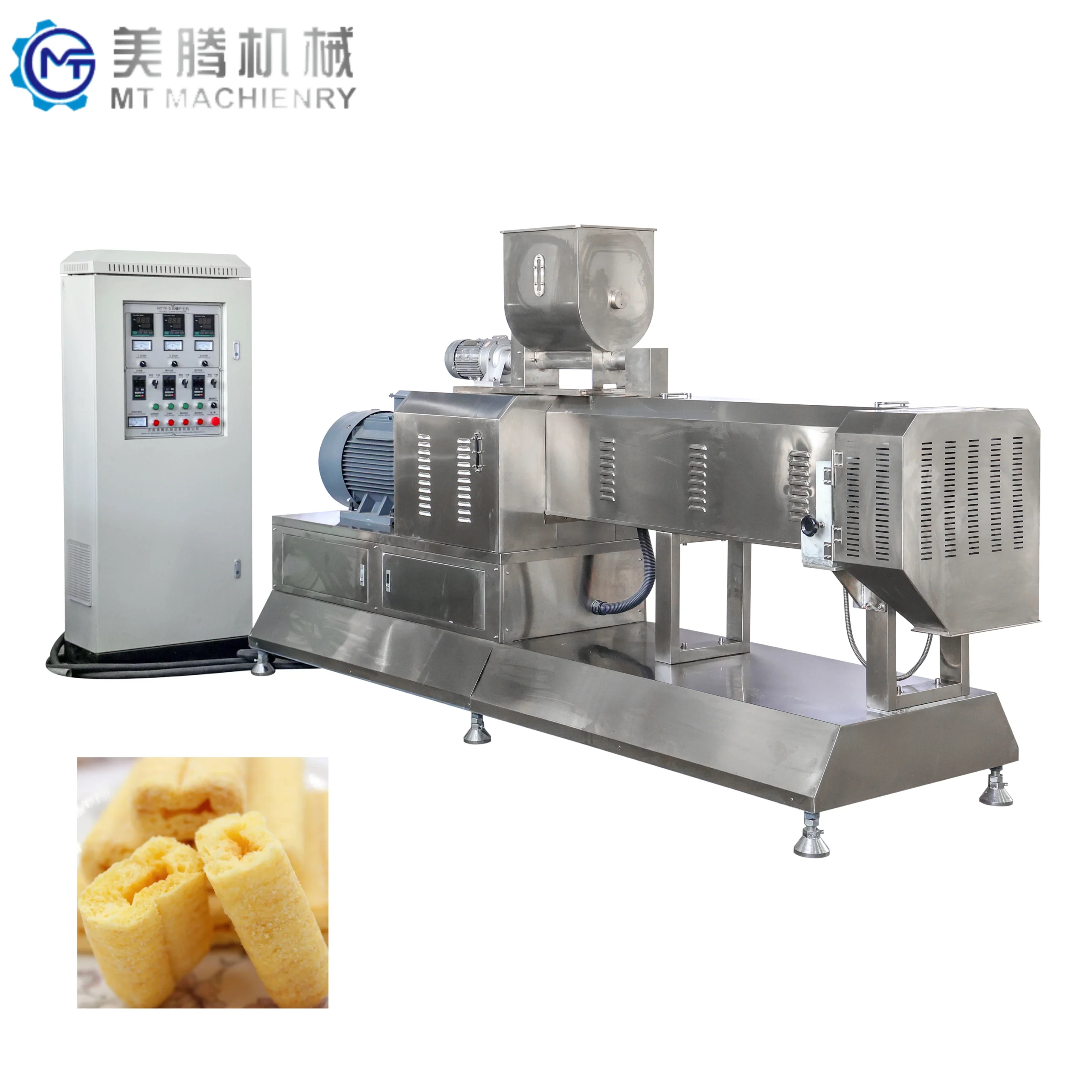
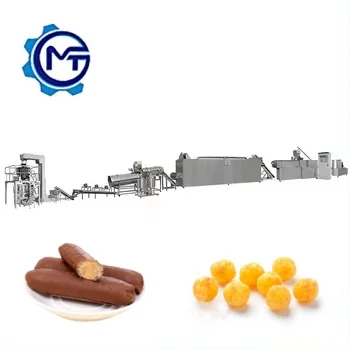
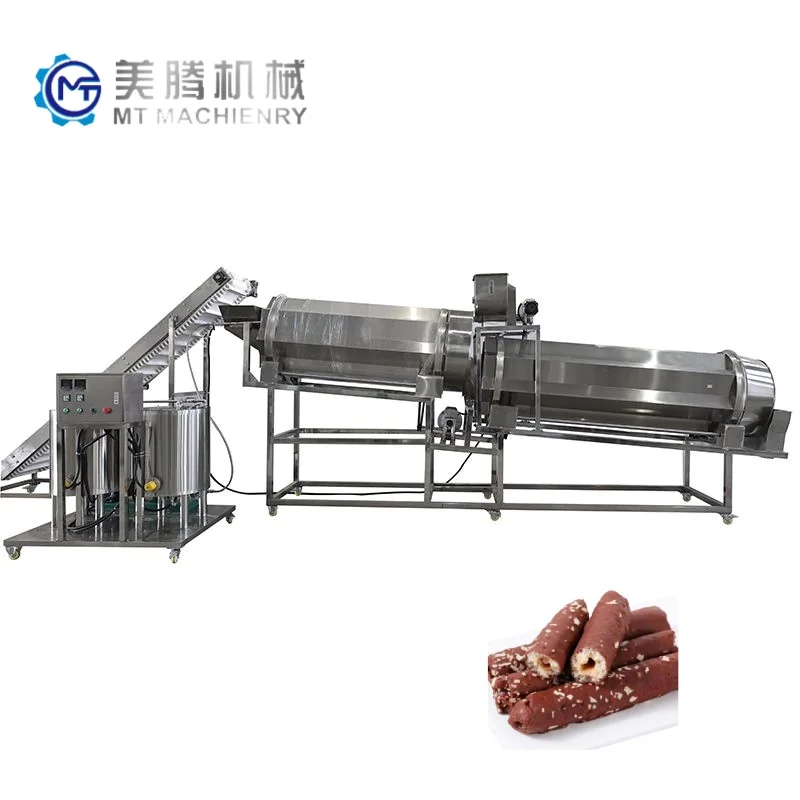
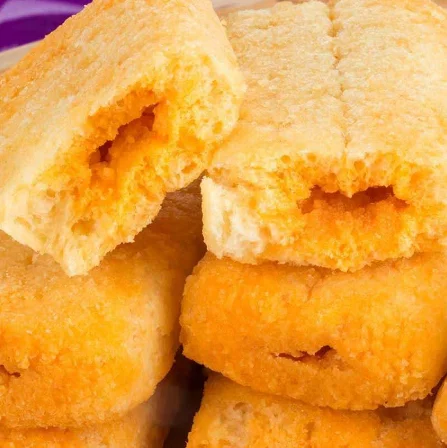
MT65 / MT70 / MT85 / MT100 Twin Screw Corn Puff Snack Extrusion Line, 120–800 kg/h Capacity Range — engineered as a complete turnkey project from batching through extrusion, drying, flavoring, cooling, and packing.
- Twin screw configuration with automatic lubrication and frequency speed control ensures stable gelatinisation and consistent puff density across varying moisture levels
- Flexible die options — ring, tube, star, fruit loop, and more — with optional core filling module for product diversification
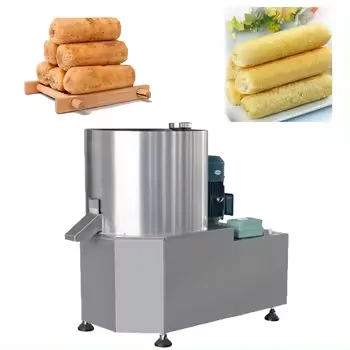
- Double drum flavoring line with sugar melting and spray nozzle matched to extruder output, preventing downstream bottlenecks
Delivered as one integrated project with throughput matched at every station, supported by in-house trial runs on your raw material before shipment and full documentation including layout, screw configuration, and electrical schematics.
Description
Turnkey Line Engineering — A complete corn puff snack extrusion line configured as one integrated project, where batching, extrusion, drying, flavoring, and packing stations are throughput-matched under single-source accountability rather than assembled from disconnected vendors.
Technical Specifications
| Parameter | Value |
|---|---|
| Model | MT65 / MT70 / MT85 / MT100 |
| Product Type | Twin Screw Corn Puff Snack Extrusion Line |
| Installed Power | 130 kW (MT65) / 180 kW (MT70) / 220 kW (MT85) / 240 kW (MT100) |
| Real Consumption | 95 kW (MT65) / 120 kW (MT70) / 130 kW (MT85) / 160 kW (MT100) |
| Output Capacity | 120–150 kg/h (MT65) / 200–300 kg/h (MT70) / 300–500 kg/h (MT85) / 600–800 kg/h (MT100) (basis not stated in source — confirm raw material type, moisture content and die configuration) |
| Screw Type | Twin Screw |
| Control System | Frequency speed controlling system |
| Lubrication | Automatic lubricating and cooling |
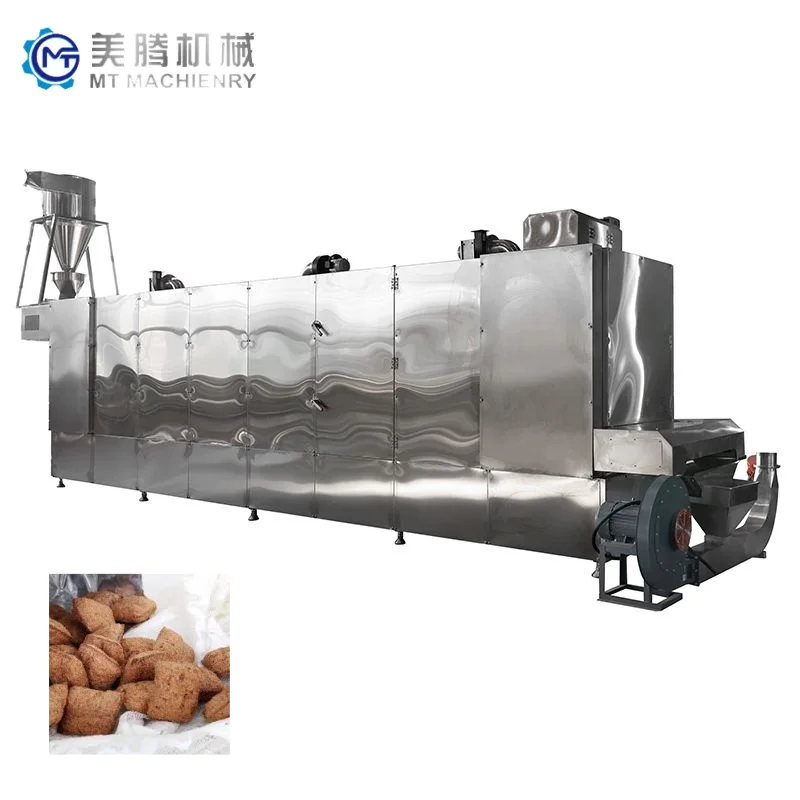
| Drying Heat Source | Electric / steam / gas (configurable to local utility conditions) |
| Flavoring System | Double drum flavoring line with sugar melting and spraying nozzle |
| Packing System | Automatic weighing, sealing, marking, coding; vibration feeding with electronic pad weighing |
| Die Shapes | Cheese ball, ball, tube, stick, ring, fruit loop, star, wheel, flower, heart (core filling option available) |
| Assembly State | Complete turnkey line from materials preparation to stacking |
| Delivery Time | 20 working days (extrusion line); approximately 35 working days (with packing and stacking machines) |
| Warranty | 1 year |
| Certification | CE, ISO |
Application Suitability
| Application | Material or Output |
|---|---|
| Puffed corn snack production | Corn, rice, wheat, oat, and barley flour processed into expanded snack shapes |
| Core-filled snack variants | Same grain base with injected cream or chocolate center using added core filling module |
| Multi-shape snack formatting | Ring, fruit loop, star, wheel, and tube profiles via interchangeable die plates |
| Coated and flavored snack finishing | Sugar-glazed, chocolate-dusted, or seasoned output from double drum flavoring station |
| Turnkey snack line projects | Full production from raw material batching through extrusion, drying, coating, cooling, and packing |
Why Throughput Matching Defines the Real Output of a Corn Puff Snack Extrusion Line Turnkey
An extruder that outpaces its dryer creates a bottleneck, not a production line.
I spent three nights in a Southeast Asian workshop watching a corn puff line fail to reach its nameplate capacity. The extruder was rated correctly, but the dryer was undersized for the local humidity, and the flavoring drum could not keep up with the volume coming off the cooling conveyor. Every station operated within its own spec sheet, yet the line as a whole choked at the drying stage. The buyer had purchased individual machines from different vendors and expected them to work as a system [NEED_CITE: throughput matching principles in multi-station food extrusion lines]. That is precisely the failure mode this corn puff snack extrusion line turnkey is designed to eliminate — every station is calculated against the extruder output so that material flow remains continuous from batching through packing.
Layout Planning and Station Sequencing
When configuring a turnkey corn puff snack extrusion line, the sequence starts with material preparation and batching, moves through twin screw extrusion, then into drying, coating or flavoring, cooling, and finally packing and stacking. Each transition point is where throughput mismatches surface. The drying stage must account for the moisture introduced during extrusion and the ambient conditions of the installation site. A facility in a tropical climate requires longer residence time or higher drying temperature than one in a temperate zone. This line supports electric, steam, or gas heat sources for the dryer, selected during the project specification phase to match the buyer’s local utility infrastructure and cost structure.
Extruder-to-Downstream Capacity Alignment
The twin screw extruder sets the pace for everything downstream. If the MT85 model runs at its stated capacity range, the dryer must handle that volume continuously without material backing up on the conveyor or exiting with residual moisture above the target specification. The double drum flavoring line is sized accordingly — the sugar melting system and spray nozzles are calibrated to coat the full output stream evenly rather than leaving portions under-seasoned. This alignment extends to the cooling conveyor and the automatic packing station with its vibration feeding and electronic pad weighing system. When one station falls behind, the entire corn puff snack extrusion line turnkey project stalls, and operators start manually clearing jams [NEED_CITE: bottleneck analysis in continuous food processing lines].
Reading the Specification Sheet Beyond Nameplate Numbers
The installed power and real consumption figures differ meaningfully across the MT65, MT70, MT85, and MT100 models. Installed power represents peak draw during startup and load surges, while real consumption reflects steady-state operation. A buyer sizing electrical infrastructure needs both values — the peak determines breaker and cable specifications, while the continuous draw determines energy cost projections. The frequency speed controlling system allows operators to adjust screw speed during production, which directly influences residence time inside the barrel and, consequently, the expansion ratio of the corn puff. Automatic lubricating and cooling on the screw assembly maintains stable barrel temperatures during extended runs, preventing the gradual drift in product density that occurs when friction heat accumulates unchecked. The die configuration — ranging from simple ball and stick profiles to fruit loop and heart shapes — determines not only the product appearance but also the pressure profile inside the die plate, which affects expansion behavior and final texture. Core filling capability adds another layer: the cutting and injection modules must synchronize with extruder output speed to place the filling accurately without smearing or misalignment.
The Hidden Cost of Undersized Supporting Stations
A buyer once specified an extruder that met the target output on paper, then sourced the dryer and flavoring drum separately to save on the initial purchase order. Within weeks of commissioning, the dryer could not remove enough moisture at line speed, forcing the operator to reduce extruder throughput to match the drying capacity. The flavoring drum compounded the problem — its coating cycle was longer than the conveyor feed rate, creating pile-ups. The line ran, but never at the capacity the buyer had used to justify the investment [NEED_CITE: consequences of mismatched station capacity in snack extrusion projects]. Every hour of reduced output represented lost revenue against fixed operating costs. These are the failures that a properly engineered turnkey project prevents by calculating each station’s requirement against the extruder’s actual output on the buyer’s specific raw material formulation.
Why Buyers Source This Line as a Single Project
The corn puff snack extrusion line turnkey approach means one supplier carries responsibility for throughput matching across every station, from material batching through stacking. Screw configuration and die design are specified against the buyer’s actual raw material — not copied from a generic template — so the expansion ratio and product density match what the target market expects. Before shipment, the line undergoes trial runs in an in-house testing workshop using the buyer’s own formulation, identifying processing issues while adjustments are still inexpensive. Installation follows a phased schedule with commissioning support, operator training, and a documented wear parts list so the first screw or die replacement does not catch the maintenance team unprepared. The result is a production line that reaches stable output faster because the variables have been resolved before the equipment arrives on site [NEED_CITE: phased installation and commissioning methodology for food extrusion lines].
Documentation & Verification
- Line layout drawing with throughput calculation at each station for your target output
- Screw and die configuration record matched to your raw material and product shape
- Electrical schematic confirming voltage, frequency, and control language before production starts
- Trial run report on your actual corn or grain formulation from the in-house testing workshop
- Factory test record documenting continuous run performance prior to dispatch
- CE declaration of conformity and ISO certificate included with shipping documentation
Installation, Commissioning & Support
- Foundation and floor space planning based on the full line footprint from batching to stacking
- Electrical supply sizing using both installed power and real consumption figures for your selected model
- Heat source selection for the dryer — electric, steam, or gas — matched to your facility utilities
- On-site commissioning with parameter setting for screw speed, barrel temperature, and die pressure
- Operator training covering frequency speed control adjustment and automatic lubrication monitoring
- Wear parts list identifying screw elements, die plates, and flavoring nozzles with replacement intervals
What to Prepare Before Requesting a Quote
To move from inquiry to a workable line configuration, share your raw material formulation — including grain type, moisture content, and any additives — along with the target product shape and desired output range. Specify your facility’s available voltage, frequency, and whether steam or gas is accessible for the dryer. If you have existing upstream or downstream equipment that the new line must integrate with, provide those specifications as well. A sample of your raw material enables a trial run in the testing workshop before the quotation is finalized, so the proposed configuration reflects actual processing behavior rather than generic assumptions.
Frequently Asked Questions
Q: How is throughput matched across all stations in this corn puff snack extrusion line?
A: Each station — dryer, flavoring drum, cooling conveyor, and packing system — is sized against the extruder’s output on your specific raw material. The line layout document shows the calculated throughput at every transition point, ensuring no single station creates a bottleneck that limits the overall production rate.
Q: What does the installation and commissioning schedule look like?
A: Installation follows a phased approach beginning with station placement and utility connections, followed by individual station testing, then full-line dry runs and wet runs with your raw material. Commissioning includes parameter optimization for screw speed, barrel temperature, and die pressure to reach stable production conditions.
Q: Can a trial run be performed on my specific corn formulation before shipping?
A: Yes. Raw material samples are processed in the in-house testing workshop, where screw configuration and die selection are adjusted until the target expansion ratio and product density are achieved. The trial run report is shared with you and included in the delivery documentation package.
Q: How are utility requirements handled for different factory locations?
A: The dryer heat source is configured as electric, steam, or gas based on your local availability and cost structure. Voltage and frequency are confirmed against your facility supply before production begins, and the control system language is set to match your operator team’s requirements.
Q: What support is provided after commissioning for ongoing maintenance?
A: The delivery package includes a wear parts list identifying components such as screw elements, die plates, and spray nozzles with expected replacement intervals. Operator training covers daily lubrication system checks and frequency speed control calibration, and ongoing technical support is available for process adjustments as product formulations evolve.
Related products
-

New Puffed Snack Food Machine Production Line Corn Flake Puff Corn Making Machine Twin Screw Extruder 100-500kg/h Capacity Food
¥8,500.00 Select options This product has multiple variants. The options may be chosen on the product page -

Stainless Steel Corn Puff Cake Making Machine Corn Snack Food Machines Top Selling Snacks Machine
¥8,560.00 Select options This product has multiple variants. The options may be chosen on the product page -

Puffed Snack Food Machine Snack Food Machine Puffed Snack Machine
¥11,050.00 Select options This product has multiple variants. The options may be chosen on the product page -

Puffed Snacks Seasoning Flavor Machine Twin Screw Corn Puffing Food Making Extruder Equipment
¥8,355.00 Select options This product has multiple variants. The options may be chosen on the product page


