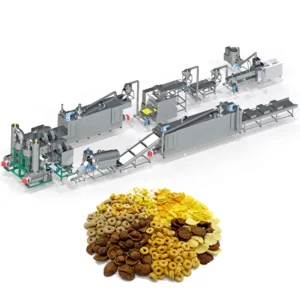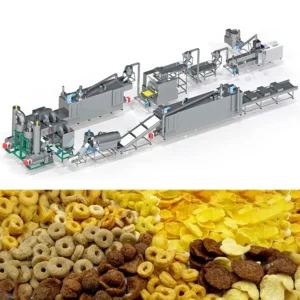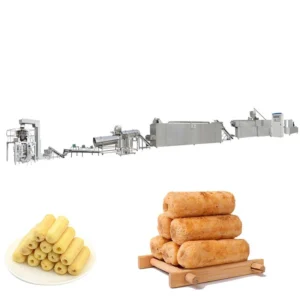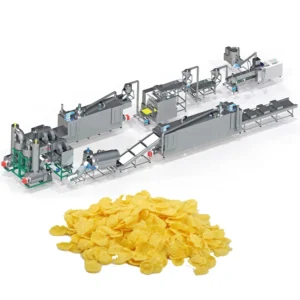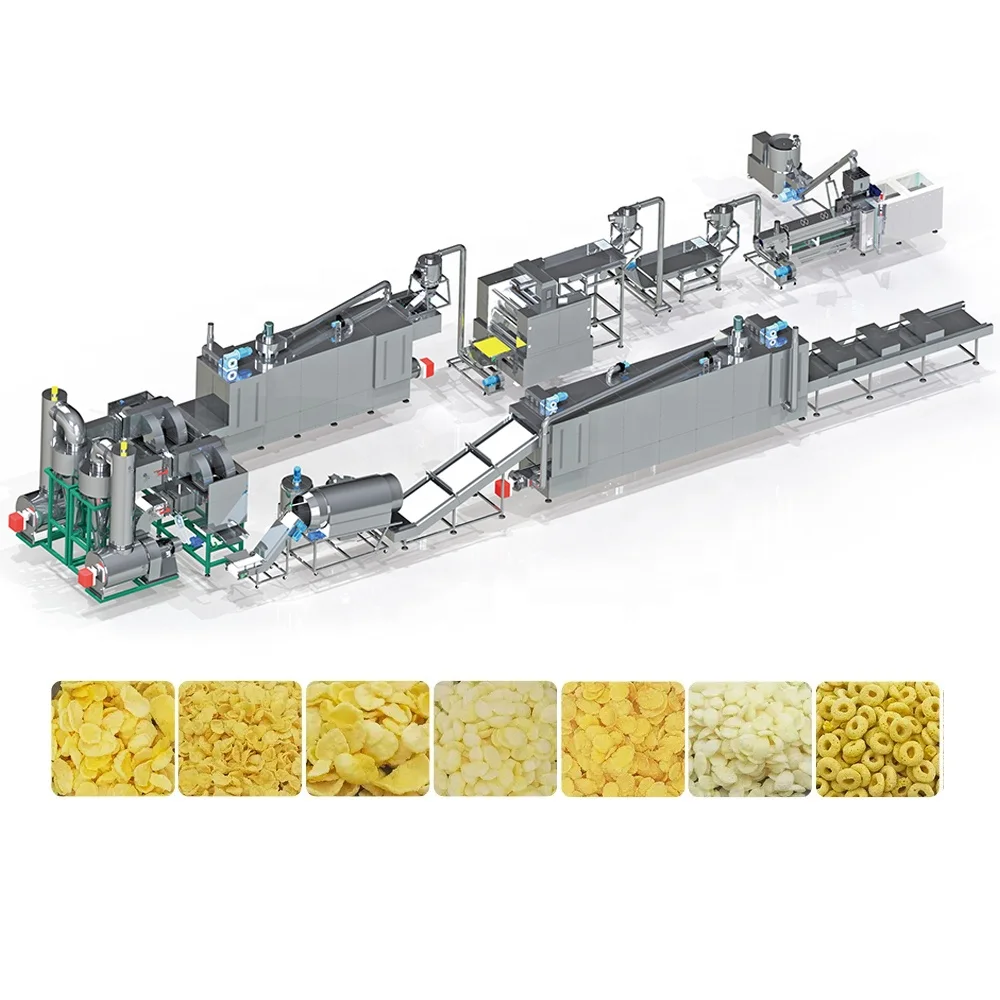


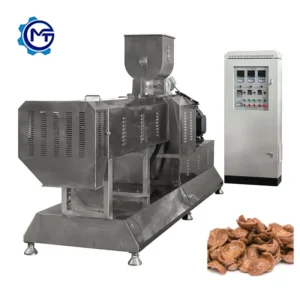
Breakfast Cereal Corn Flakes Production Line, Twin-Screw MT-75, Gas-Fired Oven — throughput-matched from flour mixing through extrusion, pressing, drying, sugar coating to cooling and packing. Co-rotating sectional screw modules handle gelatinisation, de-gassing and forming in one pass; adjustable roller gap ensures precise flake thickness. Die changes produce ring, ball, star or stick shapes from corn, rice and oat blends. Layout, trial run report and screw configuration confirmed before shipment.
Description
Throughput-Matched Integration — every station from the flour mixer through the corn flakes press to the cooling conveyor is balanced to the same output target, so no single unit chokes the line while product piles up on the belt.
Technical Specifications
| Parameter | Value |
|---|---|
| Product Type | Breakfast Cereal Corn Flakes Production Line |
| Line Configuration | Flour Mixer → Screw Elevator → Double-screw Extruder → Elevator → Dryer → Elevator → Coating Line → Vibrating Spreader → Elevator → Dryer → Cooling Conveyor → Packing Machine |
| Extruder Type | Twin-screw, co-rotating sectional modules |
| Extruder Functions | Forward and backward transport, mixing, de-gassing, cooking, forming |
| Corn Flakes Press Power | 16.12 kW |
| Corn Flakes Press Dimensions | 1550 × 1300 × 2000 mm |
| Corn Flakes Press Roller Size | 510 × 310 × 1050 mm |
| Corn Flakes Press Features | Big roller, integrated cooling system, adjustable roller distance |
| Mixer Tank Size | φ600 × 500 mm |
| Mixer Output | 10–30 kg per load |
| Mixer Power | 4 kW |
| Screw Conveyor Power | 0.75 kW |
| Screw Conveyor Dimensions | 2700 × 500 × 2400 mm |
| High-temperature Oven Dimensions | 4.5 × 1.4 × 1.8 m |
| High-temperature Oven Power | 3.75 kW |
| Oven Heating Source | Gas, both-side baking system |
| Sugar Spraying System Power | 28.75 kW |
| Sugar Spraying System Dimensions | 4000 × 1900 × 1880 mm |
| Sugar Spraying Roller Size | Ø600 × 2700 mm |
| Control System | PLC and MCC (source value — verify against manufacturer catalog for this specific line) |
| Voltage Options | 3ph 380V 50Hz / 3ph 380V 60Hz / 3ph 415V 60Hz / 3ph 220V 60Hz |
| Contact Materials | Food-grade stainless steel |
| Certification | CE |
| Output Capacity | To be confirmed based on buyer’s raw material and target product (basis not stated in source) |
Application Suitability
| Application | Material or Output |
|---|---|
| Corn flakes production | Corn grits and corn flour blends |
| Whole-grain choco hoops | Rice, oat and wheat flour with cocoa addition |
| Fruit-loop-style ring cereals | Multi-grain flour blends with fruit flavouring |
| Fortified breakfast cereal | Grain powders with vitamin and mineral premixes |
| Coated snack cereal rings | Extruded grain pieces with sugar syrup or honey glaze |
| Flaked cereal from alternative grains | Oat, rice and mixed-grain formulations |
What "Rated Capacity" Means When Your Flour Blend Hits the Extruder
A breakfast cereal corn flakes production line turnkey only delivers its quoted output if every station is matched to the behaviour of your specific grain blend under heat and shear.
I watched a buyer in Vietnam take delivery of a cereal line where the extruder was rated at a certain throughput on standard corn grits. When his actual flour mix — heavier on oat and higher in fibre — went through the barrel, the material residence time changed and the downstream dryer fell behind. Half-cooked rings sat on the belt absorbing ambient humidity. That kind of mismatch does not show up in a brochure [NEED_CITE: raw material behaviour under twin-screw extrusion conditions]. Running a buyer’s own blend in a testing workshop before the line ships is the only way to confirm that the breakfast cereal corn flakes production line turnkey holds its throughput on the material it will actually process.
How Screw Modules Shape the Gelatinisation Window
The MT-75 co-rotating twin-screw extruder uses sectional screw modules that can be rearranged along the barrel. This matters because a breakfast cereal corn flakes production line turnkey relies on controlled starch gelatinisation — the point at which granules absorb moisture, swell and lose crystalline structure under heat and mechanical shear. Moving a kneading block forward or backward in the screw profile shifts where that transition happens relative to the die face. For a dense corn flake that must press flat without cracking, the gelatinisation window needs to land in a narrow band so the dough arrives at the forming die at the right viscosity and moisture level.
Why the Corn Flakes Press Needs Its Own Cooling Circuit
The press station sits between the extruder output and the high-temperature oven. Its roller gap determines flake thickness, and the integrated cooling system prevents the dough sheet from sticking to the roller surface or tearing at the edges. On a breakfast cereal corn flakes production line turnkey, if the press rollers run too warm, starch resolidifies unevenly and flakes come out with a rough surface that later causes inconsistent sugar adhesion in the coating drum. The adjustable roller distance allows operators to dial in thickness for a thin, crisp flake or a thicker, chewier variant without swapping hardware [NEED_CITE: flake thickness effect on baking uniformity in cereal processing].
Reading the Specs That Actually Determine Product Quality
The high-temperature oven measures 4.5 metres in length with a both-side gas baking system. That length gives flakes enough residence time at baking temperature to drive residual moisture down to the level required for shelf-stable crispness. A shorter oven would force higher temperatures that scorch the surface while leaving the centre soft. The sugar spraying system runs at 28.75 kW across a Ø600 × 2700 mm roller, which keeps the syrup at a stable viscosity as it coats the cereal pieces. If the roller diameter were smaller, the coating film would be thinner and less uniform across the batch. The mixer loads 10 to 30 kg per batch, and that batch size must align with the extruder feed rate so the screw never starves or floods — a mismatch here causes density swings that carry all the way through to the finished flake.
The Cost of Ignoring Station-to-Station Balance
When the coating drum capacity lags behind the extruder output, sugar-coated cereal backs up on the conveyor. The pieces cool below the temperature needed for syrup adhesion, so the glaze pools instead of wrapping evenly. Workers end up scraping rework off the belt, and the scrapped product still counts against your raw material cost. A similar problem occurs when the cooling conveyor is too short: warm flakes enter packing bags, generate condensation inside the seal, and arrive at the retailer with a stale texture [NEED_CITE: moisture migration in packaged cereal products]. None of these failures show up in a single-machine specification sheet.
Why Buyers Source This Line From One Supplier
The flour mixer, screw elevators, extruder, dryers, press, coating system and cooling conveyor are all specified under one responsibility, so throughput calculations are done across the entire chain rather than per station. The screw configuration and die design are selected against the buyer’s actual grain blend and target flake or ring shape, not copied from a generic build. An in-house testing workshop runs the buyer’s raw material before shipment, producing a trial run report that confirms product density, texture and line balance. Voltage, frequency and control language are locked in before production begins, avoiding commissioning delays on site. PLC and MCC control allows recipe parameters — barrel temperature zones, screw speed, oven dwell time — to be saved and recalled for consistent batch-to-batch output.
Documentation & Verification
- Line layout drawing showing throughput calculation across every station from mixer to packer
- Trial run report on buyer’s grain flour blend conducted before shipment
- Screw and die configuration record matched to target cereal shape and flake thickness
- Electrical schematic with confirmed voltage, frequency and PLC language for destination market
- Factory test record documenting oven temperature profile and press roller gap settings
- Packing photographs and customs documentation for container loading plan
Installation, Commissioning & Support
- Foundation plan accounting for the 4.5 m oven length and 4 m coating system footprint
- Dedicated electrical circuit for the 28.75 kW sugar spraying system and 16.12 kW press
- Assembly sequence for sectional twin-screw modules and press roller alignment on site
- First-run parameter logging for barrel temperatures, screw speed and oven gas pressure
- Operator training on die changes for ring, ball, star and stick cereal formats
- Wear parts list covering screw elements, die plates and press roller bearings
What to Include in Your Inquiry
To configure the right breakfast cereal corn flakes production line turnkey for your facility, share your primary grain flour type and any secondary ingredients such as vitamin premixes or cocoa powder. Specify your target flake thickness or cereal piece shape, and the daily output you need to meet. Confirm the local voltage and frequency at your plant so the control panel and motor ratings are built to match, and note whether your operators require a specific PLC display language.
Frequently Asked Questions
Q: How is line capacity verified against my specific grain flour blend and moisture content?
A: Your raw material is run in the in-house testing workshop before shipment. The trial uses your exact flour blend at your stated moisture level, and the resulting product density, texture and throughput are documented in a report. This confirms that every station — extruder, press, dryer and coater — handles your material without bottlenecking.
Q: What voltage and frequency configurations are available for my target market?
A: The line supports 3-phase 380V at 50Hz or 60Hz, 415V at 60Hz, and 220V at 60Hz. The correct configuration is confirmed before production so that motors, heating elements and the PLC panel arrive matching your local supply, avoiding rewiring or transformer costs during commissioning.
Q: How are screw configuration and die design selected for different cereal shapes?
A: The co-rotating twin-screw extruder uses sectional modules that are arranged based on your target product. For a dense corn flake, the screw profile emphasises cooking and degassing; for a puffed ring, the profile shifts toward expansion. Die geometry is matched to the shape — round, star, stick — and tested with your flour blend during the pre-shipment trial.
Q: What is included in the on-site installation and operator training package?
A: Engineers oversee uncrating, station alignment, utility connections and first-run parameter setting. Operators are trained on die changes, press roller gap adjustment, PLC recipe recall and daily cleaning procedures. A wear parts list and maintenance schedule are handed over so the team knows when to inspect screw elements and roller bearings.
Q: How is the dryer and coating capacity matched to the extruder output?
A: Each station’s throughput is calculated against the extruder’s actual output on your material, not its nominal rating. The oven length, conveyor speed and sugar spraying roller dimensions are sized so that product flows continuously without accumulation, preventing moisture reabsorption or coating defects between stations.
Related products
-
1000 Lbs Automatic Corn Flakes Production Line Mixer Breakfast Cereal Corn Flakes Production Line
¥45,000.00 Select options This product has multiple variants. The options may be chosen on the product page -
Small Scale Breakfast Cereal Manufacturing Machine for Corn Flakes Process Line
¥45,000.00 Select options This product has multiple variants. The options may be chosen on the product page -
200kg/h Breakfast Cereal Extruder Making Machine Hot Sale Corn Flake Production Line
¥30,000.00 Select options This product has multiple variants. The options may be chosen on the product page -
MT Cocoa Flour Puffed Breakfast Cereal Production Line-High Large Capacity Multi-Fuel (Steam/Gas/Electric) New Shandong Origin
¥8,000.00 Select options This product has multiple variants. The options may be chosen on the product page