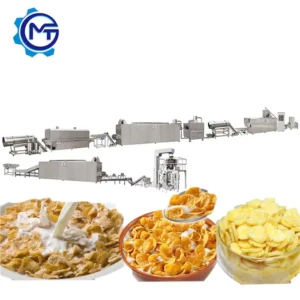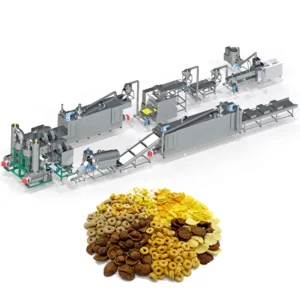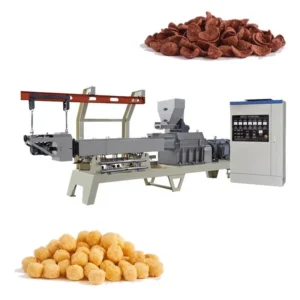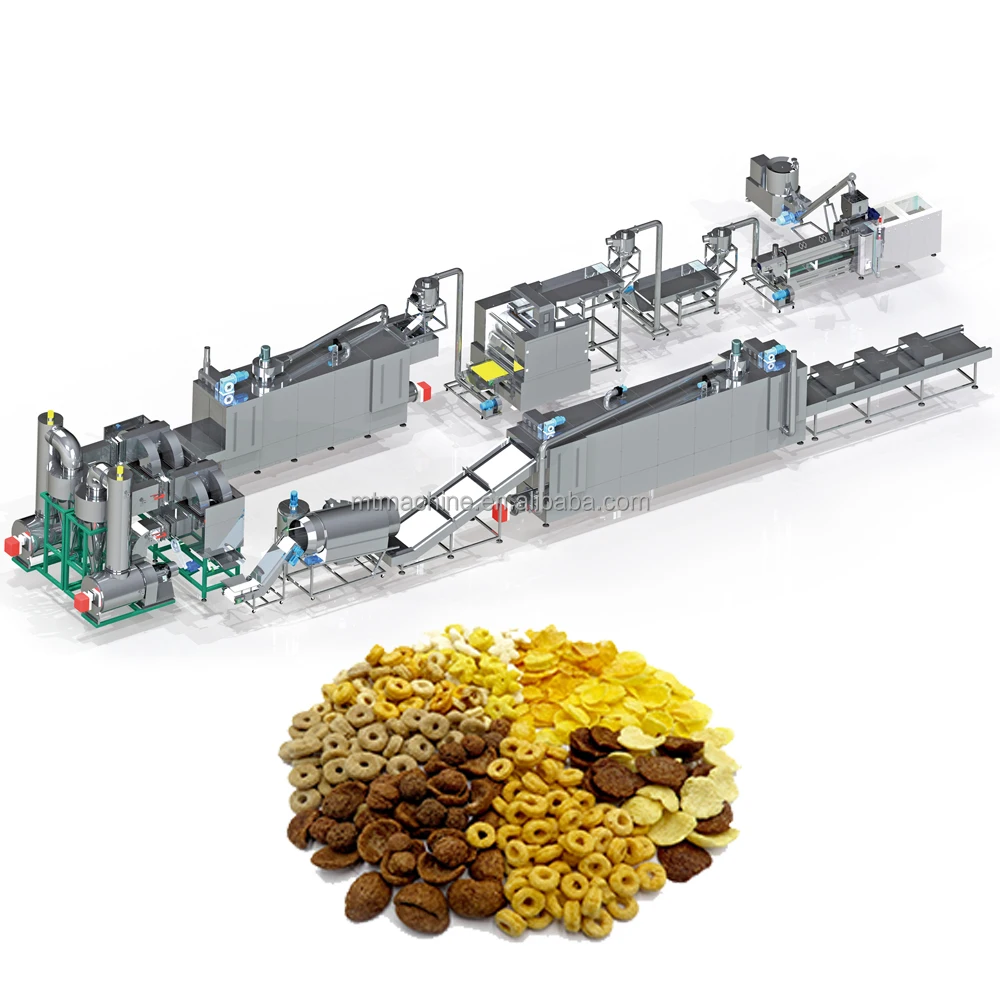


MT70 / MT85 / MT75 Corn Flakes Breakfast Cereal Production Line, Twin-Screw Extruder, PLC Control — engineered as a single turnkey project from mixing through extrusion, flaking, hot air roasting and packing, with throughput matched across every station to eliminate downstream bottlenecks.
- Hydraulic double-roller flaking with infrared temperature monitoring for consistent flake thickness
- Hot air roasting oven with dual circulating fans and cyclone dust removal for uniform blistering
- Complete line layout, capacity calculation and trial run on buyer’s raw material before shipment
Screw configuration and die design are specified to the buyer’s raw material and target product, with in-house testing workshop validation prior to delivery.
Description
Integrated Project Delivery — Every station from batching through packing is engineered under one project umbrella, eliminating the throughput mismatches that plague multi-vendor cereal line assemblies.
Technical Specifications
| Parameter | Value |
|---|---|
| Product Type | Corn Flakes Breakfast Cereal Production Line |
| Available Models | MT70 / MT85 / MT75 |
| Extruder Type | Twin Screw |
| Installed Power (MT70 / MT85 / MT75) | 160 kW / 190 kW / 210 kW |
| Power Consumption (MT70 / MT85 / MT75) | 120 kW / 140 kW / 150 kW |
| Output Capacity (MT70 / MT85 / MT75) | 150–200 kg/h / 300–400 kg/h / 300–500 kg/h (basis to be confirmed on raw material and moisture) |
| Overall Dimensions (MT70 / MT85 / MT75) | 41 × 1.5 × 2.2 m / 43 × 1.5 × 3.2 m / 45 × 1.5 × 3.5 m |
| Flaking Machinery Drive | Double motors for separate roller driving; hydraulic system for double rollers |
| Flaking Temperature Control | Infrared sensor for even temperature pipe control |
| Dryer Heating Source | Gas / Electric |
| Roasting Oven Features | Hot air roasting with conciliation burner, dual circulating fans, cyclone dust removal, vibrating pan with high temperature spraying tubes |
| Coating System | Double tumble for sugar melting, elevator, coating drum, spraying nozzle |
| Control System | PLC control; MCC and PLC available per client requirement |
| Raw Materials | Corn, rice, wheat, oat, barley powder |
| Assembly State | Complete integrated line |
| Certifications | CE, ISO |
Application Suitability
| Application | Material or Output |
|---|---|
| Natural corn flakes production | Corn grits and corn flour formulations |
| Sugar-coated and honey-coated flakes | Corn, rice, wheat base with sugar or honey spray coating |
| Multi-grain breakfast cereals | Blends of oat, barley, rice, and wheat powder |
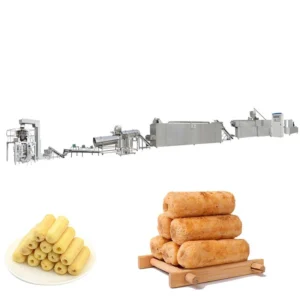
| Shaped cereal snacks | Ball, tube, stick, ring, fruit loop, star, wheel, flower, heart shapes via extruder mould adjustment |
Why the Downstream Dryer Decides Your Actual Line Output
A corn flakes production line turnkey is only as fast as its slowest station, and that station is almost never the extruder.
I once stood in a workshop watching a twin-screw extruder push out perfectly gelatinised corn dough at full rated speed while a single-pass dryer twenty metres downstream choked under the moisture load. Flakes piled up on the conveyor, cooled unevenly, and blistered inconsistently in the roasting oven. The line had been assembled from three different vendors, each quoting their machine in isolation. Nobody had mapped the moisture removal curve against the extruder output [NEED_CITE: throughput matching across cereal line stations]. When the entire corn flakes breakfast cereal production line comes from one engineering scope, the dryer capacity, the flaking roller speed, and the roasting oven dwell time are all calculated backward from the extruder throughput, not forward from individual machine nameplates.
Mapping the Line Sequence Before the Floor Plan
Natural corn flakes follow a six-station sequence: mixing, extruding, flaking, drying, hot air roasting, cooling, and packing. Sugar-coated variants insert sugar spraying, sugar coating, and a second drying stage between roasting and cooling. Each additional station changes the footprint and the utility demand. On a corn flakes production line turnkey project, the layout is drawn with every station’s throughput matched so that no conveyor accumulates product and no oven starves. The MT75 variant, for example, runs a line length approaching 45 metres, which means the utility runs for gas, compressed air, and electrical circuits must be planned against that exact sequence before concrete is poured.
Throughput Matching Between Extruder, Flaker, and Roaster
The twin-screw extruder converts raw corn, rice, or wheat flour into a cooked dough pellet. The hydraulic double-roller flaking system then presses each pellet into a thin flake, and the infrared sensor monitors roller temperature to keep thickness consistent. If the flaker runs even slightly slower than the extruder, dough pellets cool and harden before reaching the rollers, producing cracked rather than flattened flakes. Downstream, the hot air roasting oven relies on dual circulating fans and a cyclone dust removal device to achieve uniform surface blistering [NEED_CITE: hot air circulation uniformity in cereal roasting ovens]. When all three stations share one control architecture with PLC coordination, speed references can be linked so that a change at the extruder cascades automatically to the flaker and roaster.
Interpreting the Screw, Power, and Dimension Data
Twin-screw extrusion is chosen over single-screw for corn flakes because the co-rotating screw pair handles the wide moisture range of cereal dough without surging. Installed power spans 160 kW on the MT70 up to 210 kW on the MT75, but actual power consumption sits lower at 120 kW to 150 kW, reflecting the difference between motor nameplate rating and steady-state draw. Line length grows from 41 metres to 45 metres across the three models, a factor that directly affects workshop layout and utility routing. The hydraulic flaking system with double-motor separate roller driving allows independent speed adjustment of each roller, which controls flake thickness more precisely than a single-motor gear-linked arrangement. Dryer heating source options of gas or electric should be selected based on local energy cost and availability before the order is placed.
The Cost of Station-by-Station Procurement
When the extruder, flaker, dryer, and roaster arrive from different suppliers, each vendor tests their machine alone. The extruder vendor demonstrates pellet output. The dryer vendor shows moisture reduction on a pre-heated sample. Nobody runs corn flour through the entire sequence from hopper to cooling conveyor. On site, the gaps appear: voltage incompatibilities between control panels, conveyor heights that do not align, and PLC protocols that cannot communicate [NEED_CITE: integration failures in multi-vendor food processing lines]. The rework falls on the buyer’s engineering team, who must fabricate adapter chutes, rewire control loops, and negotiate between vendors who each insist their machine performs to specification.
What Single-Source Engineering Delivers
Every station in this corn flakes production line turnkey project is specified under one layout document, so throughput is calculated across the full sequence rather than at individual machines. Screw configuration and die design are matched to the buyer’s raw material formulation before the extruder barrel is assembled. The in-house testing workshop runs trial batches on the buyer’s actual corn, rice, or wheat flour, generating a trial run report before any machine is crated for shipment. Pre-sales engineering covers line layout, utility planning, and phased installation scheduling. CE and ISO certifications apply to the complete line, not just one component.
Documentation & Verification
- Line layout drawing with capacity calculation across every station from mixer to packer
- Screw and die configuration record matched to your raw material formulation
- Trial run report on your corn or grain flour conducted before dispatch
- Electrical schematic with voltage and frequency confirmed for your site
- Operation and maintenance manual with wear parts list for screws, dies, and roller surfaces
- Factory test record documenting each station’s performance before crating
Installation, Commissioning & Support
- Foundation plan accounts for the 41–45 m line length and 1.5 m working width across all stations
- Electrical supply sized for 160–210 kW installed power with dedicated circuits for extruder and roaster
- Line arrives in modular sections; assembly sequence planned to avoid workshop access conflicts
- First-run commissioning includes screw speed, barrel temperature, and roller gap calibration on your material
- Operator training covers PLC interface navigation, flaking thickness adjustment, and roaster fan balancing
- Wear parts inventory list covers twin screws, die plates, flaking roller sleeves, and roasting oven spray tubes
- Maintenance schedule defines daily, weekly, and monthly intervals for each station’s moving components
Preparing Your Project Inquiry
To scope a corn flakes breakfast cereal production line accurately, share your raw material specification including flour type, particle size, and moisture content. Provide your target hourly output and whether the final product will be natural, sugar-coated, or both. Confirm the local voltage, frequency, and preferred control language, as these determine motor winding, transformer sizing, and PLC screen configuration. If you have existing upstream silos or downstream packing machines, include their interface dimensions so the line layout can accommodate them.
Frequently Asked Questions
Q: How is throughput matched between the extruder, flaker, dryer, and roaster on this line?
A: Every station is specified within one engineering scope. The extruder output rate sets the baseline, and downstream equipment — flaking roller speed, dryer belt length and temperature zones, roasting oven dwell time — is calculated backward from that figure. PLC control links speed references across stations so a rate change cascades automatically, preventing bottlenecks or product accumulation.
Q: What utility connections are required and how is the utility plan structured?
A: The line needs three-phase electrical supply rated for the selected model’s installed power, gas supply if gas-heated drying or roasting is chosen, compressed air for pneumatic actuators and spraying nozzles, and water for cooling circuits. A utility plan document maps each connection point to the line layout, specifying pipe diameter, cable gauge, and breaker rating at every station.
Q: What does the installation and commissioning schedule look like for a full corn flakes line?
A: Installation follows a phased sequence: foundation preparation, station placement, mechanical assembly, electrical wiring, and utility hook-up. Commissioning begins with single-station dry runs, progresses to wet runs with raw material, and concludes with continuous production trials. Operator training runs concurrently during the final production trial phase.
Q: Can the same line produce both natural and sugar-coated corn flakes?
A: Yes. The sugar-coated variant adds a sugar spraying station, coating drum, and secondary dryer after the roasting oven. These stations are included in the line layout from the start. Changeover involves activating or bypassing the coating sequence through the PLC interface and adjusting the secondary dryer temperature for the sugar-set stage.
Q: What documentation is delivered when the line is handed over?
A: The handover package includes the line layout and capacity calculation, electrical schematics with confirmed voltage and frequency, screw and die configuration records, factory test records, a trial run report on your raw material, operation and maintenance manuals, and a wear parts list covering screws, dies, flaking roller sleeves, and roasting components.
Related products
-
1000 Lbs Automatic Corn Flakes Production Line Mixer Breakfast Cereal Corn Flakes Production Line
¥45,000.00 Select options This product has multiple variants. The options may be chosen on the product page -

200kg/h Breakfast Cereal Extruder Making Machine Hot Sale Corn Flake Production Line
¥30,000.00 Select options This product has multiple variants. The options may be chosen on the product page -

MT Cocoa Flour Puffed Breakfast Cereal Production Line-High Large Capacity Multi-Fuel (Steam/Gas/Electric) New Shandong Origin
¥8,000.00 Select options This product has multiple variants. The options may be chosen on the product page -
Kelloggs Corn Flakes Breakfast Cereal Normal Making Machine Breakfast Cereal Extruder Production Line
¥30,000.00 Select options This product has multiple variants. The options may be chosen on the product page