

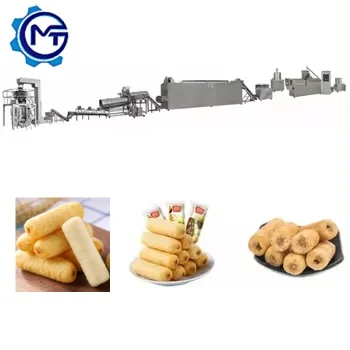
In-house trial runs on your actual raw material verify output capacity and product specifications before shipment, with on-site installation and operator training included in the project scope.
Description
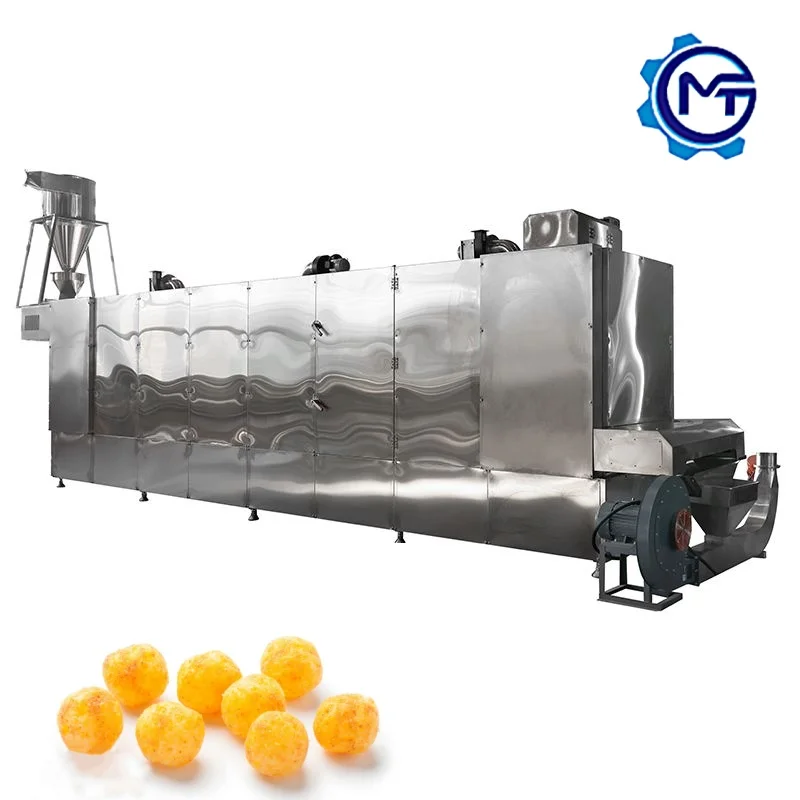
Integrated Throughput Sizing — every station from batching to packing is calculated against your specific formula moisture and target density, so the dryer and flavoring drum never bottleneck the extruder on a real production run.
Technical Specifications
| Parameter | Value |
|---|---|
| Model | MT65 / MT70 / MT85 / MT100 |
| Product Type | Twin Screw Extruder for Puffed Snack Production Line |
| Screw Configuration | Twin-screw, co-rotating, segmental build-up |
| Installed Power | MT65 — 130 kW; MT70 — 180 kW; MT85 — 220 kW; MT100 — 240 kW |
| Real Consumption | MT65 — 95 kW; MT70 — 120 kW; MT85 — 130 kW; MT100 — 160 kW |
| Output Capacity | MT65: 120–150 kg/h (basis to be confirmed); MT70: 200–300 kg/h (basis to be confirmed); MT85: 300–500 kg/h (basis to be confirmed); MT100: 600–800 kg/h (basis to be confirmed) |
| Control System | Frequency speed controlling system (PLC or MCC control available) |
| Voltage & Frequency | Configurable to target market supply (to be confirmed at order) |
| Dryer Heating Source | Electric, steam, or gas selectable |
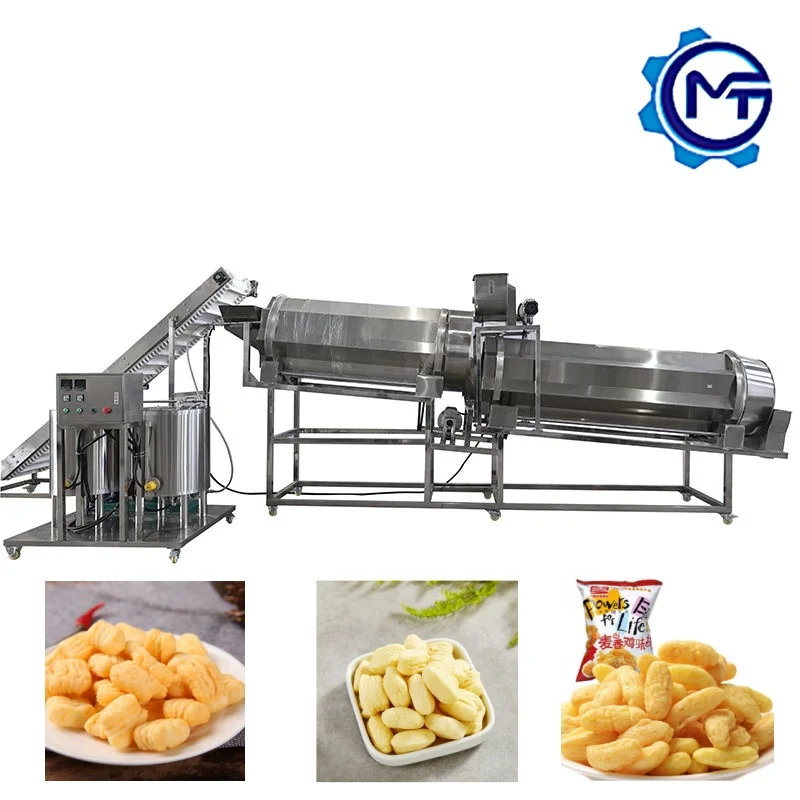
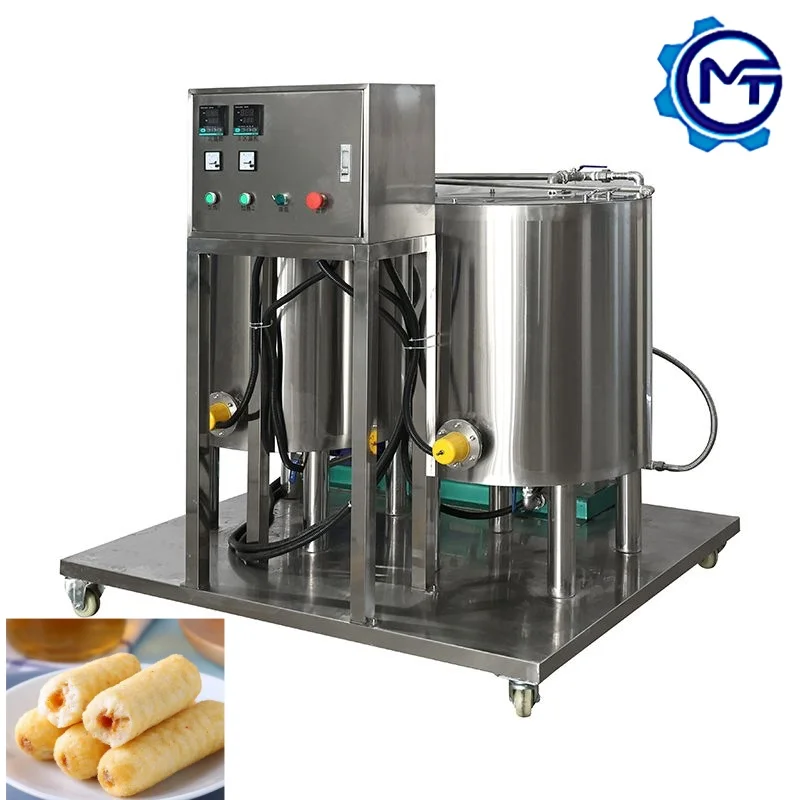
| Flavoring System | Double drum with sugar melting and spraying nozzle |
| Line Sequence | Batching → Extruding → Drying → Coating/Flavoring → Cooling → Packing → Stacking |
| Assembly State | Complete line, throughput-matched across all stations |
| Warranty | 1 year free warranty |
Application Suitability
| Application | Material or Output |
|---|---|
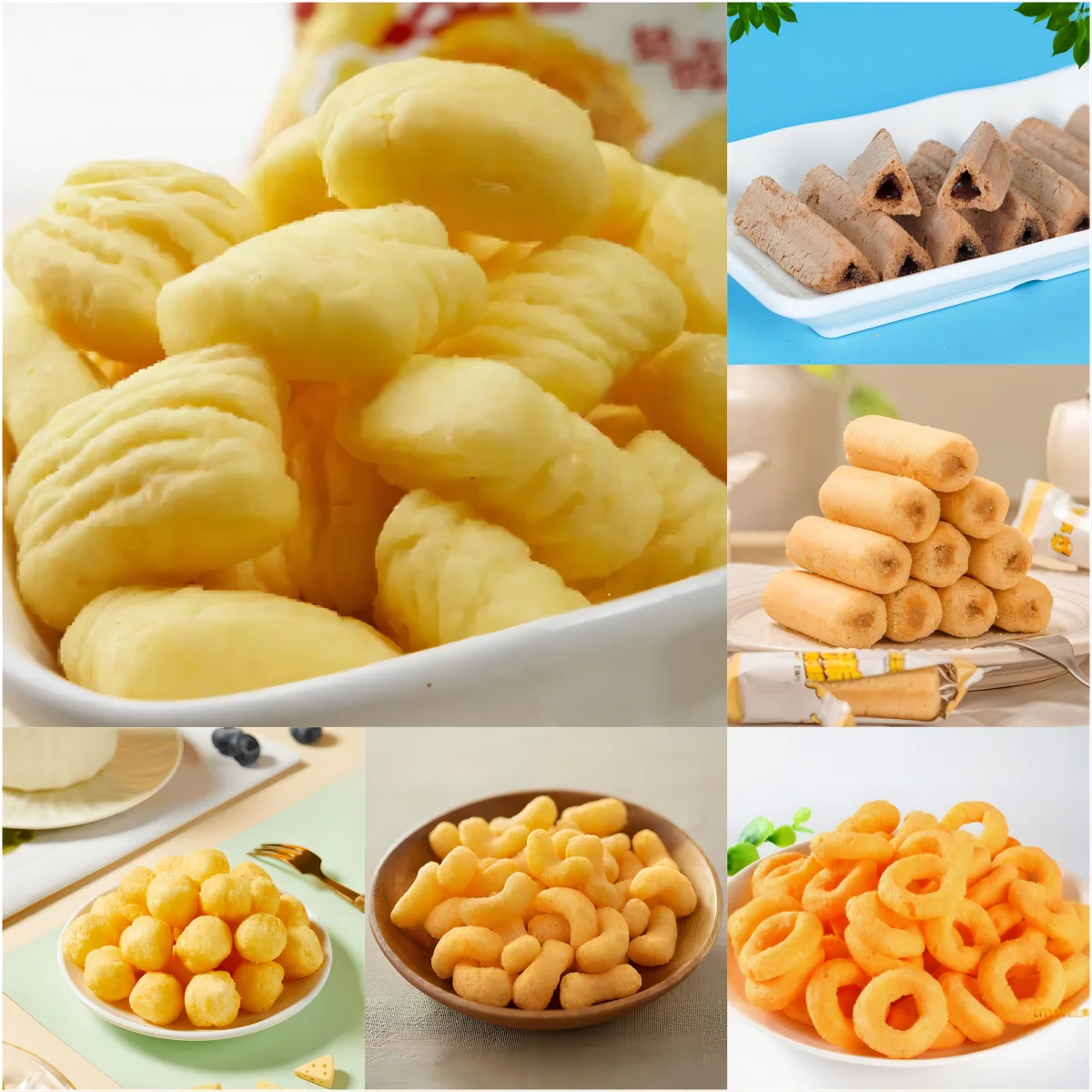
| Cheese puffs and corn puffs | Corn flour, rice flour, wheat flour |
| Core-filled snack pillows | Wheat flour, oat flour, barley flour with cream filling |
| Extruded rings and fruit loops | Multi-grain flour blends at controlled moisture |
| 3D shapes — star, wheel, flower, heart | Interchangeable dies on a single extruder platform |
| Tubes and sticks | High-starch formulations requiring specific shear profile |
What "200 kg per Hour" Leaves Out About Your Snack Line
Nominal capacity means nothing until it is verified against your actual flour blend, moisture content, and die geometry under sustained run conditions.
I have watched buyers celebrate a twin screw extruder production line quoted at a certain throughput, only to discover on day three that the dryer could not keep up once ambient humidity rose. The puffed product sat on the conveyor, absorbed moisture, and lost its crunch before reaching the flavoring drum. The extruder was rated correctly for one specific recipe on one specific die; the rest of the line was assembled from catalog defaults [NEED_CITE: importance of throughput matching in extrusion line design]. That mismatch is the reason we size every downstream station against your confirmed formula before a single motor is wired.
Line Layout and Throughput Matching as One Project
A turnkey puffed snack extrusion line is not a collection of machines connected by conveyors — it is a single system where each station has a defined residence time, thermal load, and material flow rate. We calculate the dryer belt length, the flavoring drum retention, and the cooler air volume against the extruder output on your recipe. When one station is undersized, the entire line throttles to its pace.
Utility Planning Before the Machine Leaves the Workshop
Voltage, frequency, steam pressure, gas line diameter, and compressed air volume must align with your factory supply before the control cabinet is assembled. We confirm these parameters during the proposal stage and reflect them in the electrical schematic. A twin screw extruder production line delivered with the wrong voltage rating delays commissioning by weeks while transformers or contactors are sourced locally [NEED_CITE: voltage and frequency standards by export market].
Screw Configuration and Die Geometry in Practice
Twin-screw extrusion relies on the intermeshing screw profile to generate shear, mix ingredients, and gelatinise starch within a controlled residence time. The segmental screw build-up allows us to adjust the shearing intensity and convey ratio to match your flour blend — high-amylose corn behaves differently from oat flour under the same profile. The die aperture determines expansion ratio and final product density; a cheese puff die and a fruit loop die require different moisture windows and barrel temperature zones. Frequency speed control on the main drive lets operators fine-tune screw RPM during the run to hold consistent expansion across a shift. The real consumption figures — substantially lower than installed power — reflect the actual thermal and mechanical load once steady-state extrusion is reached.
The Cost of Assembling Stations from Separate Vendors
When the extruder, dryer, and flavoring drum arrive from different suppliers, no single party owns the throughput guarantee. If puffed snacks exit the dryer at higher moisture than the flavoring drum can handle, each vendor blames the other’s upstream output. This fragmentation also means spare parts, electrical standards, and control languages arrive uncoordinated, turning a commissioning visit into a multi-week troubleshooting exercise [NEED_CITE: common commissioning delays in multi-vendor extrusion lines].
Why Procure the Complete Line Here
Every station — batching, extruding, drying, flavoring, cooling, packing, stacking — is engineered under one project scope so throughput is matched and responsibility is undivided. Screw configuration and die selection are specified to your raw material and target shape before production starts, not copied from a generic build. An in-house testing workshop runs your actual flour blend through the extruder before shipment, generating a trial report that confirms output, expansion, and density. On-site installation, commissioning, and operator training are included in the project timeline, and a wear parts list covering screws, dies, and seals ships with the line. The dryer heating source is selectable among electric, steam, and gas to align with your site utilities.
Documentation & Verification
- Line layout drawing confirming throughput match across every station for your recipe
- Screw and die configuration record mapped to your target product shape
- Electrical schematic with voltage and frequency confirmed to your factory supply
- Trial run report on your raw material verifying expansion and density before dispatch
- CE declaration of conformity and ISO certificate for the complete line
- Operation and maintenance manual with illustrated wear parts list
Installation, Commissioning & Support
- Factory floor space and utility drop-off points confirmed against the line layout drawing before shipment
- Dedicated circuit sizing based on confirmed real consumption of the selected model
- All stations delivered as matched modules with labeled electrical and pneumatic connections
- Commissioning run on your raw material with screw RPM, barrel temperature, and dryer belt speed set to hold target density
- Operator training covering die changeover, flavoring drum adjustment, and daily screw inspection
- Wear parts kit including replacement screw segments, die plates, and seals for first-year operation
What to Include in Your Inquiry
Send us your target product shapes, the flour blend or raw material specification, the moisture content you plan to extrude at, and your desired hourly output. We also need your factory voltage and frequency, available heating source for the dryer, and the floor area allocated for the line. If you have an existing upstream mixer or downstream packing machine, let us know the model and throughput so we can match the interface.
Frequently Asked Questions
Q: How is output capacity verified on my specific raw material before the line ships?
A: We conduct a trial run in our testing workshop using your actual flour blend and target die. The run records screw speed, barrel temperature, moisture content, and expansion ratio. A written report accompanies shipment confirming the throughput and product density achieved under those conditions.
Q: How do you ensure throughput matching between the extruder and downstream stations?
A: Each station — dryer belt length, flavoring drum volume, cooler air flow — is calculated against the extruder output on your confirmed recipe. The line layout document shows the material flow rate at every transfer point so no station becomes a bottleneck during sustained production.
Q: What utility planning does my factory need before the line arrives?
A: We provide a utility requirement sheet covering electrical load, voltage and frequency, steam or gas supply for the dryer, compressed air volume, and water supply. This document is issued during the proposal stage so your facility team can prepare connections before installation begins.
Q: What is the phased installation and commissioning timeline?
A: Production lead time is typically several weeks for the extrusion line, extending if packing and stacking machines are included. After arrival, mechanical assembly and electrical connection are followed by a commissioning run on your raw material, operator training, and a documented handover with set parameters recorded.
Q: How are screw configuration and die selection matched to my product?
A: We select the screw segment profile — conveying, kneading, and reverse elements — based on your flour starch content and target texture. The die aperture is chosen for the required expansion ratio and shape. Both are recorded in the configuration document shipped with the line for future reorders.
Related products
-

Full Automatic Puffed Corn Snack Food Extruder Puffed Snack Corn bar Making Machine
¥8,500.00 Select options This product has multiple variants. The options may be chosen on the product page -

Automatic Puff Corn Snack Stick Production Line Equipment New Condition Machines
¥100.00 Select options This product has multiple variants. The options may be chosen on the product page -

Corn Puff Processing Line with Mixer Fryer Baking Oven Automatic High Productivity Grain Products Snack Making Machine
¥8,300.00 Select options This product has multiple variants. The options may be chosen on the product page -

Sweet Puffed Rice Making Machine Stainless Steel Extruded Puff Snacks Ball Food Produce Machinery
¥7,580.00 Select options This product has multiple variants. The options may be chosen on the product page


