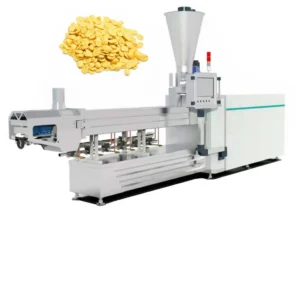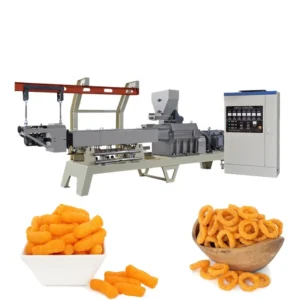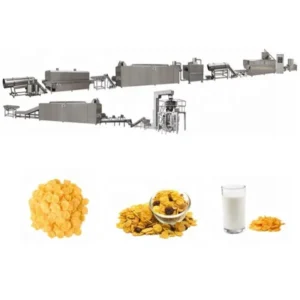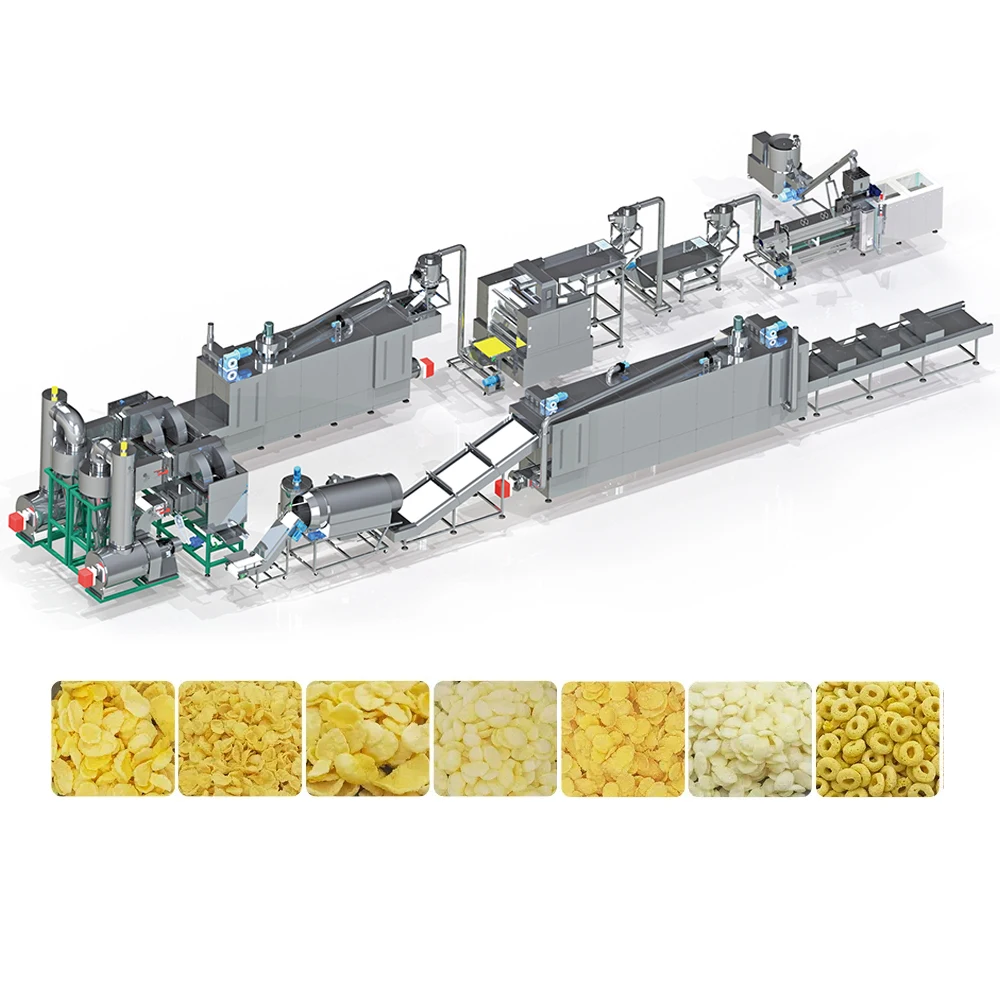
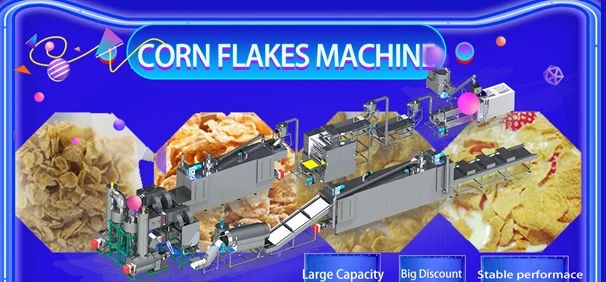
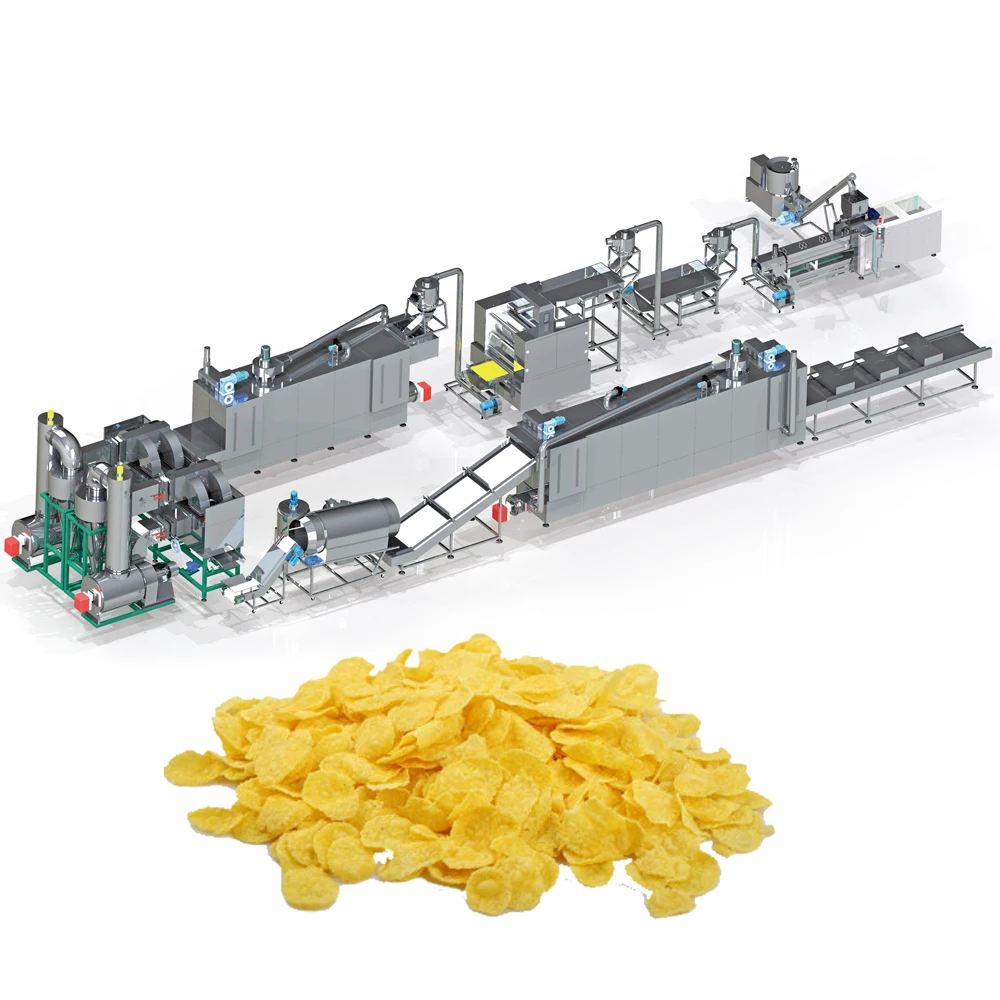
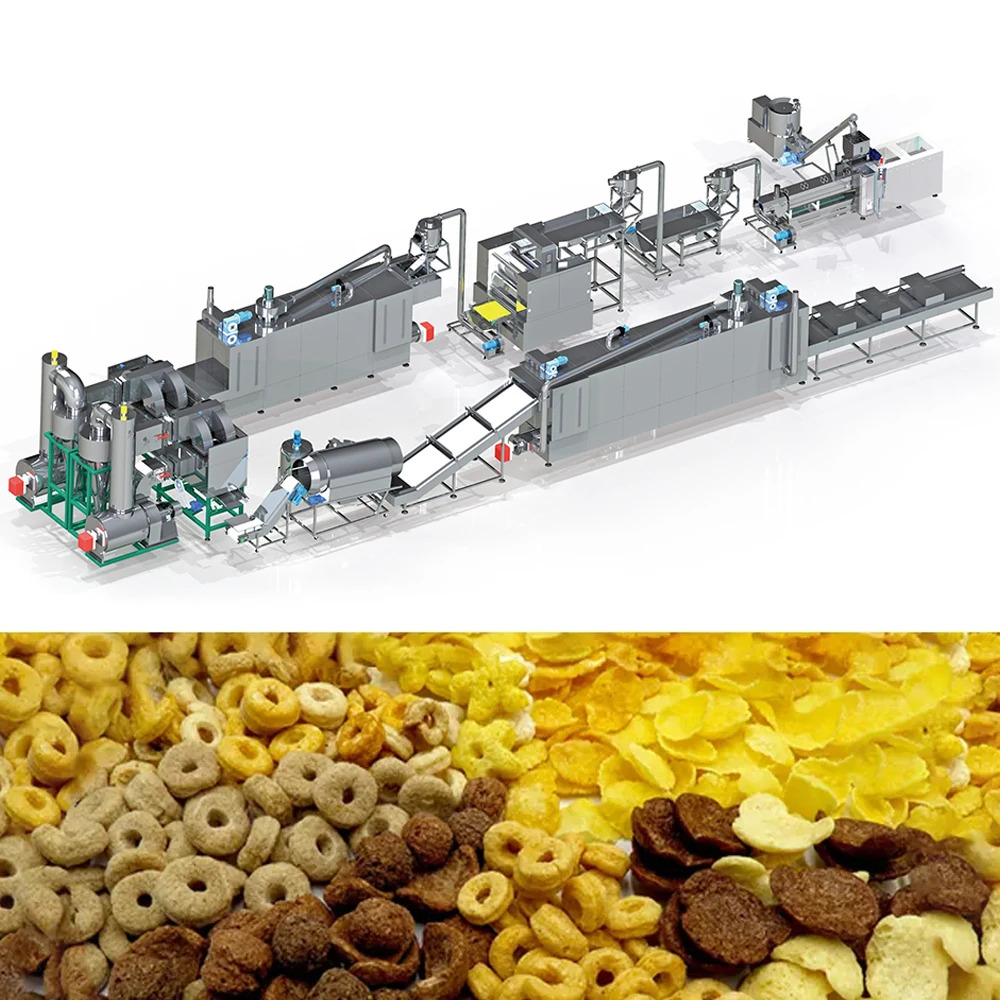
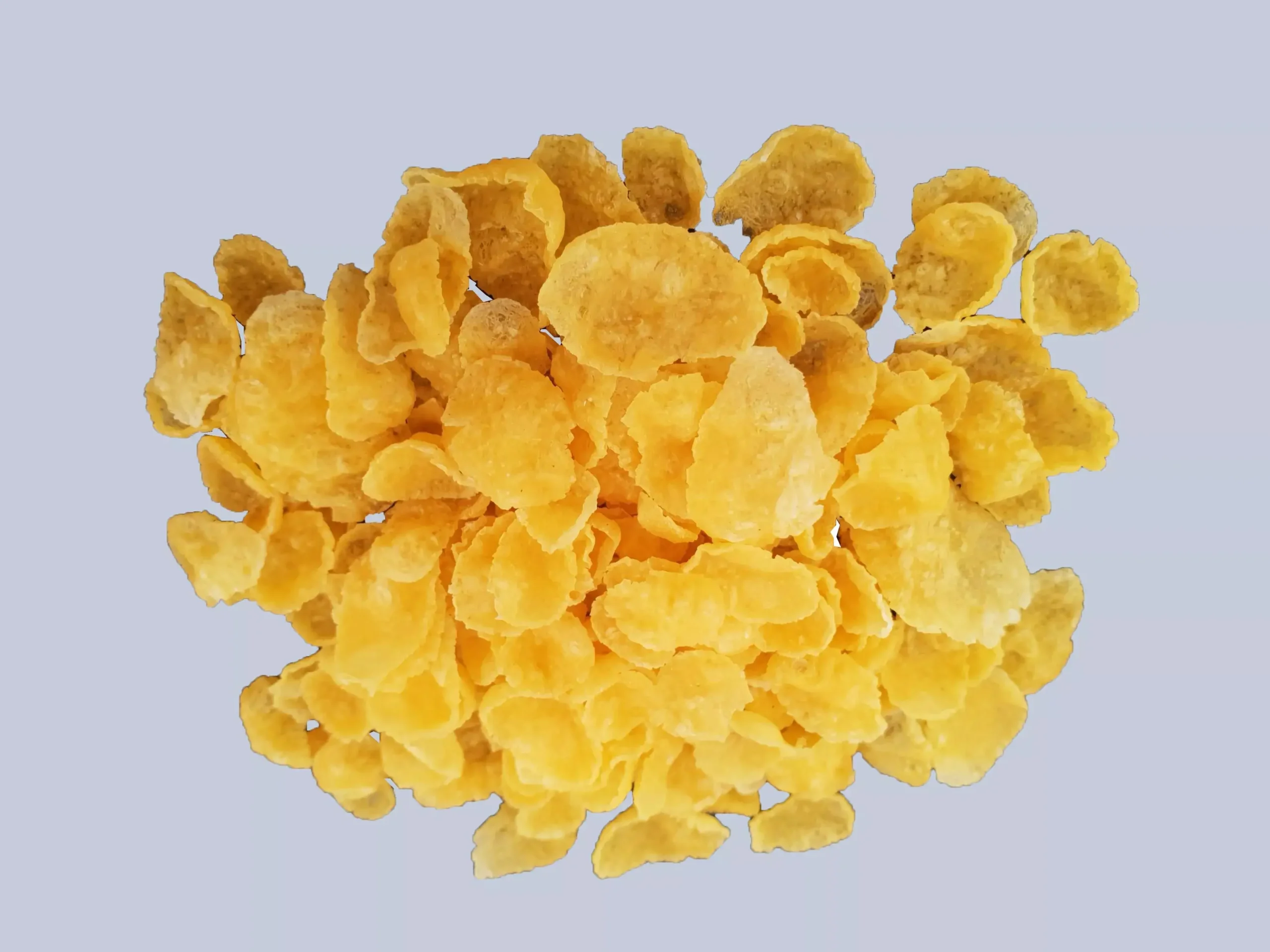
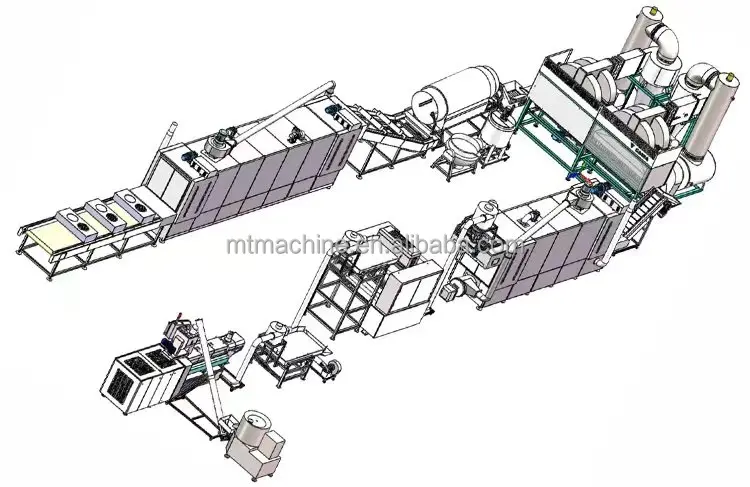
Corn Flakes Breakfast Cereal Production Line, Twin-Screw Extruder, PLC Control — engineered as a single turnkey project from batching through cooling, with throughput matched at every station to eliminate bottleneck risk.
- Twin-screw extruder with co-rotating sectional modules for controlled gelatinisation, mixing, and forming
- Gas-fired high-temperature oven with both-side baking for uniform crispness
- Dedicated flaking press with adjustable roller gap and integrated cooling
- Full PLC and MCC control with customizable voltage and frequency
Pre-shipment trial runs on your specific corn flour formulation verify real-world output, flake density, and thickness before the line ships.
Description
Integrated Line Engineering — every station from the flour mixer through the cooling conveyor is throughput-matched under one supplier, eliminating the bottleneck risk that plagues lines assembled from separate vendors.
Technical Specifications
| Parameter | Value |
|---|---|
| Product Type | Corn Flakes Breakfast Cereal Production Line |
| Line Configuration | Flour Mixer → Screw Elevator → Double-screw Extruder → Elevator → Dryer → Elevator → Coating Line → Vibrating Spreader → Elevator → Dryer → Cooling Conveyor |
| Extruder Type | Twin-screw (co-rotating, sectional screw modules) |
| Mixer Output | 10–30 kg/load |
| Mixer Power | 4 kW |
| Mixer Tank Size | φ600 × 500 mm |
| Mixer Dimensions | 1000 × 800 × 1200 mm |
| Screw Conveyor Driving Power | 0.75 kW |
| Screw Conveyor Dimensions | 2700 × 500 × 2400 mm |
| Corn Flakes Press Machine Power | 16.12 kW |
| Corn Flakes Press Machine Roller Size | 510 × 310 × 1050 mm |
| Corn Flakes Press Machine Dimensions | 1550 × 1300 × 2000 mm |
| High-temperature Oven Size | 4.5 × 1.4 × 1.8 m |
| High-temperature Oven Power | 3.75 kW |
| High-temperature Oven Heating | Gas-fired, both-side baking system |
| Sugar Spraying System Total Power | 28.75 kW |
| Sugar Spraying System Dimensions | 4000 × 1900 × 1880 mm |
| Sugar Spraying System Roller Size | Ø600 × 2700 mm |
| Control System | PLC and MCC |
| Voltage & Frequency | Customizable (e.g., 3ph 380V 50Hz, 3ph 415V 60Hz, 3ph 220V 60Hz) |
| Contact Materials | Food-grade stainless steel throughout |
| Assembly State | Complete turnkey line (batching to cooling) |
| Overall Line Capacity | (basis not stated in source — confirm target product, raw material, moisture content) |
Application Suitability
| Application | Material or Output |
|---|---|
| Standard corn flakes production | Maize or corn flour at controlled moisture |
| Multi-grain breakfast cereal | Blends of corn, rice, and oat powders |
| Vitamin-enriched fortified cereal | Grain flour with nutritional premix dosing |
| Coated cereal snacks | Corn flakes with sugar or honey coating |
| Alternative shapes on the same extruder | Ring, ball, star, and stick forms via interchangeable moulds |
Why Nominal Capacity Figures Mislead Corn Flake Buyers
A corn flakes production line turnkey quoted at a fixed output number often fails to deliver that rate once your actual raw material enters the hopper.
I spent years commissioning extruders across Africa and South Asia, and the most common failure on cereal lines is not mechanical — it is a mismatch between the screw configuration and the buyer’s local flour. One corn flakes plant ordered a line rated for a certain hourly throughput based on standard low-moisture corn grits. Their local supplier delivered high-moisture corn flour instead. The extruder could not achieve sufficient gelatinisation, expansion dropped, and the line ran at roughly half the quoted rate. The entire production bottlenecked at the extrusion stage while downstream dryers and coaters sat idle. [NEED_CITE: starch gelatinisation thresholds in twin-screw extrusion of cereal grains]
That is why verifying capacity against your specific flour formulation — before the line ships — matters more than any number on a quotation sheet.
Throughput Matching Across Every Station
A corn flakes line is only as fast as its slowest station. When the extruder, dryer, flaking press, and coating drum are sourced from separate vendors, each operates at its own rated speed with no coordination. The result is material pile-up between stations and frequent line stops. On this corn flakes production line turnkey, the flour mixer output, extruder feed rate, dryer belt speed, and sugar spraying drum rotation are all calculated as a single system. The vibrating spreader between the first dryer and the coating line ensures flakes enter the drum in a single layer, which is essential for even sugar coverage and prevents clumping that would otherwise force a shutdown.
Pre-Shipment Trial Runs on Your Raw Material
Running your exact flour blend through the extruder before the line leaves the factory is the single most effective way to catch formulation problems early. The in-house testing workshop allows screw configuration and die selection to be adjusted based on how your material behaves under heat and shear. A trial run report documents actual flake density, expansion ratio, and output rate — not theoretical values. This step eliminates the scenario where product development begins only after installation, delaying commercial production by weeks. [NEED_CITE: pre-shipment factory acceptance testing standards for food extrusion equipment]
Extruder Screw Configuration and Gelatinisation Control
The MT-65 twin-screw extruder uses co-rotating sectional screw modules, which means the screw profile can be rearranged to match the gelatinisation behaviour of your specific grain blend. Corn flour with higher protein content requires a different shear profile than pure maize starch to achieve full gelatinisation without over-cooking. The sectional design allows the forward transport, mixing, de-gassing, cooking, and forming zones to be tuned independently. Barrel temperature profiling works in tandem with the screw arrangement — too much heat in the early zones causes premature expansion and uneven flake texture after pressing, while insufficient heat in the cooking zone leaves raw starch that produces a gritty mouthfeel.
Dedicated Flaking Press and Oven Design
The flaking press uses a large roller with an integrated cooling system and an adjustable gap, which directly controls flake thickness. Consistent thickness is critical because it determines how the flakes behave in the high-temperature oven. The gas-fired oven employs a both-side baking system across a 4.5-meter length, which provides the residence time needed for uniform crispness. If flakes enter the oven at varying thicknesses — a common result when the press roller gap drifts — the thinner pieces over-brown while the thicker ones remain chewy. The separate controller box for the press allows operators to make real-time adjustments without stopping the upstream extruder. [NEED_CITE: flake thickness uniformity requirements for breakfast cereal shelf stability]
The Hidden Cost of Wrong Configuration Choices
Ordering a corn flakes line without confirming screw and die configuration against your raw material leads to problems that surface only after installation. Generic screw builds copied from unrelated applications produce flakes with incorrect density — too dense and the cereal sinks in milk, too light and it crushes during packaging. Unmatched dryer capacity means flakes exit with residual moisture, shortening shelf life and inviting mould in humid climates. Voltage and control language left unconfirmed before production result in commissioning delays while panels are rewired and HMI screens are reprogrammed on site. These are not minor inconveniences — they represent weeks of lost production and unbudgeted engineering visits. [NEED_CITE: CE machinery directive requirements for industrial food processing equipment]
Why Source This Line Here
Every station on this corn flakes production line turnkey is engineered under one supplier, so throughput calculations account for the entire chain rather than individual machine ratings. Screw configuration and die design are specified to the buyer’s raw material and target flake shape, not pulled from a generic catalogue. The in-house testing workshop runs your actual flour formulation before shipment, producing a documented trial report. Twin-screw expertise extends across breakfast cereals, pet food, aquatic feed, and snack applications, meaning the engineering team understands how grain behaviour varies by product category. Pre-sales consultation covers line layout and utility planning, and on-site support continues through commissioning and operator training.
Documentation & Verification
- Line layout drawing showing station spacing and throughput calculation for your target output
- Screw and die configuration record matched to your corn flour formulation and flake shape
- Trial run report on your raw material with documented density, thickness, and output rate
- Electrical schematic with confirmed voltage, frequency, and control language before production
- Factory test record and CE declaration of conformity for customs clearance
- Wear parts list with recommended replacement intervals for screws, dies, and press roller
Installation, Commissioning & Support
- Foundation plan based on the 4.5 m oven and full line footprint with utility connection points
- Dedicated electrical circuits for the 28.75 kW sugar spraying system and 16.12 kW flaking press
- Phased assembly schedule from mixer through cooling conveyor with station-by-station alignment checks
- First-run parameter setting on your raw material including barrel temperature profile and press roller gap
- Operator training covering PLC interface navigation, screw module changes, and daily cleaning procedures
- Spare screw modules, die plates, and press roller bearings supplied with the initial shipment
Before You Request a Quotation
To size a corn flakes production line turnkey correctly, share your primary grain flour type and its typical moisture content, your target flake thickness and density, and whether the final product will be sugar-coated or plain. Include your facility voltage and frequency, preferred control language, and available floor space with ceiling height. If you can send a sample of your raw material, a trial run in the testing workshop will provide actual throughput data before any commitment is made.
Frequently Asked Questions
Q: How is line capacity verified against my specific corn flour formulation?
A: Your raw material is run through the twin-screw extruder in the testing workshop before shipment. The trial produces actual flake samples and a report documenting density, expansion behaviour, and output rate. Screw modules and die plates are adjusted during this test to match your flour’s gelatinisation characteristics, so the capacity figure you receive reflects your material — not a generic benchmark.
Q: What layout and utility planning is needed for the complete line?
A: The line spans from the flour mixer through the cooling conveyor and requires gas supply for the oven, dedicated electrical circuits for the press and coating system, and compressed air for pneumatic controls. A layout drawing is provided showing station spacing, material flow direction, and utility connection points. Ceiling height must accommodate the screw elevators between stations, and floor drainage is needed near the mixer and cleaning areas.
Q: How is throughput matched between the extruder, dryer, and coating stations?
A: Each station’s operating speed is calculated as part of a single system. The extruder feed rate determines the material volume entering the dryer, which sets the belt speed needed for correct residence time. The vibrating spreader ensures a single-layer flake bed before the coating drum, and the drum rotation speed is matched to the incoming flow rate. This prevents material pile-up and eliminates the bottleneck risk that occurs when stations are sourced separately.
Q: What voltage and control language options are confirmed before shipment?
A: Voltage, frequency, and control language are specified in writing during the quotation stage and confirmed again before production begins. Standard options include three-phase 380V at 50Hz, 415V at 60Hz, and 220V at 60Hz, with other configurations available. The PLC and MCC panels are built and wired to your confirmed specification, and the HMI language is set before the factory test so operators can verify the interface during the trial run.
Q: What commissioning schedule and operator training is included?
A: On-site installation follows a phased schedule covering mechanical assembly, electrical connection, and station-by-station commissioning. Once the line runs on your raw material, operators receive training on PLC navigation, screw module replacement, press roller gap adjustment, and daily cleaning protocols. A wear parts list is provided with recommended replacement intervals, and ongoing maintenance support continues after the commissioning team departs.
Related products
-
Intelligent Corn Flakes Production Line Twin Screw Extruder to Make Corn Flakes amd Morning Cereals
¥30.00 Select options This product has multiple variants. The options may be chosen on the product page -
Whole Grain Choco Hoop Crunchy Wheat Cereal Ring Fruit Loops Snacks Extruder Machine /breakfast Cereals Corn Flakes Production
¥48,000.00 Select options This product has multiple variants. The options may be chosen on the product page -

Hot Selling Automatic Corn Flakes Breakfast Cereal Production Line Making Machine
¥20,000.00 Select options This product has multiple variants. The options may be chosen on the product page -

Best Price Corn Flakes Making Machine Breakfast Cereals Processing Line with Motor As Core Component
¥19,000.00 Select options This product has multiple variants. The options may be chosen on the product page