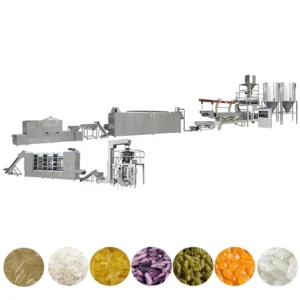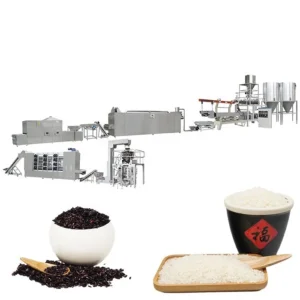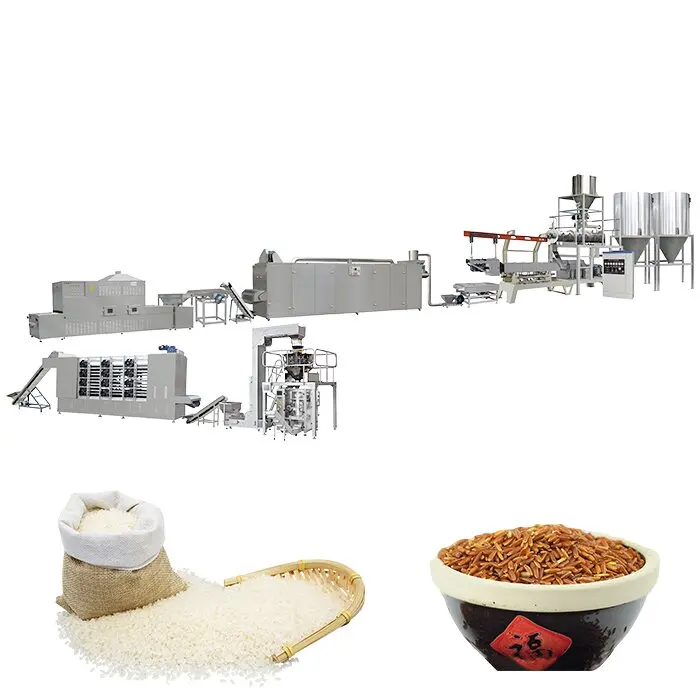

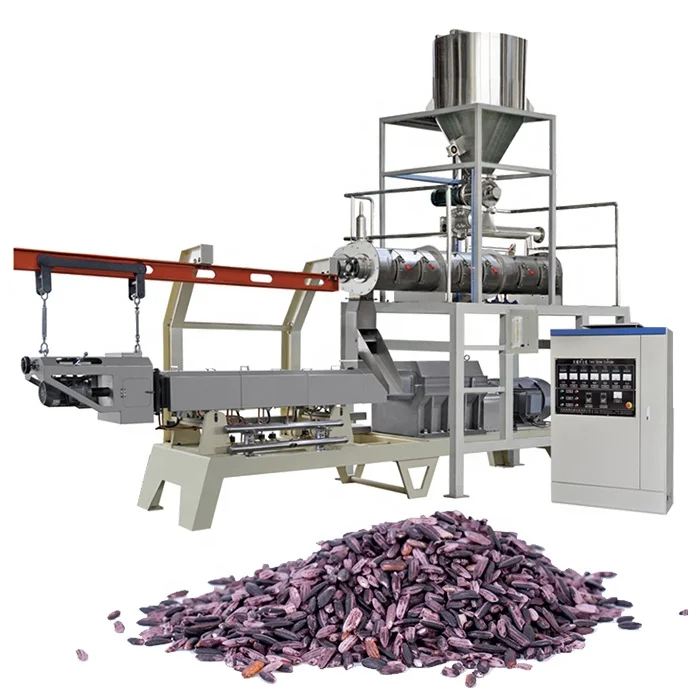


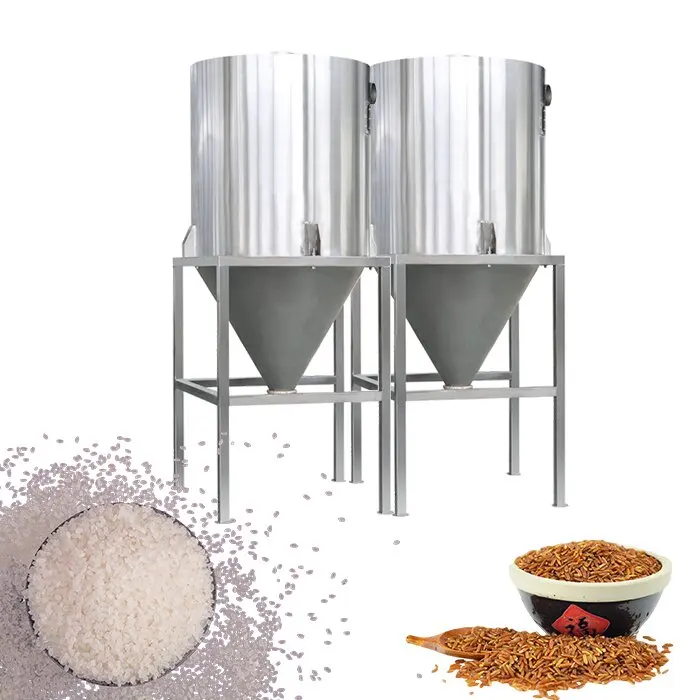
MT65 / MT70 / MT85 / MT75 / MT95 Fortified Artificial Rice Production Line, Twin-Screw Extruder, CE Certified — engineered as a complete turnkey project from mixing through packing.
- Line throughput validated at every station — extruder, dryer, cooler and packing — so rated output holds without downstream bottlenecking
- Screw configuration and die design matched to your raw material formulation and target kernel density
- Multiple capacity models available with electric or gas drying and frequency-controlled belt speed
In-house trial runs on your raw material before shipment ensure the screw profile and moisture parameters deliver the exact fortified rice kernel your market requires.
Description
Integrated Line Throughput — Every station from mixing to packing is capacity-balanced so the fortified rice extruder never waits on a slower dryer or cooler downstream.
Technical Specifications
| Parameter | Value |
|---|---|
| Product Type | Fortified Artificial Rice Production Line |
| Available Models | MT65 / MT70 / MT85 / MT75 / MT95 |
| Screw Type | Twin-screw |
| Installed Power Range | 85 kW (MT65) to 260 kW (MT95) |
| Power Consumption Range | 60 kW (MT65) to 195 kW (MT95) |
| Output Capacity | 80–1000 kg/h depending on model and formulation (basis to be confirmed) |
| Overall Dimensions | 28–36 m (L) × 1.2–3.5 m (W) × 2.2–4.3 m (H) depending on model |
| Line Stations | Mixing → Extruding → Vibrating → Low-temperature drying → Cooling → High-temperature roasting → Cooling → Packing |
| Control System | Frequency speed control with high automation |
| Screw Material | Wear-resistant alloy |
| Drying Oven Heating Source | Electric or gas |
| Lubrication | Automatic |
| Assembly State | Complete turnkey line |
| Standards | CE, ISO |
Application Suitability
| Application | Material or Output |
|---|---|
| Government and NGO nutrition programmes | Fortified rice kernels blended with vitamins and minerals |
| Commercial artificial rice production | Broken rice, rice flour, and rice bran reconstituted into whole kernels |
| Multigrain nutritional rice | Corn, millet, wheat, oats, and buckwheat blended with starch binders |
| Legume-based fortified grains | Bean flour and starch formulated into high-protein rice analogues |
| Institutional food supply chains | Shelf-stable fortified rice kernels for large-scale meal programmes |
Why "Rated Capacity" Means Nothing Without Raw Material Context
The output number on a nameplate only holds if your actual formulation behaves like the test formulation.
I worked on a project a few years back where a client in West Africa sourced a nutrition line based on a capacity figure that looked right on paper. Their local cassava starch had a completely different gelatinisation profile from the corn flour we used during the factory test. When the line started running on-site, the extruder could not achieve the same expansion, and throughput dropped noticeably. That experience shaped how I approach every fortified artificial rice production line turnkey project now — the capacity calculation must be tied to the buyer’s specific raw material, moisture content, and micronutrient premix ratio, not a generic benchmark [NEED_CITE: raw material variability in starch gelatinisation for extrusion].
How a Turnkey Layout Prevents Station Mismatches
A fortified artificial rice production line turnkey configuration is only as reliable as its weakest station. If the extruder produces at a rate the dryer cannot match, wet product accumulates on the belt and moisture levels drift out of specification. Our line layouts calculate throughput at every station — mixing batch size, extruder screw speed, dryer belt length and residence time, cooler capacity — so each piece of equipment is sized against the others rather than selected in isolation.
Screw Configuration and Die Design for Rice Kernel Formation
The twin-screw setup on these models allows the screw profile and die geometry to be matched to the specific grain blend and target kernel shape. Artificial rice requires a die that forms small, uniform kernels with consistent density so they cook evenly alongside natural rice. The screw configuration controls shear and residence time inside the barrel, which directly affects how completely the starch gelatinises. A poorly matched screw set will produce kernels that either disintegrate during cooking or remain too hard in the centre [NEED_CITE: twin-screw extrusion parameters for starch-based food products].
Reading the Power and Dimension Data
The installed power figures across the MT65 through MT95 range reflect the mechanical energy available for mixing, shearing, and pushing material through the die. Higher installed power on the MT85 and MT95 models supports the torque needed to process denser formulations with higher mineral premix loading. The dimension spread — from 28 m to 36 m in line length — tells you the floor space requirement grows with throughput class. The low-temperature drying and high-temperature roasting stages each occupy significant line length, and these sections cannot be shortened without reducing residence time and compromising kernel moisture uniformity. Frequency-controlled drive systems on the main extruder motor allow operators to adjust screw speed within the mechanical envelope, giving some flexibility to tune output once the line is running on the buyer’s actual material.
The Cost of Skipping a Pre-Shipment Trial Run
When a line ships without being tested on the buyer’s specific raw material, all the process tuning happens during on-site commissioning. That means your installation window extends, your first production batches may fall outside specification, and you might discover that a different screw element arrangement is needed — by which time the spare parts inventory on site may not include the right elements. A pre-shipment trial run in the factory testing workshop catches these mismatches early, so the screw and die configuration that arrives at your facility is already validated for your formulation [NEED_CITE: importance of factory acceptance testing in food extrusion projects].
Why Source the Complete Line From One Supplier
Having every station from batching through packing supplied and engineered by one team means throughput is calculated across the entire line, not just at the extruder. The screw configuration and die design are specified to the buyer’s raw material and target kernel shape, not copied from a generic build. An in-house testing workshop allows trial runs on the buyer’s actual grain blend and micronutrient premix before the line ships. The twin-screw extrusion expertise covers fortified rice alongside pet food, aquatic feed, and cereal applications, so process knowledge transfers across product categories. Pre-sales consultation through installation, commissioning, and ongoing maintenance is handled by the same engineering team that designed the layout.
Documentation & Verification
- Line layout drawing showing station-by-station throughput for your chosen model
- Trial run report generated on your grain blend and premix ratio before dispatch
- Electrical schematic with voltage, frequency, and control language confirmed for your market
- Screw and die configuration record documenting the element arrangement matched to your kernel specification
- CE declaration of conformity and ISO certificate for import and regulatory compliance
- Operation and maintenance manual with wear parts list specific to your model configuration
Installation, Commissioning & Support
- Floor plan and foundation requirements based on the selected model’s 28–36 m footprint and operating weight
- Dedicated electrical circuit sized to the model’s installed power, from 85 kW to 260 kW
- Line arrives in modular sections for staged assembly inside your facility
- First-run commissioning includes screw speed tuning and dryer temperature profiling on your material
- Operator training covers frequency control interface, automatic lubrication checks, and die changeover
- Wear parts list identifies screw elements and die inserts with reorder specifications for your configuration
What to Include in Your Inquiry
To configure the right line, share your primary grain ingredients, the micronutrient premix ratio you plan to use, and your target daily output. Include your workshop dimensions, ceiling height, and local voltage and frequency standards. If you have upstream milling or blending equipment already in place, specify its capacity so the new line can be matched accordingly.
Frequently Asked Questions
Q: How is line throughput verified across every station, not just the extruder?
A: The layout document calculates batch size at the mixer, output at the extruder, belt speed and residence time in the dryer and roaster, and packing speed. Each station is sized so material flows continuously without accumulation or starvation at any point in the fortified artificial rice production line.
Q: What does the phased installation and commissioning schedule look like?
A: The line arrives in modular sections that are assembled in sequence — extruder and vibrating screen first, then dryer and cooler, then packing station. Commissioning proceeds station by station, with process parameters tuned on your raw material before full-line continuous runs begin.
Q: Can a trial run be done on my raw material before the line ships?
A: Yes. You send a sample of your grain blend and micronutrient premix to the testing workshop. The trial run validates screw configuration, die selection, and dryer settings, and a report documenting the results is provided before the line is cleared for shipment.
Q: How are voltage, frequency, and control language confirmed for my market?
A: During the specification confirmation stage, your local electrical standards are documented on the electrical schematic. The control interface language and frequency drive parameters are set to match your facility’s power supply before production begins.
Q: What operator training is included, and how are wear parts supplied after handover?
A: Training covers daily operation, screw speed adjustment, automatic lubrication monitoring, and die changeover procedures. A wear parts list specific to your model is provided, identifying screw elements and die inserts with part numbers for reordering as maintenance intervals require.
Related products
-

High Productivity New Condition Safe Healthy and Nutritious Baby Food Meal Replacement Powder Production Line
¥30.00 Select options This product has multiple variants. The options may be chosen on the product page -
Healthy Baby Food Production Line Nutritional Powder Equipment for Baby Food Supplements for Flour Processing Machinery
¥8,500.00 Select options This product has multiple variants. The options may be chosen on the product page -
Automatic Nutritional Powder Making Machine Safe Rice Cereal for Babies
¥30.00 Select options This product has multiple variants. The options may be chosen on the product page -

High Quality Automatic PLC Controlled 500kg/h Twin Screw Extruder Machine for Baby Rice Nutrition Powder
¥8,238.27 Add to cart