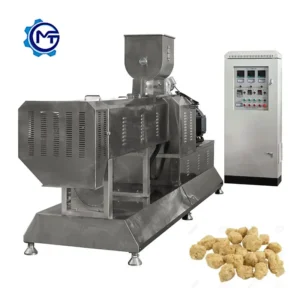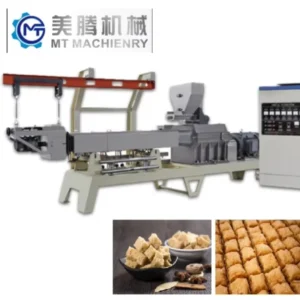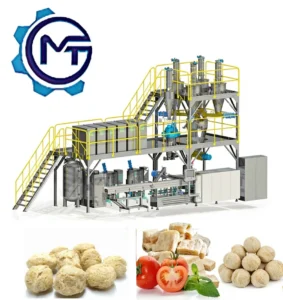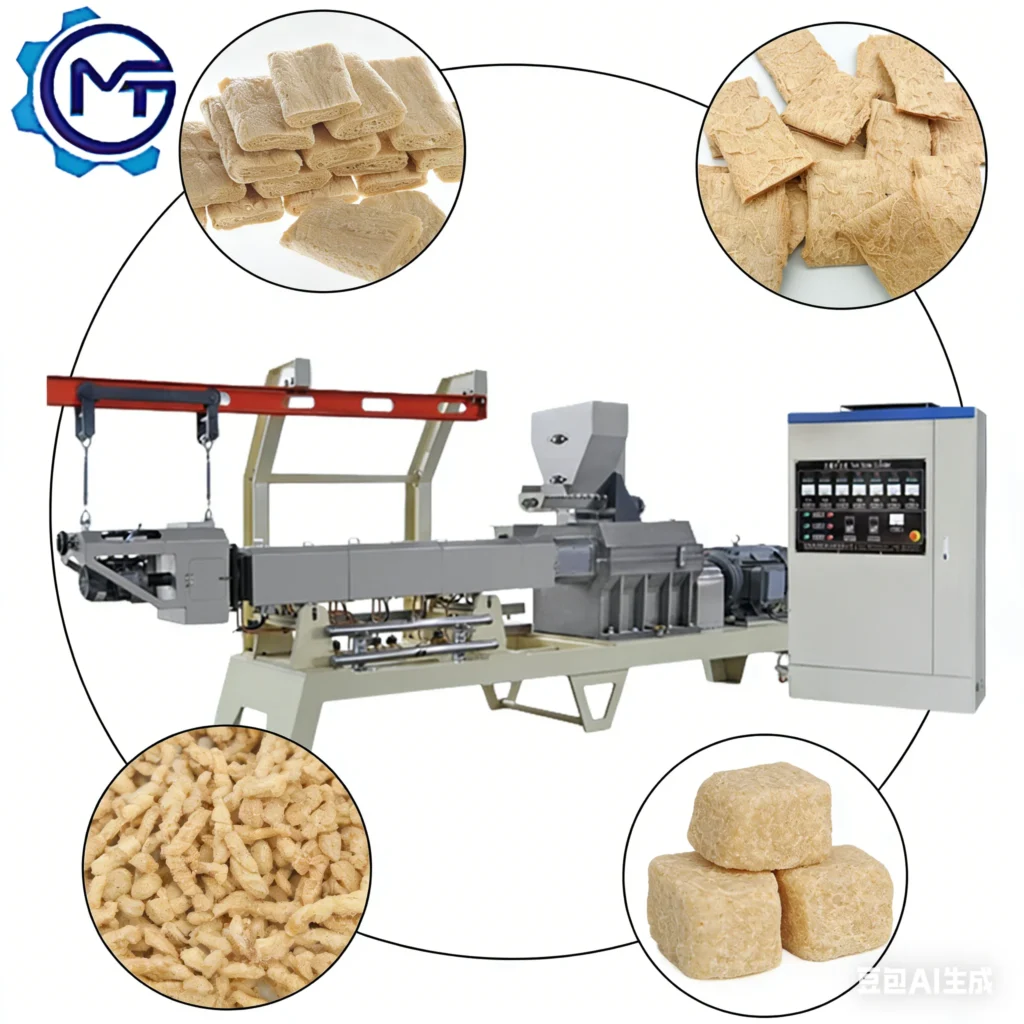
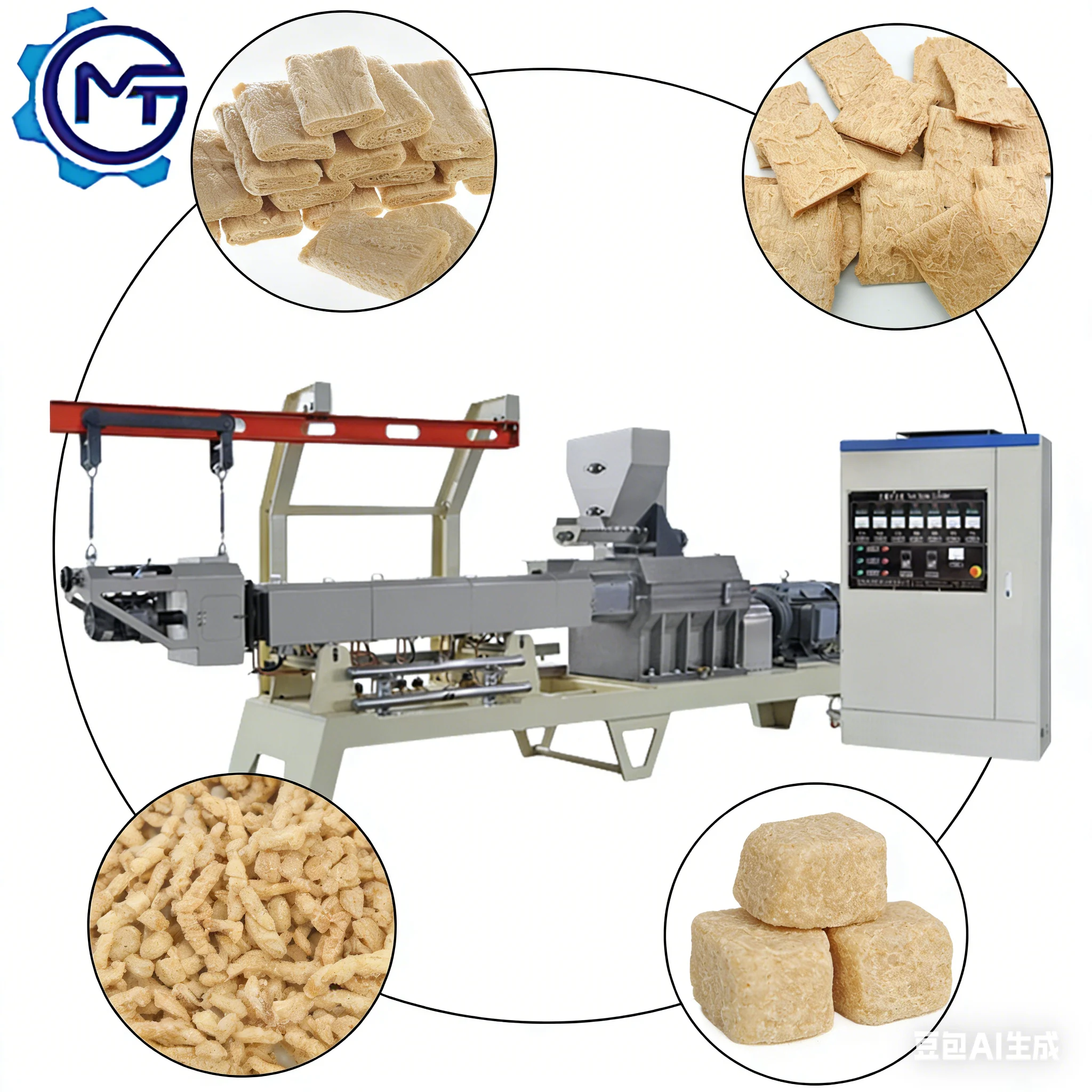

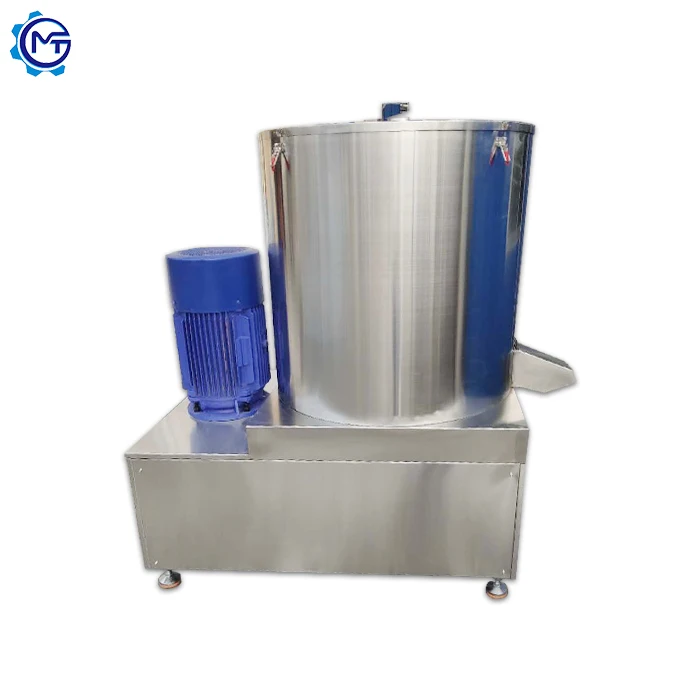
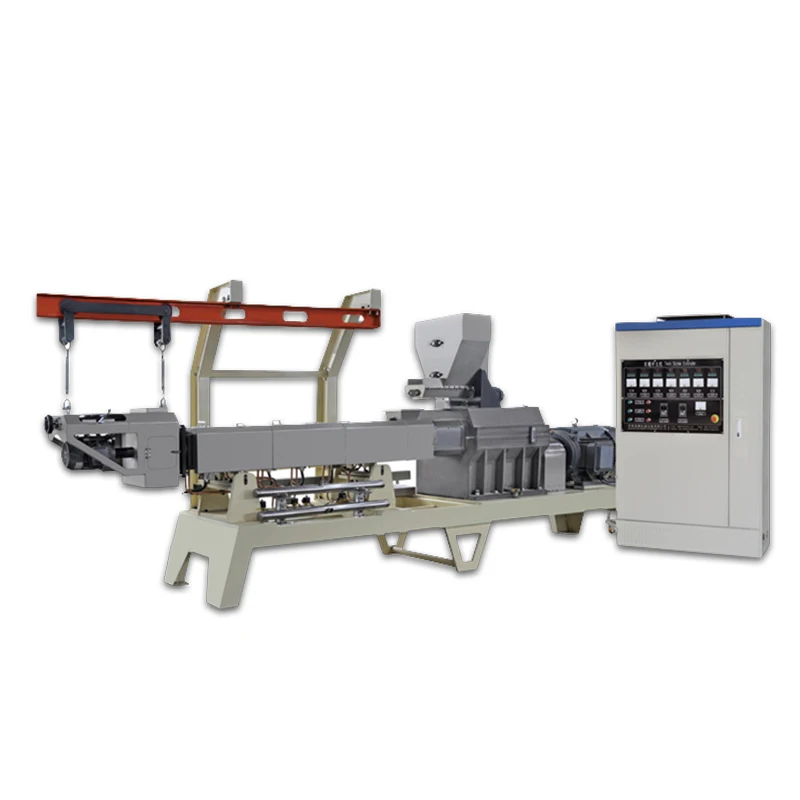

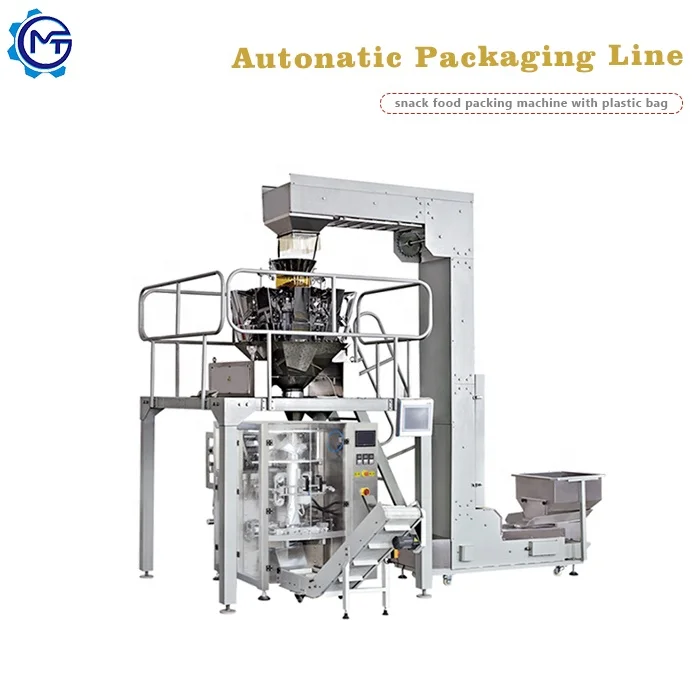
MT65 / MT70 / MT75 / MT85 High Moisture Vegetarian Meat Extrusion Production Line, Twin Screw, Multi-layer Dryer — configured as a complete turnkey system from batching through cooling, with each station sized to match throughput and eliminate bottlenecks. Screw configuration, die design, and barrel temperature profile are specified to your raw material and target fiber structure, verified by in-house trial runs before shipment.
- Food-grade stainless steel 304 contact materials throughout mixing station
- Dryer with selectable energy source (fuel / gas / electricity) and double-pitch roller chain drive
- CE and ISO certified, with full electrical schematic and voltage confirmation per destination market
Description
Integrated Line Engineering — Throughput matching across every station from batching to cooling eliminates the bottlenecks that typically emerge when extruders, dryers, and conveyors are sourced from separate vendors.
Technical Specifications
| Parameter | Value |
|---|---|
| Product Type | High Moisture Vegetarian Meat Extrusion Production Line |
| Model | MT65 / MT70 / MT75 / MT85 |
| Screw Type | Twin Screw |
| Screw Length | 1050 mm / 1520 mm |
| Installed Power | MT65: 84 kW / MT70: 160 kW / MT75: 190 kW / MT85: 210 kW |
| Power Consumption | MT65: 59 kW / MT70: 120 kW / MT75: 140 kW / MT85: 140 kW |
| Main Motor Power | 22 kW / 30 kW / 45 kW |
| Output Capacity | MT65: 100–150 kg/h (basis not stated in source — confirm raw material and moisture content); MT70: 150–200 kg/h (basis to be confirmed); MT75: 150–200 kg/h (basis to be confirmed); MT85: 250–300 kg/h (basis to be confirmed) |
| Overall Dimensions (L×W×H) | MT65: 40,000×1,200×2,200 mm / MT70: 41,000×1,500×2,200 mm / MT75: 43,000×1,500×3,200 mm / MT85: 45,000×1,500×3,500 mm |
| Rotary Cutting Motor | 0.75 kW |
| Feeding Motor | 0.75 kW |
| Pump Motor | 0.37 kW |
| Heating Power | 10 kW / 14 kW |
| Mixer Capacity | 20–30 kg / 70–80 kg / 170–180 kg |
| Mixer Power | 4 kW / 7.5 kW / 15 kW |
| Mixer Contact Material | Stainless Steel 304 |
| Mixer Shelf Material | Carbon Steel |
| Dryer Drive | Double Pitch Roller Chain |
| Dryer Energy Options | Fuel / Gas / Electricity |
| Line Stations | Mixer → Screw Conveyor → Twin Screw Extruder → Air Conveyor → Multi-layer Dryer → Cooling Machine |
| Standards | CE (certified since 2014), ISO |
Application Suitability
| Application | Material or Output |
|---|---|
| Soy protein meat analogues | Defatted soya flour, low-temperature soya flakes |
| Textured vegetable protein (TVP/TSP) | Soya flour with varying protein concentration |
| Soya chunks and nuggets | Defatted soya flour, soybean dregs |
| High-moisture layered fiber products | Low-temperature soya flakes, peanut dregs |
| Vegetarian meat blocks | Blended plant protein with starch and moisture |
| Cereal and snack formats (reconfigured) | Adjusted screw and die configuration required |
Why Nominal Capacity Figures Fail on Plant Protein Formulations
The throughput printed on a quotation rarely survives contact with the buyer’s actual raw material.
A plant based meat processing line turnkey quoted at a clean number often drops noticeably once the screw meets pea protein instead of soy, or once moisture content shifts by a few percentage points. I spent two extra weeks on-site in Southeast Asia recalibrating screw speed and feed ratio after a client swapped their formulation from the standard soy isolate we trialed to a regional pea protein blend. The fiber structure only stabilized after we rebuilt the screw profile from the third element onward. This mismatch is the single most common reason commissioning schedules slip past the planned window. [NEED_CITE: variability in plant protein extrusion behavior across raw material sources]
Barrel Temperature Profiling for Fiber Structure Control
High-moisture meat analogue extrusion depends on precise thermal management across multiple barrel zones. The heating system on these models delivers 10 kW to 14 kW distributed along the barrel, allowing operators to set a gradient that moves the protein through denaturation, alignment, and cooling phases within a single pass. Maintaining this gradient is what separates a fibrous, layered texture from a homogeneous paste. A plant based meat processing line turnkey without zone-level control cannot reliably produce the striated structure that end consumers associate with muscle-meat alternatives.
Screw Configuration as a Formulation-Specific Variable
Screw length options of 1050 mm and 1520 mm correspond to different residence times inside the barrel. Longer screws give high-protein formulations more shear exposure, which is necessary when working with materials that resist denaturation. Shorter configurations suit starch-heavy blends where excessive shear breaks down the binding matrix. During the commissioning phase, we match screw element arrangement — forwarding, kneading, and reverse elements — to the specific protein-to-starch ratio the buyer intends to run. [NEED_CITE: relationship between screw element sequence and protein fiber alignment in twin-screw extrusion]
Matching Extruder Output to Downstream Drying and Cooling
An extruder producing at the upper end of its range will overwhelm an undersized dryer, leaving product with residual moisture that compromises shelf life and texture. The multi-layer dryer on this line uses a double-pitch roller chain drive to move product through multiple temperature zones without jamming, and energy source selection between fuel, gas, and electricity allows the drying profile to match local utility costs. The cooling machine downstream must then bring the product to a stable temperature before packing. Every station on a plant based meat processing line turnkey is sized against the others so that no single point constrains overall throughput.
Power Allocation and Its Effect on Extrusion Stability
The main motor options of 22 kW, 30 kW, and 45 kW determine how much mechanical energy the screws can deliver to the material. High-protein formulations with low moisture content demand more torque to maintain consistent throughput, and undersized motors will stall or produce uneven density. Installed power ranges from 84 kW on the MT65 up to 210 kW on the MT85, accounting for heating, feeding, cutting, and conveying motors simultaneously. When we size a line for a buyer, we calculate the combined draw at peak load to ensure the facility’s electrical infrastructure can sustain continuous operation without tripping upstream breakers.
The Cost of Ignoring Raw Material Variability
Buyers who select a line based solely on a brochure capacity figure often discover during commissioning that their local protein source behaves differently from the trial material. The screw configuration optimized for one formulation may produce a dense, rubbery extrudate on another, requiring physical reconfiguration of screw elements and die geometry. This rework extends the commissioning window and delays revenue generation. [NEED_CITE: commissioning delays caused by raw material substitution in food extrusion projects] The downstream dryer may also need recalibration if the extrudate moisture profile changes, compounding the schedule impact.
Why Procurement Consolidation Matters for Throughput Matching
Sourcing the extruder from one vendor, the dryer from another, and the conveyor from a third introduces interface gaps that no single party owns. A plant based meat processing line turnkey under one supplier means throughput calculations span every station from the mixer to the cooling machine, and responsibility for balancing those stations sits with the line integrator. We specify screw configuration and die design against the buyer’s target product rather than applying a generic build. Our in-house testing workshop runs the buyer’s actual raw material before shipment, generating a trial report that documents achievable throughput and fiber structure under controlled conditions. The electrical schematic is confirmed for the destination market’s voltage and frequency before production begins, preventing the commissioning delays that arise from mismatched power supply.
Documentation & Verification
- Line layout showing throughput matching from mixer through cooling machine for your target capacity
- Screw and die configuration record specific to your plant protein formulation and target texture
- Trial run report on your raw material conducted in our testing workshop before dispatch
- Electrical schematic with voltage and frequency confirmed for your facility’s power supply
- CE declaration of conformity and ISO certificate for customs and regulatory clearance
Installation, Commissioning & Support
- Foundation must support the longest configuration at 45,000 mm length with leveled anchor points
- Dedicated circuit sized for up to 210 kW installed power with voltage confirmed before energizing
- Line arrives in modular sections requiring on-site assembly and alignment across all six stations
- First run includes screw speed, barrel temperature, and feed ratio calibration on your formulation
- Operator training covers screw element swaps and die changes for product changeovers
- Wear parts list provided with recommended replacement intervals for screws, dies, and chain drive
What We Need to Configure Your Line
To prepare a layout and capacity calculation, share your primary protein source and its typical moisture content, your target product format (chunks, nuggets, or layered blocks), and your planned daily output. Include your facility’s available floor length and ceiling height, as the line footprint ranges up to 45 meters. Confirm your local voltage and frequency, preferred control language, and whether you want to send a raw material sample for a pre-shipment trial run.
Frequently Asked Questions
Q: How is line capacity verified on my specific plant-protein raw material before shipment?
A: We run your actual formulation through the extruder in our in-house testing workshop, documenting throughput, moisture content, and fiber structure in a trial report. This confirms what the line produces with your material rather than relying on nominal figures derived from standard soy isolates.
Q: What is the phased installation and commissioning schedule for a complete turnkey line?
A: The line arrives in modular sections. Assembly begins with the extruder and dryer, followed by conveyor and cooling integration. Commissioning covers mechanical alignment, electrical verification against your facility voltage, and process calibration using your raw material formulation.
Q: How do you ensure throughput is matched between extruder, dryer, and cooling stations?
A: Each station is sized during the line design phase against the extruder’s verified output on your specific formulation. The dryer belt speed and temperature zones, along with cooling machine capacity, are calculated to handle the extrudate volume without creating upstream backlog or downstream starvation.
Q: How are screw configuration and die design selected for high-moisture meat analogue fiber structure?
A: We select screw element arrangement and die geometry based on your protein source, target moisture level, and desired fiber alignment. Longer screw barrels provide extended residence time for high-protein blends, while die aperture and land length control the expansion and lamination of the final extrudate.
Q: What voltage, frequency, and control language options are confirmed before production?
A: We confirm your facility’s electrical supply specifications and preferred operator interface language during the engineering phase. The electrical schematic is finalized and approved before manufacturing begins, ensuring the motor ratings, heating elements, and control panels match your site conditions upon arrival.
Related products
-
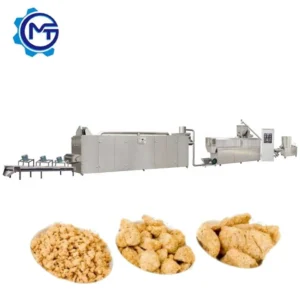
New Pea and Soybean Protein Production Line Equipment with Mechanical Extruder Food Grade Stainless Steel High Productivity
¥65.00 Select options This product has multiple variants. The options may be chosen on the product page -
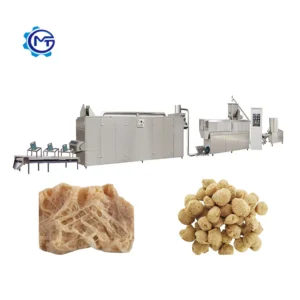
New High Efficiency Protein Production Line Plant Protein Equipment for Artificial Vegetarian Meat Processing Food Grade
¥65.00 Select options This product has multiple variants. The options may be chosen on the product page -
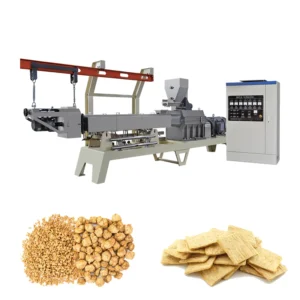
New Condition Soybean Protein Machine for Soy Chunks Production Textured Vegetable Protein Production Line
¥30.00 Select options This product has multiple variants. The options may be chosen on the product page -
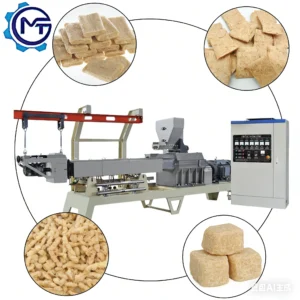
High Moisture Vegetarian Meat Extrusion Machine
¥9,500.00 Select options This product has multiple variants. The options may be chosen on the product page