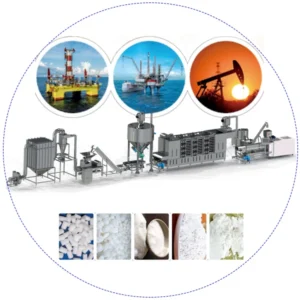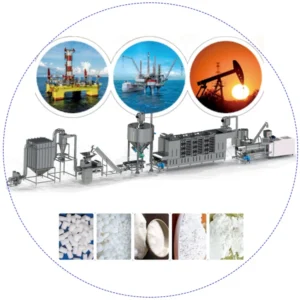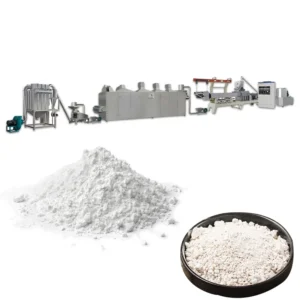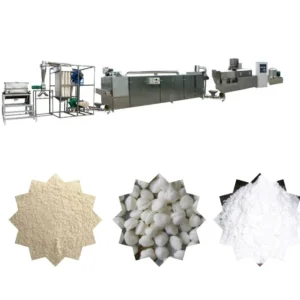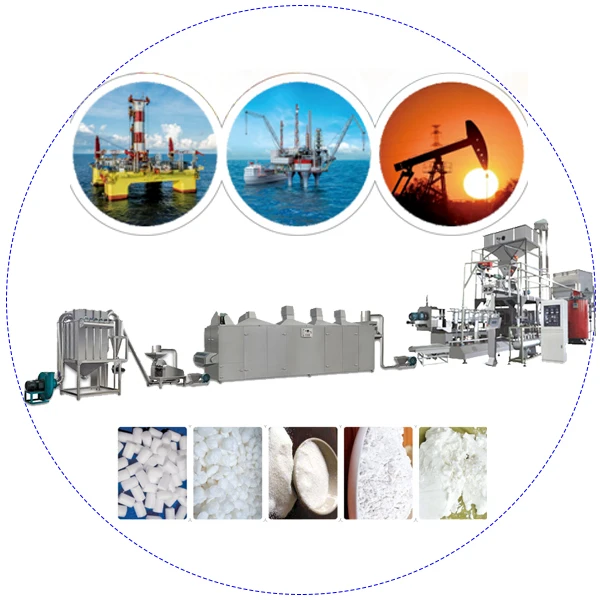
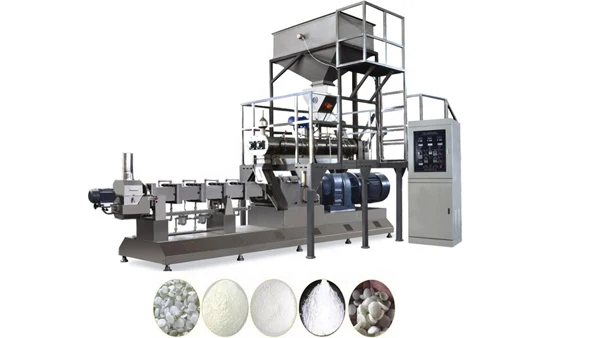


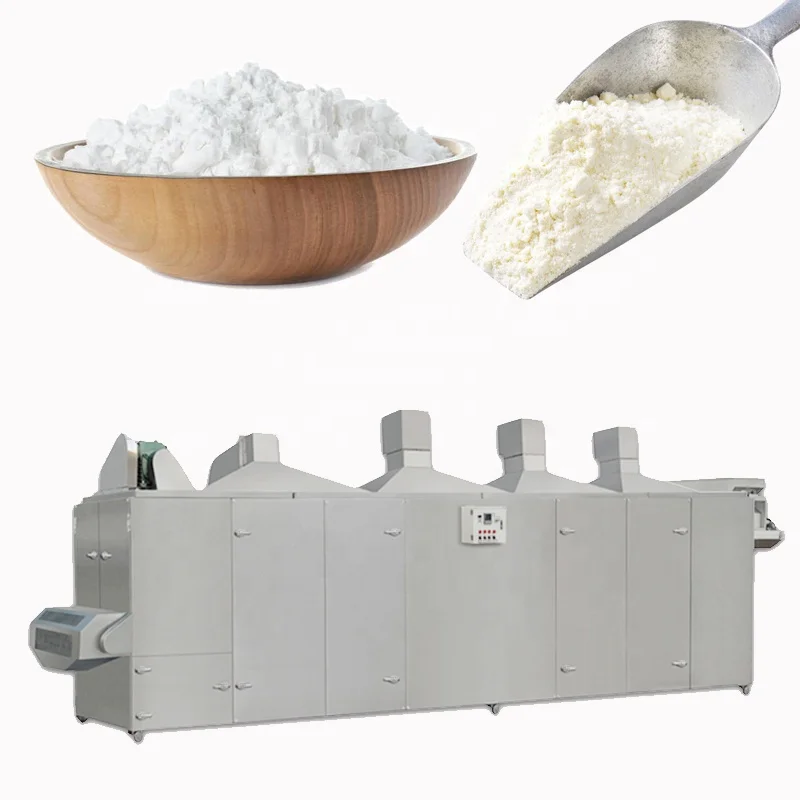
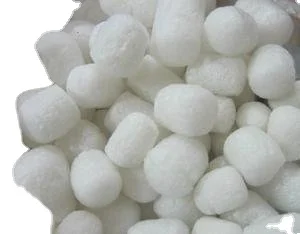
Modified and Pregelatinized Starch Extrusion Line, Twin-Screw, Food-Grade 304 Contact Parts — engineered as a complete turnkey project from batching through drying and grinding. Every station is throughput-matched under one layout, with screw configuration and die design specified to your starch source and target modification degree. Flexible energy options (electricity, gas, diesel, steam) adapt to local utility conditions, while interchangeable dies allow product form changes without line redesign.
- Capacity verified on your raw material in our testing workshop before shipment
- Electrical schematic confirmed to your local voltage and frequency
- On-site installation, commissioning and operator training included
Description
Throughput-Matched Engineering — Every station from batching to grinding is calibrated as one integrated project, ensuring the extruder output never waits on the dryer or the grinder falls behind the conditioner.
Technical Specifications
| Parameter | Value |
|---|---|
| Product Type | Modified and Pregelatinized Starch Extrusion Line |
| Screw Type | Twin screw |
| Output Capacity | 80–500 kg/h (basis not stated in source — confirm raw material type, moisture content and target starch modification degree) |
| Raw Materials | Wheat flour, corn starch, potato starch |
| Barrel & Screw Element Material | 45 steel (screw element), food-grade 304 stainless steel (contact parts) |
| Frame Material | Stainless steel 201 |
| Rated Power | ~100 kW (electric heating) / 50–60 kW (gas or diesel heating) |
| Energy Options | Electricity, gas, diesel, steam |
| Voltage & Frequency | Three phase 380V/50Hz, single phase 220V/50Hz (customizable to local supply) |
| Motor Brand | Siemens (China) or equivalent top-tier Chinese brand |
| Inverter | Delixi or Delta |
| Mixer Motor | 4.0 kW |
| Mixer Batch Output | 3.0–4.0 kg per batch (verify against final configuration) |
| Screw Conveyor Motor | 1.1 kW |
| Screw Conveyor Throughput | 0–150 kg/h (verify against final configuration) |
| Die Configuration | Interchangeable dies for different product forms |
| Line Sequence | Mixer → Screw Conveyor → Twin Screw Extruder → Shifter → Air Conveyor → Dryer → Air Conveyor → Conditioning → Conveyor → Grinder |
| Standards | CE |
| Warranty | 1 year |
Application Suitability
| Application | Material or Output |
|---|---|
| Pregelatinized starch for instant food and nutritional powders | Corn starch, cassava starch, potato starch |
| Modified starch as thickening and stabilizing agent | Wheat flour, corn starch |
| Industrial modified starch for paper and non-food use | Corn starch, potato starch |
| Starch gelatinization and viscosity modification | Wheat, corn, potato, cassava sources |
Why Nominal Capacity Quotations Fail on Starch Lines
A modified starch processing line turnkey quotation that lists only a peak kilogram-per-hour figure — without naming the starch source, moisture level, or target modification degree — is the single most common cause of commissioning disappointment. [NEED_CITE: industrial starch processing line commissioning failures linked to capacity mismatch]
The capacity number means nothing without the raw material context attached to it.
I saw this firsthand last month when a Southeast Asian customer ordered a pregelatinized starch line quoted at a comfortable mid-range output. We ran trial tests on cassava starch and everything tracked to spec. Then the customer switched to corn starch for actual production — same moisture, same barrel profile — and the expansion dropped noticeably. The screw combination had to be completely reworked. Cassava gelatinizes at a lower temperature and responds differently to shear than corn does. A line built around one feedstock will underperform on another unless the screw elements, barrel heating zones, and die geometry are specified for that exact material. [NEED_CITE: starch gelatinization temperature variation across botanical sources]
Screw Configuration Dictates Starch Behaviour Under Shear
The twin-screw extruder at the heart of this modified starch processing line turnkey system uses 45 steel screw elements arranged in a configuration chosen after reviewing the buyer’s specific starch source and target modification degree. Forward-conveying elements, kneading blocks, and reverse elements are combined in ratios that control residence time and shear intensity. Corn starch, with its higher amylose content, requires a different shear profile than waxy maize or potato starch to achieve consistent gelatinization without over-degradation. The barrel is segmented with independent heating zones, allowing a precise temperature ramp from feed intake through the die — critical when viscosity curves differ between starch types.
Matching Dryer and Conditioner Capacity to Extruder Output
One of the most frequent mistakes in starch line procurement is treating the extruder as an isolated purchase and sourcing the dryer separately. When the dryer cannot evaporate moisture fast enough to keep pace with extruder output, wet product backs up and gelatinization quality degrades. On this modified starch processing line turnkey project, the dryer and conditioning stages are sized together with the extruder during the layout phase. The air conveyor between stations is rated for the same throughput envelope, so material never accumulates in transfer points. The conditioning step after drying allows moisture equalization before the grinder, which is essential for achieving uniform particle size in the final pregelatinized starch powder. [NEED_CITE: moisture equalization requirements in starch drying before milling]
Reading the Specification Sheet Like a Process Engineer
The rated power split — roughly 100 kW for electric heating versus 50–60 kW for gas or diesel — reflects how much thermal energy the barrel zones demand during continuous starch gelatinization. Electric heating offers finer zone-by-zone temperature control, which matters when processing heat-sensitive modified starches where a few degrees of overshoot can alter viscosity. Gas or diesel heating reduces electrical load, which is significant in regions where industrial power tariffs are high or three-phase supply is limited.
The food-grade 304 stainless steel contact parts are non-negotiable for starch intended for food or nutritional applications, while the 201 stainless steel frame keeps structural costs reasonable without compromising hygiene in non-contact zones. The Delixi or Delta inverters on the main drive allow screw speed adjustment during commissioning, letting operators fine-tune shear rate once actual raw material is running through the barrel. The interchangeable die system means the same extruder can produce different starch pellet forms — useful when a producer supplies both instant-food-grade pregelatinized starch and industrial-grade modified starch from one line.
The Hidden Cost of Skipping the Trial Run
Buying a starch extrusion line without a pre-shipment trial on your actual raw material means your first real test happens after installation, with your production schedule already committed. If the screw combination is wrong for your corn or cassava source, reconfiguring the barrel on-site takes days of downtime and requires spare elements that may not be in the initial shipment. [NEED_CITE: extrusion line reconfiguration downtime when screw profile is mismatched to feedstock] Conditioners and grinders tuned for one particle size distribution will produce inconsistent output when fed material that expanded differently than expected. The electrical configuration — voltage, frequency, control language — if unconfirmed before shipping, delays commissioning further while transformers or control panels are sourced locally.
Why This Line Is Engineered as One Project
Every station on this modified starch processing line turnkey system is specified under one supplier, so throughput is matched across the mixer, conveyor, extruder, dryer, conditioner, and grinder rather than assembled from unrelated vendors. The screw configuration and die design are documented specifically for the buyer’s raw material and target starch modification degree, not copied from a generic build. Pre-shipment trial runs in the in-house testing workshop use the customer’s actual starch source, so expansion, gelatinization degree, and particle size are validated before the line leaves the factory. Electrical schematics confirm voltage, frequency, and control language for the destination market before production begins. The twin-screw expertise behind this line covers starch, protein, and cereal applications, meaning the engineering team understands how starch behaves differently from other extruded materials.
Documentation & Verification
- Line layout drawing with throughput calculations matched across every station
- Screw element arrangement and die configuration record for your starch source
- Trial run report on your raw material conducted before shipment
- Electrical schematic confirming voltage, frequency, and control panel language
- CE declaration of conformity for the complete processing line
- Wear parts list with recommended spare screw elements and die inserts
Installation, Commissioning & Support
- Foundation and floor space planning based on the full ten-station line footprint
- Dedicated power circuit sizing for the ~100 kW electric heating configuration or gas supply routing
- Assembly and alignment of all conveyor and dryer sections on site
- First-run parameter setting: barrel zone temperatures, screw speed, and die pressure tuned to your starch
- Operator training covering screw changeover, die swap, and daily cleaning procedures
- Spare screw elements and die inserts supplied with initial shipment for first replacement cycle
What We Need to Configure Your Line
To prepare an accurate layout and quotation for your modified starch processing line turnkey project, share your starch source — corn, cassava, potato, or wheat — along with the target modification degree or end-use specification. Include your local voltage and frequency so the electrical design matches your facility supply. Let us know your available workshop footprint and ceiling height, and whether you need the line to integrate with existing upstream batching or downstream packing equipment. If you can send a sample of your raw material, we will run it in our testing workshop before finalizing the screw configuration.
Frequently Asked Questions
Q: How is line capacity verified against my specific starch source?
A: Before quotation, we run your actual corn, cassava, potato, or wheat starch through the twin-screw extruder in our testing workshop. We measure expansion, gelatinization degree, and throughput at steady state. The capacity figure in the final proposal always carries the raw material type and moisture content it was measured on, so there is no ambiguity at commissioning.
Q: What voltage and frequency options are available for my market?
A: The line ships in three-phase 380V/50Hz or single-phase 220V/50Hz by default, and we configure motors, heaters, and control panels to match your local utility specification. Voltage and frequency are confirmed during the specification review stage before production begins, and the electrical schematic documents every component rating for your records.
Q: How are the dryer and conditioner sized relative to extruder output?
A: During the layout phase, the dryer evaporation rate and conditioner residence time are calculated against the extruder’s verified throughput on your starch source. This ensures wet product never accumulates between stations and that moisture equalization is complete before grinding. The entire sequence is designed as one project under one supplier.
Q: Can screw configuration and die design change if I alter my product target?
A: Yes. The twin-screw barrel accepts rearranged screw elements and interchangeable dies, so the same extruder can shift between pregelatinized starch and different modified starch forms. We document each configuration, and if you plan to run multiple products, we can specify a screw and die set for each during the initial design phase.
Q: What does on-site installation and operator training include?
A: Our team handles station alignment, utility connections, and first-run parameter tuning on your actual raw material. Operators are trained on screw changeover procedures, die swaps, barrel temperature adjustment, and daily maintenance routines. A wear parts list and recommended spare inventory are reviewed before handover so replacements are on site when needed.
Related products
-
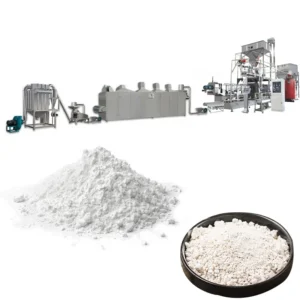
API Standard Pregelatinized Starch Line for Oilfield Drilling Fluid. High Yield Modified Starch Equipment
¥65.00 Select options This product has multiple variants. The options may be chosen on the product page -
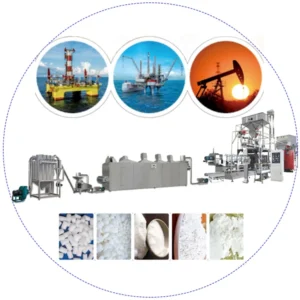
New Automatic Modified Starch Puffing Production Line – Long Service Life Pregelatinized Starch Equipment
¥65.00 Select options This product has multiple variants. The options may be chosen on the product page -
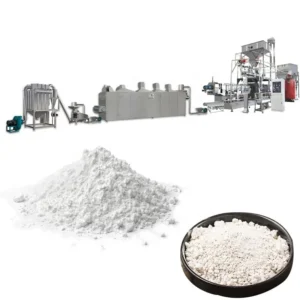
Corn Cassava Modified Starch Powder Production Line Electric-powered Motor Automatic 400kg/h Processing Equipment New Condition
¥65.00 Select options This product has multiple variants. The options may be chosen on the product page -
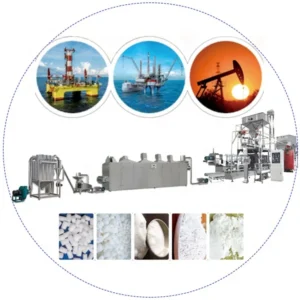
Automatic Industrial Adhesive Starch Modification Production Line – Pre-Gelatinization Extrusion Equipment
¥65.00 Select options This product has multiple variants. The options may be chosen on the product page