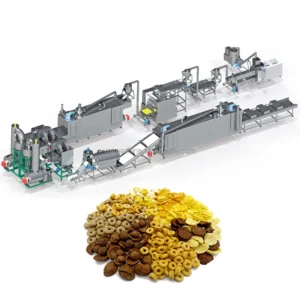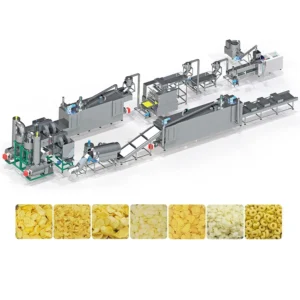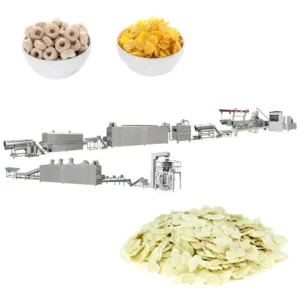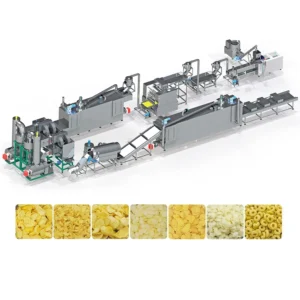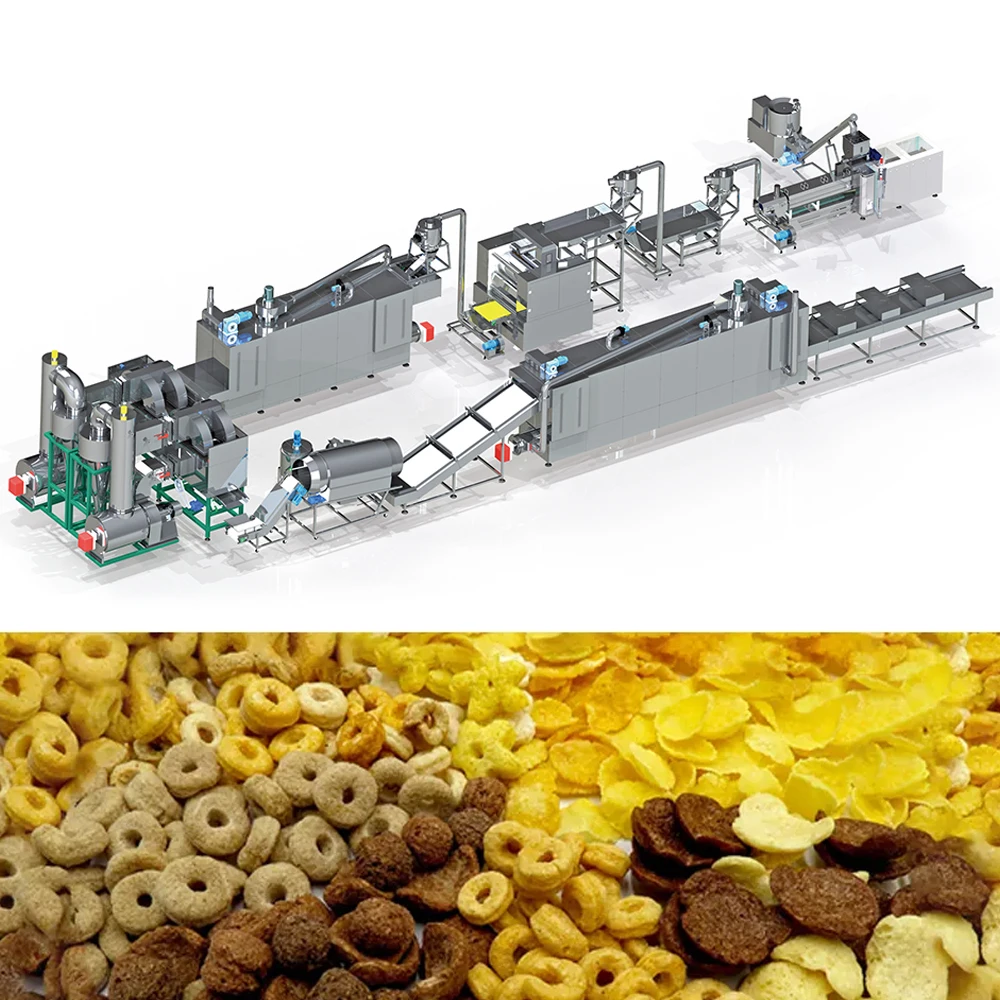
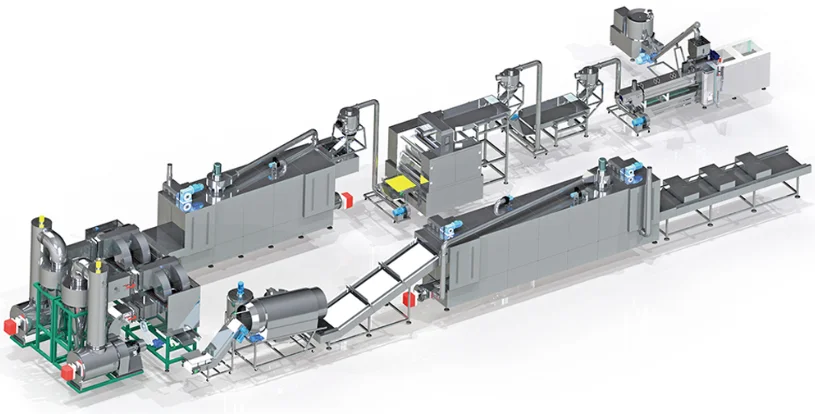


MT70 / MT85 / MT75 Corn Flakes Breakfast Cereal Production Line, Twin-Screw Extrusion, PLC Control — configured for natural and sugar-coated flakes from corn, rice, wheat, oat, or barley.
- Screw configuration and die design specified to your grain blend and target flake density
- Hydraulic double-roller flaking with infrared temperature monitoring for uniform sheet thickness
- Hot air roasting with dual circulating fans and cyclone dust removal for consistent blister and crispness
- Trial runs on your raw material in our testing workshop before shipment, with full report provided
Description
Turnkey Throughput Matching — Every station on this corn flakes production line, from batching to packing, is sized against the extruder’s verified output so no single workstation caps your actual throughput below nameplate capacity.
Technical Specifications
| Parameter | Value |
|---|---|
| Product Type | Corn Flakes Breakfast Cereal Production Line |
| Models Available | MT70, MT85, MT75 |
| MT70 Installed Power | 160 kW |
| MT70 Power Consumption | 120 kW |
| MT70 Output Capacity | 150–200 kg/h (basis not stated in source) |
| MT70 Overall Dimensions | 41 × 1.5 × 2.2 m |
| MT85 Installed Power | 190 kW |
| MT85 Power Consumption | 140 kW |
| MT85 Output Capacity | 300–400 kg/h (basis not stated in source) |
| MT85 Overall Dimensions | 43 × 1.5 × 3.2 m |
| MT75 Installed Power | 210 kW |
| MT75 Power Consumption | 150 kW |
| MT75 Output Capacity | 300–500 kg/h (basis not stated in source) |
| MT75 Overall Dimensions | 45 × 1.5 × 3.5 m |
| Extruder Type | Twin Screw |
| Flaking System | Hydraulic double-roller, dual motor drive, infrared temperature sensor |
| Dryer Heating Source | Gas or Electric (selectable) |
| Roasting Oven | Hot air with dual circulating fans, vibrating pan, cyclone dust removal |
| Coating System | Double tumble sugar melting, elevator, coating drum, spray nozzle |
| Control | PLC and MCC available |
| Voltage Options | Configurable; 415V 50/60Hz, 440V 50/60Hz, 220V 60Hz referenced |
| Certifications | CE, ISO |
Application Suitability
| Application | Material or Output |
|---|---|
| Natural corn flakes for retail breakfast cereal | Corn grits or corn flour |
| Sugar-coated corn flakes for food service and retail | Corn base with sugar glaze or syrup coating |
| Multi-grain breakfast flakes | Blends of corn, rice, wheat, oat, and barley powder |
| Extruded cereal snack shapes | Ball, tube, stick, ring, fruit loop, star, wheel, flower, heart via die change |
| Fortified nutrition flakes for programme supply | Grain blends with added vitamin and mineral premix |
Why the Flaker and Dryer Decide Your Actual Line Capacity
A corn flakes production line turnkey is only as fast as its slowest downstream station, and that station is rarely the extruder.
I spent a season in a Thai cereal plant where the extruder ran fine but wet flakes piled up before the press roller. The dryer could not keep pace, so the sheet came out uneven and partly raw in the centre. The rated extruder output meant nothing because the flaking and drying stages were undersized for the actual moisture load. When a corn flakes production line turnkey is quoted on extruder capacity alone, the flaker gap, dryer belt length, and roaster residence time often get treated as afterthoughts [NEED_CITE: typical bottlenecks in flaked cereal line throughput]. That mismatch shows up on day one of commissioning, not in the brochure.
Screw and Die Configuration Against Your Grain Blend
Twin-screw extrusion gives operators control over shear, residence time, and moisture injection across the barrel zones. The screw elements and die plate on the MT70, MT85, and MT75 are selected after reviewing the buyer’s grain formulation — corn alone behaves very differently from a corn-rice-oat blend in terms of gelatinisation temperature and expansion at the die face. A configuration that works for pure corn grits may produce a dense, under-expanded sheet when barley or oat is introduced, because those grains alter the starch profile and water absorption rate.
How the Flaking Stage Controls Final Sheet Uniformity
The flaking machinery uses a hydraulic double-roller system with separate motors driving each roller, which maintains consistent nip pressure across the full sheet width. Infrared sensors monitor roller surface temperature in real time, because even a few degrees of drift can change how the cooked grit adheres to the roller and releases as a flake. Uniform sheet thickness directly determines how evenly the flakes toast in the roasting oven — thick spots stay chewy while thin spots scorch [NEED_CITE: effect of flake thickness variance on roasting uniformity in cereal processing].
Reading the Power and Capacity Data Across Three Models
The MT70 at 160 kW installed and 120 kW consumption suits pilot-scale or specialty cereal runs where batch flexibility matters more than volume. The MT85 and MT75 step up to 190–210 kW installed power and correspondingly larger dimensions, accommodating wider barrel assemblies and higher screw torque for continuous production. Output ranges listed for each model carry a note that the basis — raw material type and moisture content — must be confirmed during the trial phase, because corn grits at one moisture level will yield a different mass throughput than a multi-grain blend at another. The PLC control system ties the extruder feeder, barrel heaters, and cutter into one loop so that operator adjustments propagate consistently rather than requiring manual synchronisation at each station.
What Happens When Downstream Stations Are Undersized
When the dryer belt is too short or the roaster airflow is inadequate for the extruder’s actual wet output, partially dried flakes reach the packing station with residual moisture that causes clumping in the bag within days. Coating drums that cannot match the upstream feed rate create a backlog that forces the extruder to idle, wasting energy and degrading the cooked mass sitting in the barrel. These are not defects in any single machine — they are line integration failures that appear only when the stations are sourced from different vendors who each quote their equipment in isolation [NEED_CITE: cereal line integration failures from unmatched station capacity].
Engineering the Line as One Project
Every station from the batching mixer through the extruder, flaker, dryer, roaster, coater, and packing conveyor is laid out as a single integrated project, so throughput calculations start at the packing end and work backward. The screw configuration and die design are specified to the buyer’s raw material and target flake density, not copied from a generic build. An in-house testing workshop runs trial production on the buyer’s actual grain blend before the line ships, generating a trial report that documents real output, flake dimensions, and roasting behaviour. Electrical schematics confirm voltage, frequency, and control language before fabrication begins, avoiding commissioning delays on site.
Documentation & Verification
- Line layout drawing showing station spacing, conveyor lengths, and utility drop points for your factory floor
- Capacity calculation sheet matching each station’s throughput to your confirmed grain blend and moisture level
- Screw element arrangement and die plate drawing recorded against your specific corn or multi-grain formulation
- Trial run report from the testing workshop documenting flake thickness, expansion, and roasting results on your material
- Electrical schematic with confirmed voltage, frequency, phase, and PLC language before production starts
- CE declaration of conformity and ISO certificate for customs and local regulatory filing
Installation, Commissioning & Support
- Foundation plan accounting for the 41–45 m line length and individual station load points
- Dedicated power circuit sizing for 160–210 kW installed load depending on selected model
- Modular station delivery with sequenced rigging plan for extruder, flaker, dryer, and roaster placement
- First-run parameter setting covering barrel temperature zones, roller nip gap, and roaster airflow balance
- Operator training on PLC interface, recipe recall, and hydraulic flaker pressure adjustment
- Wear parts list covering screw elements, die plates, and roller surfaces with recommended replacement intervals
Before You Send the Inquiry
To scope a corn flakes production line turnkey that matches your actual production target, share your grain formulation including any premix additions, your target daily output in finished product weight, and the voltage and frequency standard at your facility. If you have existing upstream milling or downstream packing equipment, include those specifications so the line can be designed around confirmed interface points rather than assumed ones.
Frequently Asked Questions
Q: How is line capacity verified against my specific grain blend and moisture content?
A: Before shipment, a trial run is conducted in the in-house testing workshop using your actual raw material. The resulting report documents real throughput, flake dimensions, expansion behaviour, and roasting performance. Capacity figures quoted for the MT70, MT85, or MT75 are then confirmed against that data rather than left as generic nameplate values.
Q: How do you ensure the dryer and coater are not bottlenecking the extruder output?
A: The line layout begins with a throughput calculation at the packing station and works backward through roasting, drying, flaking, and extrusion. Each station’s belt speed, airflow, or drum volume is sized to handle the wet mass output from the extruder at your confirmed recipe, so no single station forces the extruder to idle.
Q: What voltage and control language options are confirmed before build?
A: The electrical schematic is finalised with your facility’s voltage, frequency, and phase before fabrication starts. Referenced options include 415V and 440V at 50/60Hz as well as 220V 60Hz. The PLC interface language is set to match your operators’ requirement so that commissioning does not stall on translation issues.
Q: Can I run a trial on my raw material before shipment, and what does the trial report include?
A: Yes. The testing workshop processes your grain blend through the extruder, flaker, and a representative drying cycle. The trial report records extruder parameters, screw configuration, flake sheet thickness, moisture reduction across the dryer, and roasting colour and blister formation, giving you documented proof of line performance before it leaves the factory.
Related products
-
Cereales Copos de Maíz con Azúcar Máquina de Extrusión de Copos de Maíz Línea de Producción de Cereal para Desayuno
¥23,000.00 Select options This product has multiple variants. The options may be chosen on the product page -
Máquina automática para la fabricación de cereales de desayuno instantáneos y alimentos para bocadillos
¥10,000.00 Select options This product has multiple variants. The options may be chosen on the product page -
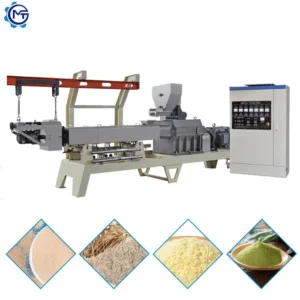
Nueva máquina para hacer comida para bebés en polvo nutricional de cereales instantáneos automática técnica
¥10,000.00 Select options This product has multiple variants. The options may be chosen on the product page -
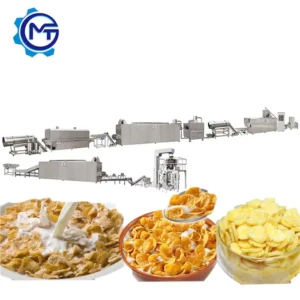
Máquina automática de fabricación de copos de maíz de 500 kg/h Nueva condición Alta productividad Línea de procesamiento de cereales dulces para el desayuno Desde la fábrica
¥8,500.00 Select options This product has multiple variants. The options may be chosen on the product page