

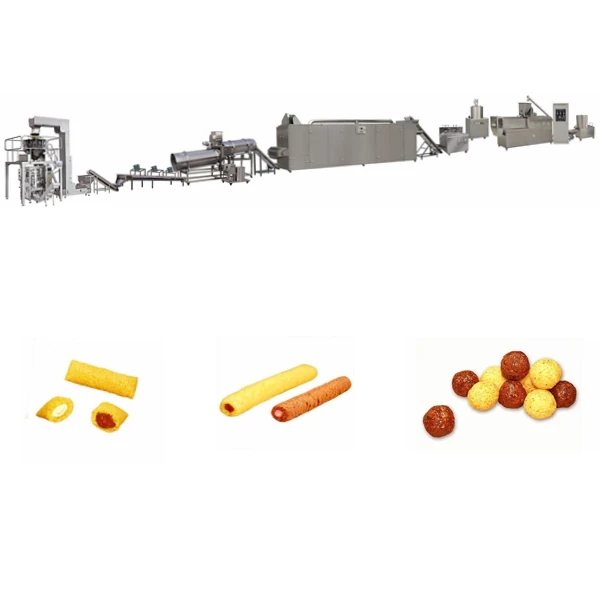
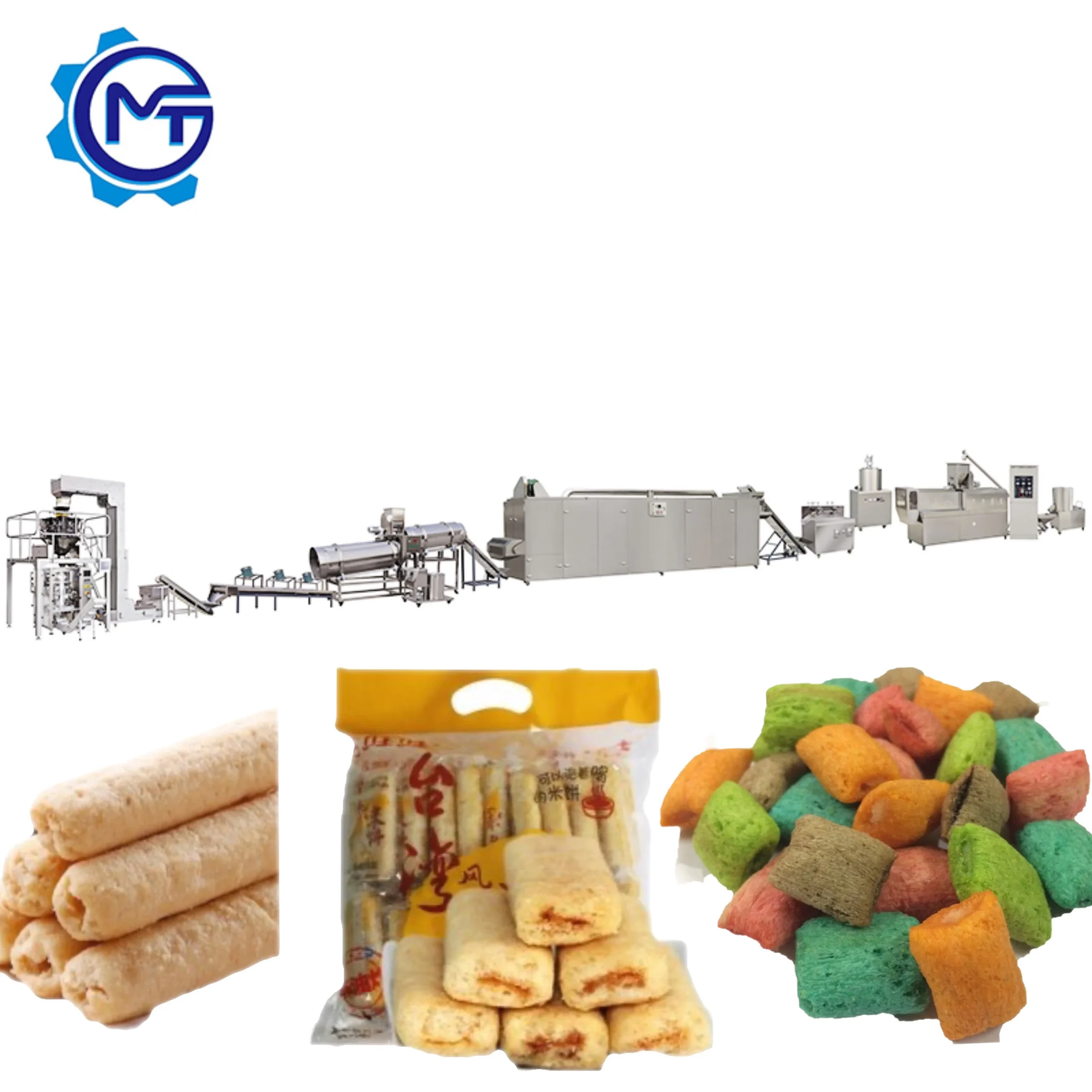
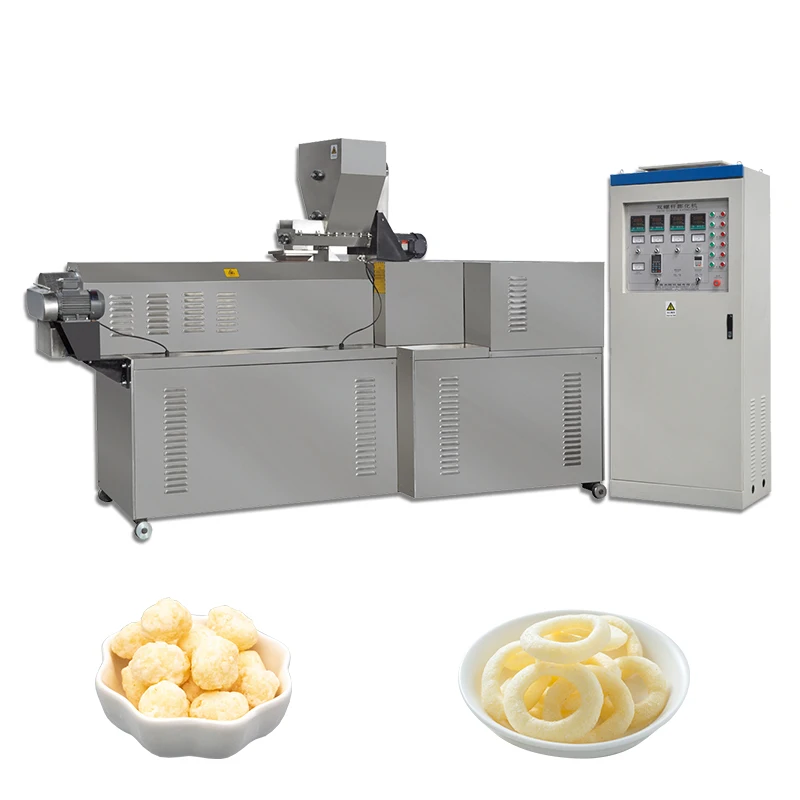
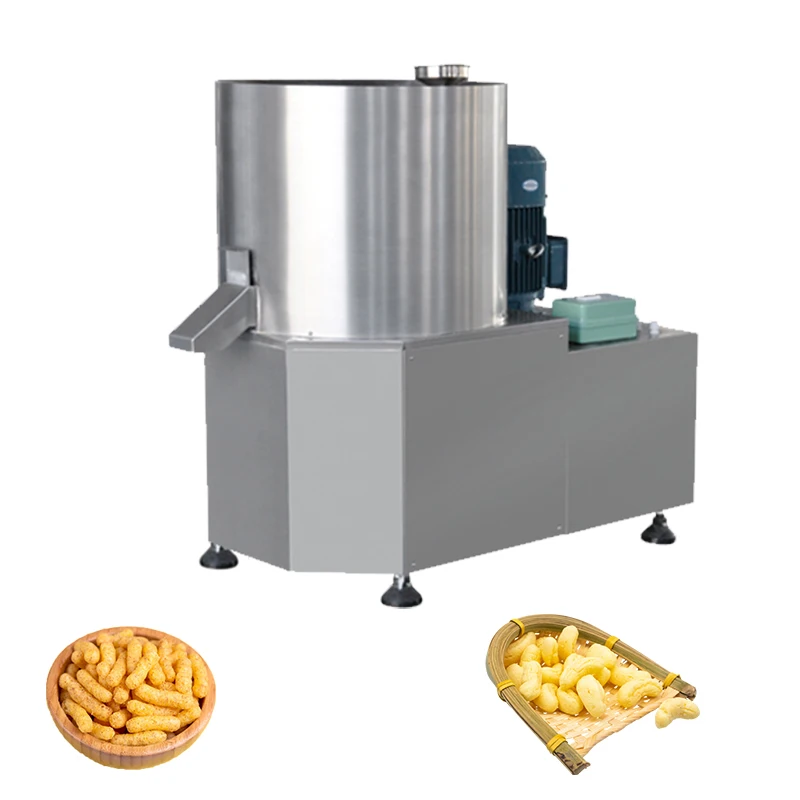
MT70 / MT85 / MT75 Twin Screw Extrusion Puffed Snack Production Line, 130–220 kW Installed Power, PLC and MCC Control — throughput-matched across mixing, extruding, drying, coating, cooling and packing to prevent downstream bottlenecks. Interchangeable dies enable multiple snack shapes on one extruder, with screw configuration specified to your raw material.
- Line layout, trial run on your actual raw material, and electrical schematic with confirmed voltage and frequency included before shipment.
Description
Throughput-matched layout — every station from batching to packing is sized to the extruder’s actual output on your grain formulation, preventing the downstream bottlenecks that occur when equipment is sourced from separate vendors.
Technical Specifications
| Parameter | Value |
|---|---|
| Product Type | Twin Screw Extrusion Puffed Snack Production Line |
| Models Available | MT70, MT85, MT75 |
| Screw Type | Twin screw |
| Installed Power | MT70: 130 kW; MT85: 180 kW; MT75: 220 kW |
| Power Consumption | MT70: 95 kW; MT85: 120 kW; MT75: 130 kW |
| Output Capacity | MT70: 100–120 kg/h (basis to be confirmed); MT85: 200–300 kg/h (basis to be confirmed); MT75: 300–500 kg/h (basis to be confirmed) |
| Overall Dimensions (L×W×H) | MT70: 21 × 1.5 × 2.2 m; MT85: 25 × 1.5 × 2.2 m; MT75: 28 × 1.5 × 2.2 m |
| Control System | PLC and MCC control |
| Die Configuration | Interchangeable dies (ball, tube, stick, ring, fruit loop, star, wheel, flower, heart) |
| Dryer Heating Source | Gas or Electric |
| Coating System | Double tumble sugar melter, elevator, coating drum, spraying nozzle |
| Screw Feature | Automatic lubricating and cooling function |
| Assembly State | Complete turnkey line |
| Standards | CE (since 2014), ISO certified |
Application Suitability
| Application | Material or Output |
|---|---|
| Puffed corn snacks | Corn flour, corn grits |
| Extruded rice snacks | Rice flour, rice grits |
| Multi-grain puffed snacks | Wheat, oat, and barley flour blends |
| Core-filled or coated snacks | Grain base with sugar or flavour coating |
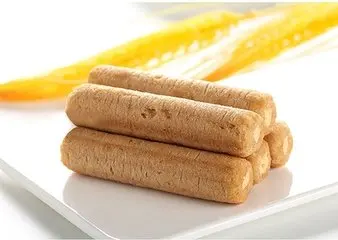
| Shaped snack formats | Cheese balls, tubes, sticks, rings, fruit loops, stars, wheels, flowers, hearts |
Why Extruder Output Rarely Matches the Nameplate in Snack Production
A puffed snack production line turnkey is only as fast as its slowest matched station.
I spent years installing extruders on factory floors and learned that a machine rated for a certain throughput on one corn grit blend can drop significantly when the buyer switches to a coarser local grain. The screw flights cannot grab the material at the same rate, the barrel fill drops, and the whole line starves. When a factory is planned around a nameplate figure that was never verified on the actual raw material, the dryer runs half-empty and the coating drum tumbles air [NEED_CITE: extruder throughput dependency on raw material particle size and moisture]. That is why we treat capacity as something to be proven on your specific formulation before the line ships, not something quoted from a catalogue.
Matching Every Station to the Extruder’s Real Throughput
A puffed snack production line turnkey fails when one station is undersized relative to the others. If the dryer cannot handle the moisture load coming off the extruder, product backs up and quality drops. We size each station — mixing, conveying, drying, coating, cooling, packing — against the extruder’s verified output so that material flows continuously without accumulation or starvation at any transfer point.
Designing the Layout Around Your Factory Footprint
The physical arrangement of a puffed snack production line turnkey determines how operators move, how utilities connect, and how maintenance access is maintained. We draft a line layout that accounts for your building dimensions, utility entry points, and material flow direction. This is not a generic drawing; it is a floor plan built around the specific model — MT70, MT85, or MT75 — and the clearances each station requires for service access and safe operation.
Reading the Specifications Beyond the Brochure Numbers
The three extruder models span installed power from 130 kW on the MT70 up to 220 kW on the MT75, with power consumption correspondingly ranging from 95 kW to 130 kW. In twin-screw extrusion, the screw configuration and barrel temperature profile together determine how completely starch gelatinises inside the cavity [NEED_CITE: starch gelatinisation mechanics in twin-screw extrusion]. The interchangeable die system allows a single extruder to produce balls, tubes, sticks, rings, fruit loops, stars, wheels, flowers, and hearts, meaning shape changes do not require a second capital purchase. The automatic lubricating and cooling function on the screws reduces wear during extended production runs and maintains consistent barrel temperature. Dryer heating is configurable between gas and electric, which matters when local energy costs differ sharply between the two sources.
The Cost of Skipping a Pre-Shipment Trial Run
When an extruder arrives at a site without having been tested on the buyer’s actual raw material, commissioning becomes product development. Screw combinations are swapped, die holes are resized, and dryer temperatures are adjusted while the line sits idle. Each day of on-site troubleshooting is a day without saleable output. The coating system may also need re-calibration if the tumbling speed was set for a different product density than what the extruder actually produces [NEED_CITE: snack coating calibration to extrudate density]. These delays compound when spare screws and dies are not on hand for the first configuration change.
Why Source This Line from a Single Project Supplier
Completing a puffed snack production line turnkey from one supplier means throughput is calculated across every station rather than assembled from mismatched vendor quotes. Screw configuration and die design are specified to your raw material and target product shape, not copied from a generic build. An in-house testing workshop allows trial runs on your actual grain formulation before shipment, so product development is done at our facility, not on your factory floor. Pre-sales engineering covers line layout and utility planning, and on-site installation includes commissioning and operator training. Ongoing support covers wear parts supply and maintenance guidance for the life of the equipment.
Documentation & Verification
- Line layout and capacity calculation showing throughput matching across every station
- Trial run report on your specific grain formulation confirming output and product density
- Screw and die configuration record matched to your target snack shape
- Electrical schematic with voltage and frequency confirmed for your local grid
- CE declaration of conformity and ISO certificate for customs and regulatory filing
- Operation and maintenance manual with wear parts list and replacement intervals
Installation, Commissioning & Support
- Foundation plan reflecting the MT75 footprint of 28 × 1.5 × 2.2 m and utility drop points
- Dedicated circuit sizing based on the MT85 installed power of 180 kW
- Sectional delivery with on-site assembly and alignment of all line stations
- First-run parameter setting on your raw material including barrel temperature profile
- Operator training covering screw changes, die swaps, and coating drum calibration
- Wear parts list with lead times for replacement screws, dies, and spray nozzles
What We Need to Configure Your Line
To build an accurate layout and quotation, we need your target snack shape, the grain or flour blend you plan to run, and the hourly output you expect from the line. Please also share your factory floor dimensions, ceiling height, and local voltage and frequency so we can confirm the electrical package before production starts. If you have existing upstream or downstream equipment that must integrate with the new line, let us know the connection points and throughput of those machines.
Frequently Asked Questions
Q: How is line capacity verified on my specific raw material before shipment?
A: We run your actual grain formulation through the extruder in our testing workshop. The screw configuration and die are adjusted until the output and product density meet your specification. A trial run report documenting throughput, moisture content, and product dimensions is shared before the line is crated for dispatch.
Q: How do you ensure dryer and coating capacity matches the extruder output?
A: Every station is sized during the layout phase based on the extruder’s verified throughput on your material. The dryer length and heating capacity are calculated to handle the moisture load, and the coating drum volume and spray rate are matched to the extrudate flow so no station becomes a bottleneck.
Q: What does the turnkey project scope cover from design to commissioning?
A: The scope includes line layout, utility planning, equipment supply, on-site installation, commissioning on your raw material, and operator training. We also provide electrical schematics, a screw and die configuration record, and a maintenance manual with a wear parts list for long-term operation.
Q: How do you handle voltage, frequency, and control language for different markets?
A: Before production begins, we confirm the voltage, frequency, and plug standard for your facility and configure the MCC and PLC accordingly. Control language is set to your preference, and the electrical schematic reflects these choices so your local electricians can service the panels without ambiguity.
Q: What does phased installation look like for an expanding facility?
A: We sequence delivery and installation so that existing production continues while the new line is assembled. Utility connections are prepared in advance, and commissioning is scheduled around your production calendar to minimise downtime during the transition period.
Related products
-

Línea de procesamiento de puff de maíz con mezclador, freidora, horno de horneado, máquina automática de alta productividad para la fabricación de productos de grano y snacks.
¥8,300.00 Select options This product has multiple variants. The options may be chosen on the product page -

Línea de procesamiento de bocadillos inflados completamente automática
¥8,500.00 Select options This product has multiple variants. The options may be chosen on the product page -

Línea de Alimentos de Snacks de Maíz Inflado Equipos de Producción de Bolas de Arroz Infladas
¥10,565.00 Select options This product has multiple variants. The options may be chosen on the product page -

Nueva línea de procesamiento de maíz inflado para alimentos, extrusora automática de maquinaria para snacks de acero inoxidable de alta calidad para la industria alimentaria.
¥12,350.00 Select options This product has multiple variants. The options may be chosen on the product page


