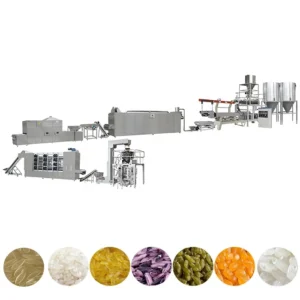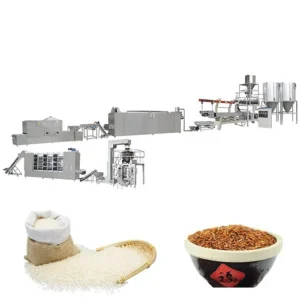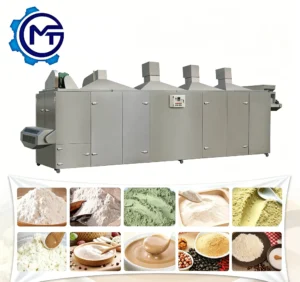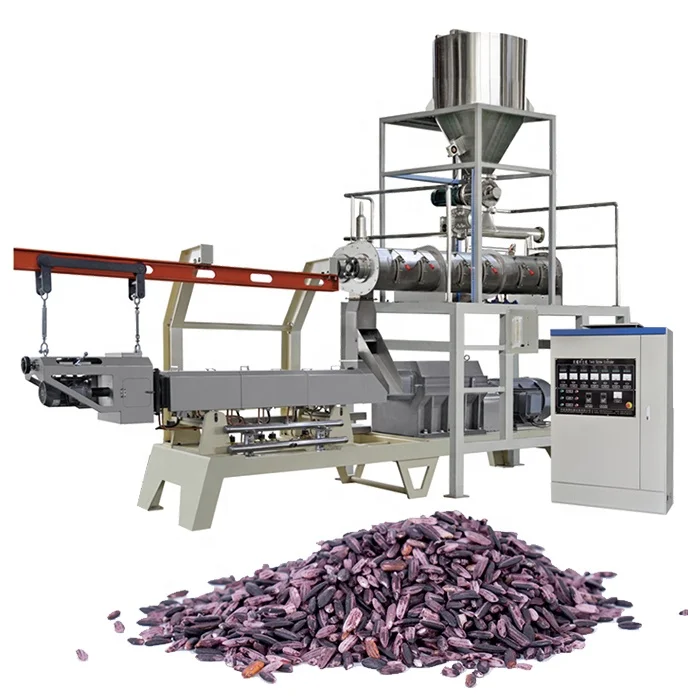
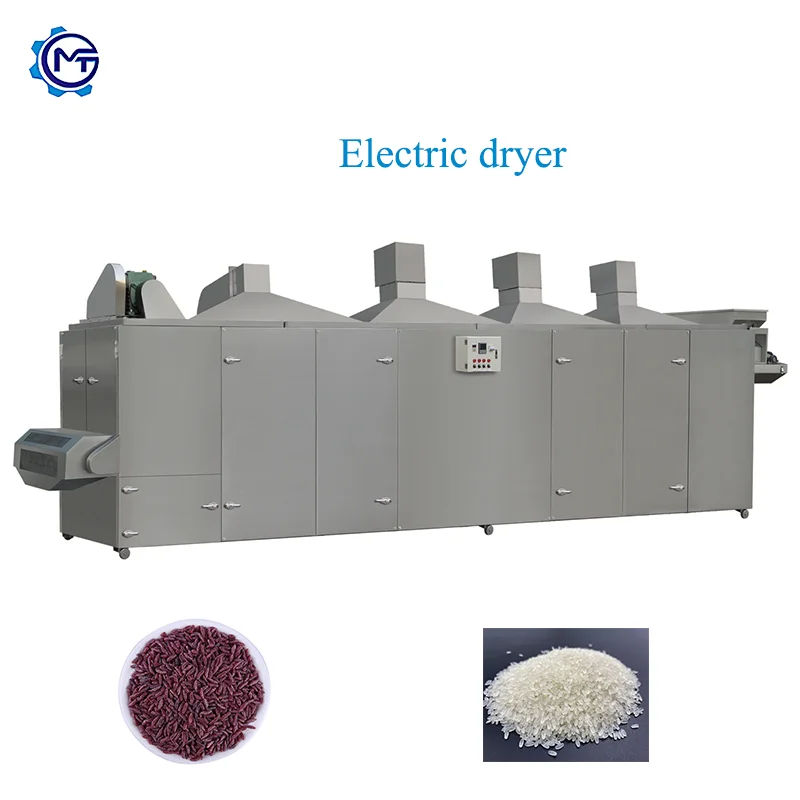
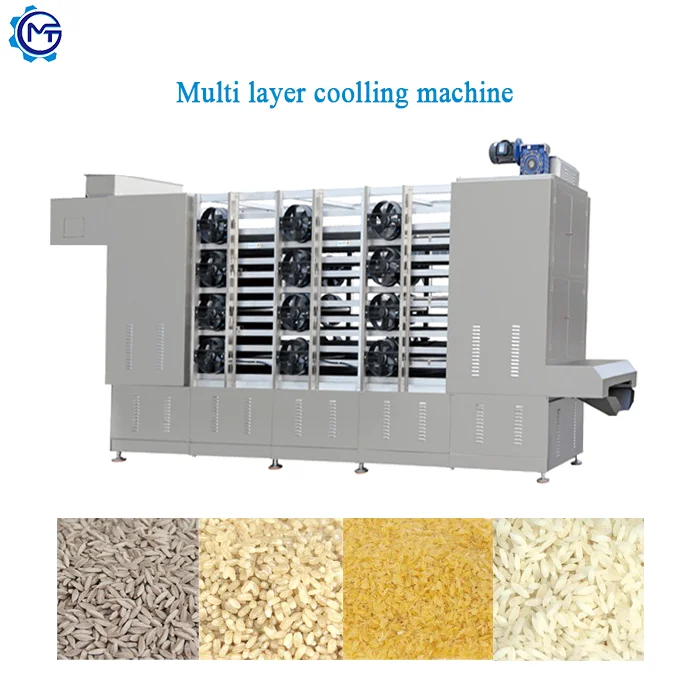
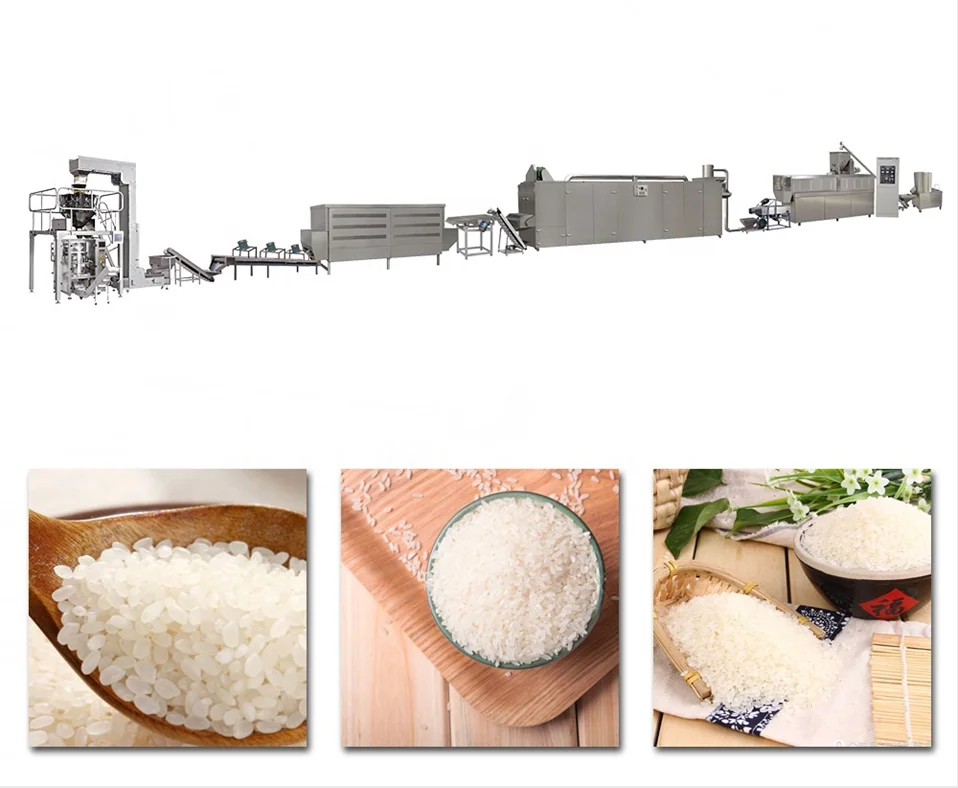
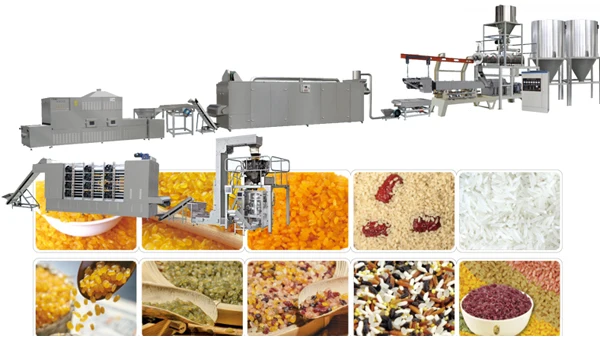
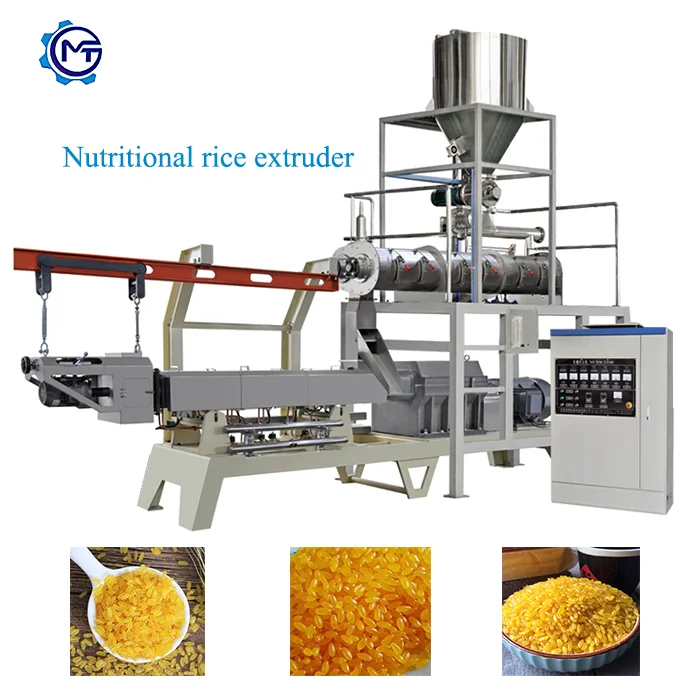
MT65 / MT70 / MT85 / MT75 / MT95 Artificial Nutritional Rice Production Line, Twin-Screw Extrusion, PLC Control — engineered as a complete turnkey project from batching through extrusion, drying, roasting and packing.
- Screw configuration and die design matched to your raw material formulation and target kernel density
- Circulation drying with frequency-controlled mesh belt for precise moisture adjustment across the product profile
- Throughput balanced at every station so no single unit bottlenecks the line
- Models from MT65 to MT95 cover pilot-scale to industrial volume requirements
Trial runs on your actual raw material are completed in our testing workshop before shipment, with a full report documenting real output and product specification.
Description
Throughput Balanced from Mixing to Packing — Every station on this artificial nutritional rice production line turnkey is sized against the actual extruder output on your grain formulation, preventing the dryer or cooler from becoming an unplanned bottleneck once the line is running.
Technical Specifications
| Parameter | Value |
|---|---|
| Product Type | Artificial Nutritional Rice Production Line |
| Models Available | MT65, MT70, MT85, MT75, MT95 |
| Screw Type | Twin-screw |
| Control System | Frequency speed control, high automation |
| Feeding System | Single or double screw feeding (selected according to material uniformity) |
| Lubrication | Automatic lubricating and cooling system |
| Screw Material | Wear-resistant alloy, extended service life |
| Drying Oven Heating Source | Electric or gas |
| Drying Oven Feature | Circulation drying process, frequency motor controlled mesh belt speed |
| Basic Materials | Broken rice, rice, corn, millet, wheat, oats, buckwheat, bean, starch, vitamin and mineral additives |
| Production Procedure | Mixing → Extruding → Vibrating → Low temperature drying → Cooling → High temperature roasting → Cooling → Packing |
| Final Products | Artificial rice, fortified rice kernels |
| Overall Capacity Range | 100–1000 kg/h (based on different models and raw material formulation) |
| MT65 Installed Power | 85 kW |
| MT65 Power Consumption | 60 kW |
| MT65 Capacity | 80–100 kg/h (basis to be confirmed on actual raw material formulation and moisture content) |
| MT65 Dimensions | 28 × 1.2 × 2.2 m |
| MT70 Installed Power | 120 kW |
| MT70 Power Consumption | 85 kW |
| MT70 Capacity | 100–120 kg/h (basis to be confirmed) |
| MT70 Dimensions | 30 × 1.5 × 2.2 m |
| MT85 Installed Power | 235 kW |
| MT85 Power Consumption | 165 kW |
| MT85 Capacity | 200–300 kg/h (basis to be confirmed) |
| MT85 Dimensions | 34 × 3.5 × 4.3 m |
| MT75 Installed Power | 180 kW |
| MT75 Power Consumption | 135 kW |
| MT75 Capacity | 300–500 kg/h (basis to be confirmed) |
| MT75 Dimensions | 32 × 3.5 × 4.3 m |
| MT95 Installed Power | 260 kW |
| MT95 Power Consumption | 195 kW |
| MT95 Capacity | 800–1000 kg/h (basis to be confirmed) |
| MT95 Dimensions | 36 × 3.5 × 4.3 m |
| Certifications | CE, ISO |
Application Suitability
| Application | Material or Output |
|---|---|
| Fortified food and nutrition programs | Micronutrient-enriched rice kernels from broken rice and starch blends with vitamin and mineral additives |
| Rice milling by-product valorization | Artificial rice kernels reconstituted from broken rice, rice bran, and milled grain fractions |
| Grain processing plant diversification | Fortified rice kernels from corn, millet, wheat, oats, and buckwheat formulations for consumer and institutional markets |
Why the Stated Capacity Rarely Matches Your Actual Output
The number on the quotation is only valid if your raw material formulation and moisture content match the test conditions behind it.
I have seen buyers compare two artificial nutritional rice production line turnkey proposals purely on the capacity figure printed in the spec sheet, then discover during commissioning that their multigrain formula behaves nothing like the supplier’s standard rice flour. The extruder barrel fills differently, the die pressure shifts, and what was rated at a certain throughput drops because the material simply cannot be pushed through at that rate. [NEED_CITE: raw material formulation impact on extrusion throughput consistency]. When the dryer and cooler were already sized to that original number, product backs up and you end up running the entire line below nameplate capacity just to keep the downstream stations from flooding.
Throughput Matching Across Every Station
A complete artificial nutritional rice production line turnkey involves at least eight distinct processing stages from initial mixing through final packing. Each station has its own throughput curve depending on the moisture content, bulk density, and residence time of the material passing through it. The twin-screw extruder might process a given volume per hour, but the low-temperature drying stage requires a specific retention period on the mesh belt to pull moisture down uniformly, and that belt speed is controlled by a frequency motor to allow adjustment.
Why Layout Comes Before Quotation
Before any pricing discussion makes sense, the line layout needs to account for your workshop dimensions, utility connection points, and material flow direction. The MT85 model alone requires a footprint of 34 × 3.5 × 4.3 m for the core extrusion and drying section, and that does not include the upstream mixing and batching area or the downstream cooling and packing stations. [NEED_CITE: industrial food processing line layout planning standards]. A proper layout proposal maps every conveyor, transition, and utility drop so that installation follows a known sequence rather than requiring field improvisation.
What the Extrusion Parameters Actually Control
The twin-screw configuration is central to how this line handles grain-based formulations. Screw elements are arranged in zones that control conveyance, mixing, shear, and pressure buildup before the die. The barrel temperature profile works together with screw speed and feed rate to determine starch gelatinisation — the point at which the grain starches absorb water, swell, and bond into a coherent mass that can be shaped into rice kernels through the die plate. Too little shear and the kernels fall apart during drying; too much and the product surface cracks or develops internal voids that affect cooking behaviour. The frequency speed control system allows operators to adjust screw RPM in real time, which is necessary when switching between formulations that have different starch and protein ratios.
The Cost of Skipping Configuration Verification
When screw and die specifications are copied from a generic build rather than matched to the buyer’s actual raw material, the problems do not show up until the first production run. Kernels may extrude at the wrong density, causing some to float and some to sink in the drying oven, which ruins the circulation drying uniformity. The automatic lubricating and cooling system keeps the gearbox stable under load, but it cannot compensate for a screw profile that generates excessive friction on a high-fiber formulation. [NEED_CITE: twin-screw extrusion die configuration for grain-based products]. Buyers who skip the pre-shipment trial run often spend weeks adjusting parameters on-site that should have been locked in before the machine left the factory.
What Distinguishes This Turnkey Approach
Every station from the batching system through extrusion, vibrating separation, low-temperature drying, cooling, high-temperature roasting, and packing is sourced from a single supplier, meaning throughput is engineered across the full chain rather than assembled from independent vendors who each guarantee only their own section. Screw configuration and die design are specified to your raw material and target kernel density, not pulled from a standard template. The in-house testing workshop runs your actual formulation before shipment, producing a trial run report that documents achievable throughput and product quality on your grain blend. Electrical schematics, voltage requirements, and control language are confirmed before production begins, so commissioning on your floor follows a known procedure rather than an improvised one.
Documentation & Verification
- Line layout drawing showing station placement, conveyor routing, and utility connection points for your facility dimensions
- Capacity calculation sheet referencing your raw material formulation and target moisture at each processing stage
- Screw and die configuration record documenting element arrangement and die aperture matched to your grain blend
- Trial run report from the in-house testing workshop conducted on your supplied raw material before dispatch
- Electrical schematic with confirmed voltage, frequency, and control panel language for the destination country
- Operation and maintenance manual with wear parts list specific to your model configuration
Installation, Commissioning & Support
- Foundation and floor loading plan prepared for the selected model footprint, up to 36 × 3.5 × 4.3 m for the MT95
- Dedicated electrical circuit sizing based on the installed power of the chosen configuration, ranging from 85 kW to 260 kW
- Assembly sequence documentation for the modular extruder barrel sections and drying oven mesh belt installation
- First-run parameter setting for barrel temperature zones, screw speed, and dryer belt frequency based on the trial run report
- Operator training covering formulation changeover procedures and twin-screw wear inspection intervals
- Spare wear parts inventory list covering screws, die plates, and cutting blades for the first replacement cycle
What We Need to Prepare Your Proposal
To move from initial inquiry to a concrete line configuration, we need your target product specification including kernel dimensions and density range, the raw material formulation with moisture content and particle size, your target hourly or daily output, and the electrical supply standard at your facility. If you have existing upstream milling or downstream packing equipment, share the interface requirements so the line can be designed around them. Providing a sample of your actual grain blend allows us to conduct the trial run before the line is built.
Frequently Asked Questions
Q: How is line throughput matched across extrusion, drying, and packing stations?
A: Each station is sized based on the extruder output calculated from your specific raw material formulation and moisture content. The drying oven mesh belt speed is adjustable via frequency motor control, and the cooling and roasting sections are dimensioned to handle the volume exiting the dryer without product accumulation or idle time.
Q: What happens during the trial run on customer raw material?
A: Your grain blend is shipped to the testing workshop where it is processed through a twin-screw extruder with the proposed screw and die configuration. The trial documents achievable throughput, kernel density, surface quality, and moisture profile after drying, giving both parties verified parameters before the full line is assembled.
Q: How are voltage, frequency, and control language confirmed before production?
A: The electrical schematic is prepared based on your facility supply standard and reviewed before manufacturing begins. Control panel labels, PLC interface language, and frequency drive settings are all configured to match the destination country requirements, preventing delays during on-site commissioning.
Q: What screw and die configuration is used for different formulations?
A: Screw element arrangement — including kneading blocks, reverse elements, and conveyance sections — is selected based on the starch, protein, and fiber content of your grain blend. Die aperture and land length are matched to the target kernel shape and density, and the configuration is documented in the build record.
Q: What does the installation and commissioning schedule look like?
A: The line arrives in modular sections with assembly documentation. Installation covers station placement, utility connections, and conveyor alignment. Commissioning involves verifying each station independently, then running the integrated line with your formulation to confirm throughput and product quality against the trial run report.
Related products
-
Máquina comercial de mezcla y molienda de polvo de arroz para bebés de acero inoxidable
¥8,238.27 Select options This product has multiple variants. The options may be chosen on the product page -
Máquina automática de hacer harina de arroz en polvo de nutrición para bebés de la marca MT de pequeña escala con capacidad de producción de 500 kg/h y control PLC.
¥9,500.00 Add to cart -

Línea de producción de polvo de reemplazo de comida para bebés segura, saludable y nutritiva en condiciones nuevas de alta productividad.
¥30.00 Select options This product has multiple variants. The options may be chosen on the product page -

Nueva máquina automática para la producción de polvo nutricional para la línea de producción de alimentos para bebés.
¥20.00 Select options This product has multiple variants. The options may be chosen on the product page