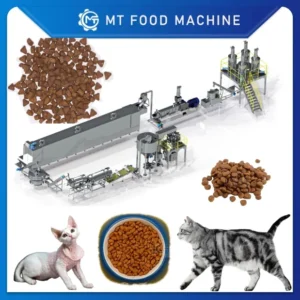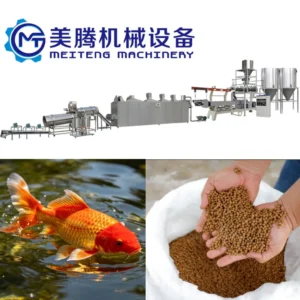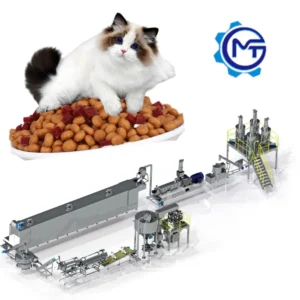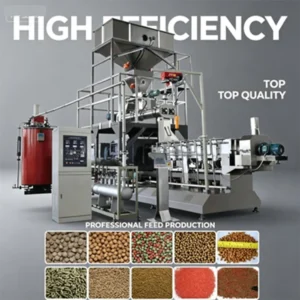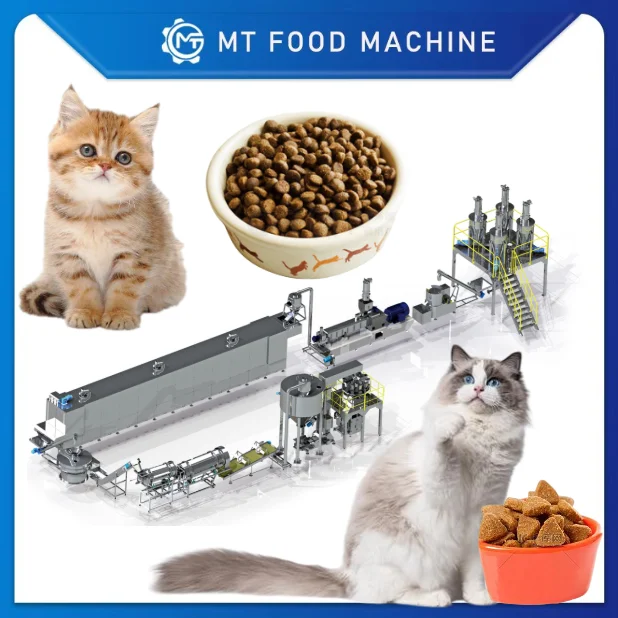


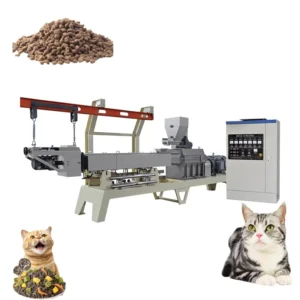
Pet Food Production Line, 450-550 kg/h, PLC Controlled — complete turnkey system from batching through extrusion, drying, flavouring and packing for multi-species feed. Every station’s throughput is matched as one integrated project, with screw configuration and die design specified to your raw material and target kibble density. In-house trial runs on customer formulas validate output before shipment. Line layout and capacity calculation documents provided for each station.
- Multi-species applications: cat, dog, fish, bird and cattle feed production
- Full automation with consistent recipe execution across all processing stages
- Electrical schematics with voltage, frequency and control language confirmed pre-production
Description
Integrated Throughput Matching — Every station on this multi-species pet food line is sized so the extruder, dryer, coater and cooler run at the same sustainable rate, eliminating wet-material pile-ups that stall single-vendor assemblies.
Technical Specifications
| Parameter | Value |
|---|---|
| Product Type | Multi-Species Pet Food Processing Line |
| Output Capacity | 450-550 kg/h (basis not stated in source — confirm raw material type, moisture content and kibble size) |
| Control System | PLC Controlled |
| Line Configuration | Batching, extrusion, drying, flavouring, coating, cooling, packing |
| Target Species | Cat, dog, fish, bird, cattle |
| Assembly State | Complete processing line under single supplier |
| Technical Support | Video technical support, online after-sales service |
Application Suitability
| Application | Material or Output |
|---|---|
| Dry kibble for dogs and cats | Meat meal, corn, wheat, rice, soy blended to target protein and fat ratio |
| Floating and slow-sinking fish pellets | Fish meal, starch binders, vitamin premix at controlled moisture |
| Extruded bird feed | Grain-based mixes with seed inclusions and calcium supplements |
| Cattle feed pellets | Roughage, grain, molasses and mineral concentrates |
| Training treats and functional bites | High-meat or high-fibre recipes requiring specific die geometry |
What "Nominal Capacity" Leaves Out on a Pet Food Line
A quoted kg/h number is only as honest as the raw material and kibble size behind it.
I have watched lines arrive at a Latin American plant, get wired up, and then fail to hold their stated output once the buyer’s local corn and meat meal went into the hopper. The extruder pushed material faster than the dryer could handle, and wet kibble sat on the belt turning gummy. A Pet Food Production Line Turnkey only earns that label when the capacity calculation accounts for your exact formula, moisture level and die opening — not a generic benchmark [NEED_CITE: extruder output variation by raw material composition].
Screw and Die Configuration Before the Crate Closes
The twin-screw extruder on this Pet Food Production Line Turnkey is configured with screw elements and die plates chosen after your raw material is reviewed. Barrel sections are zoned for independent temperature control, letting the process engineer set a profile that matches starch gelatinisation requirements for your specific grain and protein blend. This eliminates the guesswork that typically happens after the machine lands on your floor.
Throughput Balance Across Every Station
A turnkey project lives or dies on whether the dryer, flavouring drum and cooler can keep pace with the extruder. Each station in this line is sized against the others so that material flow stays continuous at the target rate. When the extruder discharges 450 kg/h of hot, moist kibble, the downstream dryer must remove the right percentage of moisture within the same hour — otherwise product quality drifts and the line stalls.
How PLC Control Holds Recipe Consistency
The PLC system stores multiple recipes and manages temperature, screw speed, feeder rate and moisture injection for each one. When a multi-species producer switches from dog kibble to floating fish feed, the operator calls up the saved profile and the control system adjusts setpoints across the line. This reduces the batch-to-batch variation that manual dial settings introduce, keeping kibble density and expansion within market specifications [NEED_CITE: PLC recipe management benefits in extrusion processing].
Reading the Numbers That Matter
The stated output range applies only after raw material type, incoming moisture and target kibble dimensions are confirmed — a line running small-diameter fish pellets will behave differently from one pushing large-diameter dog kibble. PLC control covers the full line rather than just the extruder, meaning the dryer temperature and coating drum speed follow the same automated logic. Multi-species capability depends on die changes and recipe storage, not on a single fixed screw profile. These factors together determine what the line actually delivers on your factory floor.
The Cost of Ignoring Downstream Matching
Buyers who purchase the extruder alone often discover that their existing dryer cannot handle the moisture load, forcing them to run at reduced feed rates. I have seen a Colombian plant lose weeks of production because the coater was undersized for the oil application rate their market required. When stations are not matched as a system, every bottleneck becomes a retrofit project — and retrofitting inside an operating plant costs far more in downtime than specifying the full line upfront [NEED_CITE: production line bottleneck analysis in food extrusion].
Why Source the Full Line Here
Every station from batching through packing comes from one supplier, so throughput calculations are cross-checked before fabrication rather than reconciled on your floor. Screw configuration and die design are specified against your raw material sample, not copied from a generic build. An in-house testing workshop runs your actual formula before shipment, producing a trial report you can review. Pre-sales engineering covers line layout and utility planning, and on-site commissioning includes operator training on your specific recipes.
Documentation & Verification
- Line layout drawing showing throughput at each station for your target kibble size
- Screw element arrangement and die plate record matched to your raw material
- Trial run report on customer-supplied formula conducted before dispatch
- Electrical schematic with confirmed voltage, frequency and PLC language
- CE declaration of conformity and ISO certificate for the complete line
Installation, Commissioning & Support
- Floor plan and utility connection points prepared before equipment arrival
- PLC panel wired to confirmed local voltage and frequency specifications
- Extruder barrel and screw assembly verified against your die configuration record
- Dryer and cooler airflow balanced to match extruder discharge moisture
- Operator training on recipe changeover between species and kibble sizes
- Wear parts list with lead times for screws, dies and dryer belt sections
Before You Send the Inquiry
Share your primary raw materials, their typical moisture content, and the kibble sizes you plan to run. Confirm your local voltage, frequency and preferred PLC display language so the electrical package is built correctly from the start. If you are integrating this line alongside existing packing or storage equipment, provide the interface dimensions and throughput expectations for those stations.
Frequently Asked Questions
Q: How is the 450-550 kg/h capacity verified against my specific raw material and recipe?
A: The capacity range is confirmed only after we receive your raw material sample and target kibble specification. We run a trial in our testing workshop using your formula, measure actual output and product density, and issue a trial report. The line configuration is then finalised based on those results, not on a generic benchmark.
Q: How do you match throughput between extruder, dryer and coating stations so no bottleneck occurs?
A: Each station is sized during the layout phase based on the extruder’s verified discharge rate and the moisture removal required for your product. The dryer belt length, airflow and coating drum volume are calculated together so material flows continuously without pile-ups or idle time between units.
Q: What voltage, frequency and PLC language options are confirmed before production starts?
A: Before fabrication begins, we confirm your site voltage, frequency and the language for the PLC human-machine interface. The electrical schematic is then prepared to those specifications, and the control panel is built and tested in our factory to match, avoiding commissioning delays caused by incorrect wiring.
Q: Can I run a trial on my own raw material in your testing workshop before shipment?
A: Yes. You send your raw material blend and we run it through the extruder and downstream equipment in our testing workshop. The trial produces actual kibble samples and a written report covering output rate, expansion ratio and density, giving you verified data before the line ships.
Q: How is on-site installation, commissioning and operator training scheduled for a full turnkey line?
A: After shipment, our engineers travel to your site for installation supervision, utility connection checks and first-run commissioning. Operator training covers recipe changeover, daily maintenance and troubleshooting on your specific product range, and we leave a wear parts list with recommended replacement intervals.
Related products
-
Línea de procesamiento industrial de producción de alimento para peces acuáticos flotantes y hundidos con extrusora automática de doble tornillo de ahorro de energía.
¥65.00 Select options This product has multiple variants. The options may be chosen on the product page -
Línea de procesamiento de alimentos para gatos de múltiples especies controlada por PLC con capacidad de 250-300 kg/h
¥35,000.00 Select options This product has multiple variants. The options may be chosen on the product page -
Línea de producción de alimentos para mascotas completamente automática Máquina de extrusión de grano de doble tornillo grande
¥9,500.00 Select options This product has multiple variants. The options may be chosen on the product page -
Equipo Premium para Procesamiento de Alimentos para Mascotas Máquina para Fabricar Alimento para Perros y Gatos
¥9,500.00 Select options This product has multiple variants. The options may be chosen on the product page