

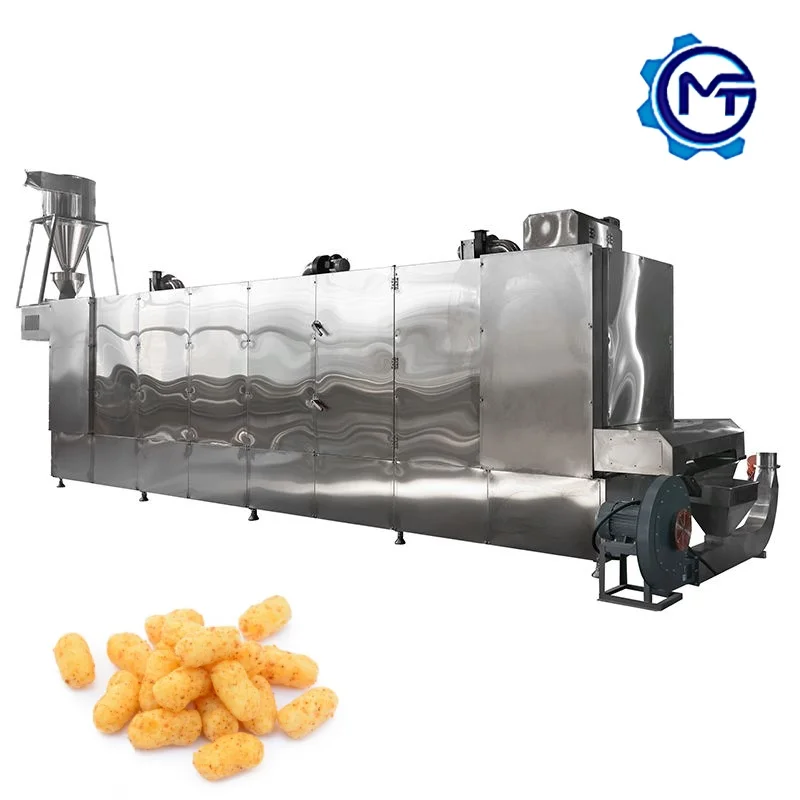
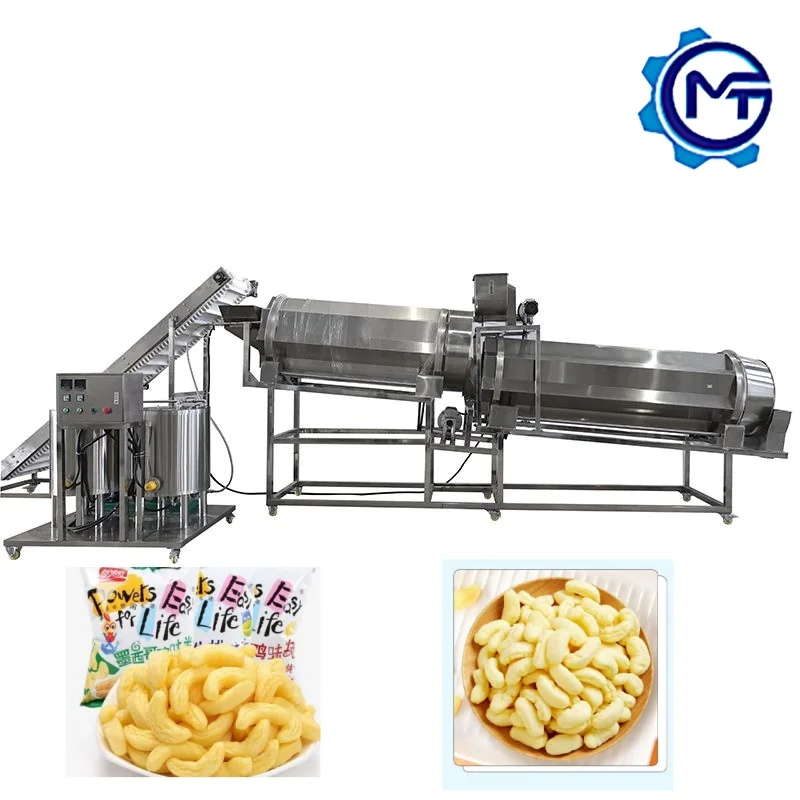
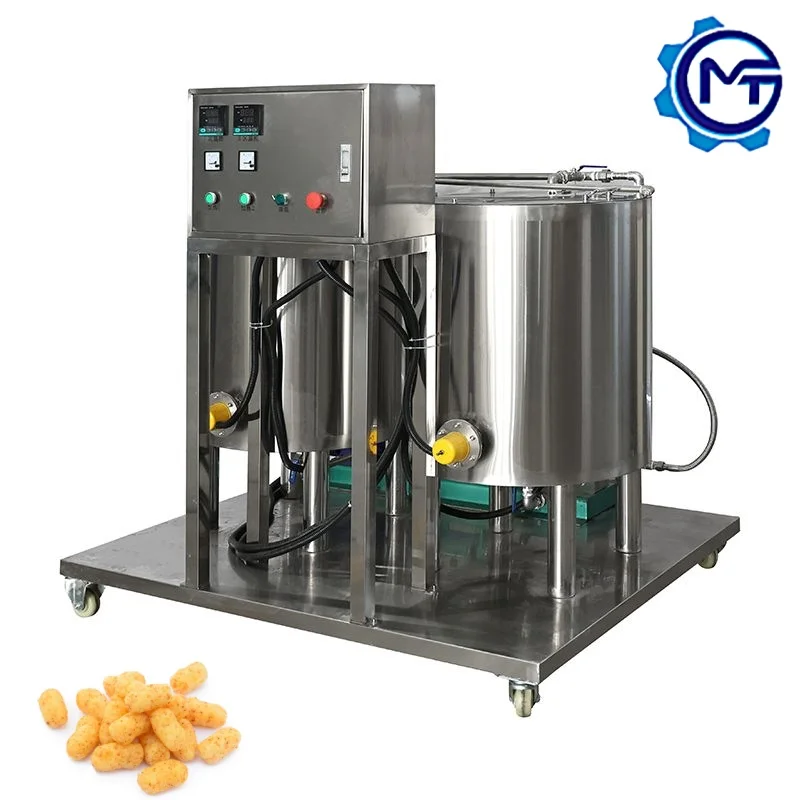
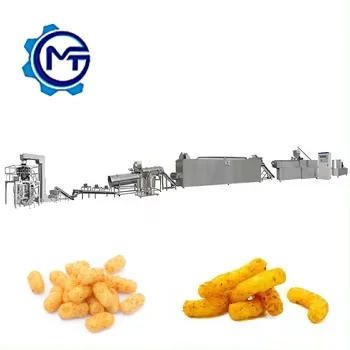
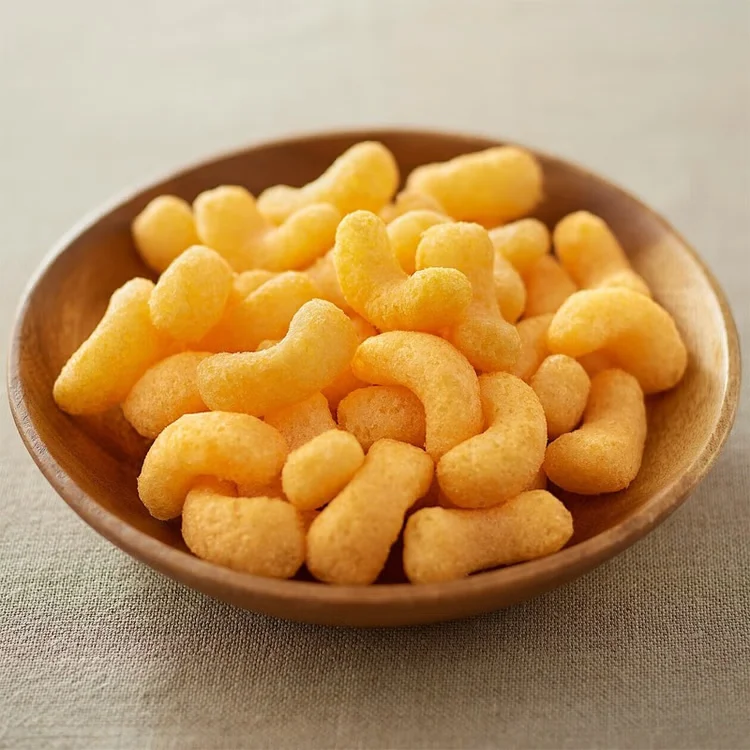
MT65 / MT70 / MT85 / MT100 Twin Screw Extruder Puffed Snack Production Line, Interchangeable Dies, Automatic Lubrication — complete turnkey layout from material batching through extrusion, drying, flavoring, cooling, and packing. Screw configuration and die design are specified to your raw material and target shape, with throughput matched across every station to prevent downstream bottlenecks.
- Factory trial runs on your actual formula before shipment
- On-site installation, commissioning, and operator training included
- Ongoing wear parts supply and maintenance support available
Description
Throughput-Matched Extrusion Lines — Every station on the puffed snack production line turnkey project is balanced from batching to packing, verified against your actual formula and raw material before factory dispatch.
Technical Specifications
| Parameter | Value |
|---|---|
| Product Type | Twin Screw Extruder Puffed Snack Production Line |
| Model Options | MT65 / MT70 / MT85 / MT100 |
| Screw Type | Twin-screw |
| Installed Power | MT65 130 kW / MT70 180 kW / MT85 220 kW / MT100 240 kW |
| Real Consumption | MT65 95 kW / MT70 120 kW / MT85 130 kW / MT100 160 kW |
| Output Capacity | MT65 120–150 kg/h (basis not stated in source) / MT70 200–300 kg/h (basis not stated in source) / MT85 300–500 kg/h (basis not stated in source) / MT100 600–800 kg/h (basis not stated in source) |
| Control System | Frequency speed controlling system (PLC / MCC availability to be confirmed) |
| Raw Materials | Corn, rice, wheat, oat, and barley flour |
| Die Configuration | Interchangeable dies for cheese ball, tube, stick, ring, fruit loop, star, wheel, flower, heart shapes |
| Dryer Heating Source | Electric, steam, or gas (selectable) |
| Line Stations | Materials preparation → Material batching → Extruding → Drying → Coating or flavoring → Cooling → Packing → Stacking |
| Lubrication | Automatic lubricating and cooling system |
| Core Filling Option | Available with add-on core filling machine and cutting machine |
| Assembly State | Turnkey complete line |
| Warranty | 1 year |
| Voltage & Frequency | Configurable (to be confirmed for target market) |
| Certifications | CE (referenced in company profile) |
Application Suitability
| Application | Material or Output |
|---|---|
| Cheese ball production | Corn and rice flour blends, extruded and coated with cheese powder |
| Core-filled snack extrusion | Grain-based outer shell with cream, chocolate, or fruit paste filling |
| Ring and tube snacks | Wheat and oat flour formulations for direct expanded formats |
| Breakfast cereal loops | Corn and barley flour, dried to target moisture for retail packaging |
| Star and wheel puffed shapes | Multi-grain blends requiring precise die geometry and moisture control |
What Nominal Capacity Figures Leave Out on a Puffed Snack Production Line Turnkey
A quoted kg/h number means nothing without the raw material formula and moisture content it was measured against.
I once watched a snack line stall because the extruder was sized for dry corn grits but the buyer switched to a high-fat oat blend. The material required different shear, more residence time, and a cooler barrel profile — none of which the original spec accounted for. The extruder ran, but density drifted out of spec and the downstream dryer could not compensate. Throughput dropped to roughly half the nameplate figure within the first week [NEED_CITE: extrusion throughput variance under unverified raw material conditions]. A puffed snack production line turnkey should be engineered from your actual ingredient list, not a catalog average.
Screw Configuration Dictates Texture Before the Die Is Even Cut
The twin-screw extruder range (MT65 through MT100) uses modular screw elements whose arrangement determines how much mechanical shear the dough receives. A high-shear configuration gelatinizes starch aggressively, producing a lighter, more expanded snack. A low-shear setup suits formulas with higher fat or fiber content where over-expansion creates fragile, break-prone pieces. On a puffed snack production line turnkey, the screw profile must be locked to your recipe before the line leaves the factory — adjusting it on site wastes raw material and production time.
Die Geometry and Moisture Content Define Final Product Density
Interchangeable dies let a single line produce cheese balls, rings, tubes, stars, and heart shapes, but each geometry interacts differently with barrel moisture and temperature. A ring die with a thin wall section demands precise moisture control; too wet and the ring collapses during drying, too dry and it fractures at the seam. This is why the factory trial run matters — it catches the mismatch between die cut and dough rheology before the equipment ships [NEED_CITE: twin-screw die design and expansion behavior in cereal extrusion].
Power Draw, Heating Source, and What the Electrical Room Actually Needs
Installed power ranges from 130 kW on the MT65 to 240 kW on the MT100, but real consumption sits lower — between 95 kW and 160 kW — because heaters cycle and motors rarely run at full load simultaneously. The dryer heating source is selectable between electric, steam, or gas. If your facility already has a steam boiler, routing that to the dryer reduces electrical demand and shifts your utility planning. Frequency-controlled drives across the line mean each station can be tuned independently, but the total connected load still needs a dedicated transformer circuit sized for the upper bound. Voltage and frequency must be confirmed against your local grid before the control panel is wired [NEED_CITE: industrial voltage and frequency standards by export market].
The Hidden Cost of Skipping Throughput Verification Between Stations
When the extruder outputs faster than the dryer can handle, product piles up on the conveyor, cools unevenly, and enters the flavoring drum at the wrong moisture level. The sugar coating then clumps or crystallizes inconsistently. I have seen this exact bottleneck force an entire shift to run the extruder at reduced speed — effectively paying for capacity you cannot use. The double-drum flavoring line with sugar melting and spraying must be matched to extruder output, and the cooling conveyor must be long enough to bring product temperature down before packing. Skipping this balance check during layout design turns a puffed snack production line turnkey into a collection of mismatched machines [NEED_CITE: production line throughput imbalance consequences in snack extrusion].
Why Sourcing the Full Line from One Supplier Matters Here
Every station — batching, extruding, drying, flavoring, cooling, packing — is specified under one engineering scope, so conveyor widths, dryer belt lengths, and drum volumes are calculated against the same throughput target. Screw configuration and die design are documented against your raw material, not pulled from a generic build. The in-house testing workshop runs your actual flour blend through the extruder before shipment, generating a trial report that confirms expansion ratio and density. Electrical schematics arrive with your target voltage and frequency already built into the panel layout. Ongoing support covers screw and die wear parts with replenishment documentation included from day one.
Documentation & Verification
- Line layout showing throughput calculation matched across batching, extrusion, drying, and packing stations
- Screw element arrangement and die selection record tied to your specific flour blend and target shape
- Trial run report from the testing workshop using your raw material, documenting expansion and moisture data
- Electrical schematic with voltage, frequency, and control language confirmed for your facility
- CE declaration of conformity covering the complete extrusion and downstream equipment assembly
- Wear parts list identifying screw segments, die plates, and dryer belt sections with reorder references
Installation, Commissioning & Support
- Foundation and floor space planning based on the full line footprint from batching hopper to packing station
- Dedicated power circuit sized for the MT65–MT100 real consumption range up to 160 kW
- Equipment arrives in modular sections; extruder barrel, dryer, and flavoring drums assembled and aligned on site
- First-run commissioning includes barrel temperature profiling and die pressure adjustment to your formula
- Operator training covers screw configuration changes, die swap procedures, and frequency drive tuning per station
- Wear parts kit with initial screw segments and die plates supplied; replenishment schedule documented
What to Prepare Before Requesting a Quote
To size a puffed snack production line turnkey correctly, share your target product shape and the raw material formulation including flour type, fat percentage, and expected moisture at the extruder inlet. Specify your daily or hourly production target in kilograms and the shift pattern you plan to run. Confirm local voltage, frequency, and whether steam or gas is available for the dryer. If you have existing upstream mixing or downstream packing equipment, note the interface points so the line layout accounts for them. Sending a sample of your raw material enables a factory trial run before the quotation is finalized.
Frequently Asked Questions
Q: How is line capacity verified against my specific raw material and formula?
A: We run your actual flour blend through the extruder in the in-house testing workshop, documenting expansion ratio, density, and moisture at each stage. The trial report becomes part of your delivery documentation and confirms whether the quoted throughput holds under your specific conditions rather than a generic catalog figure.
Q: How do you match throughput between the extruder, dryer, flavoring drum, and packing station?
A: Each station is sized during layout design using the same target output figure. Dryer belt length, drum volume, and cooling conveyor speed are calculated so product flows continuously without accumulation. The frequency-controlled drives allow fine-tuning, but the physical capacity of each station must align from the start.
Q: What does the factory trial run cover, and can I send my raw material for testing before shipment?
A: Yes — you send a representative sample of your flour blend, and we run it through the configured extruder and die set. The trial measures expansion behavior, product density, and moisture profile. Results are documented in a report that accompanies the shipment and serves as the commissioning baseline.
Q: How is the installation and commissioning schedule phased, and what operator training is included?
A: Equipment arrives in modular sections. Installation follows a sequence from extruder placement through dryer, flavoring, and cooling station alignment. Commissioning includes barrel temperature profiling and die adjustment. Operators are trained on screw configuration changes, die swaps, and drive tuning across each station.
Q: What spare wear parts are supplied, and how is ongoing replenishment handled?
A: The initial shipment includes a wear parts kit covering screw segments, die plates, and key dryer components. A documented parts list with reorder references is provided so you can plan replenishment cycles. Screw and die specifications remain on file for consistent future manufacturing.
Related products
-

Fully automatic puff snack processing line
¥8,500.00 Select options This product has multiple variants. The options may be chosen on the product page -

New Puffed Snack Food Machine Production Line Corn Flake Puff Corn Making Machine Twin Screw Extruder 100-500kg/h Capacity Food
¥8,500.00 Select options This product has multiple variants. The options may be chosen on the product page -

Twin Screw Extruder for Cheese Puffs Food Stainless Steel Simple Puffed Rice Snack Machine
¥8,500.00 Select options This product has multiple variants. The options may be chosen on the product page -

Twin Screw Corn Puffs Extruder Machine Small Corn Snack Food Extruder Machine
¥100.00 Select options This product has multiple variants. The options may be chosen on the product page


