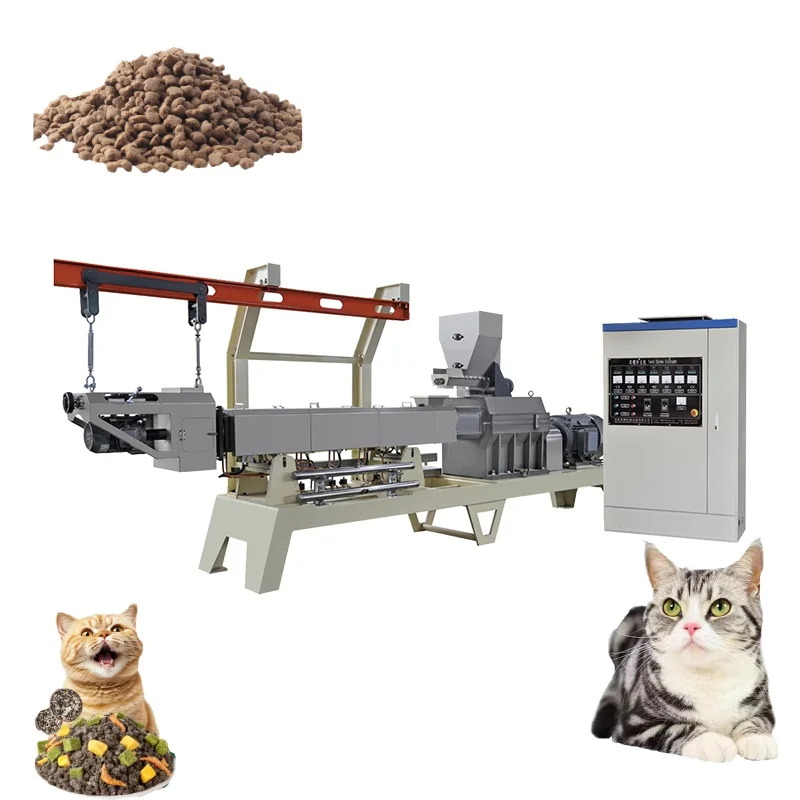


Pet Food Processing Equipment, Twin Screw Extrusion, Up to 3 Tons/Hour — engineered for dry kibble and aquatic feed production with matched throughput across every station from batching to packing.
As a turnkey line solution, this system features twin-screw extrusion with adaptable screw and die configurations to handle diverse raw material formulations and achieve target kibble density, whether producing floating or sinking aquatic feed.
- Complete line layout and capacity calculation provided against your specific formulation
- In-house trial runs on your raw material before shipment ensure product quality
- One-year comprehensive warranty covers the entire line scope
Description
Throughput matched at every station — a single-supplier pet food production line turnkey project from batching to packing, engineered so the extruder, dryer, and coating drum never bottleneck one another.
Technical Specifications
| Parameter | Value |
|---|---|
| Product Type | Twin Screw Pet Food Extrusion Line |
| Output Capacity | Up to 3 tons per hour (basis not stated in source — confirm raw material formulation, moisture content, kibble size & density) |
| Applications | Dry dog and cat kibble, floating and sinking aquatic feed |
| Control System | PLC and MCC control (specification to be confirmed per facility) |
| Voltage & Frequency | Configurable to target market electrical standard (to be confirmed) |
| Screw Configuration | Twin-screw with die design matched to target product |
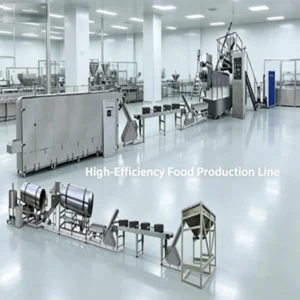
| Line Stations | Batching, extrusion, drying, coating, cooling, packing (process drawing supplied) |
| Warranty | 1 year comprehensive coverage |
| Certification | CE and ISO certified manufacturing |
Application Suitability
| Application | Material or Output |
|---|---|
| Dry kibble for dogs and cats | Corn, meat meal, fish meal, grain blends formulated to target density and crunch |
| Floating aquatic feed | Starch-rich formulations expanded for buoyancy in fish farming operations |
| Sinking aquatic feed | Higher-density pellets for bottom-feeding species such as catfish and shrimp |
| Multi-species production runs | Adaptable screw and die configurations allowing format changeovers on a single line |
What "Nominal Capacity" Leaves Out on a Pet Food Production Line Turnkey
The extruder may hit the quoted number, but if the dryer cannot keep up, your real output is the dryer’s limit.
I once watched a Middle East facility run a twin-screw extruder at full speed while finished kibble piled up ahead of an undersized dryer, forcing the operator to throttle back the entire line. The rated capacity on paper meant nothing because the stations were never matched [NEED_CITE: line throughput balancing principles for extruded food processing]. A pet food production line turnkey project only delivers its promise when every station — from batching through packing — is calculated against your actual raw material formulation and target kibble density, not a generic benchmark.
Layout Logic for Complete Extrusion Projects
A pet food production line turnkey installation starts with a layout that respects the physical sequence of heat, moisture, and mechanical handling. The extruder discharges hot, moist kibble that must enter the dryer within a defined window; too much distance or an incorrectly specified conveyor lets surface moisture reabsorb, compromising shelf life. Every station footprint is calculated so material flow remains continuous without intermediate buffering that degrades product quality.
Throughput Matching Across Every Station
The dryer, coating drum, and cooling conveyor each have a maximum throughput tied to residence time and product load. When one station runs slower than the extruder, the entire line stalls to that pace. Throughput matching means calculating each station against your specific kibble size, moisture profile, and coating ratio so no single unit dictates the ceiling. This matching is where multi-vendor assemblies typically fail [NEED_CITE: throughput synchronization in multi-station food processing lines].
Screw, Die, and Formulation Interplay
The twin-screw configuration generates shear and heat that gelatinize starch, expand the kibble, and set its internal structure. Screw element sequencing and die geometry are selected based on your raw material blend — a high-meat-meal formula behaves differently from a corn-dominant mix. The correct configuration determines whether kibble floats, sinks, or achieves the crunch density your market expects, and it must be validated before the line ships.
The Cost of Skipping Configuration Verification
When a line arrives with a generic screw build, the first production run often yields kibble that is either too dense for the pet food market or too fragile to survive packing and transport. I have seen entire batches rejected because the extruder was set up for a reference formula that did not match the buyer’s actual ingredients [NEED_CITE: extrusion screw configuration impact on kibble texture and density]. Reworking screw elements after installation costs production time and raw material, delays that compound when commissioning windows are already tight.
Why Procure This Line as a Single Project
Sourcing the full pet food production line turnkey scope from one supplier means throughput calculations, electrical schematics, and control language are coordinated before fabrication begins. The in-house testing workshop runs your raw material through the configured extruder before shipment, producing a trial run report that catches formulation mismatches early. Electrical documentation locks down voltage, frequency, and control language to your facility standard so commissioning does not stall on unresolved specifications. A single point of accountability covers layout, installation sequencing, and operator training, eliminating the blame-shifting that occurs when separate vendors supply individual stations.
Documentation & Verification
- Line layout and capacity calculation specific to your raw material formulation and target kibble density
- Trial run report from in-house testing workshop using your actual ingredients before dispatch
- Electrical schematic confirming voltage, frequency, and control language for your facility
- Screw and die configuration record matched to your product specification
- Operation and maintenance manual covering all line stations with wear parts list
Installation, Commissioning & Support
- Foundation and utility routing plan aligned to the supplied line layout and station footprint
- Electrical connection per confirmed voltage and frequency with dedicated circuit requirements for the extruder motor
- Modular or assembled shipment configuration specified to match your facility access constraints
- On-site commissioning with parameter setting for screw speed, barrel temperature, and dryer residence time
- Operator training covering formulation changeover, screw element replacement, and daily maintenance routines
- Wear parts list and spare screw and die inventory planning for first scheduled replacements
Before You Request a Quotation
To specify a pet food production line turnkey project accurately, share your target kibble or pellet format, the raw material formulation you intend to run, and your required hourly output based on that formulation. Include your facility voltage, frequency, and preferred control language so electrical documentation is prepared before production. If you have existing upstream batching or downstream packing equipment, provide specifications so the new line integrates without throughput gaps.
Frequently Asked Questions
Q: How is the line output capacity verified against my specific raw material and kibble specification?
A: The manufacturer conducts a trial run in their in-house testing workshop using your actual raw material blend. This run tests the configured screw and die setup, measures output against your target kibble density and size, and produces a documented report. Any adjustments to screw elements or barrel temperature profile are completed before the line ships to your facility.
Q: What is the station-by-station throughput matching process from batching to packing?
A: Each station — extruder, dryer, coating drum, cooler, packing — is calculated against your product’s moisture loss curve, coating load, and cooling requirement. The slowest station determines real line output, so every unit is specified to ensure no single point constrains the extruder. This matching is documented in the line layout and capacity calculation.
Q: Can I run a trial with my own raw material in the testing workshop before shipment?
A: Yes. The in-house testing workshop accepts your raw material for a dedicated trial run on the configured twin-screw extruder. You receive a trial run report documenting output rate, kibble density, expansion ratio, and any screw or die adjustments made. This step ensures product development is addressed before installation, not after.
Q: How are voltage, frequency, control language, and utility requirements confirmed for my facility?
A: Electrical schematics and voltage specifications are locked down during the pre-sales engineering phase based on your facility’s local standard. Control panel language and PLC interface are set to your preference. This confirmation prevents the commissioning delays that occur when electrical mismatches are discovered after the equipment arrives on site.
Related products
-
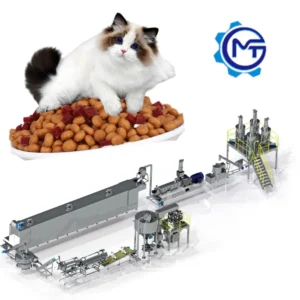
MT70 200-250kg/h Dog Cat Pet Food Processing Line 380V 50HZ Three Phase 45KW
¥35,000.00 Select options This product has multiple variants. The options may be chosen on the product page -
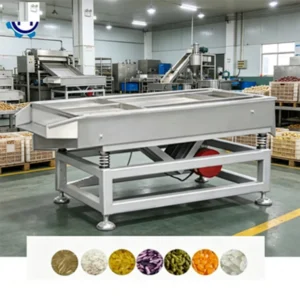
Energy Saving Automatic Twin Screw Extruder Floating Sinking Aquatic Fish Feed Industrial Production Processing Line
¥65.00 Select options This product has multiple variants. The options may be chosen on the product page -
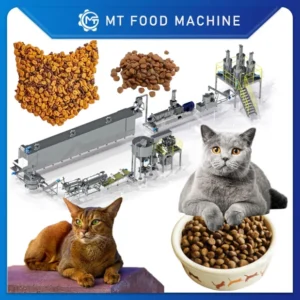
250-300kg/h Capacity PLC Controlled Multi-Species Cat Food Processing Line
¥35,000.00 Select options This product has multiple variants. The options may be chosen on the product page -
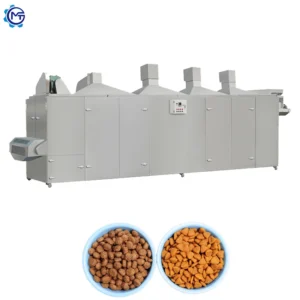
Premium Pet Food Processing Equipment Dog Cat Feed Making Machine
¥9,500.00 Select options This product has multiple variants. The options may be chosen on the product page