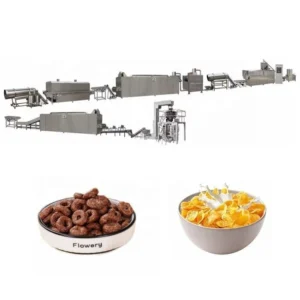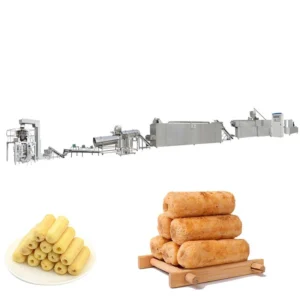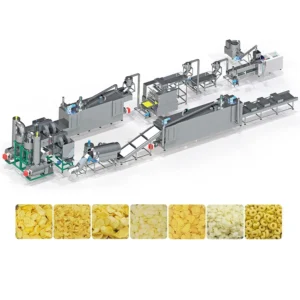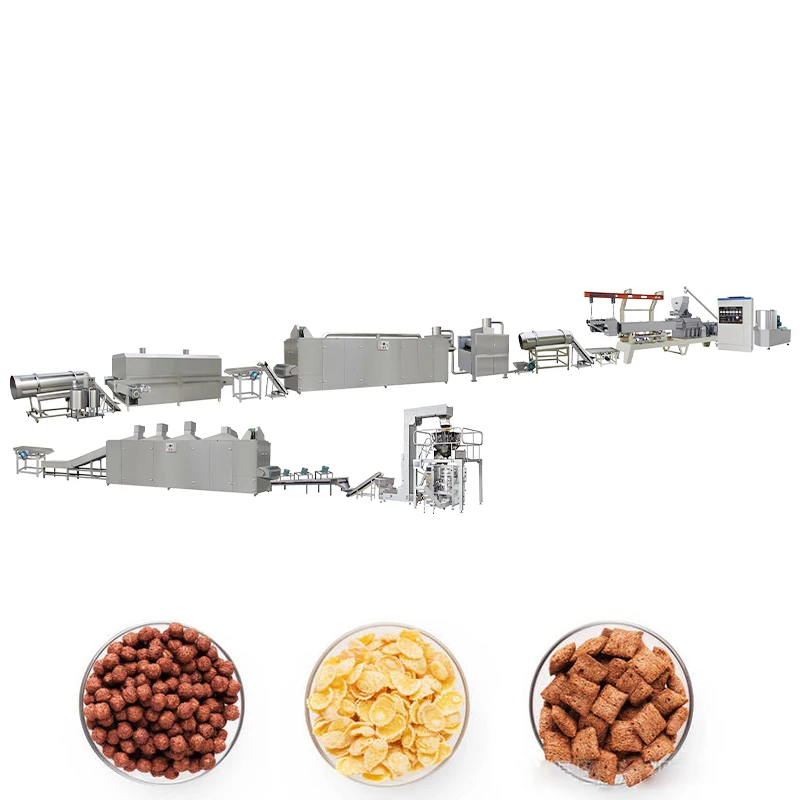
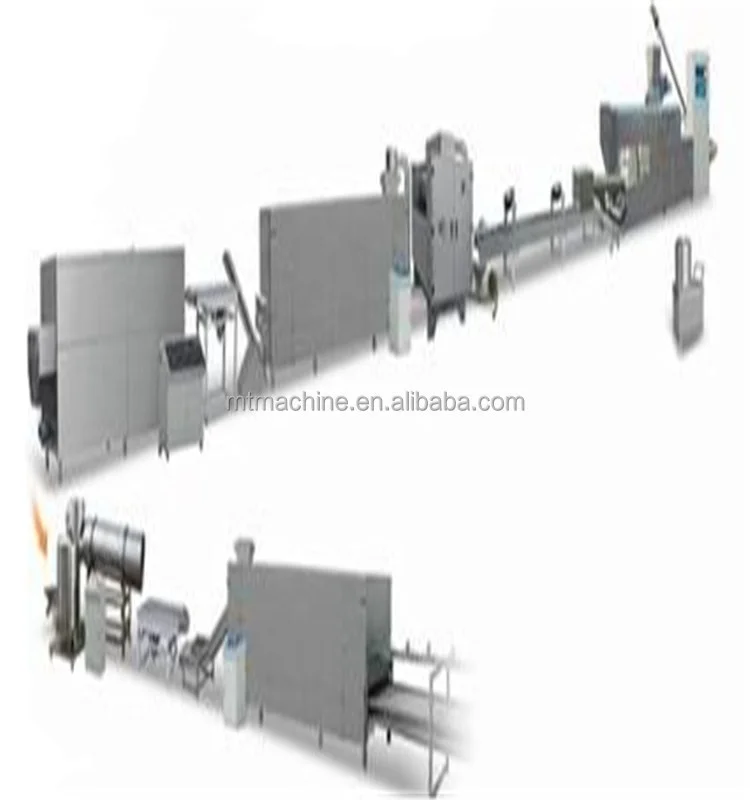


MT75 Corn Flakes Production Line, 300–500 kg/h, Twin-Screw Extrusion, PLC Control — engineered as a complete turnkey project from mixing through extrusion, hydraulic flaking, hot air roasting, and packing.
- Screw configuration and die design matched to your raw material formulation and target flake density
- Dual-line capability for natural and sugar-coated corn flakes on one platform
- Hydraulic double-roller flaking with infrared temperature control for uniform thickness
Delivered with in-house trial run on your actual raw material before shipment, so product development starts before installation — not after.
Description
Throughput-Matched Turnkey Engineering — Every station from mixing to packing is calculated against your actual corn formulation, preventing the dryer or roaster bottleneck that stalls lines quoted only on extruder nominal output.
Technical Specifications
| Parameter | Value |
|---|---|
| Product Type | Corn Flakes Production Line |
| Model | MT75 |
| Extruder Type | Twin Screw (MT-75) |
| Installed Power | 210 kW |
| Power Consumption | 150 kW |
| Line Capacity | 300–500 kg/h (basis not stated in source — confirm raw material formulation, moisture content, and final product format) |
| Extruder Capacity | 200–300 kg/h (basis not stated in source — confirm raw material and moisture) |
| Overall Dimensions | 45 × 1.5 × 3.5 m |
| Control System | PLC control with MCC available |
| Flaking System | Hydraulic double-roller, separate motor drive, infrared temperature control |
| Dryer Heating Source | Gas or Electric |
| Roasting Oven | Hot air with vibrating pan, dual circulating fans, cyclone dust removal |
| Coating System | Double tumble sugar melting, elevator, coating drum, spraying nozzle |
| Screw Feature | Automatic lubricating and cooling, wear-resistant manufacturing technique |
| Standards | CE certified, ISO certified |
Application Suitability
| Application | Material or Output |
|---|---|
| Natural corn flakes | Corn grits, corn flour, corn meal |
| Sugar-coated corn flakes | Corn base with sugar syrup coating |
| Fortified breakfast cereals | Corn, rice, wheat, oat, and barley powder blends |
| Shaped cereal variants | Ball, tube, stick, ring, fruit loop, star, wheel, flower, heart profiles |
Why "Nominal Capacity" Derails a Corn Flakes Project
Line throughput is only as strong as its weakest station, and that station is almost never the extruder.
A corn flakes production line turnkey project often fails not because the extruder underperforms, but because downstream equipment was sized to a catalogue number rather than to the actual moisture curve and flake density the buyer needs. I have configured lines where the twin-screw extruder ran comfortably at its rated output, yet the dryer could not pull moisture down to the required level fast enough. Flakes emerged soft, fractured under the roaster vibrating pan, and the entire line stalled at half its quoted capacity. The lesson was expensive and avoidable. Specifying each station against your raw material formulation and target flake moisture — before a single machine is built — eliminates this mismatch. [NEED_CITE: typical moisture reduction targets for flaked breakfast cereals]
Screw Configuration and Flake Density Control
The twin-screw extruder in this corn flakes production line turnkey system is configured after reviewing the buyer’s exact grain blend and target flake density. Screw element arrangement and die geometry determine how thoroughly the starch gelatinises inside the barrel, which directly controls how the flake behaves when it passes through the hydraulic double-roller press. Incorrect shear and residence time produce a half-cooked pellet that either shatters under roller pressure or fails to flatten into the uniform thickness the roaster requires for consistent surface bubbling.
Dual-Line Flexibility for Natural and Sugar-Coated Output
The core extrusion and flaking stations remain identical whether the target is natural or sugar-coated corn flakes. Downstream, the line branches: natural flakes proceed through hot air roasting and cooling, while sugar-coated variants enter the double-tumble sugar melting system, coating drum, and a second drying pass. This shared-platform design lets producers respond to market demand across both categories without duplicating upstream capital expenditure. [NEED_CITE: market demand split between natural and coated breakfast cereals]
Reading the Spec Sheet Against Your Production Reality
The MT75 line draws 150 kW under running load across a 45-meter footprint, which shapes your electrical infrastructure and floor plan from day one. The hydraulic flaking unit uses separate motors for each roller, allowing independent speed adjustment to control flake thickness — a detail that matters when switching between corn and wheat formulations that require different compression ratios. The roasting oven’s dual circulating fans and cyclone dust removal maintain even heat distribution while capturing fine particulate, protecting both product surface quality and workshop air standards. PLC control with MCC integration means every station from batching to packing communicates through a single logic layer, so a fault on the coating drum pauses the extruder rather than flooding downstream conveyors with unprocessed material.
The Hidden Cost of Unmatched Stations
When the dryer or roasting oven is undersized relative to extruder output, the line does not simply run slower — it produces flakes that crack during cooling or fail to achieve the crispness the market expects. Operators compensate by reducing extruder feed rate, which shifts the screw fill ratio and alters starch gelatinisation, creating a different product than the one originally specified. Wear on screws and dies accelerates because the machine runs outside its intended load profile, and unplanned downtime for barrel and screw replacement begins to cut into production schedules that were planned around a different maintenance cycle. [NEED_CITE: impact of throughput mismatch on extruder wear component lifespan]
Why Source the Complete Line from One Engineering Team
Every station is throughput-matched under a single supplier, so the dryer capacity, flaking roller width, and roasting oven belt speed are calculated together rather than assembled from independent quotations. Screw configuration and die design are specified to your raw material and target flake density before production begins. An in-house testing workshop runs trial batches on your actual corn formulation, generating a trial run report that confirms product texture and moisture before shipment. Pre-sales engineering covers factory layout design matched to your floor dimensions, voltage confirmation for your local supply, and control language specification. Ongoing support extends through on-site installation, commissioning, operator training, and wear parts supply.
Documentation & Verification
- Line layout drawing with station-by-station throughput calculation for your corn formulation
- Screw and die configuration record matched to your target flake density and moisture
- Trial run report on your raw material from the in-house testing workshop before dispatch
- Electrical schematic with voltage, frequency, and control language confirmation for your site
- CE declaration of conformity and ISO certificate for customs and regulatory clearance
- Operation and maintenance manual with wear parts list specific to your line configuration
Installation, Commissioning & Support
- Floor plan layout designed around the 45 × 1.5 × 3.5 m line footprint and your factory ceiling height
- Power infrastructure planned for 210 kW installed load with dedicated circuit for the twin-screw extruder
- Station-by-station commissioning sequence from mixing system through packing conveyor with parameter logging
- PLC and MCC control language configured to your operator requirements before first run
- Screw and die wear parts list supplied with recommended replacement intervals based on your grain blend
- Dryer and roasting oven heat profile calibrated to your target flake moisture during on-site training
Preparing Your Line Inquiry
To configure a corn flakes production line turnkey project that matches your facility, share your grain formulation and target moisture content, your daily output target and shift schedule, and your workshop dimensions with ceiling height. Specify your local voltage and frequency, preferred control language, and whether you plan to produce natural flakes, sugar-coated flakes, or both on the same platform.
Frequently Asked Questions
Q: How is line capacity verified against my specific raw material formulation and moisture content?
A: We run your actual corn blend through the twin-screw extruder and downstream stations in our in-house testing workshop. The trial run report documents flake thickness, moisture at each station, and final product texture. This data drives the screw configuration and dryer sizing before production starts, so capacity is based on your material rather than a generic benchmark.
Q: Can the same line produce both natural and sugar-coated corn flakes?
A: Yes. The mixing, extrusion, flaking, and drying stations are shared between both configurations. For sugar-coated output, the line adds a double-tumble sugar melting system, coating drum with spraying nozzle, and a second drying stage. Switching between variants requires changeover of the coating path while upstream parameters remain constant.
Q: What does the turnkey project scope include for layout and installation?
A: The scope covers factory layout design matched to your floor dimensions, utility planning for electrical and gas connections, a phased installation schedule, and on-site commissioning. We configure PLC and MCC controls to your voltage and language requirements, calibrate every station to your target output, and conduct operator training covering daily operation and routine maintenance.
Q: How do you ensure no station bottlenecks the line?
A: Each station — extruder, flaking unit, dryer, roasting oven, cooling conveyor, and packing — is sized against the throughput of the station before and after it. We calculate moisture reduction curves for the dryer and heat transfer rates for the roaster based on your specific flake thickness and formulation, so no single unit limits overall line output.
Related products
-
New Technical Automatic Cereal Nutritional Powder Instant Porridge Baby Food Making Machine
¥10,000.00 Select options This product has multiple variants. The options may be chosen on the product page -

MT Cocoa Flour Puffed Breakfast Cereal Production Line-High Large Capacity Multi-Fuel (Steam/Gas/Electric) New Shandong Origin
¥8,000.00 Select options This product has multiple variants. The options may be chosen on the product page -

Best Price Corn Flakes Making Machine Breakfast Cereals Processing Line with Motor As Core Component
¥19,000.00 Select options This product has multiple variants. The options may be chosen on the product page -
Corn Flake Making Machine Corn Puffs Making Machine Snack Food Production Line
Price range: ¥500.00 through ¥1,200.00 Select options This product has multiple variants. The options may be chosen on the product page