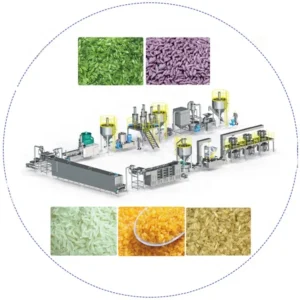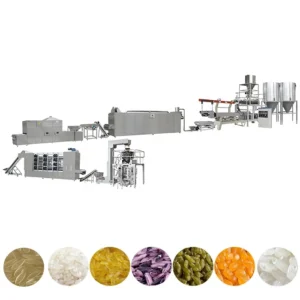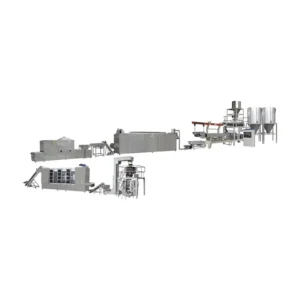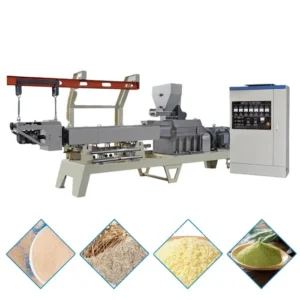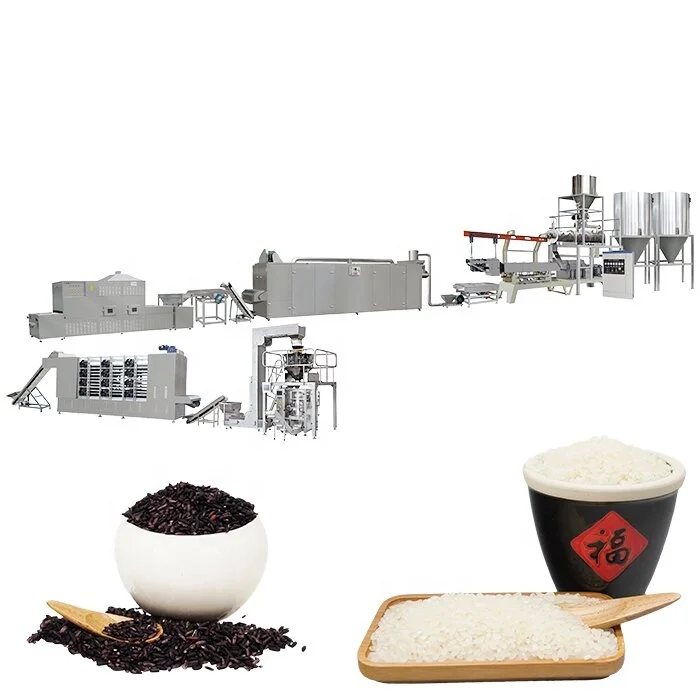


Nutritional Artificial Rice Processing Line, Twin-Screw Extruder, 110 kW Main Drive — integrates mixing, extrusion, drying, polishing, and packing into a single matched system. Screw configuration and die design are specified to your raw material formulation, with 2500 mm screw length enabling precise starch gelatinisation and grain uniformity across instant, self-heating, and fortified rice applications. Voltage and control language are confirmed before production to match your site conditions. Line layout, capacity calculation, and in-house trial run report on your raw material provided before shipment.
Description
Technical Specifications
| Parameter | Value |
|---|---|
| Product Type | Nutritional Artificial Rice Processing Line |
| Line Configuration | Mixer → Feeder → Twin-screw extruder → Vibrating screen → Air conveyor → Drying box → Lifting machine → Polishing drum → Air conveyor → Storage tank → Packaging machine |
| Mixer Capacity | 130–150 kg per batch |
| Mixer Tank Material | Stainless steel, 1.5 mm tank thickness, 1.2 mm cover thickness |
| Extruder Type | Twin-screw |
| Extruder Main Drive Power | 110 kW with frequency control |
| Extruder Feeder Power | 1.5 kW with frequency control |
| Extruder Cutting Power | 2.2 kW with frequency control |
| Extruder Screw Length | 2500 mm |
| Dryer Heating Type | Electric (gas, diesel, or steam available on request) |
| Cooling Dryer Belt Width | 1 mm (source value — verify against manufacturer catalog) |
| Voltage Options | Customizable (e.g., 3-phase 380V 50Hz, 3-phase 415V 60Hz) |
| Control System | Frequency control on key drives |
| Output Capacity | Basis to be confirmed against raw material and target rice grain specification |
| Assembly State | Complete integrated line from mixing through packing |
| Certification | CE, ISO |
Application Suitability
| Application | Material or Output |
|---|---|
| Fortified nutritional rice production | Rice flour blended with vitamin and mineral premixes |
| Instant rice for self-heating meal kits | Pre-gelatinised starches and rice flour |
| Artificial grain for food aid programmes | Composite flours with legume and cereal blends |
| Quick-cooking minute rice | Parboiled rice flour with controlled gelatinisation |
| Low-GI reconstituted rice | High-amylose starch and dietary fibre blends |
What "Nominal Output" Leaves Out About Rice Extrusion Lines
A rated throughput means nothing if the screw configuration cannot hold that output on your specific flour blend and moisture content.
Many buyers discover after installation that their nutritional rice production line turnkey setup cannot maintain the quoted capacity once real production begins. The extruder may run at nameplate speed, but the actual output of acceptable rice grains — those with the correct density, shape, and cooking behaviour — falls well below expectations. This gap usually traces back to a screw and die set that was specified for a generic starch formulation rather than the buyer’s actual recipe, which may contain higher fat, fibre, or protein fractions that alter gelatinisation behaviour inside the barrel [NEED_CITE: starch gelatinisation behaviour under varying formulation compositions].
Screw Geometry and Barrel Zones That Shape Every Grain
The twin-screw extruder at the heart of this line uses a 2500 mm screw length, which provides sufficient residence time for complete starch gelatinisation across a range of rice flour formulations. Frequency control on the 110 kW main drive allows the operator to adjust screw speed in response to dough viscosity changes as the formulation shifts between batches. The barrel temperature profile is managed in zones, giving independent control over the feeding, compression, and metering sections so that each phase of dough development can be tuned to the target rice grain texture.
How Downstream Stations Must Match Extrusion Throughput
A nutritional rice production line turnkey project succeeds or fails on whether every downstream station can absorb what the extruder delivers. The vibrating screen separates broken or misshapen grains before they enter the drying circuit. The dryer — available with electric, gas, diesel, or steam heating — must remove moisture at a rate that prevents case hardening while keeping up with continuous extruder output. The polishing drum then smooths the grain surface for the visual quality that retail and institutional buyers expect, and the final storage tank buffers production before packing.
Reading the Spec Sheet Against Your Actual Formulation
The 130–150 kg batch mixer feeds the line at intervals, and its stainless steel tank with 1.5 mm wall thickness handles the abrasive wear common with mineral-fortified flour blends. The extruder feeder at 1.5 kW uses frequency control to meter dough into the barrel at a rate matched to main drive speed, preventing surging that causes density variation between grains. The oil pump at 0.75 kW provides barrel lubrication that reduces start-up torque and protects screw surfaces during formulation changeovers. Voltage is configurable to match the buyer’s facility — whether that is 380V 50Hz, 415V 60Hz, or another standard — and this must be confirmed before production begins [NEED_CITE: industrial voltage and frequency standards by region].
The Cost of Skipping a Trial Run Before Shipment
When an extruder ships without a trial run on the buyer’s actual raw material, the first weeks on site become an expensive experiment. Screw combinations must be swapped, barrel temperatures re-profiled, and die openings adjusted while production staff wait for acceptable output. In one project involving a high-fat杂粮 formulation, the absence of pre-shipment testing led to ten days of on-site commissioning before the correct screw arrangement and thermal profile were established. A nutritional rice production line turnkey system should arrive with these parameters already documented and validated [NEED_CITE: commissioning delays caused by untested extrusion configurations].
Why Sourcing the Full Line From One Supplier Matters
Matching throughput across stations is the central engineering task, and it requires one team to own every connection point. This line is designed as a single project where the mixer batch cycle, extruder feed rate, dryer belt speed, and polishing drum rotation are calculated against each other rather than assembled from independent vendors. Screw configuration and die design are specified to the buyer’s raw material and target grain dimensions, not copied from a generic catalogue build. The in-house testing workshop runs the buyer’s formulation before shipment, producing a trial report that documents screw arrangement, temperature settings, and achieved grain characteristics. Electrical schematics, voltage confirmation, and control language are locked in before production starts, avoiding the commissioning standstill that occurs when a panel arrives wired for the wrong supply. Pre-sales engineering, on-site installation, operator training, and ongoing wear parts support are delivered by the same team that built the line.
Documentation & Verification
- Line layout showing throughput balance from mixer through packing for your target capacity
- Screw and die configuration record matched to your flour formulation and grain specification
- Trial run report from in-house testing on your raw material documenting grain density and shape
- Electrical schematic with voltage, frequency, and control language confirmed for your facility
- CE declaration of conformity and ISO certificate for import and compliance requirements
- Wear parts list with screw element and die specifications for first replacement ordering
Installation, Commissioning & Support
- Foundation plan based on the 5000 × 1500 × 1900 mm dryer footprint and extruder load points
- Dedicated power circuit for the 110 kW extruder main drive plus auxiliary motors
- Assembled line delivered in modular sections for positioning within standard workshop clearances
- First-run parameter setting covering screw speed, barrel zones, and dryer temperature
- Operator training on formulation changeover procedures and frequency drive adjustments
- Spare screw elements and die plates supplied against the documented wear parts list
- Maintenance schedule aligned with mixer bearing, extruder gearbox, and dryer belt inspection intervals
What to Prepare Before Requesting a Quotation
To move from inquiry to a credible line proposal, share your raw material specification including flour type, moisture content, fat and fibre percentages, and any micronutrient premix additions. Define your target rice grain dimensions, cooking time requirement, and daily output expectation. Confirm your facility voltage, frequency, and the control language your operators will use. If you have existing upstream milling or downstream packing equipment, provide interface details so the line layout can be designed around them.
Frequently Asked Questions
Q: How is line output verified against my specific rice flour formulation?
A: The buyer supplies raw material to the in-house testing workshop, where a trial run is conducted using the proposed screw configuration and die design. A report documents achieved throughput, grain density, shape uniformity, and moisture content at the dryer exit. These results form the basis of the capacity guarantee written into the quotation, rather than a nominal figure based on a generic starch recipe.
Q: Will the dryer and polishing drum keep up with the extruder at full speed?
A: Every station is sized against the extruder output calculated for your formulation. The dryer belt speed, heating capacity, and residence time are matched so that moisture removal completes before grains reach the polishing stage. The storage tank downstream buffers any minor timing differences between polishing and packing, preventing backlog accumulation.
Q: How do I know the screw configuration is designed for my recipe and not a standard build?
A: The screw arrangement record included in your documentation lists every element type, position, and spacing along the 2500 mm shaft. This record is generated from the trial run on your raw material and is specific to your formulation’s gelatinisation behaviour. Any subsequent recipe change triggers a re-evaluation and updated configuration document.
Q: What happens if my local power supply differs from the machine’s default wiring?
A: Voltage and frequency are confirmed during the specification stage before production begins. The electrical schematic is drawn to match your facility supply — whether 380V 50Hz, 415V 60Hz, or another combination — and the control panel labels are printed in your chosen language. This prevents the rewiring delays that commonly stall commissioning on arrival.
Related products
-
Automatic Nutritional Powder Making Machine Safe Rice Cereal for Babies
¥30.00 Select options This product has multiple variants. The options may be chosen on the product page -
CE cerelac Instant Baby Food Porridge Making Machine Production Line
¥35,000.00 Select options This product has multiple variants. The options may be chosen on the product page -

Industrial Automatic 500kg/h Baby Cereal Nutrition Powder Extruder Manufacturing Process Line
¥8,238.27 Add to cart -

Hygienic Stainless Steel Infant Rice Powder Processing Line Automatic 500kg/h Capacity PLC Controlled
¥9,500.00 Add to cart