

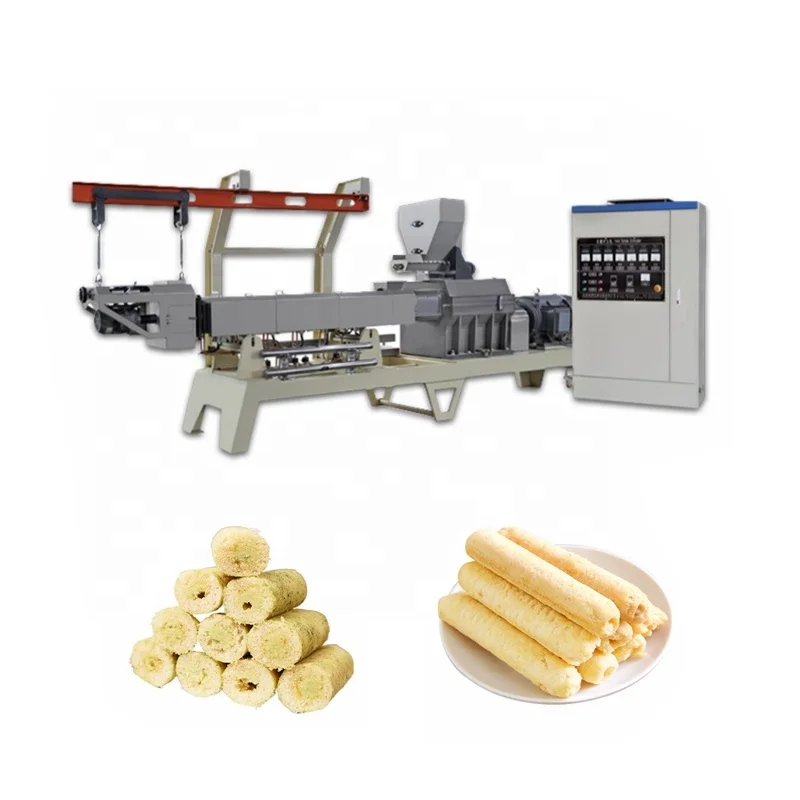
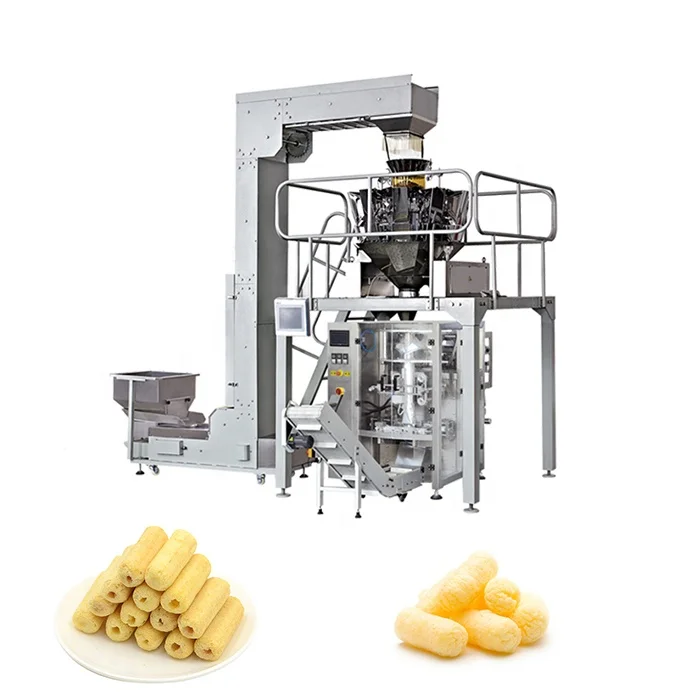
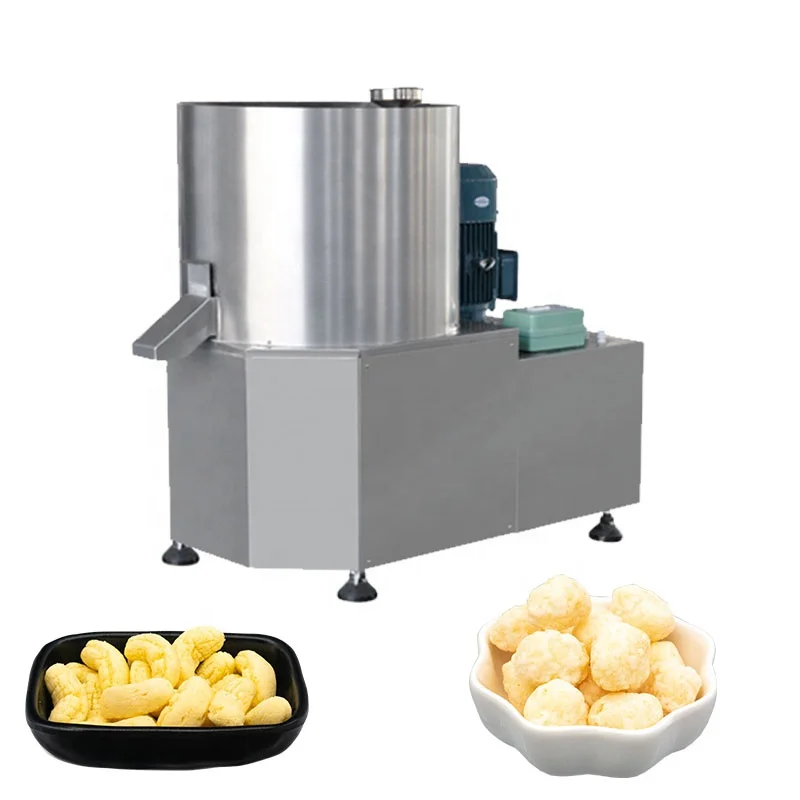
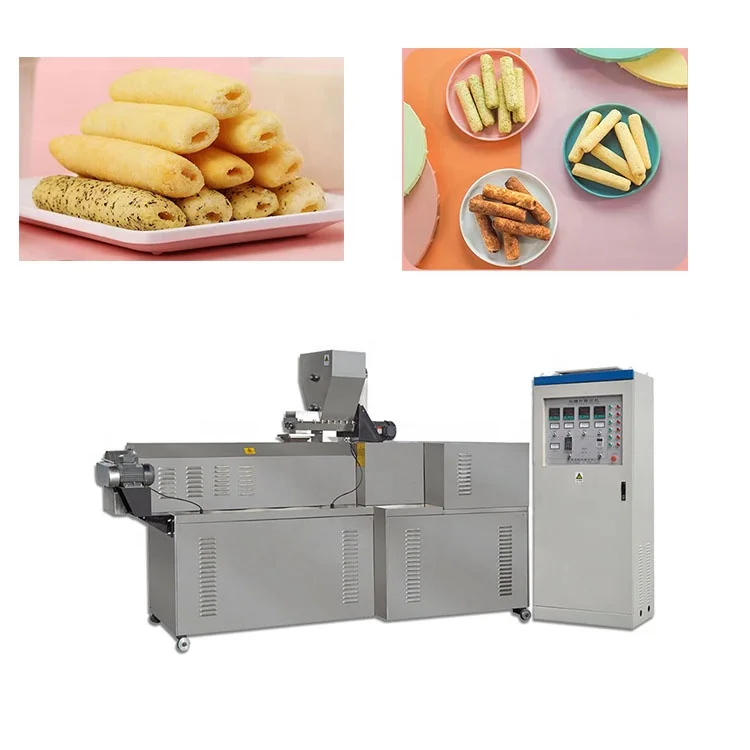
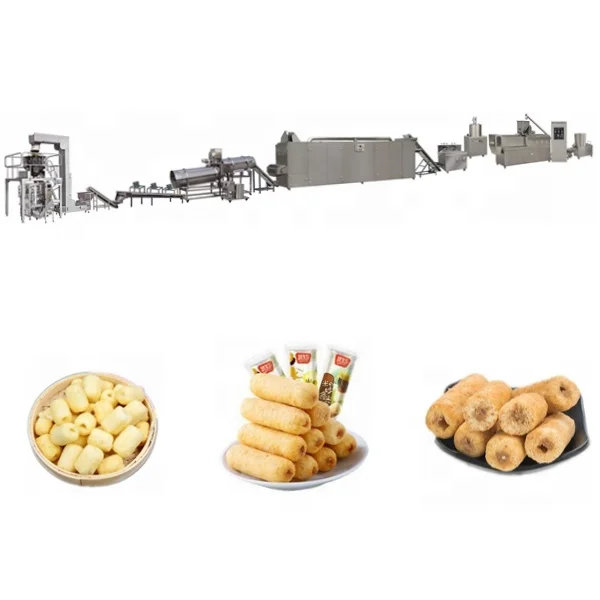
MT65 / MT70 / MT85 Core-Filled Snack Food Extrusion Processing Line, Twin-Screw, Multi-Station — engineered for chocolate and cream center-filled puffed snacks with interchangeable moulds across bar, pillow, and sheet formats.
- Screw configuration and die design matched to your raw material and target product density, controlling expansion and filling ratio through barrel temperature and moisture profile
- Every station — mixing, extrusion, center filling, air conveying, seasoning — throughput-balanced to eliminate bottlenecks on your actual recipe
- Line layout and capacity calculation provided with trial run on your raw material before shipment, plus voltage confirmation and operator training at commissioning
Description
Integrated Turnkey Extrusion — Every station from batching to seasoning is throughput-matched to your raw material and core-filled product format, eliminating mid-line bottlenecks on the core-filled snack food extrusion production line.
Technical Specifications
| Parameter | Value |
|---|---|
| Product Type | Core-Filled Snack Food Extrusion Processing Line |
| Line Configuration Options | MT65 / MT70 / MT85 processing line |
| Extruder Screw Type | Twin-screw (Double-screw extruder MT-II) |
| Extruder Total Power | 36 kW |
| Extruder Dimensions | 2800 × 800 × 1800 mm |
| MT65 Power Consumption | 59 kW |
| MT65 Output Capacity | 120–150 kg/h (basis to be confirmed against raw material and moisture) |
| MT65 Overall Dimensions | 21000 × 1200 × 2200 mm |
| MT70 Power Consumption | 92 kW |
| MT70 Output Capacity | 200–250 kg/h (basis to be confirmed against raw material and moisture) |
| MT70 Overall Dimensions | 23000 × 1500 × 2200 mm |
| MT85 Power Consumption | 167 kW |
| MT85 Output Capacity | 300–400 kg/h (basis to be confirmed against raw material and moisture) |
| MT85 Overall Dimensions | 28000 × 3500 × 4300 mm |
| Mixer Power / Output | 4 kW / 70–100 kg/h (basis to be confirmed against batch cycle) |
| Mixer Dimensions | 900 × 700 × 1200 mm |
| Screw Conveyor Power | 1.1 kW |
| Screw Conveyor Dimensions | 200 × 800 × 3000 mm |
| Center Filling Machine Power | 4 kW |
| Center Filling Machine Dimensions | 800 × 800 × 1500 mm |
| Air Conveyor Power / Height | 32 kW / 23000 mm |
| Seasoning Machine Power / Drum Diameter | 0.75 kW / 700 mm |
| Seasoning Machine Dimensions | 3000 × 800 × 1900 mm |
| Product Formats | Core-filled bars, cream-filled pillows, corrugated corn puffs, rice cakes, cereal bars, sheet snacks |
| Mould Capability | Interchangeable moulds for shape variation |
| Line Stations | Mixer → Screw Conveyor → Twin-Screw Extruder → Center Filling Machine → Air Conveyor → Seasoning Machine |
| Warranty | 1 year complete guarantee with lifetime maintenance service |
Application Suitability
| Application | Material or Output |
|---|---|
| Chocolate-filled extruded bars | Wheat flour, corn grits, rice flour with chocolate core injection |
| Cream-filled pillow snacks | Grain-based dough with cream or paste center filling |
| Corrugated core-filled corn puffs | Corn meal and grain blends with sweet or savory filling |
| Cereal bars and rice cakes | Multi-grain formulations with center filling and seasoning |
| Sheet snacks from grain dough | Wheat and rice flour with co-extruded filling layers |
What a Nominal Capacity Figure Conceals About Your Line
A rated output number is only meaningful when tied to the exact raw material, moisture content, and core-filled product format you intend to run.
Too often, buyers receive a core-filled snack food extrusion production line quotation listing a peak capacity that was measured on a simple, unfilled puff — not the dense, cream-filled pillow or chocolate bar actually planned for production. The extruder might push that volume, but the center-filling pump cannot keep pace, or the seasoning drum cannot tumble the heavier filled product without breakage. The result is a line that stalls at the filling station while the extruder idles, and operators spend shifts chasing synchronization rather than running product. [NEED_CITE: throughput matching between extrusion and downstream filling stations]
Synchronization Between Extruder Output and Center Filling
The defining challenge of any core-filled snack food extrusion production line is keeping the filling station locked to the extruder discharge rate. The twin-screw extruder pushes a continuous ribbon of expanded dough, and the center filling machine must inject chocolate or cream at a matching volume per linear meter of product. If the pump cycle runs ahead, filling material wastes and seals fail; if it lags, product sections emerge unfilled and must be rejected. The MT65, MT70, and MT85 tiers each pair a specific extruder throughput band with a center filling machine rated to sustain that band, so the injection logic stays aligned across shifts.
Full-Line Station Matching From Mixing to Seasoning
A core-filled snack is only as consistent as its weakest station. The mixer must prepare batch sizes that feed the screw conveyor without gaps, and the screw conveyor must deliver a steady material flow into the twin-screw barrel. After extrusion and filling, the air conveyor lifts product to the seasoning drum, which must rotate at a speed gentle enough to preserve the filled shape while distributing coating evenly. Every station in this line — from the 4 kW mixer through the 32 kW air conveyor to the 700 mm seasoning drum — is specified so that no single unit constrains the others. [NEED_CITE: continuous food extrusion line station throughput engineering]
Reading the Specification Sheet for What It Actually Controls
The twin-screw extruder at the heart of this line runs a 36 kW main drive, which determines the shear energy available for starch gelatinisation inside the barrel. Higher shear means more complete gelatinisation, which directly affects how well the extruded shell holds the injected filling without collapsing. The interchangeable moulds allow shape changes — from round bars to flat pillows — without replacing the entire die plate, reducing changeover downtime between product runs. The 23-meter air conveyor height on the MT85 configuration provides sufficient cooling travel time for larger, denser filled pieces before they enter the seasoning drum, preventing coating melt and clumping. Screw and die configuration records are documented for each product format so that repeat orders reproduce the same expansion and texture.
The Hidden Cost of Assembling Stations From Separate Vendors
When an extruder, a filling machine, and a seasoning drum arrive from three different suppliers, nobody owns the throughput gap between them. The extruder vendor points to their discharge rate, the filling machine vendor points to their pump cycle, and the line never reaches the output anyone promised. Electrical interfaces compound the problem — different PLC languages, incompatible signal protocols, and mismatched emergency stop circuits delay commissioning by days. Buyers who have walked this path know that the weeks spent troubleshooting communication between mismatched stations cost more than any price difference between a bundled line and a pieced-together one. [NEED_CITE: integration risk in multi-vendor food processing lines]
Why This Line Is Engineered as One Project
The MT65, MT70, and MT85 configurations are not catalog items picked from a shelf — each is laid out as a complete project with throughput calculated against the buyer’s raw material and target product. Screw configuration and die design are specified to the filling type and shell thickness required, not copied from a generic build. An in-house testing workshop runs trial production on the buyer’s actual raw material before shipment, so the trial run report confirms real output rather than a theoretical figure. Electrical schematics confirm voltage and frequency for the destination market before the control panel is wired. On-site installation covers station alignment, filling pump calibration, and operator training on mould changes and daily maintenance routines.
Documentation & Verification
- Line layout and capacity calculation matched to your raw material and core-filled product format
- Screw and die configuration record documented for each target shape and filling type
- Trial run report on your raw material produced in the testing workshop before shipment
- Electrical schematic with voltage and frequency confirmed for your destination market
- Operation and maintenance manual with wear parts list for screws, dies, and filling nozzles
Installation, Commissioning & Support
- Floor space planning based on MT65, MT70, or MT85 overall dimensions and air conveyor height
- Dedicated power circuits sized to line total consumption from 59 kW to 167 kW
- Station-by-station assembly with extruder, filling machine, and conveyor alignment verified on site
- Center filling pump calibration against extruder discharge rate during first production run
- Operator training on mould changeover, screw configuration adjustment, and filling nozzle cleaning
- Wear parts inventory for twin-screw elements, die plates, and filling seals with replacement schedule
Preparing Your Line Inquiry
To configure the right tier and station layout, share the grain or flour types you plan to process, the core filling material (chocolate, cream, fruit paste), and your target daily output. Include your facility floor dimensions and ceiling height so the air conveyor path can be plotted. Specify local voltage and frequency standards, preferred control language, and whether you need a raw material trial run before shipment to validate the screw and die configuration.
Frequently Asked Questions
Q: How is line capacity verified against my specific raw material and core-filled product format?
A: Before shipment, the testing workshop runs your raw material through the twin-screw extruder and center filling station together. The trial run report documents actual throughput, filling accuracy, and shell expansion for your exact recipe. This data confirms the capacity band rather than relying on generic catalog figures.
Q: What is the phased installation and commissioning schedule for a complete turnkey line?
A: Installation begins with station positioning and utility connections, followed by extruder screw assembly and die fitting. Commissioning then moves through dry runs, filling pump calibration, and full production runs with your raw material. Operator training runs concurrently, covering mould changes, parameter adjustments, and daily maintenance routines.
Q: How are throughput rates matched between the extruder, center-filling station, and seasoning drum?
A: Each line tier pairs a specific extruder output band with a center filling machine pump cycle and a seasoning drum rotation speed calculated for the same product flow rate. This prevents the extruder from overfeeding the filling station or the drum from under-processing finished pieces.
Q: What utility planning is required for each line tier?
A: The MT65 requires a 59 kW supply and fits within a 21-meter line length, while the MT85 draws 167 kW across a 28-meter footprint with a 4.3-meter height clearance for the air conveyor. Detailed utility plans covering power circuits, compressed air points, and floor loading are provided with the line layout proposal.
Q: How does operator training and ongoing maintenance support work after commissioning?
A: On-site training covers extruder screw configuration, filling pump synchronization, mould changeover, and emergency stop procedures. A wear parts list identifies replacement intervals for twin-screw elements, die plates, and filling nozzles, with ongoing maintenance support available throughout the equipment service life.
Related products
-

Automatic Corn Crisps Extruder Production Machine for Maize Chips and Corn Sticks New Condition
¥8,000.00 Select options This product has multiple variants. The options may be chosen on the product page -

Full Automatic Puffed Corn Snack Food Extruder Puffed Snack Corn bar Making Machine
¥8,500.00 Select options This product has multiple variants. The options may be chosen on the product page -

Fully automatic puff snack processing line
¥8,500.00 Select options This product has multiple variants. The options may be chosen on the product page -

Automatic Rice Crispies Extruder Machine/Chocolate Corn Flakes Extrusion Plant/wheat Flaking Snacks Production Line
¥8,500.00 Select options This product has multiple variants. The options may be chosen on the product page


