

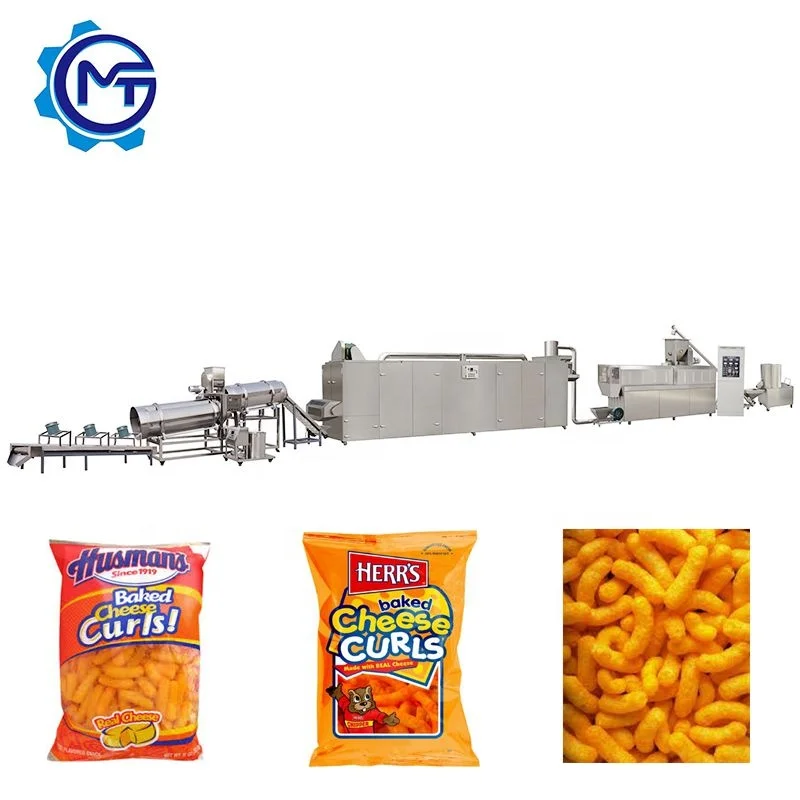
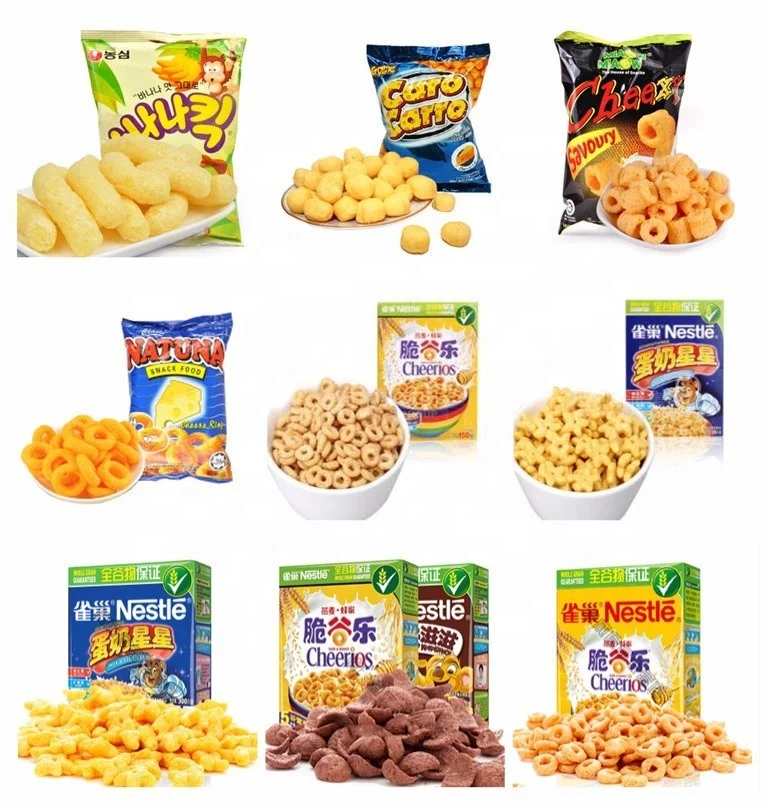
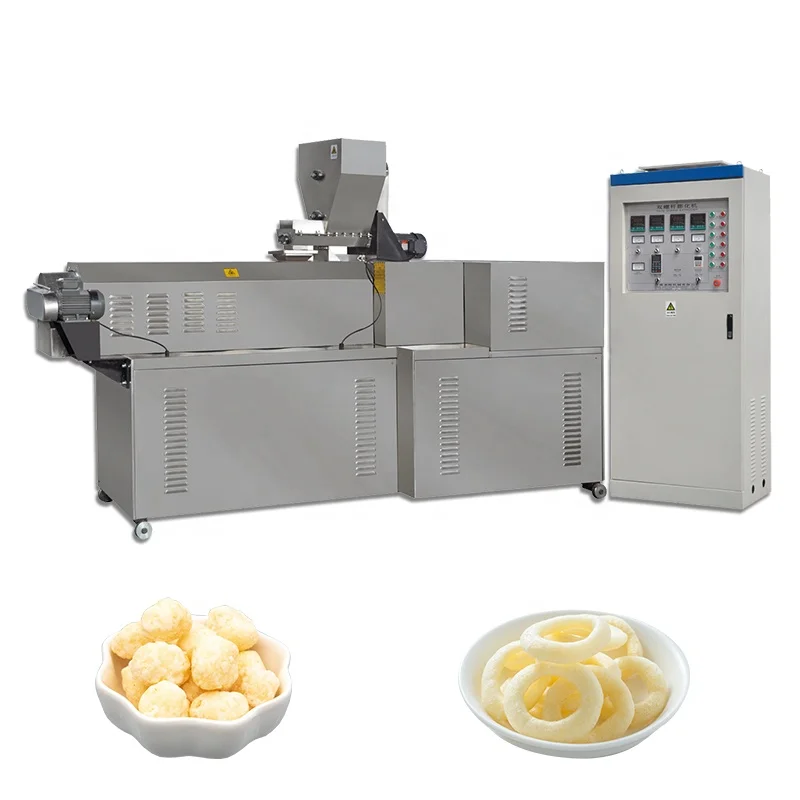
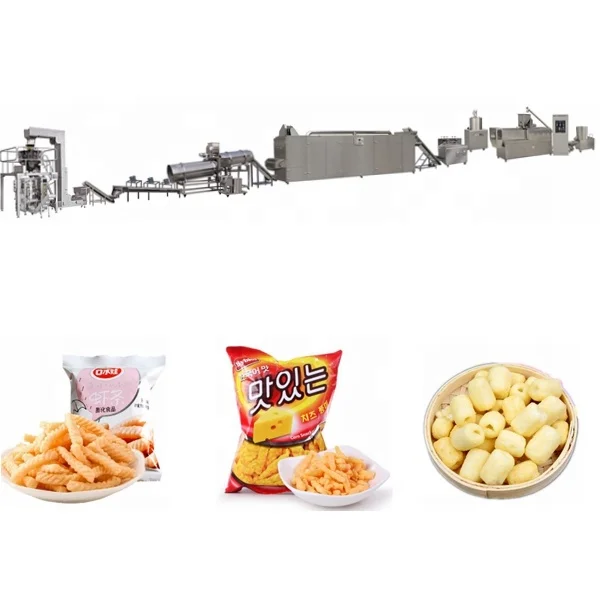
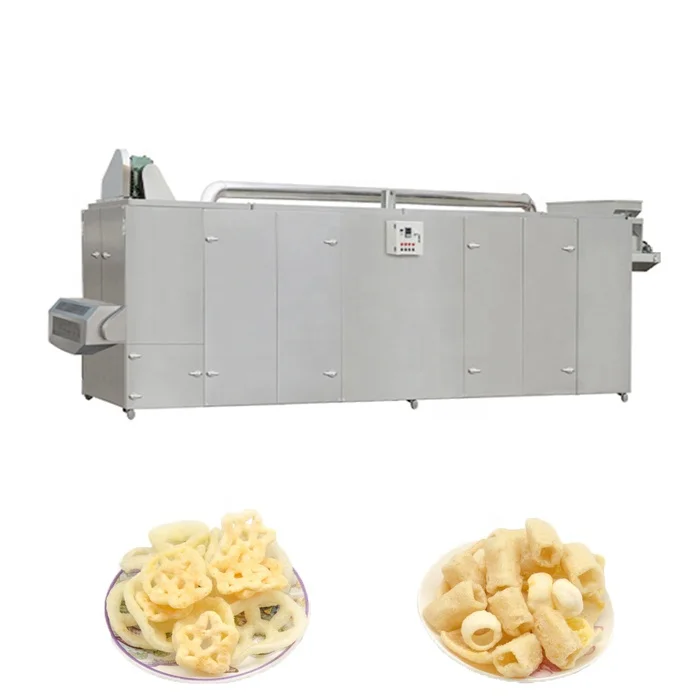
MT65 / MT70 / MT70C / MT75 Puffed Corn Snacks Twin-Screw Extrusion Production Line, PLC Control — engineered for balanced throughput across extrusion, multi-layer drying and flavouring stations. Twin-screw configuration and die design are specified to the buyer’s flour or grits blend, controlling shear, moisture and expansion for target product density. Core-filling capability supports cream, chocolate or fruit paste injection within the same process.
- Line layout, capacity calculation and trial run report on customer raw material provided before shipment
- Screw and die configuration record matched to target shape and density, not a generic build
- Voltage, frequency and control language confirmed prior to production to match factory utility supply
Description
Throughput-Matched Turnkey Line Delivery — Every station from mixing to flavouring is specified against the extruder’s real output on your raw material, not assembled from isolated vendor quotes.
Technical Specifications
| Parameter | Value |
|---|---|
| Product Type | Puffed Corn Snacks Twin-Screw Extrusion Production Line |
| Model | MT65 / MT70 / MT70C / MT75 |
| Screw Type | Twin-screw |
| Installed Power | MT65 — 110 kW; MT70 — 160 kW; MT70C — 170 kW; MT75 — 190 kW |
| Power Consumption | MT65 — 90 kW; MT70 — 140 kW; MT70C — 145 kW; MT75 — 150 kW |
| Output Capacity | MT65 — 100–150 kg/h (basis to be confirmed); MT70 — 150–200 kg/h (basis to be confirmed); MT70C — 200–250 kg/h (basis to be confirmed); MT75 — 300–350 kg/h (basis to be confirmed) |
| Overall Dimensions (L×W×H) | MT65 — 40,000 × 1,500 × 2,200 mm; MT70 — 41,000 × 1,500 × 2,200 mm; MT70C — 42,000 × 1,500 × 2,400 mm; MT75 — 43,000 × 1,500 × 3,200 mm |
| Control System | PLC-based with frequency conversion for feeding, rotary cutting and spindle |
| Barrel / Screw Structure | Twin-screw with feeding bucket, main motor, rotary cutting motor, feeding motor, oil pump, reducer, distribution box, screw and barrel assembly |
| Dryer | Multi-layer oven; fuel / gas / electricity heating options selectable; double pitch roller chain drive |
| Flavouring Line | Hoist conveying, screw-type seasoning transport, imported adjustable oil nozzle, electric heating oil tank with pump delivery |
| Raw Material Form | Powder (flour) or grits |
| Warranty | 1 year complete guarantee with life-time maintenance service |
| Certification | CE |
Application Suitability
| Application | Material or Output |
|---|---|
| Puffed corn snack production | Corn flour or corn grits, rice, millets, wheat, oat, barley |
| Core-filled puffed snacks | Cream, chocolate, fruit paste, date paste or jelly filling |
| Multi-grain extruded snacks | Blended cereal flours and grits at controlled moisture |
| Pillow, ball and stick formats | Shape achieved through die and rotary cutting configuration changes |
What the Stated Capacity Figures Leave Out on a Puffed Corn Snacks Production Line Turnkey
Nominal output means nothing until it is measured against your specific grits size and moisture content.
A puffed corn snacks production line turnkey is often quoted on a capacity number that assumes ideal laboratory flour, not the coarse corn grits arriving at your loading dock. When the particle size is larger than what the screw profile was designed for, gelatinisation drops and the extruder cannot sustain its rated throughput. The dryer then runs under capacity while the flavouring drum sits idle, destroying the line balance you paid for. [NEED_CITE: starch gelatinisation requirements in twin-screw extrusion of coarse grits]
How Screw Configuration Shapes Your Snack Texture
The twin-screw assembly in a puffed corn snacks production line turnkey does far more than push material forward. The arrangement of conveying elements, kneading blocks and reverse-screw sections inside the barrel determines how much shear energy goes into your dough. Adjusting this profile changes the degree of starch gelatinisation, which directly governs expansion ratio and final bite density. A configuration set for fine rice flour will overwork coarse corn grits, producing a dense, under-expanded product.
Why the Dryer Must Be Matched to Real Extruder Output
A multi-layer oven with selectable fuel, gas or electric heating sounds flexible, but its residence time and temperature zones must be calculated from the extruder’s actual discharge rate on your recipe. If the dryer is sized for a nominal capacity the extruder cannot sustain, product moisture exits too high and shelf life suffers. Conversely, an oversized dryer wastes thermal energy and floorspace. [NEED_CITE: moisture target ranges for shelf-stable extruded snacks]
Reading the Power and Dimension Data
Installed power across the MT65 to MT75 range spans 110 kW to 190 kW, with operating consumption roughly twenty percent lower. This gap reflects the motor starting surge and the headroom needed when raw material viscosity fluctuates between batches. Line length grows from 40 metres to 43 metres as capacity increases, a planning figure that matters for factory layout and utility routing. The PLC control with frequency conversion on the feeding, cutting and spindle motors allows operators to fine-tune throughput without mechanical changeover, maintaining batch-to-batch consistency.
The Hidden Cost of Mismatched Line Stations
When the flavouring drum capacity is specified from a catalogue rather than from the dryer’s real discharge rate, seasoning coverage becomes uneven at higher throughput. Product accumulates between stations, and operators manually intervene to clear blockages. Over a production run this leads to inconsistent flavour dosage, higher breakage rates, and unplanned stoppages that erode the output the buyer originally paid for. [NEED_CITE: throughput balancing across extrusion, drying and coating stations]
Why Source the Entire Line from One Supplier
Sourcing a puffed corn snacks production line turnkey from a single supplier means the extruder output, dryer capacity and flavouring throughput are calculated against one another before fabrication begins. The screw and die configuration is documented to your raw material specification, not copied from a generic build. An in-house testing workshop allows trial runs on your flour or grits before shipment, so product development is not deferred to your factory floor. Line layout, electrical schematic and voltage confirmation are delivered as one documentation package, reducing commissioning variables. CE certification covers the integrated line rather than individual machines bolted together after arrival.
Documentation & Verification
- Line layout and capacity calculation showing throughput balance across extruder, dryer and flavouring stations
- Screw and die configuration record matched to your flour or grits particle size and target expansion
- Trial run report on your actual raw material produced in the testing workshop before dispatch
- Electrical schematic with voltage, frequency and control language confirmed prior to production
- Factory test record documenting running parameters at sustained throughput
- Operation and maintenance manual with wear parts list for screws, dies and seals
Installation, Commissioning & Support
- Foundation plan accounts for line length up to 43,000 mm and multi-layer dryer weight distribution
- Dedicated power circuit sized to the MT75 operating draw of 150 kW with starting surge allowance
- Assembled dryer and flavouring modules arrive in sections aligned to the extruder discharge height
- PLC parameter sets loaded and verified against trial run data during on-site commissioning
- Operator training covers frequency conversion adjustment on feeding, cutting and spindle motors
- Spare screw elements, die plates and oil nozzles stocked for first replacement cycle
Preparing Your Line Specification Request
To receive a configuration that matches your factory, share the exact flour or grits source, typical moisture content at intake, and the target snack format including any core-filling requirement. Provide your facility voltage, frequency and preferred control language so the electrical package is confirmed before fabrication. If you have existing upstream batching or downstream packing equipment, include the interface dimensions and throughput expectation so the line endpoints align.
Frequently Asked Questions
Q: How is the line’s real output verified on my raw material before shipment?
A: Your flour or grits is run through the extruder in the in-house testing workshop at your specified moisture level. A trial run report records actual throughput, expansion ratio and product density. This data then confirms or adjusts the dryer and flavouring station sizing before the line ships.
Q: How do you match dryer and flavouring throughput to the extruder on my recipe?
A: The dryer residence time and temperature zones are calculated from the extruder’s verified discharge rate on your material, not its nominal catalogue figure. The flavouring drum speed and oil nozzle flow are then set so seasoning coverage remains even at that actual throughput.
Q: What does the installation and commissioning sequence look like for a full line?
A: Equipment arrives in station modules aligned to the approved layout drawing. Commissioning starts at the extruder with screw and die verification, then progresses through the dryer and flavouring line. Operator training covers PLC adjustment, frequency conversion settings and routine wear part replacement on each station.
Q: How are screw configuration and die design selected for my product?
A: The screw element arrangement is chosen based on your flour or grits particle size and the target expansion and density. Die geometry and rotary cutting speed are then matched to achieve the required snack shape. Both are recorded in the configuration document supplied before shipment.
Q: What electrical details are confirmed before production begins?
A: Voltage, frequency and phase are confirmed against your factory supply. Control language for the PLC interface is set to your operator requirement. The electrical schematic reflecting these choices is issued for approval before the control cabinet is wired, avoiding delays during on-site commissioning.
Related products
-

Puffed Snacks Seasoning Flavor Machine Twin Screw Corn Puffing Food Making Extruder Equipment
¥8,355.00 Select options This product has multiple variants. The options may be chosen on the product page -

Puffed Snack Food Machine Snack Food Machine Puffed Snack Machine
¥11,050.00 Select options This product has multiple variants. The options may be chosen on the product page -

Full Automatic Crispy Maize Chocos Corn Flakes Breakfast Cereals Processing Production Line Industrial Equipment
¥1,000.00 Select options This product has multiple variants. The options may be chosen on the product page -

Fully automatic puff snack processing line
¥8,500.00 Select options This product has multiple variants. The options may be chosen on the product page


