

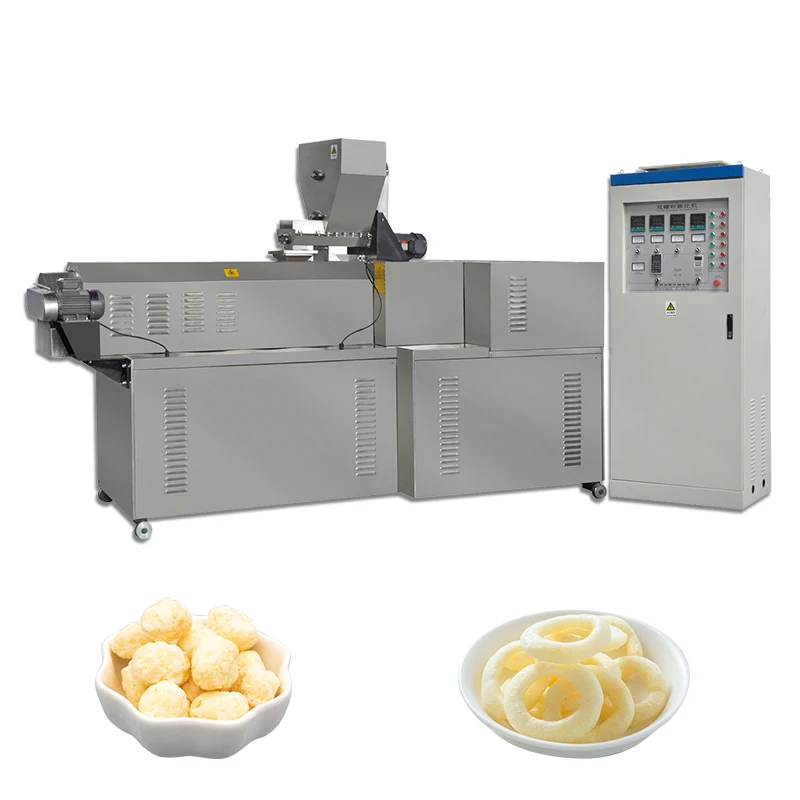
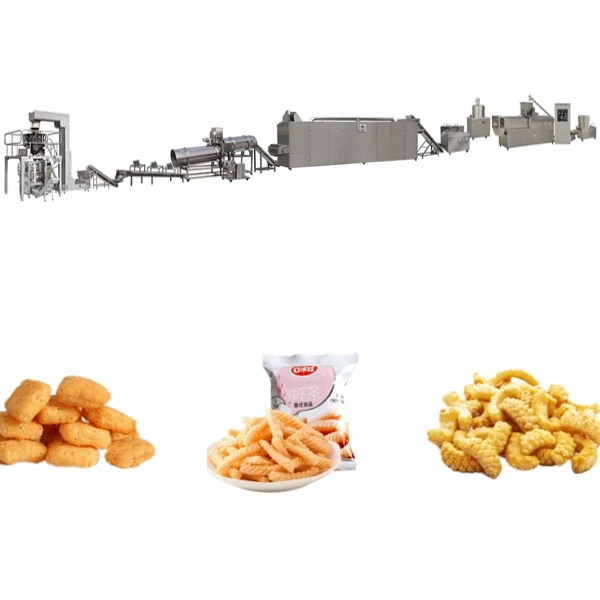
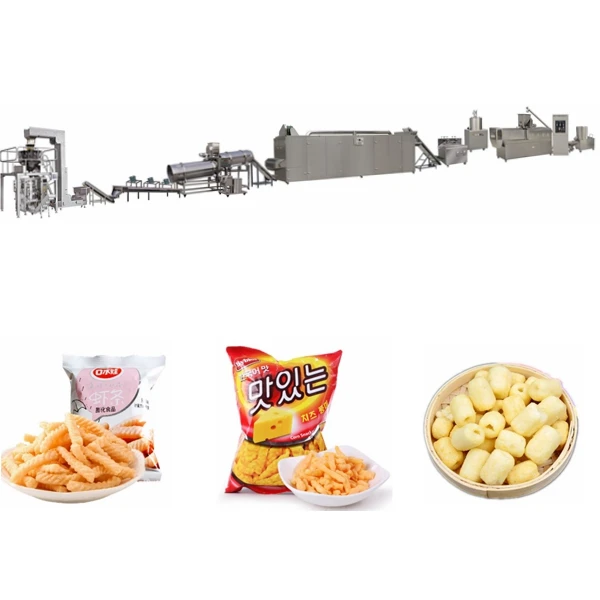
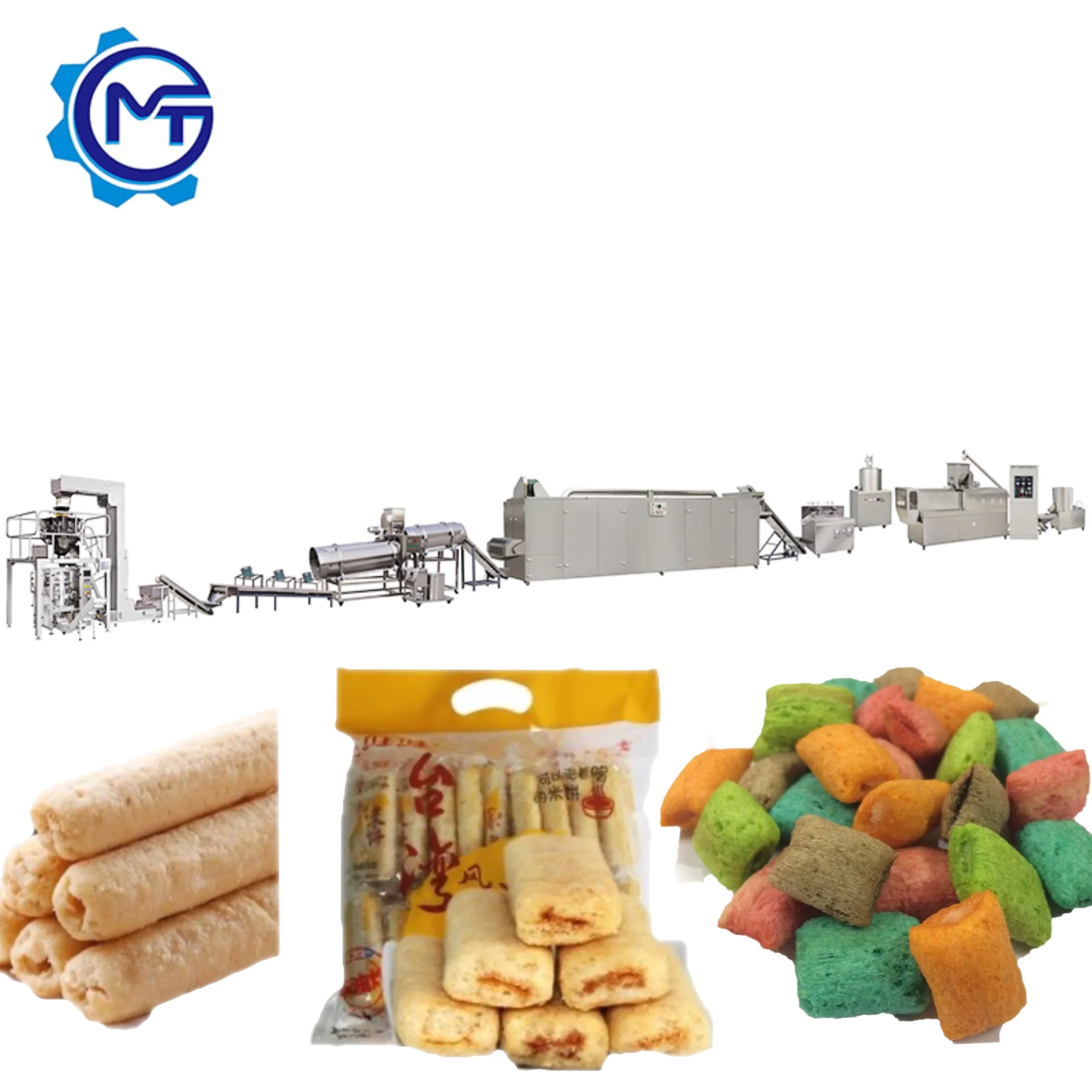
MT75 Twin Screw Puffed Snack Extrusion Line, 220 kW Installed Power, 300–500 kg/h Output — engineered for cereal-based puffed snack production from batching through extrusion, drying, coating, cooling and packing.
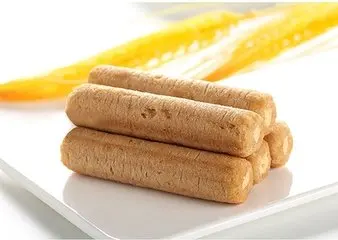
- Interchangeable die moulds produce ball, tube, ring, star and fruit loop shapes on a single extruder platform
- Dryer and double tumble coating drum sized to match extruder throughput, preventing downstream bottlenecks
- Screw and barrel feature automatic lubricating and cooling for stable continuous runs
Each line undergoes an in-house trial on your actual raw material before shipment, with a full trial run report and screw configuration record delivered for your verification.
Description
Complete Turnkey Line Integration with Throughput Matched at Every Station
Throughput-balanced extrusion systems — The puffed snack extrusion production line turnkey configuration ensures drying, coating and packing capacities are engineered to match extruder output rather than sourced as independent units.
Technical Specifications
| Parameter | Value |
|---|---|
| Product Type | Twin Screw Puffed Snack Extrusion Line |
| Model | MT75 (series includes MT70 / MT85) |
| Screw Configuration | Twin-screw with automatic lubrication and cooling |
| Installed Power (MT70 / MT85 / MT75) | 130 kW / 180 kW / 220 kW |
| Power Consumption (MT70 / MT85 / MT75) | 95 kW / 120 kW / 130 kW |
| Output Capacity (MT70 / MT85 / MT75) | 100–120 kg/h / 200–300 kg/h / 300–500 kg/h (basis to be confirmed) |
| Overall Dimensions (MT70 / MT85 / MT75) | 21 × 1.5 × 2.2 m / 25 × 1.5 × 2.2 m / 28 × 1.5 × 2.2 m |
| Line Sequence | Batching → Extruding → Drying → Coating/Flavouring → Cooling → Packing → Stacking |
| Die Options | Interchangeable moulds (ball, tube, stick, ring, fruit loop, star, wheel, flower, heart) |
| Dryer Heating Source | Gas or electric |
| Coating System | Double tumble drum with sugar melting, elevator, coating drum, spraying nozzle |
| Control System | PLC and MCC control options available (confirm language) |
| Compliance | CE, ISO |
Application Suitability
| Application | Material or Output |
|---|---|
| Puffed cereal snacks | Corn, rice, wheat, oat, and barley flour formulations |
| Coated snack formats | Cheese balls, rings, tubes, stars, fruit loops |
| New product launches | Manufacturers scaling from pilot batches to full production volumes |
| Turnkey plant projects | Contractors specifying layout, utility planning and phased installation |
| Capacity upgrades | Producers moving from smaller to larger twin-screw models in the series |
Why Nominal Capacity Figures Fail on Your Raw Material
A puffed snack extrusion production line turnkey project quoted on a generic output figure rarely delivers that throughput on the buyer’s actual formulation.
When a snack manufacturer sends a recipe with high sugar content or low gluten structure, the starch gelatinisation behaviour inside the barrel changes entirely. The expansion ratio drops, surface blistering appears, and the cutting cycle falls out of sync with the core-filling injection timing. I spent four days on-site in Saudi Arabia reconfiguring the screw profile on a core-filling line because the customer’s formula behaved nothing like the standard corn flour used in factory trials. Every Meiteng line is trialled on the buyer’s own material in the testing workshop before dispatch [NEED_CITE: in-house trial run protocols for twin-screw extrusion]. This means the screw configuration, barrel temperature profile and die selection are documented against your specific recipe, not a benchmark material.
Barrel Temperature Profiling Across the Extrusion Zones
Twin-screw extruders process cereal-based formulations through distinct thermal and mechanical zones. The feeding section maintains a lower temperature to prevent premature gelatinisation that would cause bridging, while the metering and high-shear zones progressively raise the dough temperature to achieve full starch conversion. The MT75 series features automatic screw lubrication and cooling, which stabilises barrel temperature during extended production runs and prevents the thermal drift that causes batch-to-batch density variation.
Die Geometry and Product Expansion Control
The interchangeable die system allows a single extruder to produce multiple puff shapes — from thin-walled tubes to solid balls — without changing the screw assembly. Each die geometry creates a different pressure drop at the barrel exit, which directly controls the expansion ratio and final product density [NEED_CITE: die design principles for cereal extrusion]. Selecting the correct die and matching it to the moisture content of the raw material is critical; a die specified for a ring shape on a high-moisture dough will produce collapsed, misshapen output.
Screw Wear Resistance and Continuous Operation Stability
The screws are manufactured through a special wear-resistant process that extends service life when processing abrasive cereal flours. In continuous operation, screw wear increases the clearance between the screw flights and barrel liner, reducing shear efficiency and causing a gradual decline in gelatinisation. The automatic lubricating function minimises friction-induced wear, allowing the line to maintain consistent product texture over longer intervals between scheduled screw replacements.
The Hidden Cost of Mismatched Downstream Stations
An extruder running at full output is only productive if the dryer can remove moisture at the same rate. When the drying capacity falls short, product accumulates on the belt, moisture migrates back into the puffed structure, and shelf life drops noticeably [NEED_CITE: moisture migration and shelf stability in extruded snacks]. Similarly, a coating drum sized below extruder throughput causes product to queue before the flavouring stage, leading to surface abrasion and breakage. These bottlenecks are invisible in a quotation that lists extruder capacity without specifying the matching dryer belt length and drum volume.
Why Source the Full Line from One Integration Point
The puffed snack extrusion production line turnkey approach from Meiteng delivers layout, throughput matching and commissioning as a single project scope. Line layout and capacity calculations are engineered to your factory footprint, not taken from a standard template. Screw and die configurations are specified to your raw material and target product shape, with the exact tooling documented before production begins. The in-house testing workshop runs your formulation before shipment, so product development starts at the factory rather than on your floor during commissioning. Pre-sales consultation covers voltage confirmation, control language selection and phased installation scheduling.
Documentation & Verification
- Line layout drawing matched to your factory dimensions and utility connection points
- Capacity calculation sheet specifying raw material basis and moisture assumptions
- Screw and die configuration record for your target product shape and density
- Electrical schematic with confirmed voltage, frequency and HMI language
- Trial run report on your raw material conducted in the testing workshop
- CE declaration of conformity and ISO certificate for customs and compliance
Installation, Commissioning & Support
- Foundation and floor load assessment based on the 28 m MT75 line footprint
- Dedicated electrical circuit sized for 220 kW installed power with confirmed voltage and frequency
- Modular delivery with staged assembly to fit phased construction schedules
- On-site parameter setting including barrel temperature profile and die pressure calibration
- Operator training covering screw changeover, die replacement and lubrication system checks
- Wear parts list with reorder intervals for screws, dies and barrel liners
Requesting a Quotation with the Right Detail
To specify a puffed snack extrusion production line turnkey project accurately, share your raw material formulation, target product shapes and the daily output volume you need to meet. Provide your factory floor dimensions and ceiling height so the layout can be configured before quotation, along with your local voltage, frequency and preferred control language to avoid commissioning delays.
Frequently Asked Questions
Q: How is output capacity verified on my raw material?
A: Every line undergoes a trial run in the testing workshop using your actual raw material before shipment. The output rate, moisture content and expansion ratio are recorded in a trial report, so the capacity figure you receive is tied to your specific formulation rather than a generic benchmark.
Q: How are the dryer and coating drum matched to the extruder?
A: The dryer belt length and drum volume are calculated against the extruder’s verified output on your material. This prevents product accumulation between stations, which would cause moisture migration, surface damage or coating inconsistency during continuous production.
Q: What electrical and control details are confirmed before production?
A: Voltage, frequency and HMI language are confirmed against your site standard before the line enters production. The electrical schematic is included in the documentation package, ensuring your local electrical contractor can prepare the connection before the equipment arrives.
Q: Can my raw material be tested before the line ships?
A: Yes. You send a sample of your raw material to the testing workshop, where the configured screw profile and die are run under production conditions. The trial report documents expansion, density and texture so you can approve the setup before dispatch.
Q: How is the factory layout adapted to my building?
A: Your factory floor plan and ceiling height are used to engineer the line layout, including station placement, conveyor routing and utility drop points. This ensures the puffed snack extrusion production line turnkey configuration fits your space and supports phased installation if needed.
Related products
-

Automatic Corn Crisps Extruder Production Machine for Maize Chips and Corn Sticks New Condition
¥8,000.00 Select options This product has multiple variants. The options may be chosen on the product page -

Puff Corn Snacks Food Line Puffed Rice Ball Production Making Equipment Machines
¥10,565.00 Select options This product has multiple variants. The options may be chosen on the product page -

Puff Corn Extruder Machine Puffed Core Filled Snack Food Production Line Machine
¥8,500.00 Select options This product has multiple variants. The options may be chosen on the product page -

Fully automatic puff snack processing line
¥8,500.00 Select options This product has multiple variants. The options may be chosen on the product page


