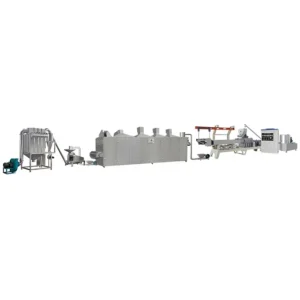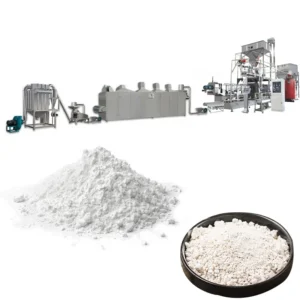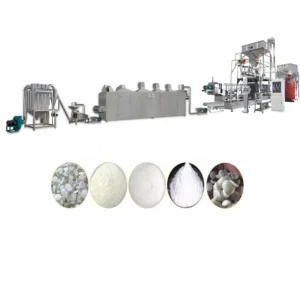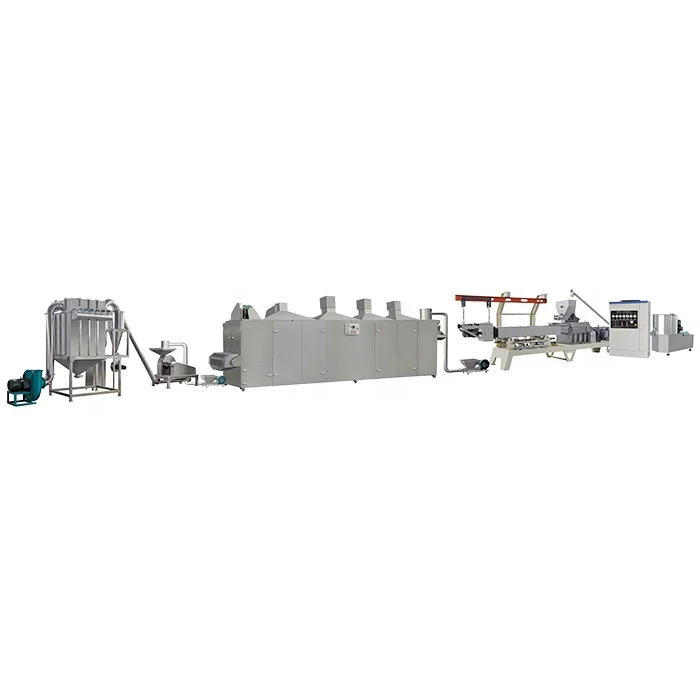


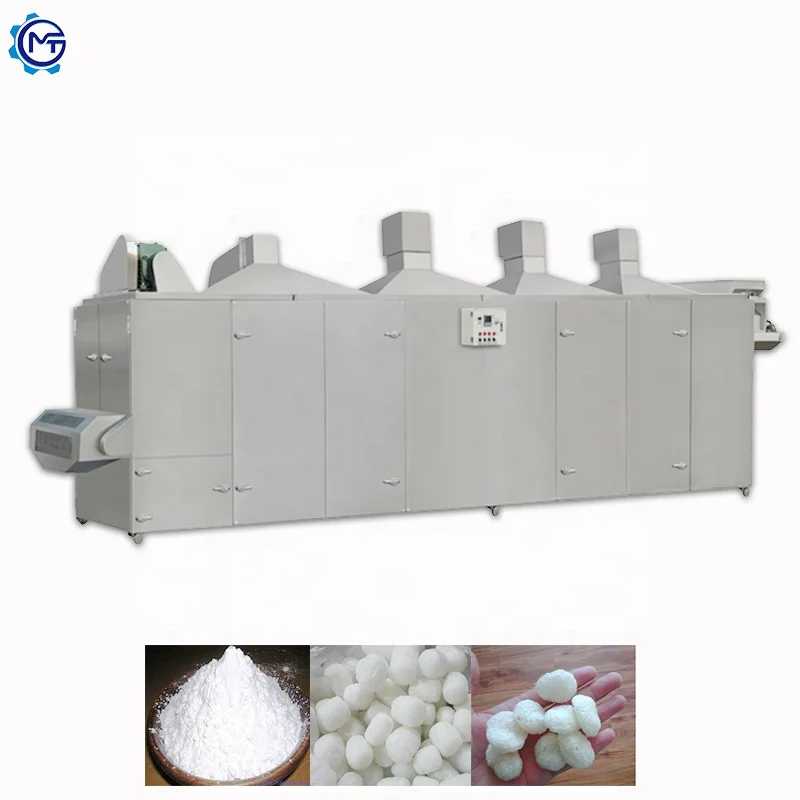

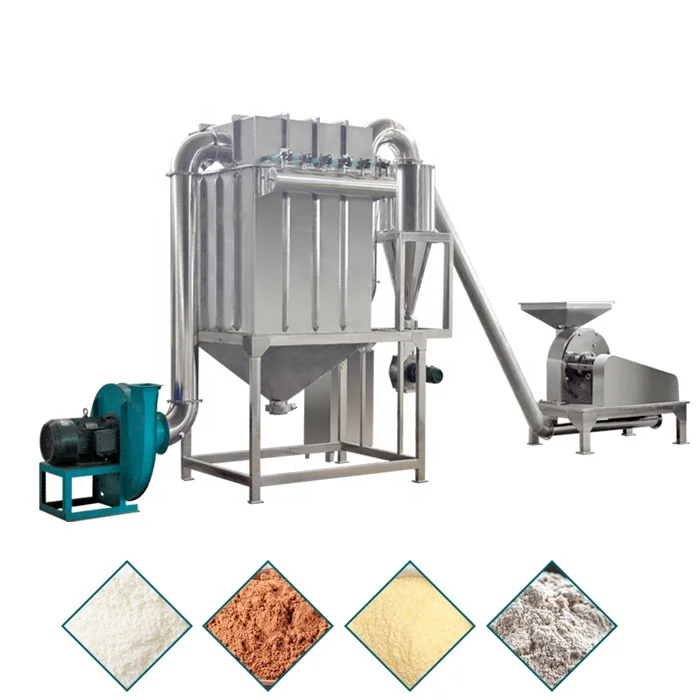
MT70 / MT85 / MT75 Modified Starch Processing Line, Twin-Screw Extrusion, PLC Control — engineered as a complete turnkey project from batching through extrusion, drying and grinding.
- Screw configuration and die design matched to your raw starch base and target modification type (E1422, pregelatinised)
- Barrel cooling system ensures precise temperature control during gelatinisation
- 5-layer dryer with inverter speed and multiple fuel options for consistent moisture reduction
Layout, throughput matching and trial runs on your raw material completed in our testing workshop before shipment.
Description
Matched Throughput Across Stations — Every component in this modified starch processing line turnkey system is balanced from mixing through extrusion to drying, so no single station bottlenecks the actual output your raw material can sustain.
Technical Specifications
| Parameter | Value |
|---|---|
| Product Type | Modified Starch Processing Line (Twin-Screw Extrusion) |
| Available Models | MT70 / MT85 / MT75 |
| Screw Type | Twin-screw |
| Screw Material | 38CrMo |
| Screw Diameter | 70 mm (MT70, verify for MT85/MT75) |
| Screw Length | 1520 mm (MT70, verify for MT85/MT75) |
| Main Motor Power | 30 kW (MT70, verify across models) |
| Installed Power | 160 kW (MT70) / 190 kW (MT85) / 210 kW (MT75) |
| Power Consumption | 120 kW (MT70) / 140 kW (MT85) / 150 kW (MT75) |
| Output Capacity | 150–200 kg/h (MT70, basis not stated in source — confirm raw material type and moisture content) |
| Output Capacity | 300–400 kg/h (MT85, basis not stated in source — confirm raw material type and moisture content) |
| Output Capacity | 300–500 kg/h (MT75, basis not stated in source — confirm raw material type and moisture content) |
| Overall Dimensions (L×W×H) | 41000×1500×2200 mm (MT70) / 43000×1500×3200 mm (MT85) / 45000×1500×3500 mm (MT75) |
| Barrel Cooling System | Yes, integrated cooling for temperature control |
| Voltage & Frequency | 380V 50Hz Three Phase (default); custom options available — 380V 60Hz, 415V 60Hz, 220V 60Hz |
| Control System | PLC and MCC |
| Feeding Power | 0.75 kW |
| Cutting Power | 0.75 kW |
| Heating Ring Power | 14 kW (7×2 kW) |
| Mixer Capacity | 20–30 kg/time, 70–80 kg/time, or 170–180 kg/time depending on model |
| Mixer Power | 4 kW / 7.5 kW / 15 kW |
| Mixer Material | 201SS / 304SS options |
| Dryer Type | 5-layer baking oven |
| Dryer Size | 5.0×1.2×2.3 m |
| Dryer Power | 3 kW |
| Dryer Fuel Options | Gas / Diesel / Electricity / Steam |
| Dryer Speed Control | Inverter |
| Dryer Material | 201 SS (standard) |
| Pulse Grinder | Cyclone discharge with dust collector, auger feeder with speed control |
| Food-Grade Contact Materials | Yes (food-grade stainless steel; some conveyors with PVC) |
| Standards | CE, ISO |
Application Suitability
| Application | Material or Output |
|---|---|
| E1422 acetylated distarch adipate production | Corn starch or wheat flour base with chemical reagent dosing |
| Pregelatinised starch for food ingredient use | Corn starch, tapioca starch, or potato starch base |
| Industrial modified starch for textile sizing | Corn starch base with cross-linking modification |
| Modified starch for paper coating and building materials | Wheat flour or corn starch with specific viscosity targets |
| Pre-gelatinised starch for instant food powders | Corn starch requiring controlled gelatinisation temperature |
Why Raw Material Origin Changes Everything on a Modified Starch Line
A processing line configured for one starch source will underperform or fail entirely when fed a different base material.
I watched a complete modified starch extrusion line sit idle for weeks because the screw profile and barrel temperature zones were set for tapioca starch, while the buyer’s local supply was potato starch with a different gelatinisation onset. The line was mechanically sound, but the product came out either under-cooked or burned depending on which zone you looked at. This is the gap between a catalogue capacity figure and what actually runs on your factory floor. When sourcing a modified starch processing line turnkey, the first question should never be about output per hour — it should be about what you are feeding into the hopper [NEED_CITE: gelatinisation temperature variance between starch sources].
Screw Configuration Dictates Modification Degree
The twin-screw arrangement in this line is not a generic build. Screw elements are selected and sequenced based on the target modification — whether you need mild pregelatinisation or a higher degree of cross-linking for E1422 production. The shear profile, residence time, and compression ratio all shift when the screw combination changes, and each starch base responds differently to the same mechanical input. This is where the modified starch processing line turnkey either matches your specification or misses it.
Barrel Temperature Zones and Gelatinisation Control
Precise thermal management across the barrel sections determines whether the starch granules swell uniformly or rupture prematurely. The integrated barrel cooling system works alongside the 14 kW heating rings to hold each zone within a narrow band. For modified starch production, a deviation of a few degrees can shift the final viscosity and water-binding capacity outside the buyer’s specification. The PLC control system manages these zones continuously rather than relying on manual adjustment [NEED_CITE: temperature sensitivity in starch modification reactions].
Reading the Power and Capacity Figures
The installed power across the MT70, MT85, and MT75 models ranges from 160 kW to 210 kW, with actual consumption figures notably lower at 120 kW to 150 kW. The gap between installed and consumed power reflects the headroom needed for startup torque and transient load spikes when denser material enters the barrel. Capacity values listed for each model carry no stated basis for raw material type or moisture content, meaning those figures shift depending on whether you run corn starch at 12% moisture or tapioca starch at a different hydration level. The mixer options — from 20–30 kg per batch up to 170–180 kg — must be matched to the extruder throughput so that the upstream feed never starves the screws or floods the barrel. The 5-layer dryer with inverter speed control handles moisture reduction after extrusion, and its fuel flexibility allows adaptation to local energy costs.
The Hidden Cost of Unmatched Line Stations
When the dryer capacity falls short of the extruder output, material piles up and moisture content drifts beyond specification. When the grinder cannot handle the dried output rate, the entire line slows to the pace of its weakest station. These mismatches do not show up in a quotation that lists each machine separately [NEED_CITE: throughput bottleneck impact on continuous processing lines]. The result is a line that technically runs but never reaches the output the buyer expected, and the troubleshooting cycle consumes weeks of production time.
Why Procurement Here Differs
Every station in this modified starch line — mixer, twin-screw extruder, dryer, pulse grinder — is specified together so that throughput is balanced before the equipment is built. Screw configuration and die design are documented against your specific raw material and target starch type, not copied from a generic template. The testing workshop runs your actual starch base before the line ships, generating a trial report that confirms temperature settings, screw speed, and product quality. Electrical schematics are confirmed for your market’s voltage and frequency before production begins, preventing commissioning delays. CE and ISO documentation accompanies every shipment, and wear parts lists ensure the first replacement set of screws and dies is available when needed.
Documentation & Verification
- Line layout and capacity calculation with throughput balance across all stations
- Screw and die configuration record matched to your starch base and target modification
- Trial run report on your raw material completed before dispatch
- Electrical schematic with confirmed voltage, frequency, and control language
- CE declaration of conformity and ISO certificate for customs and compliance
- Operation and maintenance manual with wear parts list
Installation, Commissioning & Support
- Foundation and floor space planning based on the 41–45 metre line length and station layout
- Dedicated electrical circuit sized for 120–150 kW consumption with confirmed voltage and frequency
- Pre-assembled factory test before shipment reduces on-site assembly time
- First-run parameter setting including barrel zone temperatures and screw speed for your starch type
- Operator training covering PLC interface, mixer batching sequence, and dryer speed adjustment
- Wear parts supply including 38CrMo screws and dies with replacement scheduling guidance
What We Need to Configure Your Line
To build a line that runs your material from day one, we need the specific starch base you will process — corn, tapioca, potato, or wheat — along with the target modification type and final product specification. Your local voltage and frequency, preferred control language, and available workshop dimensions shape the electrical and layout proposal. If you have an existing upstream batching system or downstream packing line, share the interface details so throughput matching extends across the entire operation.
Frequently Asked Questions
Q: How is line output capacity verified, and what raw material and moisture conditions does it depend on?
A: Capacity depends on the starch base, its moisture content, and the target modification degree. We run a trial on your actual raw material in our testing workshop before shipment, documenting screw speed, barrel temperatures, and throughput achieved. The trial report becomes the baseline for commissioning, replacing generic catalogue figures with verified data specific to your input material.
Q: How is screw and die configuration selected for different modified starch types?
A: Each modification — E1422, pregelatinised, cross-linked — demands a different shear profile and residence time inside the barrel. We select screw elements and die geometry based on your target starch specification and raw material behaviour, recording the configuration so replacements match exactly when wear parts are needed.
Q: Can a trial run be conducted on our raw material before shipment?
A: Yes. Send a representative batch of your starch base to our testing workshop. We run the complete sequence — mixing, extrusion, drying, and grinding — and deliver a report covering temperature settings, screw speed, product quality measurements, and achieved throughput under those specific conditions.
Q: How is throughput matched between the extruder, dryer, and grinder to avoid bottlenecks?
A: Each station is specified together during the layout phase. The mixer batch cycle, extruder output, dryer belt speed, and grinder feed rate are calculated against one another so that no single station limits the line. This matching is documented in the capacity calculation provided with your quotation.
Q: What voltage, frequency, and control language options are confirmed before production?
A: Standard configuration is 380V 50Hz three-phase, with alternatives including 380V 60Hz, 415V 60Hz, and 220V 60Hz. The PLC interface language and electrical schematic are confirmed for your market before production begins, ensuring the control panel matches your operators’ requirements and local electrical standards.
Related products
-
Modified and Pregelatinized Starch Processing Equipment – Pregelatinized Corn Cassava Modified Starch Puffing Machine
¥65.00 Select options This product has multiple variants. The options may be chosen on the product page -
New Automatic Modified Starch Puffing Production Line – Long Service Life Pregelatinized Starch Equipment
¥65.00 Select options This product has multiple variants. The options may be chosen on the product page -
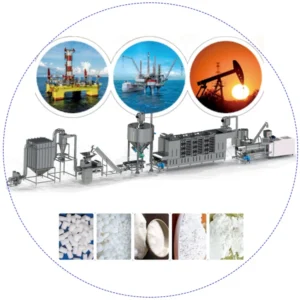
Automatic 304 Stainless Steel Modified Corn Starch Making Machine TWIN SCREW 500kg/h Capacity Starch Processing Production Line
¥50.00 Select options This product has multiple variants. The options may be chosen on the product page -
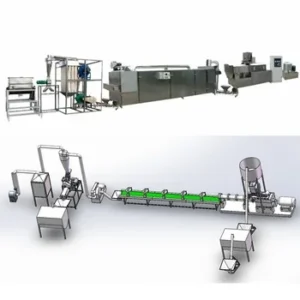
2025 New Design Modified Starch Big Capacity Industrial Use Food Additives Core Components Motor Bearing
¥50.00 Select options This product has multiple variants. The options may be chosen on the product page