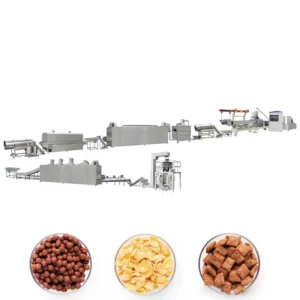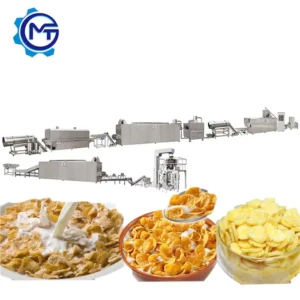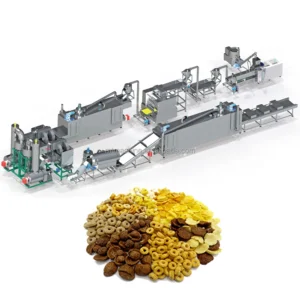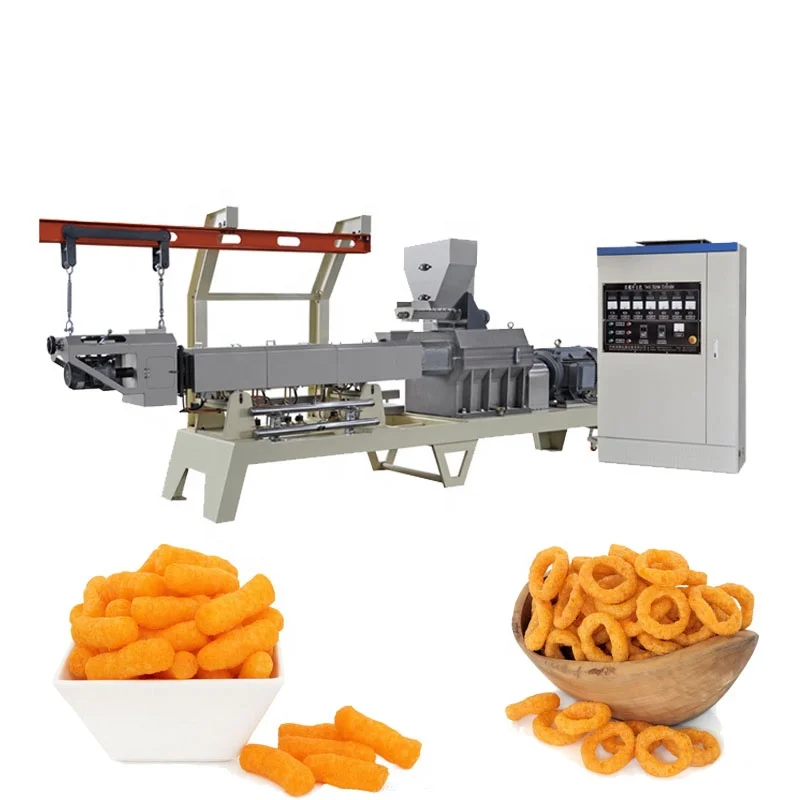
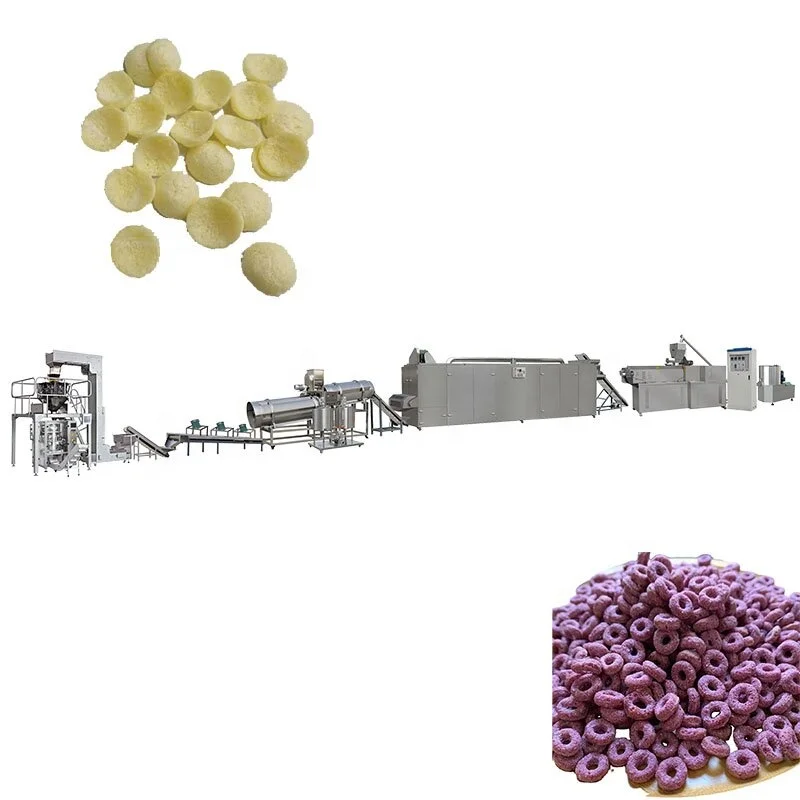
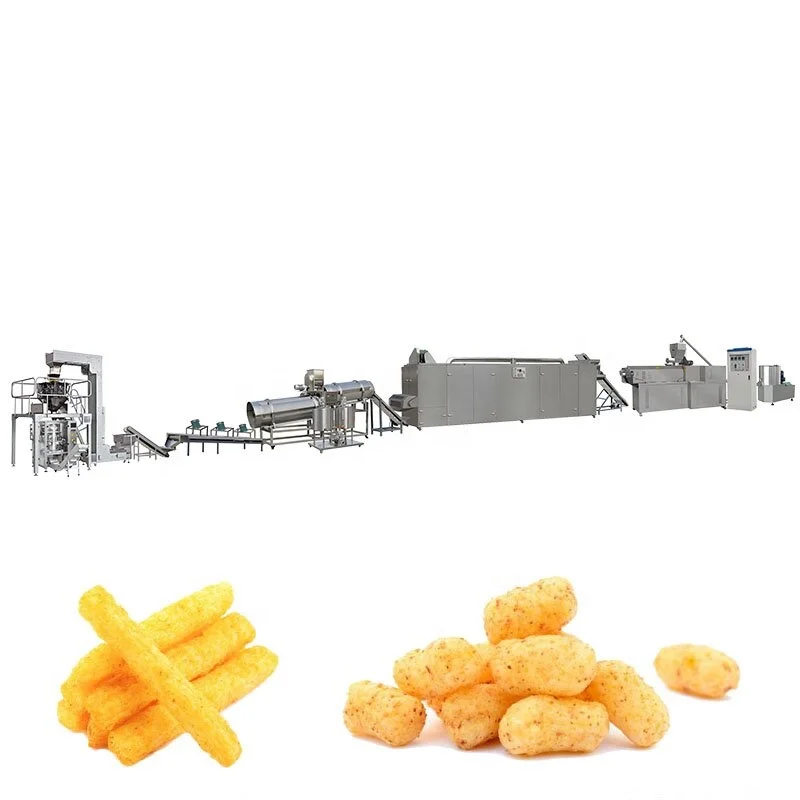
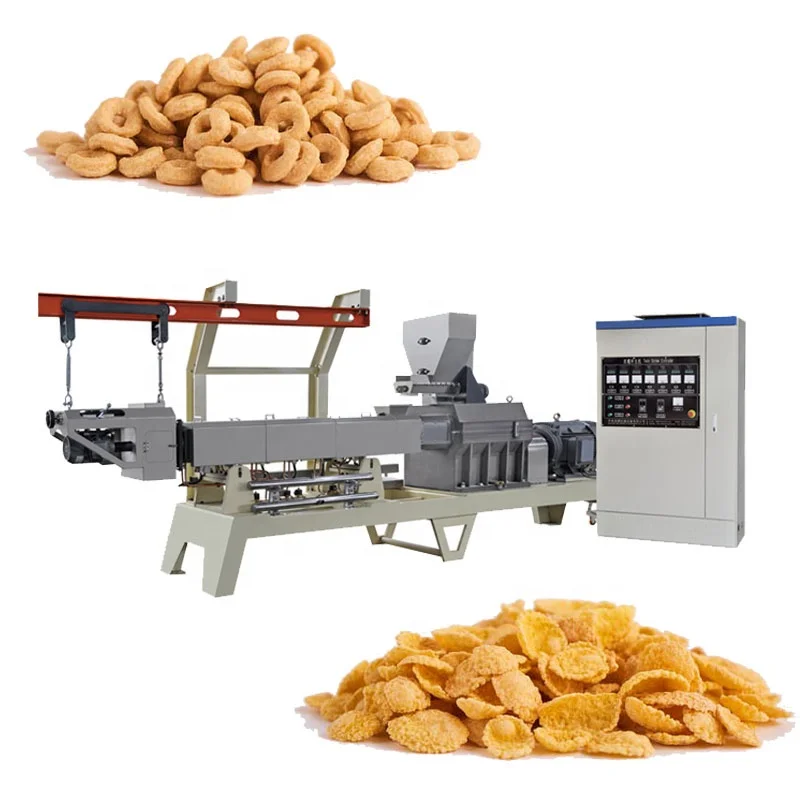
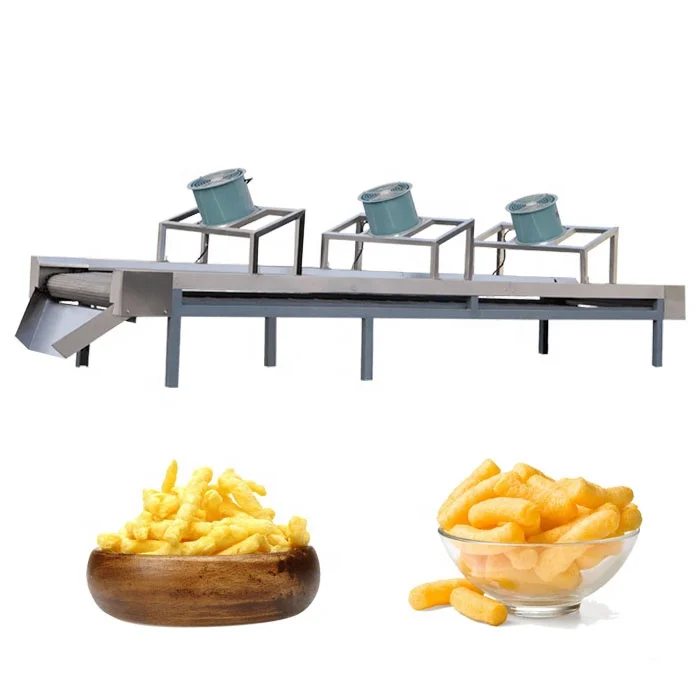
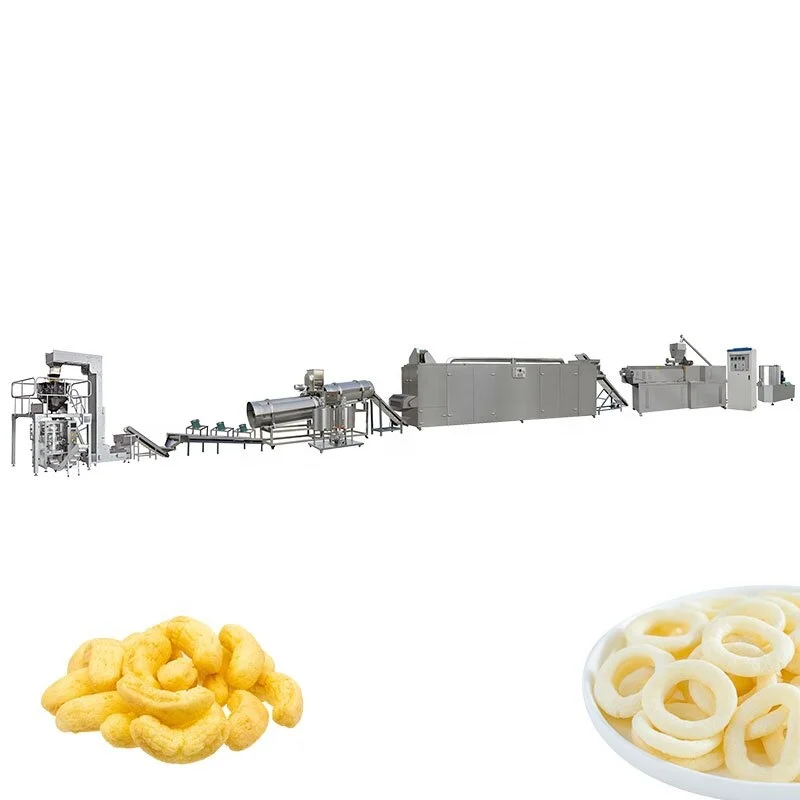
MT70 / MT85 / MT75 Corn Flakes Production Line, Twin Screw Extruder, PLC & MCC Control — complete turnkey configuration from mixing through extruding, flaking, drying, hot air roasting to sugar coating and packing.
Screw configuration and die design are matched to your raw material blend of corn, rice, wheat, oat, or barley powder, controlling moisture, shear, and expansion for target flake density and surface bubbling. Hydraulic double-roller flaking with infrared temperature monitoring ensures consistent thickness before roasting.
- Throughput verified on your actual material in our testing workshop before shipment, with trial run report and screw/die configuration record included.
Description
Matched Throughput at Every Station — We configure screw geometry, flaker gap, dryer length, and roasting airflow as one system, so no single station bottlenecks the line or forces operators to run upstream equipment below capacity.
Technical Specifications
| Parameter | Value |
|---|---|
| Product Type | Corn Flakes Production Line (Twin Screw Extrusion) |
| Model | MT70 / MT85 / MT75 |
| Screw Configuration | Twin Screw |
| Installed Power | MT70: 160 kW / MT85: 190 kW / MT75: 210 kW |
| Power Consumption | MT70: 120 kW / MT85: 140 kW / MT75: 150 kW |
| Output Capacity | MT70: 150–200 kg/h (basis not stated in source) / MT85: 300–400 kg/h (basis not stated in source) / MT75: 300–500 kg/h (basis not stated in source) |
| Overall Dimensions (L×W×H) | MT70: 41 × 1.5 × 2.2 m / MT85: 43 × 1.5 × 3.2 m / MT75: 45 × 1.5 × 3.5 m |
| Basic Material Input | Powder of corn, rice, wheat, oat, barley |
| Control System | PLC control (flaking machinery); MCC and PLC available for line |
| Flaking Machinery | Hydraulic double rollers, separate motor drives, infrared sensor temperature control |
| Dryer Heating Source | Gas or Electric |
| Hot Air Roasting Oven | Vibrating pan, conciliation burner, dual circulating fans, cyclone dust removal |
| Coating System | Double tumble sugar melting, elevator, coating drum, spraying nozzle |
| Assembly State | Complete turnkey line |
| Standards | CE (since 2014); ISO certified |
Application Suitability
| Application | Material or Output |
|---|---|
| Natural corn flakes manufacturing | Corn powder, corn grits |
| Sugar-coated breakfast cereal production | Corn, rice, wheat, oat blends with sugar or honey coating |
| Multi-shape extruded cereal formats | Grain powder mixes producing rings, stars, balls, tubes, fruit loops |
| Mixed-grain and fortified flake production | Barley, oat, and wheat powder blends |
Why "Nominal Output" Is the Wrong Number to Build Your Line Around
The only capacity figure that matters is what the extruder actually holds on your specific flour blend at your target moisture.
When a breakfast cereal plant signs off on a line based on a brochure number, the first production run often tells a different story. I have watched corn flakes production line turnkey installations stall because the quoted throughput assumed pure corn grits, while the buyer’s actual recipe included oat flour and barley powder that changed the dough viscosity entirely. The extruder could not push the material through at the promised rate, and downstream the flaker sat idle waiting for feed. That mismatch between nameplate capacity and real-world material behaviour is the single most expensive surprise in cereal processing [NEED_CITE: material-dependent extruder throughput variation in grain processing].
The corn flakes production line turnkey configuration you evaluate must be tested on the exact powder blend you intend to run — at the moisture content your mixing system actually delivers. Anything else is a guess that your commissioning budget will pay for.
Screw Geometry That Matches Your Grain Blend, Not a Catalogue Default
Every grain powder behaves differently under heat and shear inside a twin-screw barrel. Corn powder gelatinises at a different moisture threshold than oat or barley, and the screw element sequence — conveying, kneading, reverse — must be arranged to give your specific blend enough residence time for complete starch conversion without over-shearing the dough. When we configure a corn flakes production line turnkey system, the screw profile is selected after reviewing your material safety data, particle size distribution, and target flake density. A die plate with the wrong orifice diameter will produce pellets that are too dense to flake into a crisp sheet or too fragile to survive the roasting stage.
Flaker and Roaster Synchronisation — Where Most Lines Choke
The flaking station uses hydraulic double rollers driven by separate motors with infrared temperature sensing to maintain consistent gap and surface condition across the roller face. But consistent flakes only matter if the roasting oven can handle the volume the flaker delivers. The hot air roasting oven on this line uses a vibrating pan with a conciliation burner and two circulating fans to control the surface bubbling and final crispness of each flake. If the oven is undersized relative to the flaker output, flakes queue up, absorb ambient moisture, and lose the texture your market expects [NEED_CITE: moisture re-absorption effects on flaked cereal during line hold-ups]. Throughput matching between these stations is calculated during the layout phase, not adjusted on the factory floor.
What the Spec Sheet Numbers Actually Mean for Your Daily Run
The installed power figures — 160 kW for the MT70, 190 kW for the MT85, and 210 kW for the MT75 — reflect the combined draw of the extruder main drive, feeder, and cutter. Power consumption values sit roughly 70–75 percent of installed capacity, which is typical for twin-screw extrusion under continuous load. The overall line length across all three models stretches between 41 and 45 metres, so your facility needs clear floor space plus access room for maintenance on both sides. The PLC-controlled flaking machinery holds roller gap tolerance through hydraulic feedback, which directly affects flake thickness uniformity — a critical factor when your packaging line weights out portions by volume. Gas or electric dryer options let you match the heating source to your local utility cost structure rather than accepting a single default.
The Hidden Cost of Skipping a Pre-Shipment Trial Run
A buyer who accepts delivery without a trial run on their own raw material inherits every process risk. When the formula contains mixed grain powders, the extruder barrel temperature profile and screw speed that work perfectly on pure corn may produce under-expanded pellets from a wheat-barley blend. Those pellets crack instead of flattening under the flaker rollers. The resulting flakes are dense, hard, and unsellable — and by the time you discover this, the line is already installed, the utility connections are poured, and you are paying for an engineer to fly back and reconfigure [NEED_CITE: cost of post-installation process re-engineering in food extrusion]. That re-work costs more than the trial run ever would have.
Why Sourcing the Full Line From One Supplier Matters Here
Complete line responsibility under one supplier means the mixing system batch size is calculated to feed the extruder at its verified rate, not at a catalogue number. The extruder screw configuration and die design are specified against your raw material sample, not copied from a generic cereal build. The in-house testing workshop runs your actual powder blend before the equipment ships, so expansion, pellet density, and flake crispness are confirmed in advance. Twin-screw expertise across corn, rice, wheat, oat, and barley applications means the process parameters are set by people who have seen how each grain responds to shear and moisture. Pre-sales engineering through to on-site commissioning and operator training keeps accountability in one place instead of scattered across five vendors.
Documentation & Verification
- Line layout drawing showing station spacing matched to your factory footprint and ceiling height
- Capacity calculation sheet referencing your specific grain powder blend and moisture content
- Screw and die configuration record documenting element sequence selected for your target flake density
- Electrical schematic with voltage, frequency, and PLC language confirmed for your country before production
- Trial run report on your raw material documenting pellet expansion, flake thickness, and roasting outcome
- CE declaration of conformity and ISO certificate included with shipping documentation
Installation, Commissioning & Support
- Foundation plan provided for the 41–45 m line footprint accounting for extruder vibration isolation and dryer gas supply routing
- Dedicated electrical circuit sized to the MT75 peak draw of 210 kW with voltage and frequency verified against your local grid
- Equipment shipped in sectional modules for reassembly on site with flaker and roaster alignment calibrated after positioning
- First-run commissioning includes barrel temperature profiling and flaker gap adjustment on your production formula
- Operator training covers PLC interface navigation, screw wear inspection intervals, and hydraulic roller maintenance
- Wear parts list specifying screw elements, die plates, and flaker roller surfaces with recommended replacement triggers
What We Need to Size Your Line Correctly
To move past general specifications and into an accurate corn flakes production line turnkey proposal, we need your actual grain formulation — including the percentage of each powder component and the moisture content your mixer delivers. Tell us your target daily output in finished flake weight, and whether you plan to run sugar-coated variants alongside natural flakes. Your facility floor dimensions and ceiling height determine which extruder model fits and how the dryer and roasting oven are positioned. Finally, confirm your local voltage, frequency, and the language your operators will need on the PLC interface so the control system is built correctly from the start.
Frequently Asked Questions
Q: How is line capacity verified on my specific raw material before shipment?
A: We run your actual grain powder blend through the extruder in our testing workshop, measuring pellet expansion, moisture loss, and flake density under the screw configuration selected for your formula. A trial run report documenting these results ships with the equipment, so you know the verified throughput before the line arrives at your facility.
Q: How do you match throughput between extruder, flaker, dryer, and coating stations to avoid bottlenecks?
A: Each station is sized during the layout phase based on the verified extruder output on your material, not a catalogue number. The flaker roller width, dryer belt length, and roasting oven pan area are calculated to handle the actual mass flow, so no station forces upstream equipment to idle or downstream equipment to starve.
Q: What screw and die configuration is selected for my target flake density and texture?
A: The screw element sequence — conveying, kneading, and reverse elements — is arranged based on your grain blend’s gelatinisation behaviour and moisture content. Die orifice diameter is chosen to produce pellets that flatten cleanly under the flaker rollers without cracking, delivering the flake thickness and crispness your market requires.
Q: How is voltage, frequency, and PLC control language confirmed for my country?
A: Before production begins, we collect your site electrical specification and confirm the motor ratings, heating element configuration, and control panel language against your local grid standard. The electrical schematic reflects these confirmed values and is included in your documentation package for local authority approval.
Q: What installation, commissioning, and operator training is included with the turnkey line?
A: Our engineers handle on-site assembly, utility connection verification, and first production runs using your raw material. Operator training covers the PLC interface, flaker hydraulic adjustment, roasting oven temperature control, and scheduled maintenance for screw elements and die plates. Ongoing technical support continues after the commissioning period concludes.
Related products
-

MT Cocoa Flour Puffed Breakfast Cereal Production Line-High Large Capacity Multi-Fuel (Steam/Gas/Electric) New Shandong Origin
¥8,000.00 Select options This product has multiple variants. The options may be chosen on the product page -

Small Scale Breakfast Cereal Manufacturing Machine for Corn Flakes Process Line
¥45,000.00 Select options This product has multiple variants. The options may be chosen on the product page -
Complete Corn Flakes Production Line Breakfast Cereal Processing Machine Core Motor Component Cornflakes Processing Equipment
¥19,000.00 Select options This product has multiple variants. The options may be chosen on the product page -
New Technical Automatic Cereal Nutritional Powder Instant Porridge Baby Food Making Machine
¥10,000.00 Select options This product has multiple variants. The options may be chosen on the product page