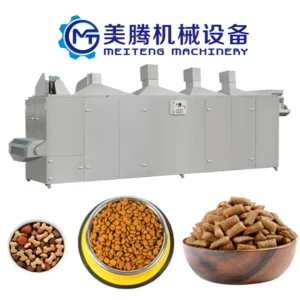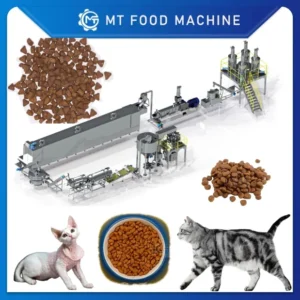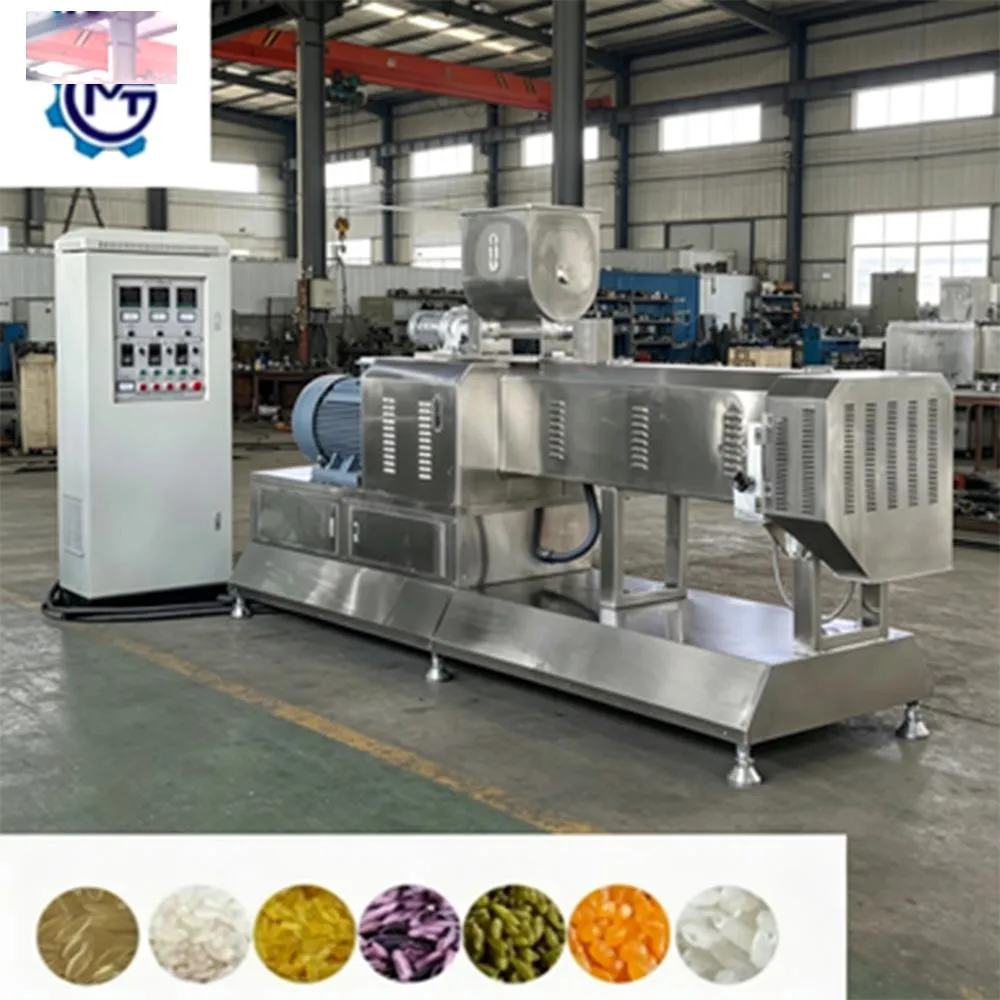
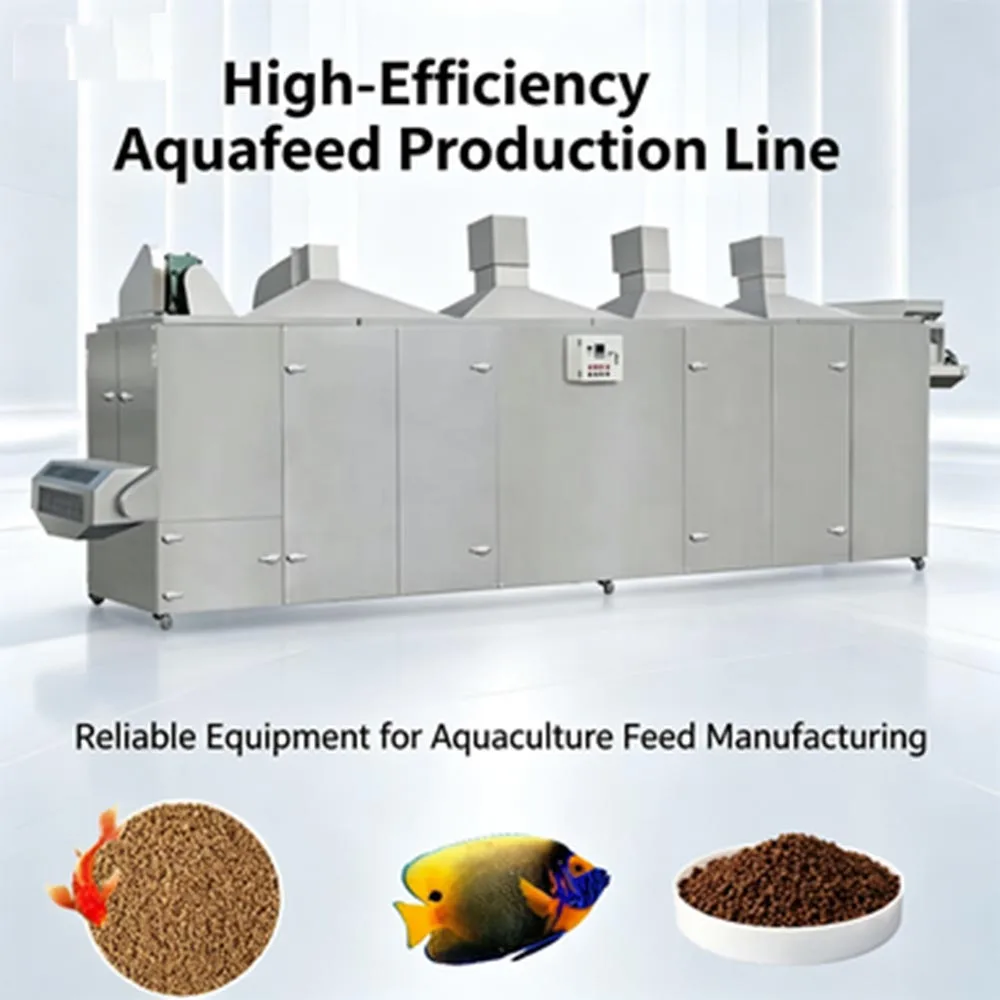


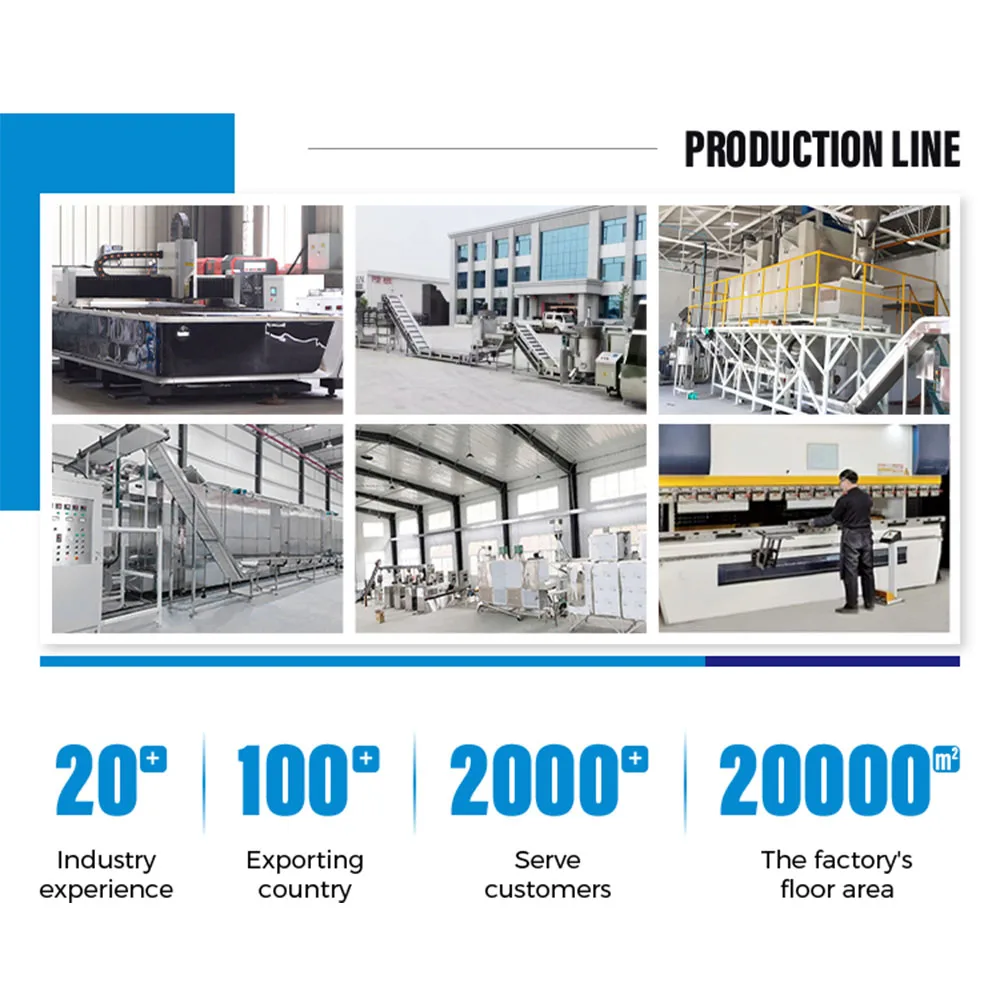
Twin Screw Fish Feed Extruder Production Line, PLC Control, 304 Stainless Steel — complete aquatic feed extrusion system from batching through extrusion, drying, coating to packing.
Screw configuration and die design are specified to your raw material formulation, enabling precise control of pellet buoyancy, size and density for both floating and sinking feed. Throughput across mixer, extruder, dryer and seasoning drum is engineered as one balanced system.
- Line layout and capacity calculation matched to your pellet specification
- In-house trial run on your raw material before shipment
- Electrical schematic with voltage and frequency confirmed for your market
Description
Integrated Throughput Engineering — Every station from batching to packing is sized as one system, preventing the dryer or coater from choking a line that was quoted on extruder capacity alone.
Technical Specifications
| Parameter | Value |
|---|---|
| Product Type | Twin Screw Fish Feed Extruder Production Line |
| Screw Type | Twin screw |
| Material Contact Parts | Food grade 304 stainless steel |
| Control System | PLC automatic control system |
| Pellet Properties | Adjustable size, hardness, buoyancy (floating and sinking) |
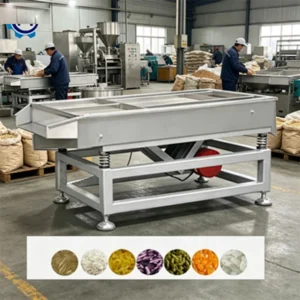
| Line Stations | Raw material mixer, extruder, dryer, seasoning coating machine, vibrating sieve, conveyor equipment |
| Operation | Full continuous automatic production from mixing to finished product discharging |
| Output Capacity | Medium to large scale industrial commercial mass production (basis to be confirmed) |
| Energy Features | Optimized energy saving transmission structure and heating system |
| Maintenance | Quick replacement of vulnerable parts, convenient daily cleaning |
Application Suitability
| Application | Material or Output |
|---|---|
| Floating feed for surface-feeding species | Fish meal, soybean meal, corn powder with compound additives for koi and tropical fish |
| Sinking feed for bottom-feeding species | Reformulated starch and protein blends for catfish, tilapia, and shrimp |
| Ornamental fish feed | Specialty pigment-enriched formulations for goldfish and aquarium species |
| Freshwater aquaculture operations | Compound additive blends scaled for medium to large commercial breeding facilities |
What "Medium to Large Scale" Actually Means When Stations Mismatch
A Twin Screw Fish Feed Extruder Production Line turnkey project lives or dies by its weakest station.
Out in Southeast Asia, I have watched an extruder push wet pellets onto a conveyor faster than the downstream dryer could handle moisture removal. The result was not a capacity problem on paper — it was a physical blockage of half-cured feed piling up, sticking to belts, and shutting the line down every few hours. Buyers often receive a quotation where the extruder is rated for a certain throughput, but the dryer, cooler, and coating drum were selected from a generic catalogue without recalculating for the specific moisture content and pellet density of aquatic formulations. When floating pellets require a longer residence time in the dryer than sinking pellets, a single fixed-speed dryer becomes the constraint that dictates what the whole line can actually ship. [NEED_CITE: throughput balancing across extrusion line stations]
Matching Screw Profile to Pellet Buoyancy Targets
Floating and sinking pellets demand fundamentally different shear and expansion behaviour inside the barrel. The screw configuration and die design on a Twin Screw Fish Feed Extruder Production Line turnkey setup must be specified against the buyer’s raw material formulation — the ratio of fish meal to starch, the fat content, and the target moisture at the die face all determine whether pellets trap enough air to float or compress enough to sink. A generic screw build copied from a kibble application will produce unpredictable buoyancy results when switched to aquatic feed, forcing the operator to guess at barrel temperature zones and screw speed adjustments during commissioning.
Why the Dryer Cannot Be an Afterthought
Aquatic feed carries higher moisture at the die exit than most puffed snacks or dry pet kibble, which means the drying stage must be engineered around the actual water load rather than a nominal belt speed. The drying section of a Twin Screw Fish Feed Extruder Production Line turnkey installation needs sufficient thermal capacity and air flow to handle the peak moisture scenario — typically floating pellets with high expansion — without slowing the extruder to match. I have seen producers in the Mekong Delta region lose entire production shifts because a dryer specified for a lower moisture product could not bring floating feed down to safe storage humidity before packing. [NEED_CITE: moisture removal requirements for expanded aquatic feed pellets]
Reading the Specs That Matter for Aquatic Feed
The twin screw design provides positive conveying and higher shear than a single screw, which is necessary when processing viscous, high-protein aquatic formulations containing fish meal and compound additives. The food grade 304 stainless steel contact parts resist corrosion from the salts and amino acids common in fish feed recipes, extending service intervals in humid tropical workshop conditions. PLC automatic control allows the operator to store and recall parameter sets — screw speed, barrel temperature profile, feeder rate — so that switching between floating and sinking pellet runs becomes a recipe selection rather than a manual recalibration. The full line integration from mixer through extruder, dryer, seasoning drum, vibrating sieve, and conveyors means that each transfer point is engineered for the pellet size range and fragility specific to aquatic feed, reducing breakage before packing.
The Hidden Cost of Skipping Station-by-Station Verification
When throughput is not balanced across every station before production begins, the consequences surface during commissioning — the most expensive time to discover a mismatch. An undersized vibrating sieve will allow broken fines to reach the packing stage, degrading the feed conversion ratio the buyer promised to their farm customers. A coating drum that cannot keep pace with the extruder output means seasoned pellets sit in the conveyor transfer, absorbing moisture from the humid air and losing their surface treatment. These are not theoretical failure modes; they are recurring complaints I have encountered across aquaculture feed installations where the line was assembled from independent equipment quotes rather than engineered as one system. [NEED_CITE: common commissioning failures in unmatched extrusion lines]
What This Supplier Brings to the Project Table
The line is designed as a single integrated system from batching through extrusion, drying, coating, and packing, with throughput matched at every transfer point so no station becomes an unplanned bottleneck. Screw configuration and die geometry are specified to the buyer’s raw material formulation and target pellet buoyancy before manufacturing begins. An in-house testing workshop conducts trial runs on the buyer’s actual raw material, generating a documented report that confirms pellet size, hardness, and floating or sinking behaviour before the line ships. The PLC control system stores complete parameter sets for each product recipe, enabling consistent batch-to-batch output across shift changes. Electrical schematics and voltage specifications are confirmed against the buyer’s local grid standards and control language preference before the panel is built.
Documentation & Verification
- Line layout and capacity calculation matched to your raw material formulation and target pellet buoyancy
- Screw and die configuration record documenting the exact profile built for your aquatic feed recipe
- Trial run report on your raw material conducted in the in-house testing workshop before shipment
- Electrical schematic with voltage, frequency, and control language confirmed for your facility
- Factory test record verifying continuous run performance across all line stations
- Operation and maintenance manual with wear parts list specific to your screw and die set
Installation, Commissioning & Support
- Foundation and utility planning based on the confirmed line layout and total connected load of the PLC-controlled system
- Dedicated electrical circuit sizing confirmed against local voltage and frequency before panel fabrication
- Modular station delivery allowing phased installation of mixer, extruder, dryer, and coating sections
- First-run parameter tuning on your raw material to validate pellet buoyancy, size, and hardness targets
- Operator training covering PLC recipe management, screw and die changeover, and daily cleaning routines
- Wear parts supply chain for screws, dies, and dryer belt segments with lead times established before commissioning
What We Need to Build Your Line Correctly
Provide your raw material formulation — including fish meal percentage, starch source, fat content, and any compound additives — along with the target pellet diameter range and whether you need floating, sinking, or both capabilities from the same line. Share your facility voltage, frequency, and preferred control language so the electrical panel and PLC interface are built to your standard. If you have existing upstream batching or downstream packing equipment, specify the interface requirements so the new line stations align with your current conveyor heights and signal protocols.
Frequently Asked Questions
Q: How is line capacity verified against my specific raw material and pellet size?
A: Capacity is not assumed from a generic rating. A trial run using your actual raw material formulation is conducted in the in-house testing workshop, where the extruder, dryer, and downstream stations are tested together. The resulting report documents throughput, pellet dimensions, buoyancy, and moisture at each stage, forming the basis of the final line configuration and capacity commitment.
Q: Can the same line produce both floating and sinking feed by adjusting extrusion parameters?
A: Yes. The PLC automatic control system stores separate parameter sets — screw speed, barrel temperature profile, moisture addition rate, and die selection — for each pellet type. Switching between floating and sinking production involves selecting the correct recipe and, where necessary, changing the die plate. The dryer settings are also adjusted to match the different moisture removal requirements of each pellet category.
Q: What voltage, frequency, and control language options are confirmed before production?
A: Electrical specifications are confirmed during the proposal stage, before panel fabrication begins. The buyer provides their local grid voltage, frequency, and preferred language for the PLC human-machine interface. The electrical schematic and control language are documented and agreed upon so that the line arrives ready for connection without on-site rewiring or interface translation delays.
Q: How is throughput balanced between extruder, dryer, and coating stations to prevent bottlenecks?
A: Each station is sized based on the peak load scenario of the target product range — typically the highest-moisture floating pellet formulation. The dryer thermal capacity, coating drum residence time, and conveyor transfer rates are all calculated against the extruder output at that peak condition, ensuring no station restricts the line below its rated continuous production rate.
Q: Is a trial run on my raw material possible before shipment?
A: Yes. The in-house testing workshop is equipped to run your raw material through the extruder and key downstream stations. The trial produces actual pellets that are tested for size, hardness, and buoyancy, and the complete results are documented in a trial run report shared with the buyer before the line is released for packing and shipment.
Related products
-
MT70 100-200kg/h Dog & Cat Pet Food Processing Line with 380V 50Hz Three Phase Power
¥35,000.00 Select options This product has multiple variants. The options may be chosen on the product page -
MT High Capacity Pet Food Extrusion Production Line for Dogs Cats Birds Fish Cattle and More (150kg/h-3T/h)
¥35,000.00 Select options This product has multiple variants. The options may be chosen on the product page -
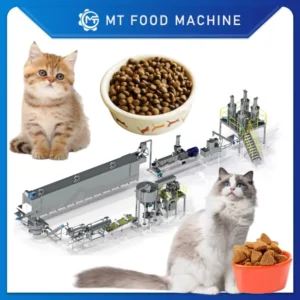
MT Brand 450-550kg/h PLC Controlled Multi-Species Pet Food Processing Line
¥40,000.00 Select options This product has multiple variants. The options may be chosen on the product page -
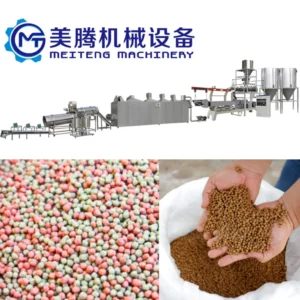
2-3t/h High Capacity Multi-Species Fish Feed Processing Line to Produce Fish Food
¥55,000.00 Select options This product has multiple variants. The options may be chosen on the product page