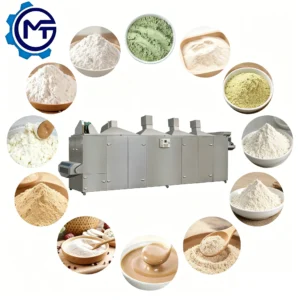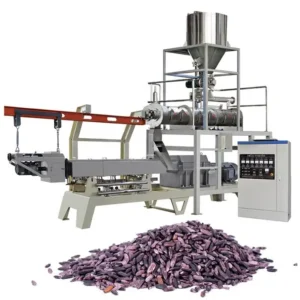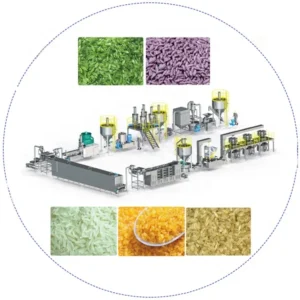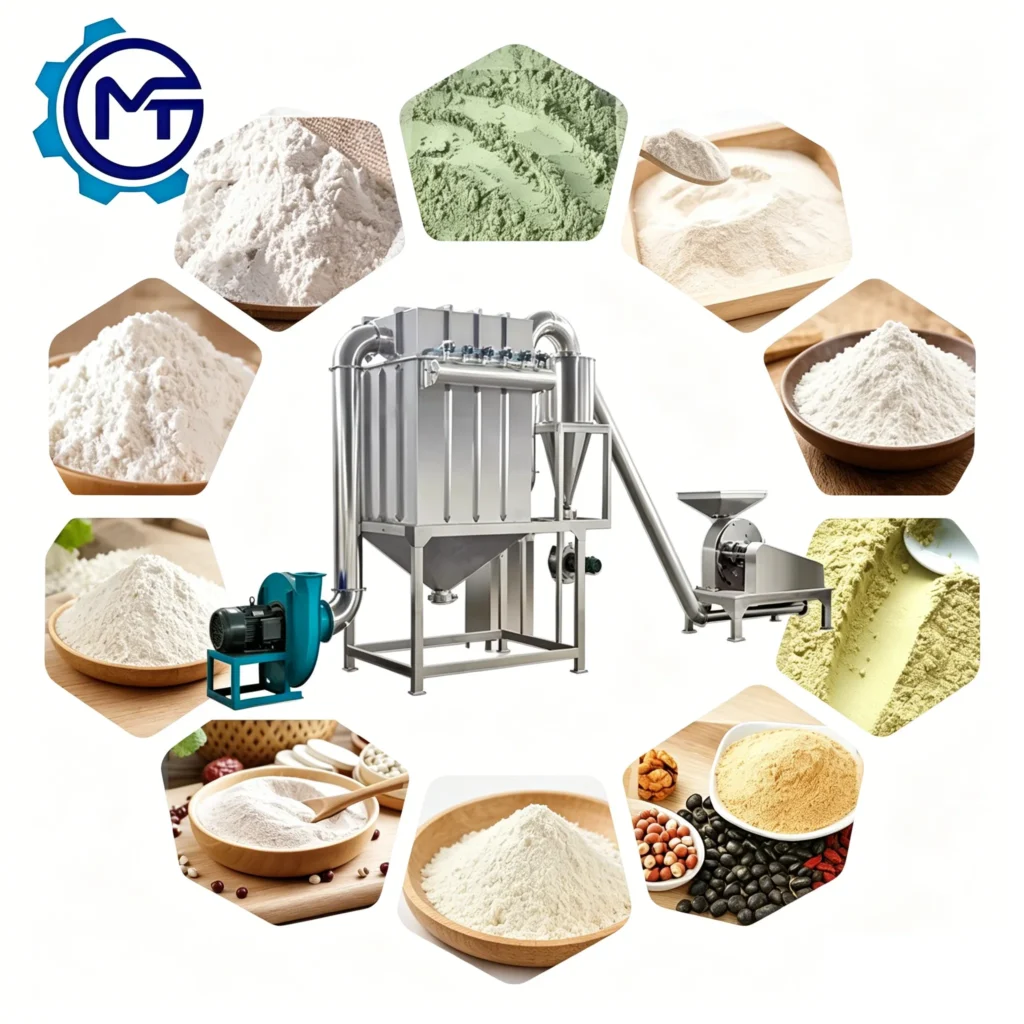

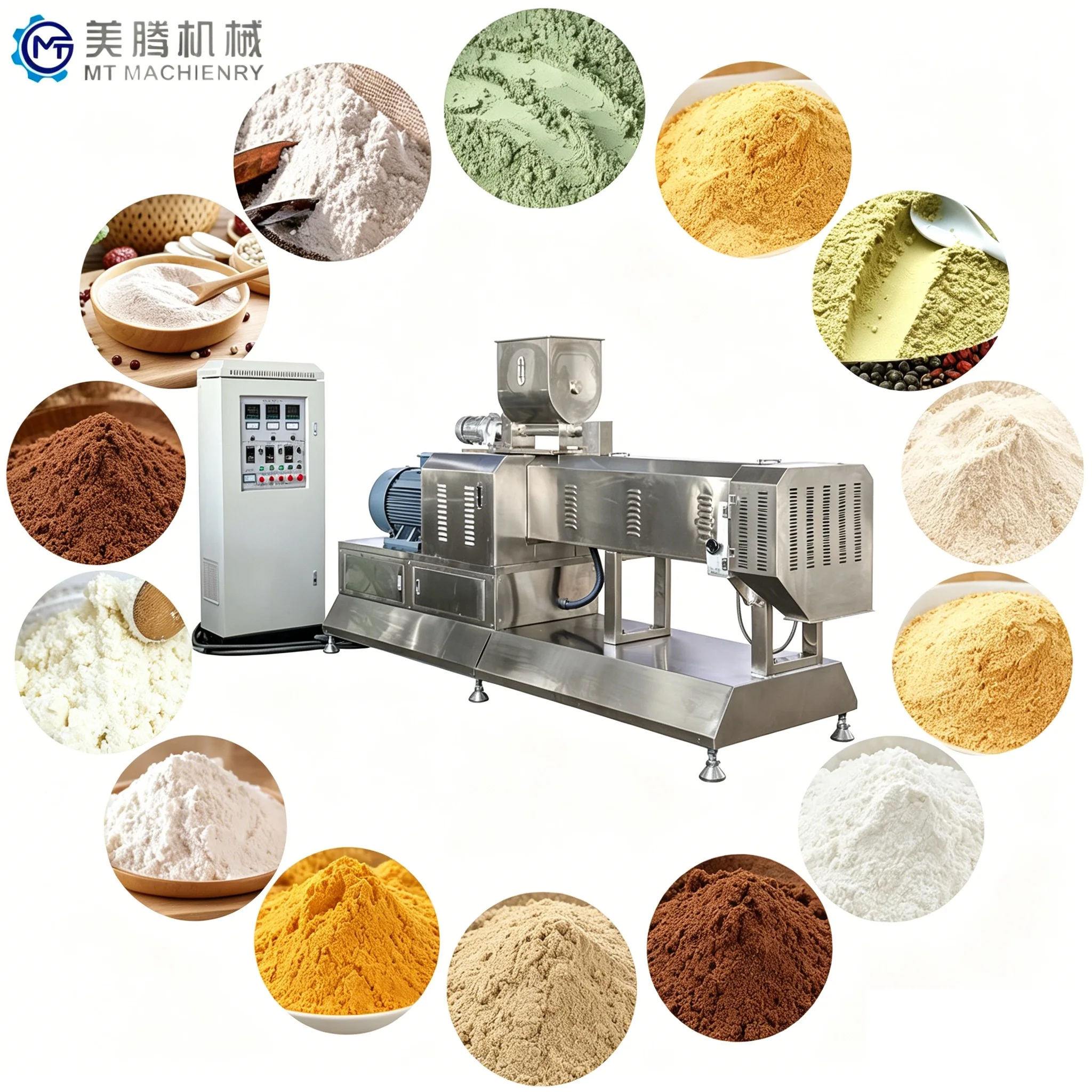
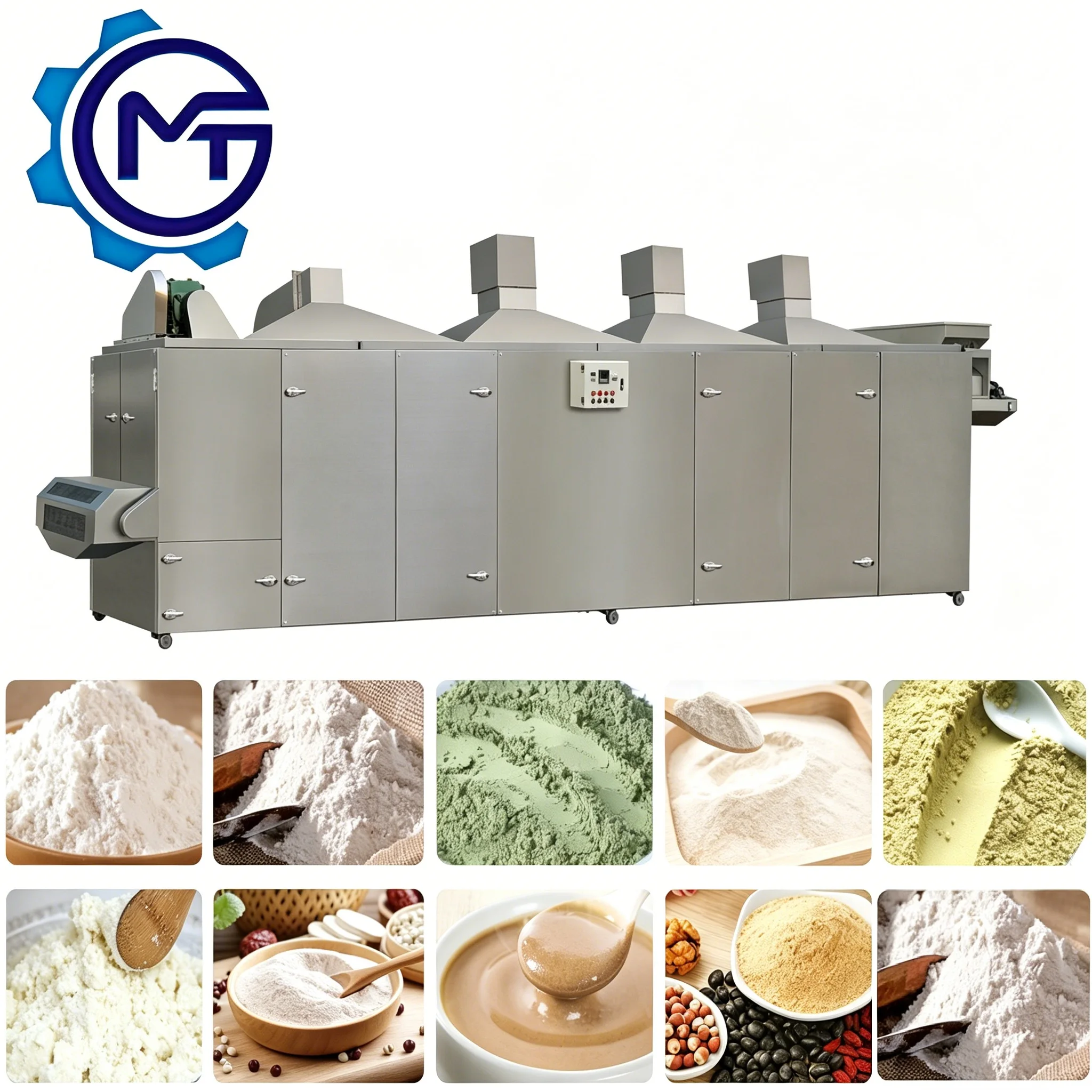


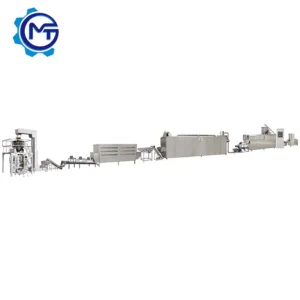
Nutrition Powder Processing Line, 200-500 kg/h, Food-Grade 304 Stainless Steel, PLC Control — designed for grain-based baby cereal and infant formula production.
From turnkey project angle, this line integrates batching, extrusion, drying and packing under one supplier with matched throughput at every station. Twin-screw configuration and die design are specified to your raw material and target product, ensuring consistent density and nutritional retention.
- Trial run on your actual raw material before shipment verifies real capacity and product quality
- Complete electrical schematics and voltage confirmation provided to match your site conditions
- Overseas installation, commissioning and operator training included with ongoing maintenance support
Description
Turnkey Integration — Throughput matched across every station from batching to packing, engineered as a single project with verified capacity on buyer-supplied raw material.
Technical Specifications
| Parameter | Value |
|---|---|
| Product Type | Nutrition Powder Processing Line |
| Output Capacity | 200–500 kg/h (basis not stated in source — confirm raw material, moisture content, and formulation) |
| Construction Material | Food-Grade 304 Stainless Steel |
| Control System | PLC with Touch Control Panel and Digital System |
| Heat Source Options | Electric / Gas / Steam |
| Automation Level | Full Automatic |
| Key Line Stations | Baking Oven, Mixer (additional stations configurable) |
| Energy Profile | Low energy consumption design (rated or peak to be confirmed) |
| Warranty | 1 Year |
| After-Sales Service | Overseas engineer service available |
| Voltage & Frequency | To be confirmed per destination market |
| CE / ISO Compliance | Available upon request for specific line configuration |
Application Suitability
| Application | Material or Output |
|---|---|
| Baby food and infant nutrition powder manufacturing | Rice, corn, beans, and various grains |
| Cereal-based porridge production | Multi-grain blends for infant and toddler feeding |
| Multi-grain nutrition powder products | Fortified formulations with added vitamins or minerals |
| Contract manufacturing for nutrition brands | Diverse baby food formulations across product SKUs |
What a Capacity Quote Leaves Out on a Nutrition Powder Processing Line Turnkey
Stated output means nothing until it holds on your specific formulation at sustained run conditions.
A capacity figure on a quotation typically reflects a standard test grain at a defined moisture level. When a buyer introduces a high proportion of whey protein, sticky hydrolysates, or fat-enriched premix into the recipe, material behaviour inside the mixer and extruder changes fundamentally. Batch cycle times extend, transfer points clog, and the dryer receives irregular feed. The result is a line that cannot sustain the quoted throughput on the products the factory actually needs to make [NEED_CITE: material behaviour variation in grain-based extrusion].
Matching Every Station to the Real Recipe
When planning a nutrition powder processing line turnkey, each station must be sized against the slowest operation in the sequence. A mixer calculated for a standard rice-and-corn blend may need considerably longer residence time once lipid-rich or protein-dense ingredients enter the formula. If the extruder downstream is specified to a higher throughput than the mixer can sustain, the line accumulates idle gaps between batches. Throughput matching begins with the buyer’s actual recipe, not a generic reference formulation.
Layout as a Commissioning Blueprint
The floor plan for a nutrition powder processing line turnkey must account for utility routing, maintenance access, and material flow direction simultaneously. Steam lines for the baking oven, electrical runs for the PLC cabinet, and dust extraction at the mixing station all require defined clearances before equipment is positioned [NEED_CITE: industrial food line layout and utility planning standards]. A layout drawn only for footprint compliance creates rework during installation when service panels are blocked or cable trays conflict with ducting.
Reading the Specification Sheet with Intent
Food-grade 304 stainless steel across all contact surfaces addresses both hygiene protocol and corrosion resistance in environments where cleaning chemicals and moisture are constant. The choice between electric, gas, and steam heating for the baking oven directly determines the utility infrastructure the factory must prepare before equipment arrives. A PLC with touch control panel centralises every station’s operational parameters — mixing time, barrel temperature, oven zone heat — into one interface, which reduces the operator error that causes batch-to-batch variation. Low energy consumption design is specified in principle; the actual connected load in kilowatts must be confirmed against the buyer’s electrical supply capacity before the line is ordered [NEED_CITE: CE machinery directive electrical supply requirements]. Voltage and frequency must be documented and confirmed for the destination country to avoid a scenario where the line arrives and the motor starters are incompatible with the local grid.
The Cost of Skipping the Trial Run
When a line ships without a documented trial on the buyer’s own raw material, product development effectively begins after installation. Screw configuration, die geometry, and oven temperature profiles are adjusted on the factory floor instead of being validated beforehand. Commissioning stretches from days into weeks while operators learn which settings produce the correct powder density and particle size. In the worst case, the line requires physical modification — a different screw profile or an added cooling stage — because the original configuration was based on assumptions about the recipe that did not hold under production conditions [NEED_CITE: extrusion trial run protocols for food processing lines].
Why Engineers Specify This Supplier for Complete Lines
A single supplier integrating every station from batching through packing eliminates the finger-pointing that occurs when equipment from multiple vendors fails to communicate at transfer points. Screw configuration and die design are specified to the buyer’s raw material and target product rather than copied from a standard build. The in-house testing workshop allows a full trial run on the buyer’s actual grain blend before shipment, producing a documented report that becomes the baseline for commissioning. Twin-screw expertise across baby cereal, aquatic feed, and snack applications means the engineering team recognises formulation behaviours that a general-purpose machine builder would miss. Pre-sales consultation extends through on-site installation, operator training, and ongoing maintenance — not just equipment delivery [NEED_CITE: twin-screw extrusion application range in food processing].
Documentation & Verification
- Line layout and capacity calculation showing throughput at each station
- Machine specification sheet with confirmed voltage and frequency
- Screw and die configuration record matched to buyer’s formulation
- Trial run report on customer raw material before dispatch
- Electrical schematic with control language confirmation
- CE declaration of conformity and ISO certificate for applicable line scope
Installation, Commissioning & Support
- Foundation and floor load assessment based on baking oven and mixer weight distribution
- Dedicated electrical circuit provision matching confirmed PLC panel voltage and total connected load
- Modular station delivery allowing phased assembly within standard container freight
- First-run parameter setting on buyer’s actual recipe during on-site commissioning
- Operator training covering PLC touch panel navigation and emergency stop sequences
- Wear parts list with screw, die, and oven belt replenishment schedule defined at handover
Preparing a Technical Inquiry
Submit your complete formulation including the proportion of each grain, protein source, and additive so the line can be configured around your actual material behaviour. Provide the target daily output and the number of operating shifts, along with your factory’s available floor area and ceiling height for layout planning. Specify your local voltage, frequency, and preferred control panel language to ensure electrical and interface compatibility from first power-on.
Frequently Asked Questions
Q: How is the line capacity verified on my specific raw material before shipment?
A: We run your actual grain blend or formulated mix through the testing workshop on the same extruder and dryer configuration specified for your line. The trial run report documents throughput, product moisture, particle size, and density. This report becomes the acceptance baseline before the equipment ships.
Q: How do you prevent bottlenecks between the mixer, extruder, and baking oven?
A: Each station is sized against the buyer’s confirmed recipe cycle time, not a generic grain reference. The line layout and capacity calculation document shows the calculated throughput at every transfer point, ensuring no station is rated higher than the one upstream of it.
Q: How are voltage, frequency, and control language confirmed for my market?
A: During the specification confirmation stage, we document your local electrical supply standards and the preferred language for the PLC touch panel. The electrical schematic and machine specification sheet reflect these values before production begins, preventing delays at commissioning.
Q: What does on-site installation and operator training involve?
A: Our engineer oversees station assembly, utility connection verification, and first-run parameter tuning on your actual formulation. Operators receive hands-on training covering PLC navigation, recipe changeover procedures, and routine maintenance points. A wear parts schedule is reviewed before handover.
Q: How are spare wear parts supplied when the first replacement is due?
A: A wear parts list is provided at commissioning, identifying screws, dies, mixer paddles, and oven components with expected service intervals. Initial spare sets can be included with the shipment, and replenishment orders are fulfilled from the same manufacturing facility that built your line.
Related products
-
Organic Gluten Free Baby Rice Nutrition Powder Automatic 500kg/h Production Processing Line
¥8,238.27 Add to cart -

High Precision Automatic 500kg/h Baby Food Nutrition Powder Rice Extrusion Processing Line
¥9,500.00 Add to cart -
Healthy Baby Food Production Line Nutritional Powder Equipment for Baby Food Supplements for Flour Processing Machinery
¥8,500.00 Select options This product has multiple variants. The options may be chosen on the product page -
Automatic Nutritional Powder Making Machine Safe Rice Cereal for Babies
¥30.00 Select options This product has multiple variants. The options may be chosen on the product page