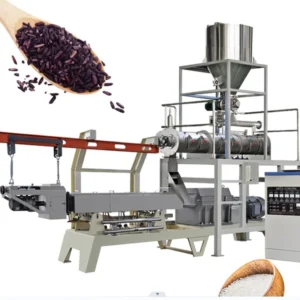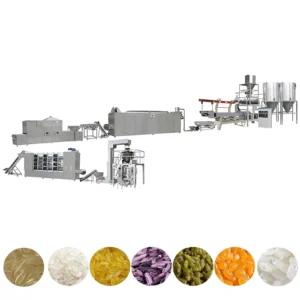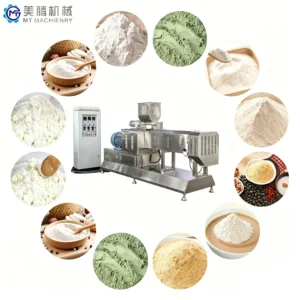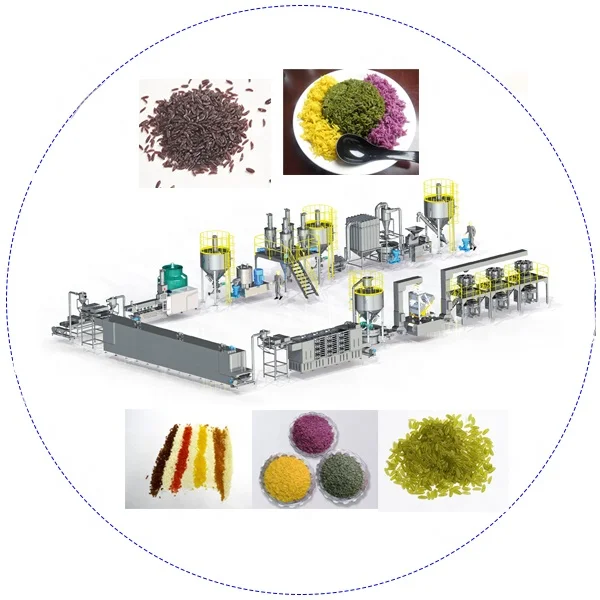
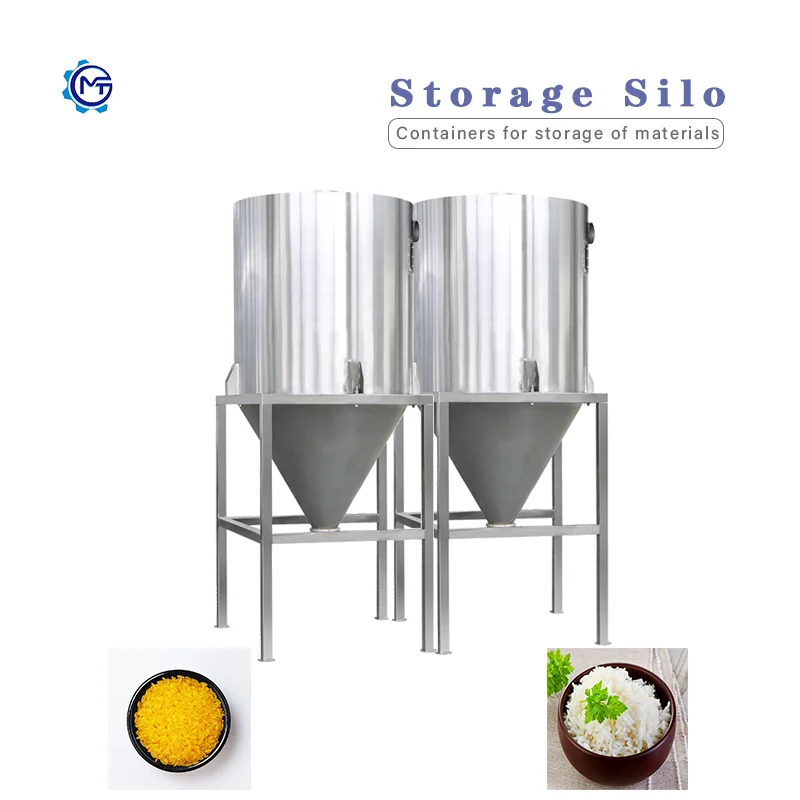
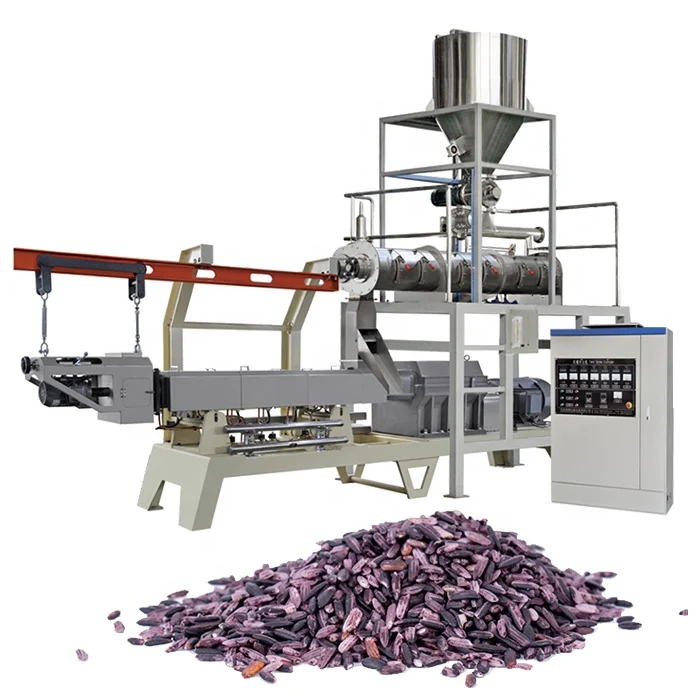
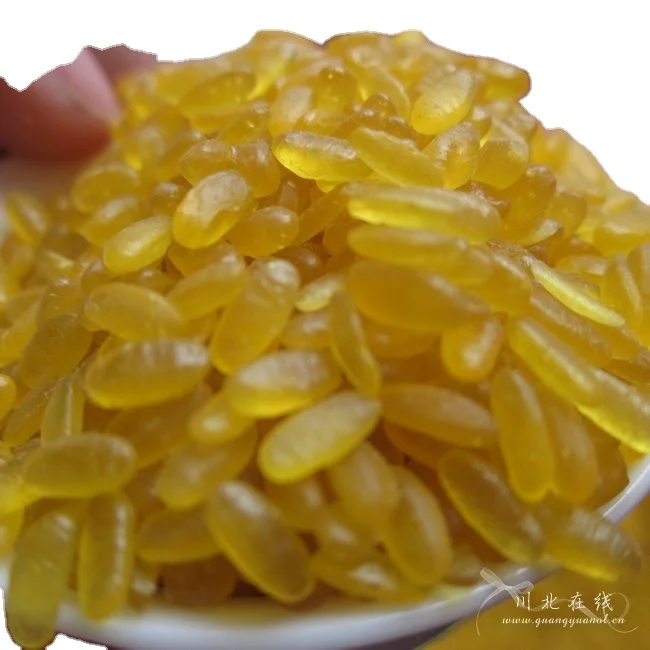
MT65 / MT70 / MT85 / MT75 / MT95 Fortified Rice Extrusion Production Line, Twin-Screw, CE Certified — complete turnkey layout from mixing through packing with throughput balanced across every station.
- Screw and die configuration matched to your raw material blend, covering broken rice, corn, millet and starch-based formulations with micro-nutrient addition
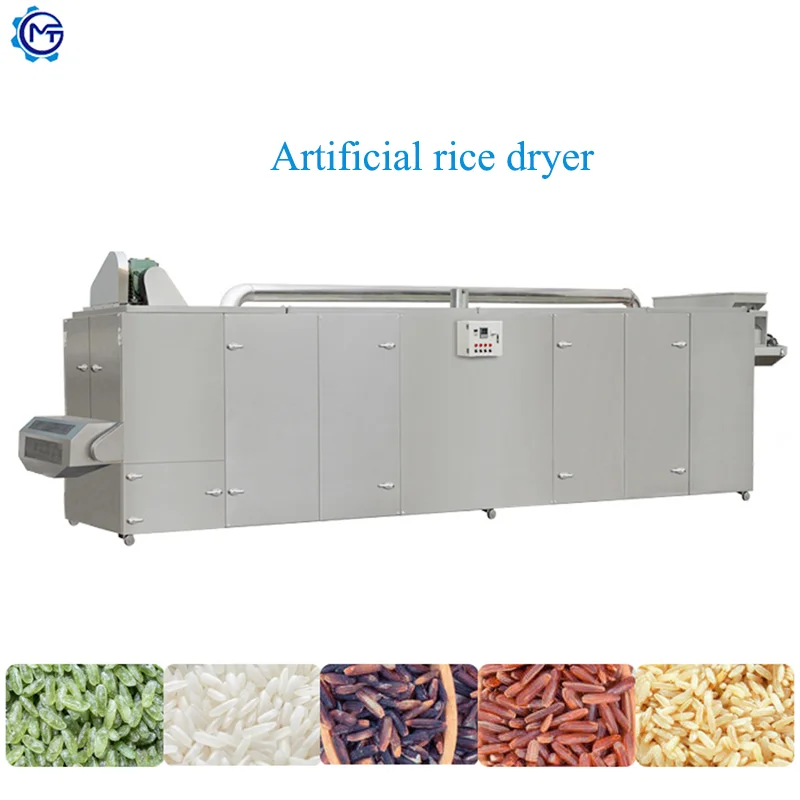
- Circulation dryer with frequency-controlled mesh belt speed ensures consistent moisture reduction and kernel integrity
- Five-model range supports facility scales from pilot to high-volume production
Line capacity verified through in-house trial runs on your specific formulation before shipment, with full documentation for commissioning and operator training.
Description
Throughput-Matched Line Design — Every station on this fortified rice extrusion production line turnkey project is calculated against your actual grain formulation, not a generic brochure capacity.
Technical Specifications
| Parameter | Value |
|---|---|
| Product Type | Fortified Rice Extrusion Production Line |
| Model | MT65 / MT70 / MT85 / MT75 / MT95 |
| Screw Type | Twin-screw |
| Installed Power | 85 kW (MT65), 120 kW (MT70), 180 kW (MT75), 235 kW (MT85), 260 kW (MT95) |
| Power Consumption | 60 kW (MT65), 85 kW (MT70), 135 kW (MT75), 165 kW (MT85), 195 kW (MT95) |
| Output Capacity | 80–100 kg/h (MT65), 100–120 kg/h (MT70), 300–500 kg/h (MT75), 200–300 kg/h (MT85), 800–1000 kg/h (MT95) — all figures basis not stated in source, raw material and moisture content to be confirmed |
| Overall Dimensions | 28×1.2×2.2 m (MT65) to 36×3.5×4.3 m (MT95) |
| Control System | Frequency speed control (PLC or MCC control available upon confirmation) |
| Feeding System | Single or double screw feeding, selected by raw material characteristics |
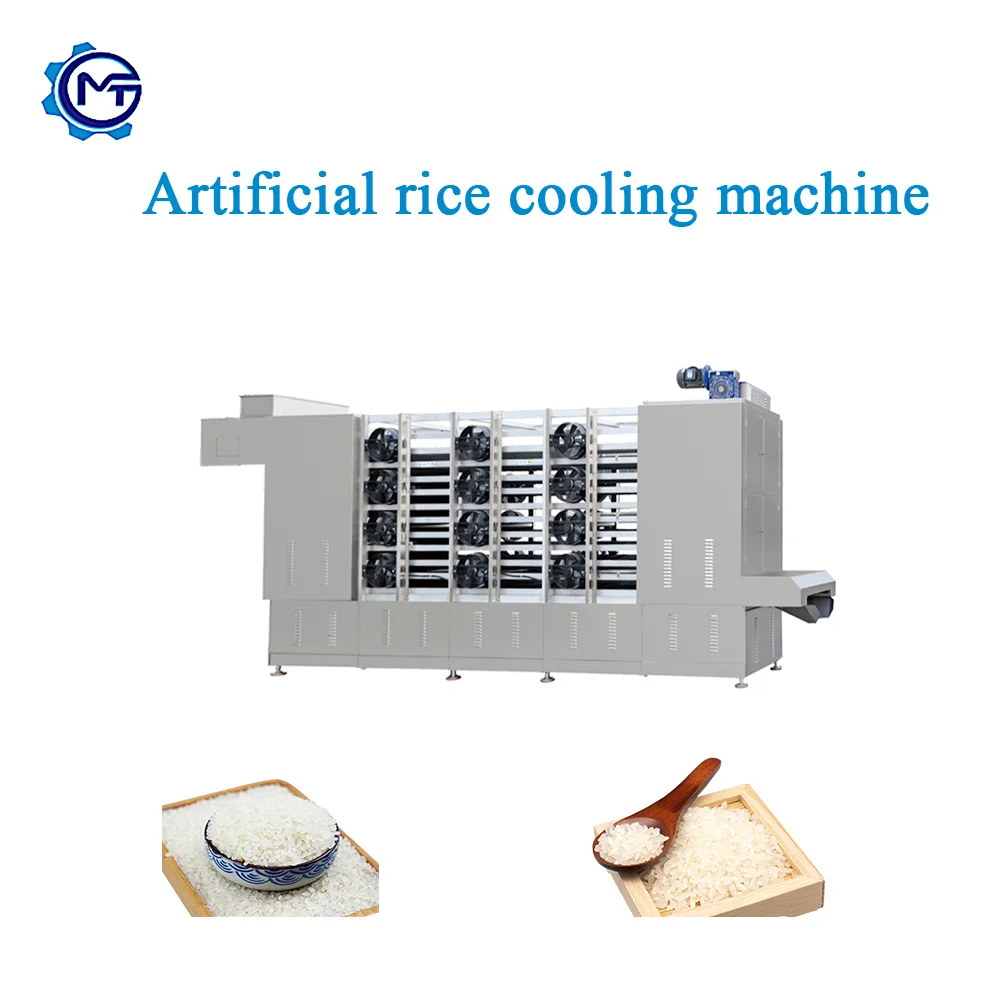
| Line Stations | Mixing → Extruding → Vibrating → Low temperature drying → Cooling → High temperature roasting → Cooling → Packing |
| Dryer Heating Source | Electric or gas |
| Dryer Feature | Circulation drying with frequency motor mesh belt speed control |
| Screw Material | Special wear-resistant alloy |
| Assembly State | Complete turnkey line |
| Voltage & Frequency | Customized to customer local standard |
| Standards | CE certified, ISO certified |
Application Suitability
| Application | Material or Output |
|---|---|
| Fortified rice kernel for nutrition programmes | Broken rice, rice flour blended with vitamin and mineral premixes |
| Artificial rice from grain by-products | Rice bran, corn, millet, wheat, oats, buckwheat, bean, starch as base ingredients |
| Nutritional grain product extrusion | Multi-grain formulations with micro-nutrient fortification for institutional feeding |
| Value-added grain processing | Reformed rice kernels from low-grade broken rice streams |
What Your Raw Material Blend Actually Does to Line Capacity
A fortified rice extrusion production line turnkey system is only as reliable as the trial run done on your exact formulation before it leaves the factory.
I remember a project in Indonesia last year. We had calibrated the line on standard polished rice flour, and everything ran clean during factory testing. The equipment shipped on schedule. Then the customer loaded their actual blend — a brown rice and multi-grain recipe with higher fibre and oil content. The extrudate density went sideways, kernels cracked during drying, and we spent four days adjusting screw configuration, barrel temperature zones, and moisture levels to stabilise output. That experience reshaped how we handle every project now. No matter the schedule pressure, the customer’s actual raw material goes into our testing workshop first. A nominal capacity figure quoted on a generic grain blend tells you very little about what the line will sustain on a high-fibre, high-fat, or micronutrient-loaded formulation [NEED_CITE: typical variation in extrusion behaviour across different grain and starch blends].
Matching Every Station Across the Grain Processing Chain
A fortified rice extrusion production line turnkey project fails when one station bottlenecks another. The extruder may push 300 kg/h, but if the dryer mesh belt and circulation airflow cannot reduce moisture at that rate, kernels either case-harden on the outside while staying wet inside, or you are forced to slow the entire line down. Our layout calculations start from the target packing rate and work backward through cooling, roasting, drying, vibrating, and extruding so that each station handles the same sustained throughput.
Screw and Die Configuration for Your Grain Formula
The twin-screw extrusion process generates shear, heat, and pressure that gelatinise starch and bind micro-nutrients into the kernel matrix. Different grain blends respond differently: a formulation heavy in broken rice starch gelatinises at lower barrel temperatures than one loaded with oat fibre or buckwheat protein. Screw element arrangement — conveying sections, kneading blocks, reverse elements — is specified to the buyer’s raw material and target kernel density. Die aperture and land length are matched to the expansion ratio your market expects, so the reformed kernel holds its shape through drying and roasting without collapsing or splitting [NEED_CITE: twin-screw extrusion parameters for starch gelatinisation in rice-based formulations].
Reading the Spec Sheet Against Your Production Target
The five-model range from MT65 through MT95 covers output capacities spanning small-scale nutrition programme production to large-volume grain processing operations. Installed power rises from 85 kW on the MT65 to 260 kW on the MT95, reflecting the motor torque needed for higher throughput and denser formulations. The feeding system — single or double screw — is chosen based on whether your premix is free-flowing or tends to bridge in the hopper. Frequency speed control across the line allows operators to fine-tune extruder screw speed, dryer mesh belt velocity, and roasting temperature without stopping production. The drying stage uses a circulation airflow design with selectable electric or gas heating, and the mesh belt speed is adjustable via frequency motor to control residence time. Overall dimensions range from a compact 28-meter footprint for the MT65 line to a 36-meter layout for the MT95, which matters when fitting into an existing processing hall with fixed column spacing.
The Hidden Cost of a Misconfigured Grain Extrusion Line
When the extruder screw profile is copied from a generic build rather than specified to your grain blend, the kernel texture drifts outside what your market accepts — too dense and the cooked rice feels wrong, too expanded and the kernel crumbles during transport. If the dryer is undersized relative to extruder output, you either cut line speed or ship kernels with residual moisture that invites mould in storage. Voltage and frequency confirmed too late in the process can stall commissioning for weeks while replacement contactors and drive modules are sourced locally. Spare wear parts — screws, barrels, dies — that are not specified and stocked from day one mean unplanned downtime the first time replacement is due [NEED_CITE: common causes of unplanned downtime in food extrusion facilities].
Why Source This Line From One Integrated Supplier
Throughput matching across every station is calculated in-house rather than assembled from separate vendor quotes, so the extruder output, dryer capacity, roasting throughput, and packing speed are balanced before the line is built. Screw configuration and die design are specified against your raw material and target kernel density, not pulled from a standard library. Every line goes through a trial run in our testing workshop using the customer’s actual formulation before shipment, eliminating the four-day on-site adjustment scenario I described earlier. Electrical schematics are reviewed with the buyer to confirm voltage, frequency, and control language before production begins. The documentation package — from layout drawings through trial run reports to wear parts lists — travels with the shipment and feeds directly into your commissioning and operator training programme.
Documentation & Verification
- Line layout and capacity calculation showing throughput matched across all stations for your grain formulation
- Trial run report on customer-supplied raw material conducted in our testing workshop before dispatch
- Screw and die configuration record specifying the exact build matched to your fortified rice blend
- Electrical schematic with voltage, frequency, and control language confirmed to your facility standard
- CE declaration of conformity and ISO certificate for customs and local regulatory submission
- Operation and maintenance manual with wear parts list for first-year planning
Installation, Commissioning & Support
- Foundation and utility layout provided for the MT65 through MT95 footprint range, covering floor load and drainage requirements
- Dedicated power circuit sizing confirmed against the installed power rating, from 85 kW to 260 kW depending on model selected
- Line ships in modular sections for assembly inside existing processing halls with limited door clearance
- First-run commissioning includes barrel temperature profiling and screw speed calibration on your grain formulation
- Operator training covers frequency speed control adjustment, feeding system changeover, and dryer mesh belt tensioning
- Wear parts inventory — screws, dies, barrel liners — specified and shipped with the initial order to cover the first replacement cycle
- Mesh belt and circulation fan maintenance schedule provided for the drying and roasting stations
What We Need to Build Your Line Proposal
To configure a fortified rice extrusion production line turnkey system that actually holds its rated output on your material, we need to understand your grain formulation and the kernel specification your market expects. Share your raw material blend ratios, including any vitamin or mineral premix loading, along with your target daily output and available workshop dimensions. Your local voltage and frequency standard, plus the preferred control language for the operator interface, should be confirmed early so the electrical package is built correctly the first time. If you are evaluating multiple grain sources or recipe variations, tell us which blends you want trialled in our testing workshop before the line ships.
Frequently Asked Questions
Q: How do you verify line capacity against my specific grain formulation?
A: We conduct a trial extrusion run in our in-house testing workshop using the exact raw material blend and vitamin premix you supply. The results — output rate, kernel density, moisture curve through drying — are documented in a trial run report. Line configuration is adjusted if the actual throughput deviates from the target before the equipment is cleared for shipment.
Q: How is throughput balanced between the extruder, dryer, and packing stations?
A: Layout engineering starts from your target packing rate and calculates backward. The dryer mesh belt length, circulation airflow, and roasting chamber capacity are sized so each station sustains the same hourly output. No single station is oversized or starved, which prevents the bottlenecking that commonly forces operators to throttle line speed.
Q: When are voltage, frequency, and control language confirmed?
A: These are locked during the specification review stage before production begins. We provide an electrical schematic showing motor ratings, control panel layout, and interface language. Any mismatch between your facility supply and our standard build is resolved at this point, avoiding the delays that occur when voltage issues surface during commissioning.
Q: Can I send my raw material for a trial run before the line ships?
A: Yes. Our testing workshop is equipped for trial extrusions on customer-supplied grain blends, including high-fibre and multi-grain formulations that behave differently from standard rice flour. The trial run report becomes part of your shipment documentation and confirms the screw and die configuration specified for your product.
Q: What documentation supports commissioning and operator training?
A: You receive a complete package including line layout, capacity calculation, screw and die configuration record, electrical schematic, trial run report, operation and maintenance manual, and wear parts list. These documents are used during on-site commissioning and form the basis for operator training sessions at your facility.
Related products
-
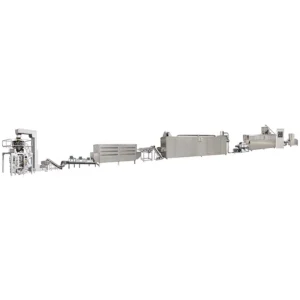
High Productivity New Condition Nutritious Baby Food Meal Replacement Powder Production Line
¥30.00 Select options This product has multiple variants. The options may be chosen on the product page -
Automatic Nutritional Powder Making Machine Safe Rice Cereal for Babies
¥30.00 Select options This product has multiple variants. The options may be chosen on the product page -
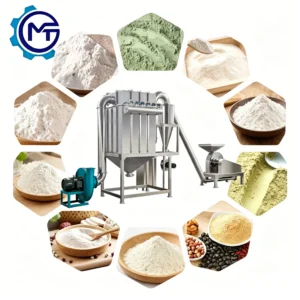
Compact Automatic Baby Cereal Nutrition Powder Production Line with 500kg/h Capacity and PLC Control
¥9,500.00 Add to cart -

Industrial Automatic 500kg/h Baby Cereal Nutrition Powder Extruder Manufacturing Process Line
¥8,238.27 Add to cart