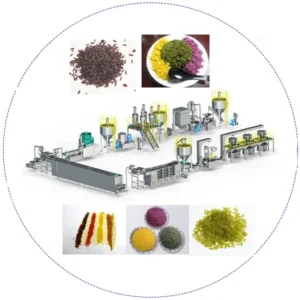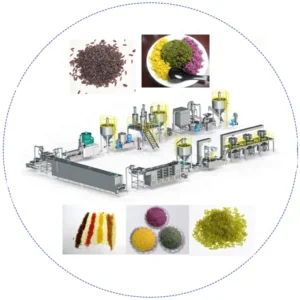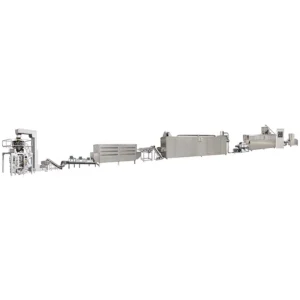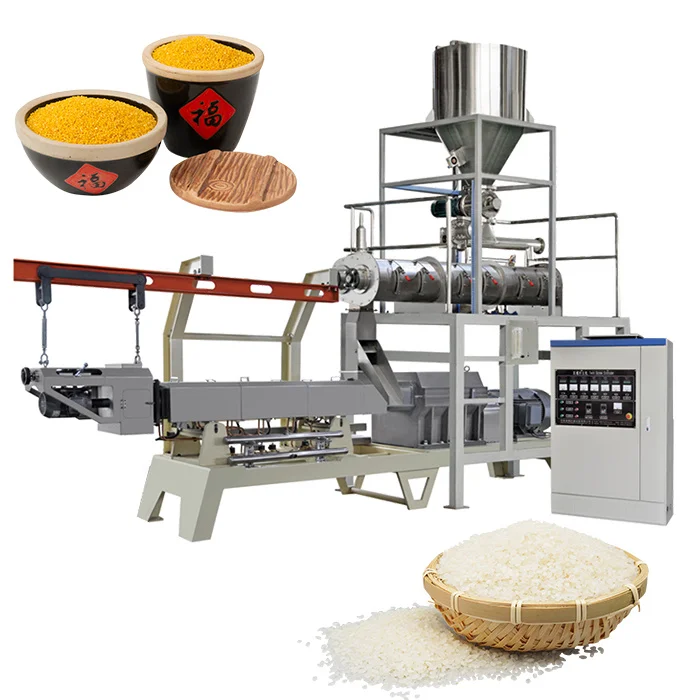
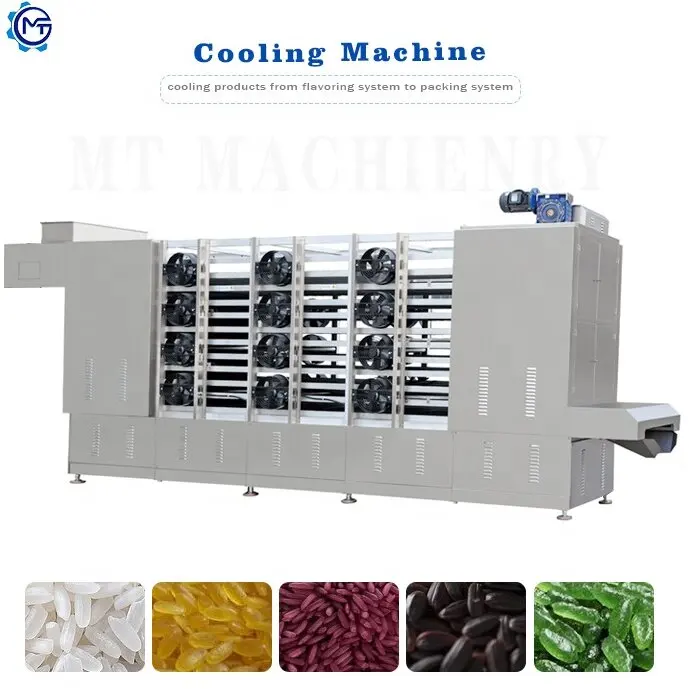
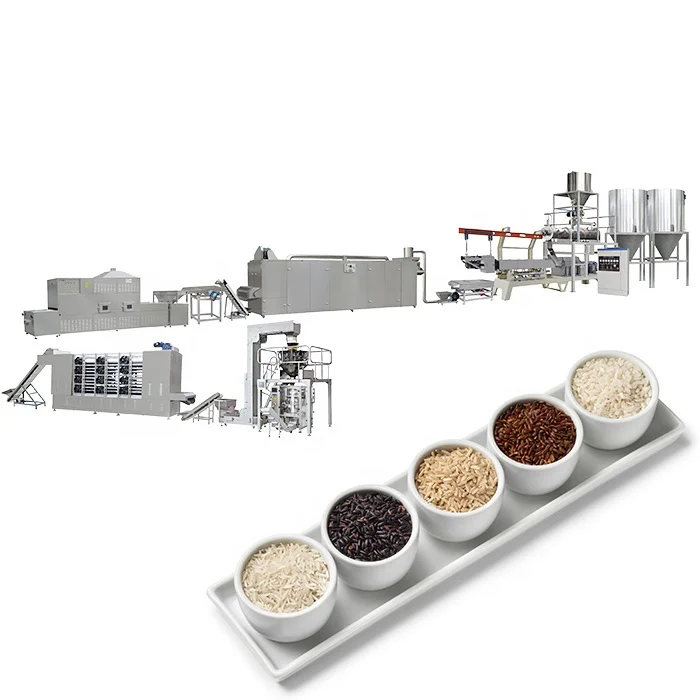
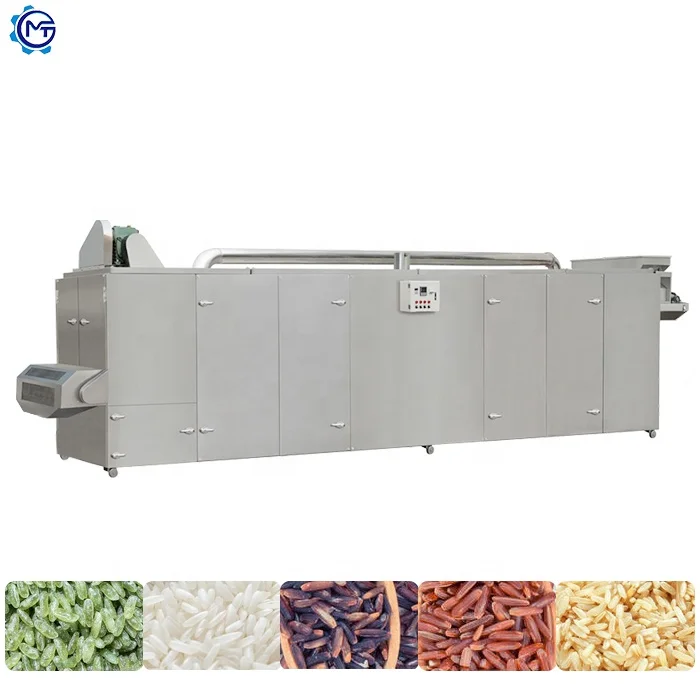
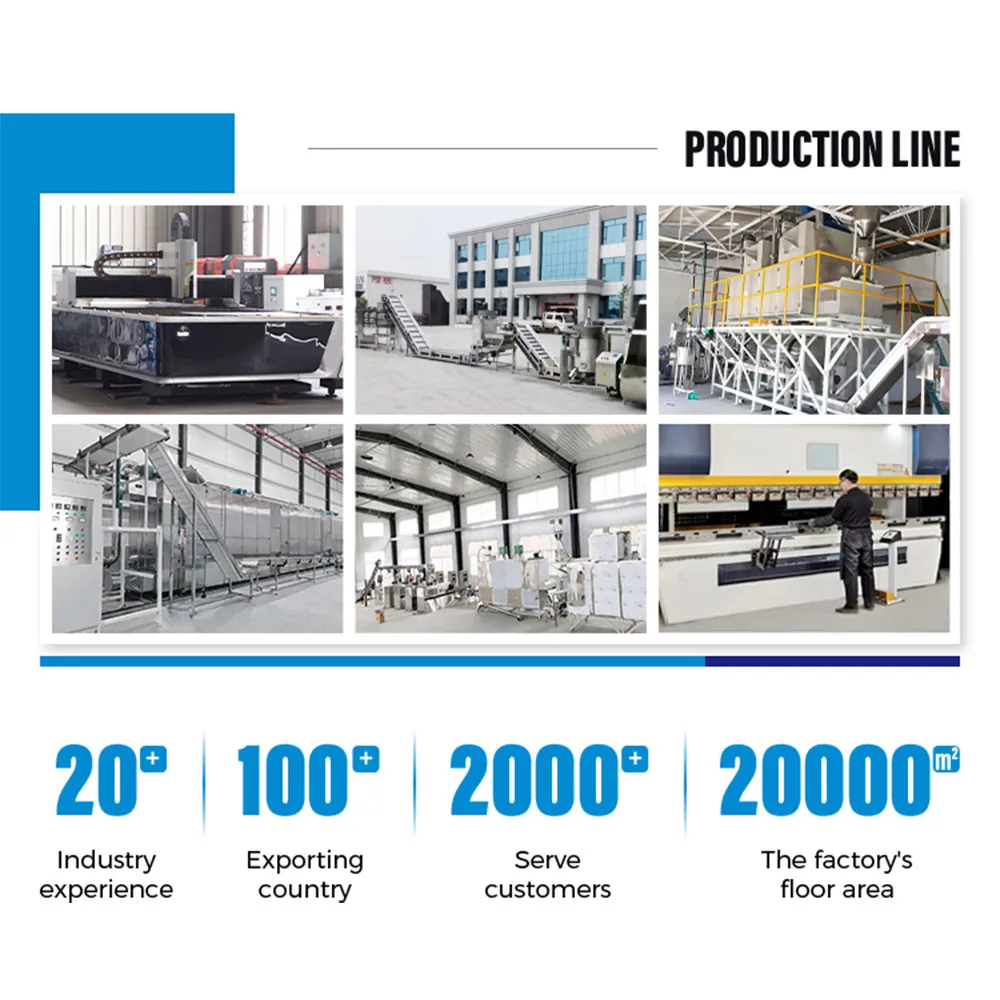
Artificial Rice Extrusion Production Line, 70-300 kg/h, 380V, Food-Grade Stainless Steel — configured for grain-based nutritional rice processing.
- Twin-screw extrusion with screw configuration and die design matched to your rice flour blend and target grain shape, ensuring consistent expansion, density and reconstitution behaviour.
- Line stations from mixing through extrusion and forming are throughput-balanced under one supplier, avoiding bottlenecks between mixer, fryer and extruder.
- Trial runs on your raw material completed in-house before shipment, with full documentation including layout, electrical schematic and wear parts list.
Description
Integrated Line Throughput — Every station from batching to packing is sized against your actual formulation, not assembled from standalone vendors and left to bottleneck at the weakest link.
Technical Specifications
| Parameter | Value |
|---|---|
| Product Type | Artificial Rice Extrusion Production Line |
| Output Capacity | 70–300 kg/h (basis not stated in source — confirm raw material, moisture and product format) |
| Voltage & Frequency | 380V / 50Hz (configurable to site requirement) |
| Construction Material | Food-grade stainless steel |
| Control System | Automatic control (PLC or MCC available on request) |
| Line Stations | Mixer, fryer, extrusion system |
| Raw Material Compatibility | Rice flour and grain-based blends |
| Assembly State | Complete production line |
Application Suitability
| Application | Material or Output |
|---|---|
| Fortified rice production | Rice flour blended with vitamin and mineral premix |
| Artificial rice manufacturing | Broken rice and grain flour reconstituted into uniform grains |
| Nutritional rice for food programmes | Cereal-based blends with added soy, legume or protein fractions |
| Extruded grain products for food plants | Multi-grain formulations targeting specific cooking and rehydration behaviour |
Why Nominal Capacity Means Nothing Without a Trial Run on Your Formula
The only output figure that matters is what the line holds on the exact blend you will run in production.
I moved into turnkey project work after spending years in testing and quality control, and one lesson stuck early: a trial on standard rice flour tells you almost nothing about how the extruder will behave once soy flour, whey protein or micronutrient premix enters the barrel. Gelatinisation shifts, expansion changes, and the screw combination that worked on a clean starch formula can produce uneven grains or a collapsed texture on a complex blend [NEED_CITE: starch gelatinisation behaviour under varied protein and fibre loading]. That is why I now insist every artificial rice production line turnkey project we scope starts with a documented trial on the buyer’s actual raw material before we finalise the screw profile and barrel temperature zones.
Matching Station Throughput Across the Whole Line
An artificial rice production line turnkey only performs as well as its most constrained station. When the mixer batch cycle is slower than the extruder feed rate, the screw runs starved and product density drifts. When the fryer or dryer cannot keep pace, partially dried rice accumulates and degrades before packing. We calculate residence time and transfer rates for each station against your target output and raw material behaviour, so the line runs as a continuous system rather than a collection of individual machines.
Phased Installation and Utility Planning on Site
Laying out an artificial rice production line turnkey in a real factory means working with the column grid, the available three-phase supply, and the drainage points for wash-down [NEED_CITE: food processing plant utility and drainage layout standards]. We sequence mechanical installation, electrical termination and control commissioning in phases so that early stations can be tested while later sections are still being positioned, cutting the time between first power-on and stable production output.
Reading the Specs That Actually Matter for Extruded Rice
The food-grade stainless steel contact surfaces prevent corrosion from the moisture and mild acidity typical in rice flour slurries, extending service intervals between sanitation shutdowns. The automatic control system holds barrel temperature and screw speed within a narrow band, which is what keeps grain shape and density consistent from the first hour of a shift to the last. Voltage and frequency must be confirmed against the buyer’s site supply before the motor and heating elements are specified — running a 380V/50Hz heating circuit on a 440V/60Hz supply will burn out elements within weeks [NEED_CITE: voltage and frequency standards by export market]. The configurable output range of 70–300 kg/h covers pilot-scale nutritional batches through to continuous commercial runs, but the achievable rate depends entirely on the formulation and target grain format.
What Happens When Configuration Is Copied Instead of Calculated
A generic screw profile applied to a high-protein fortified rice blend typically produces grains that are either too dense to cook properly or too fragile to survive packing and transport. Die openings sized for pure rice flour will extrude a soy-heavy formula into misshapen kernels that the market rejects. Without a documented trial run before shipment, all of this discovery happens on the buyer’s floor, during the weeks that should have been spent ramping to full output [NEED_CITE: extrusion screw and die selection for mixed cereal and protein formulations].
Why This Line Is Built as One Project, Not a Bundle
Every station — mixer, extruder, fryer — is sourced and matched by a single supplier so throughput is balanced before the line ships. The screw configuration and die design are recorded against your specific formulation for future reorders. A trial run on your actual raw material takes place in our testing workshop, and the results are documented before you commit to shipment. Electrical schematics and control language are confirmed during the design stage, not improvised during commissioning. Operator training covers the full line sequence, not just individual machine start-up.
Documentation & Verification
- Line layout drawing showing station placement and throughput balance for your target output
- Screw and die configuration record matched to your rice flour blend and grain shape
- Trial run report on your actual raw material conducted before shipment
- Electrical schematic with confirmed voltage, frequency and control language
- Factory test record covering continuous run stability and sanitation checks
- Wear parts list identifying screws, dies and seals due for first replacement
Installation, Commissioning & Support
- Floor plan and utility connection points mapped to your factory column grid and drainage layout
- Dedicated electrical circuit sized for the line’s total connected load at confirmed voltage and frequency
- Staged mechanical assembly allowing early stations to power on while later sections are positioned
- First-run parameter setting covering barrel temperature profile, screw speed and fryer residence time
- Operator training on full-line start-up, shutdown and sanitation procedures
- Spare screw elements, dies and seals supplied for the initial operating period
Before You Request a Quote
Share the exact formulation you plan to run, including any protein, fibre or micronutrient additions, along with the target grain shape and rehydration behaviour your market expects. Let us know your available floor space and ceiling height, the local voltage and frequency, and whether you need the control interface in a specific language. If you want a trial on your raw material before committing to the build, send a sample batch to our testing workshop and we will document the screw profile, temperature settings and output achieved.
Frequently Asked Questions
Q: How do you verify output capacity against our specific rice flour blend and formulation?
A: We run a trial in our testing workshop using your actual raw material, documenting screw speed, barrel temperature, moisture addition and the resulting grain density and shape. The output figure in the proposal reflects what the line achieved on that blend, not a nominal rating based on a generic starch formula.
Q: How are screw and die configurations matched to different fortified rice formulations?
A: Each formulation — whether it is pure rice flour or a blend with soy, legume or protein fractions — responds differently to shear and heat. We adjust screw element sequencing and die opening geometry to achieve the gelatinisation, expansion and grain shape your market requires, then record the configuration for future reference.
Q: What voltage, frequency and control language options are confirmed before the build starts?
A: We confirm site supply voltage, frequency and phase during the design stage, then specify motors, heating elements and transformers accordingly. The control interface language is agreed before the PLC or MCC panel is programmed, so operators can navigate menus from the first day of production.
Q: How is throughput balanced between the mixer, extruder and fryer to prevent bottlenecks?
A: We calculate batch cycle time for the mixer, continuous feed rate for the extruder and residence time for the fryer against your target output and raw material. Each station is sized so that no single section starves or overloads the next, keeping the line running as a continuous system.
Related products
-

Fully Automatic 500kg/h Baby Cereal Nutrition Powder Extrusion Drying Line with PLC Control
¥9,500.00 Add to cart -
Healthy Baby Food Production Line Nutritional Powder Equipment for Baby Food Supplements for Flour Processing Machinery
¥8,500.00 Select options This product has multiple variants. The options may be chosen on the product page -
High Productivity New Condition Safe Healthy and Nutritious Baby Food Meal Replacement Powder Production Line
¥30.00 Select options This product has multiple variants. The options may be chosen on the product page -

Automatic Instant Powder Production Line Nutritional Powder Extruder Machine
¥10,000.00 Select options This product has multiple variants. The options may be chosen on the product page