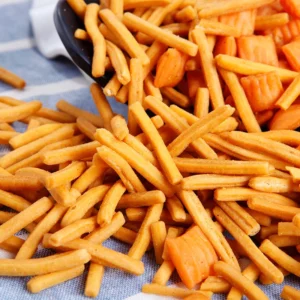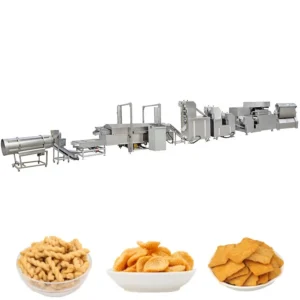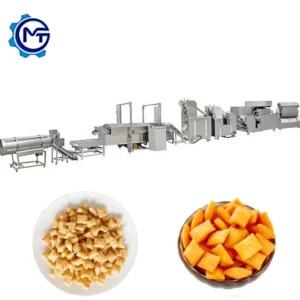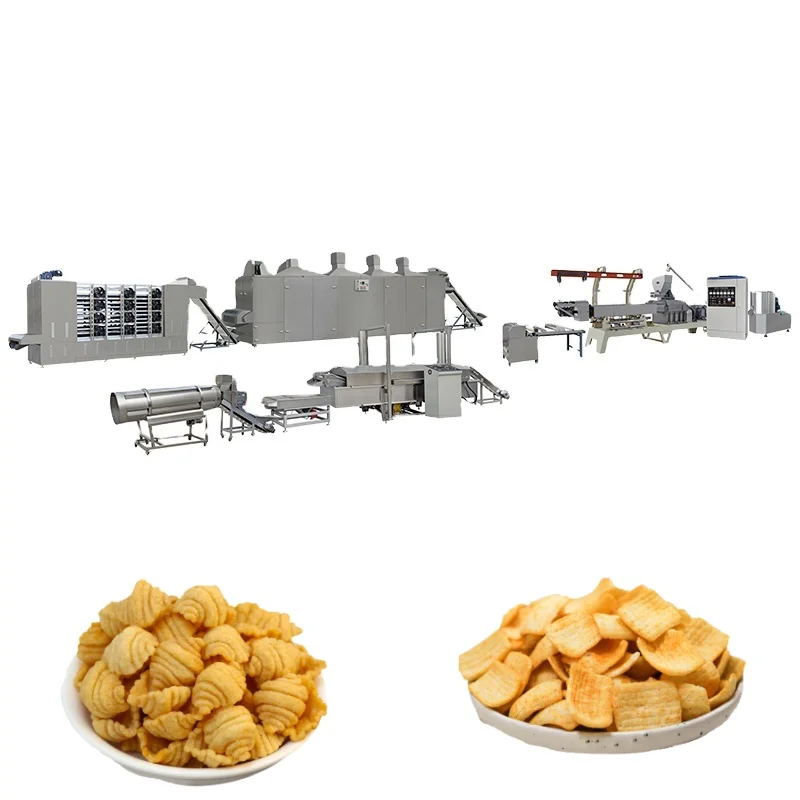




Fried Snack Food Processing Line, Twin Screw Extruder, PLC & MCC Control, CE Certified — engineered as a complete turnkey layout from batching through frying and seasoning.
- Co-rotating twin-screw extrusion with sectional screw modules configured to your raw material formulation and target snack density
- Line-wide throughput matching across mixing, extruding, cutting, frying, and flavouring stations prevents bottlenecking
- Fryer features 600 mm stainless steel belt with adjustable temperature and speed for consistent heat profile
Voltage, frequency, and control language confirmed before production; in-house trial runs validate output on your actual raw material before shipment.
Description
Turnkey Line Accountability — Every station from batching to packing is throughput-matched under a single supplier so no extruder, fryer, or seasoning drum bottlenecks the fried snack production line turnkey you paid for.
Technical Specifications
| Parameter | Value |
|---|---|
| Product Type | Twin Screw Extruded Fried Snack Production Line |
| Screw Configuration | Co-rotating twin screw with sectional modules |
| Main Motor (MT-65 / MT-70 / MT-85) | 100 kW / 130 kW / 180 kW |
| Main Motor (MT-75 / MT-95) | 185 kW / 280 kW |
| Output Capacity (MT-65) | 120–150 kg/h (basis not stated in source — confirm raw material, moisture, product shape) |
| Output Capacity (MT-70) | 200–250 kg/h (basis not stated in source — confirm raw material, moisture, product shape) |
| Output Capacity (MT-85) | 300–500 kg/h (basis not stated in source — confirm raw material, moisture, product shape) |
| Output Capacity (MT-75) | 400–500 kg/h (basis not stated in source — confirm raw material, moisture, product shape) |
| Output Capacity (MT-95) | 800–1000 kg/h (basis not stated in source — confirm raw material, moisture, product shape) |
| Mixer Power | 4 kW / 7.5 kW / 15 kW (matched to line model) |
| Cutting Machine Power | 1.47 kW |
| Fryer Belt Width | 600 mm stainless steel |
| Fryer Energy Options | Electricity / Fuel / Gas |
| Drying Method | Gas / Electric / Diesel heating |
| Control System | PLC and MCC |
| Voltage Options | 3ph 380V 50Hz / 3ph 380V 60Hz / 3ph 415V 60Hz / 3ph 220V 60Hz (configurable) |
| Overall Dimensions (MT-65 Line) | 22000 × 1200 × 2200 mm |
| Overall Dimensions (MT-70 Line) | 24000 × 1500 × 2200 mm |
| Standards | CE (since 2014), ISO certified |
Application Suitability
| Application | Material or Output |
|---|---|
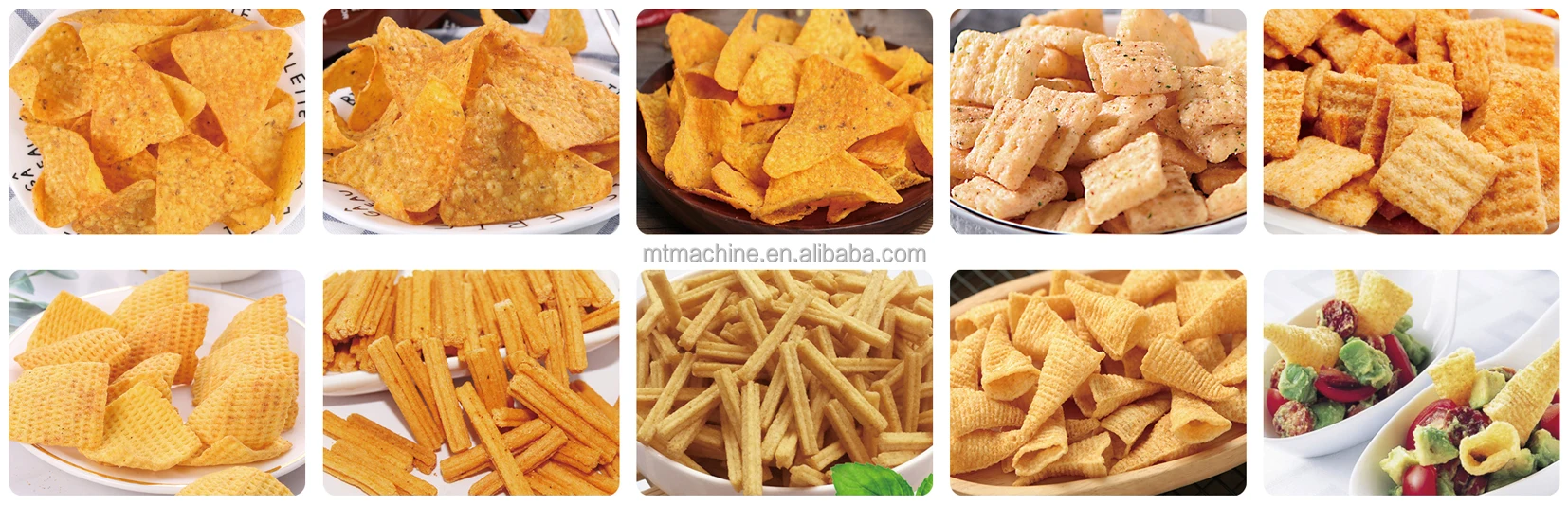
| Fried pellet snack production | Corn flour, wheat flour, potato starch blends |
| Corn chip and bugle forming | Corn grits and corn flour formulations |
| Wavy and diamond chip extrusion | Potato powder and corn starch mixes |
| Pillow, shell, and tube shapes | Multi-grain flour with adjusted moisture profiles |
| Screw and square tube formats | Wheat flour with modified starch additions |
What a Nominal Capacity Figure Leaves Out About Your Fried Snack Production Line Turnkey
A capacity number without the raw material, moisture content, and target shape attached to it is not a capacity — it is a guess.
I have watched buyers sign off on a line rated at a certain hourly output, only to discover during commissioning that the figure was based on pure corn grits while their actual recipe included rice flour, cassava starch, or higher fiber content. The extruder could not achieve the same expansion, the fryer residence time had to be extended, and the seasoning drum could not keep pace. The whole line had to be re-balanced on the factory floor — a process that should have happened in the testing workshop before the machines ever left the factory [NEED_CITE: raw material variability impact on extrusion throughput]. A fried snack production line turnkey is only as reliable as the formulation data it was configured against.
Screw Module Arrangement and Raw Material Response
The co-rotating twin-screw extruder in this line uses sectional screw modules rather than a fixed screw geometry. Each module — kneading blocks, conveying elements, reverse-flight sections — is arranged based on the buyer’s specific flour blend, starch ratio, and target product density. When a formulation shifts from pure corn to a corn-potato blend, the shear profile and residence time inside the barrel must shift accordingly, and sectional modules make that adjustment possible without replacing the entire screw assembly. This is where a fried snack production line turnkey either holds its rated behavior or starts to drift.
Throughput Matching Across Every Station
An extruder that pushes product faster than the fryer belt can carry it creates a backlog that forces the cutter to stop and start, producing inconsistent piece lengths and uneven moisture before frying. The fryer belt on this line runs at 600 mm width with adjustable speed and temperature zones, sized to absorb the output of the matched extruder model. Downstream, the flavouring drum and cooling conveyor are specified at the same throughput ceiling so that no single station in the fried snack production line turnkey forces the others into idle cycles [NEED_CITE: line balancing principles in continuous food processing].
Power, Control, and Electrical Compatibility
The main motor range spans from 100 kW on the MT-65 to 280 kW on the MT-95, and every model operates under PLC and MCC control with voltage and frequency confirmed before production begins. A 380V 50Hz machine shipped to a facility running 415V 60Hz will draw incorrect amperage, overheat motor windings, and trip thermal protection within the first shift. Confirming the electrical schematic, control panel language, and PLC interface against the buyer’s local grid standard eliminates the most common cause of delayed commissioning in export equipment installations [NEED_CITE: voltage and frequency standards by export market].
Reading the Specs That Actually Matter for Extruded Fried Snacks
The cutter operates at 1.47 kW and sits directly after the extruder die face, where product temperature and moisture are still high enough for clean shearing. If the cutter power or blade speed is mismatched to the extruder output rate, pellets tear rather than cut, creating fines that burn inside the fryer and contaminate the oil. The mixer power options — 4 kW, 7.5 kW, or 15 kW — scale with the line model to ensure batch uniformity before the material ever reaches the extruder hopper. Uneven mixing produces localized moisture pockets that expand unpredictably during extrusion, yielding a mix of over-puffed and under-puffed pieces that the fryer cannot correct. The fryer energy source — electricity, fuel, or gas — determines the heating ramp time and temperature stability across the 600 mm belt, directly influencing final product color, oil absorption, and crunch texture.
When Stations Are Mismatched, the Line Pays for It Every Shift
A fryer that cannot keep pace with the extruder forces operators to reduce extruder speed, which drops barrel temperature and shear energy, altering the gelatinization profile and producing a denser, harder pellet that fries into a tough chip rather than a crisp one. A seasoning drum that is undersized for the line output means product piles up in the cooling section, absorbing ambient moisture and losing the surface dryness that seasoning powder needs to adhere properly. These cascading failures are not visible during a factory test run on standard corn flour — they emerge only when the buyer’s actual recipe, with its specific starch-to-protein ratio and moisture target, runs through every station in sequence [NEED_CITE: extrusion line bottleneck consequences in snack manufacturing].
Why Source This Line From a Single Supplier
Throughput matching is calculated across every station — mixer, extruder, cutter, fryer, seasoning drum, cooling conveyor, and packing — before the line layout is finalized, so the output figure reflects a balanced system rather than the weakest link. Screw configuration and die design are specified against the buyer’s raw material sample and target product shape, not pulled from a generic build template. An in-house testing workshop runs trial production on the buyer’s actual formulation before shipment, generating a trial run report that documents expansion ratio, piece density, and fryer behavior. Electrical schematics and control language are confirmed in writing before fabrication begins, preventing on-site rewiring and PLC reprogramming during commissioning. CE and ISO documentation accompanies every shipment, supporting customs clearance and local regulatory registration.
Documentation & Verification
- Line layout and capacity calculation tied to your raw material blend and target snack shape
- Screw and die configuration record specifying module arrangement for your formulation
- Trial run report from the in-house testing workshop on your actual raw material
- Electrical schematic with confirmed voltage, frequency, and PLC interface language
- Factory test record documenting output behavior before dispatch
Installation, Commissioning & Support
- Foundation and floor space planning based on the confirmed line dimensions for your selected model
- Dedicated electrical circuit sized to the main motor kW rating and fryer heating load
- Assembly sequence from mixer through packing with station-by-station alignment checks
- First-run parameter setting covering barrel temperature zones, screw speed, and fryer belt rate
- Operator training on PLC interface, die changes, and cutter blade replacement procedures
- Wear parts inventory including screw modules, die plates, and fryer belt sections for the first replacement cycle
What to Include in Your Inquiry
To configure a fried snack production line turnkey that holds its output on your actual recipe, provide the raw material formulation including flour types, starch ratios, and any additive percentages. Specify the target product shapes — bugles, wavy chips, diamond chips, or pellet formats — along with the desired piece dimensions and final packaging weight. Confirm your facility voltage, frequency, and the preferred control panel language so the electrical schematic is locked before production starts.
Frequently Asked Questions
Q: How is line capacity verified on my raw material and target snack shape before shipment?
A: Your raw material sample runs through the extruder, cutter, and fryer in the in-house testing workshop before the line ships. The trial run report documents expansion behavior, piece density, and fryer output at your formulation, so capacity figures are tied to your actual recipe rather than a generic test flour.
Q: What voltage, frequency, and control language options are confirmed before production?
A: The electrical schematic is finalized with your facility specs — options include 3ph 380V 50Hz, 3ph 415V 60Hz, and others — before fabrication begins. The PLC interface language is set to match your operators, and the MCC panel is wired to the confirmed voltage so no on-site rewiring is needed during commissioning.
Q: How are extruder, fryer, and seasoning stations matched so no station bottlenecks throughput?
A: Each station is sized during the layout phase based on the extruder output for your specific formulation. The fryer belt width, seasoning drum volume, and cooling conveyor length are calculated to absorb the extruder rate without product backlog, so the line runs continuously without forced stops at any single point.
Q: What does on-site installation, commissioning, and operator training include?
A: Engineers oversee station alignment, utility connections, and first-run parameter setting covering barrel temperatures, screw speed, and fryer belt rate. Operators receive hands-on training on the PLC interface, die and screw module changes, cutter adjustment, and daily maintenance routines specific to your line configuration.
Q: How are spare wear parts such as screws, dies, and fryer belts supplied for the first replacement cycle?
A: Freely provided wearing parts ship with the line, and a wear parts list identifies every consumable component with specifications. Additional spare sets covering two to three years of operation can be included in the initial shipment so replacements are on hand when the first change-out is due.
Related products
-
Hot Selling Puffed Ball Snacks Food Processing Line Fried Snacks Processing Line Corn Puff Snacks Machine
¥100.00 Select options This product has multiple variants. The options may be chosen on the product page -
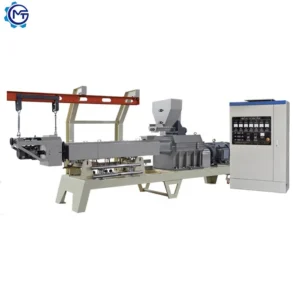
Industrial Fully Automatic Stainless Steel Deep Fried Line – Snack Factory Miscellaneous Grains Special Processing Equipment
¥65.00 Select options This product has multiple variants. The options may be chosen on the product page -
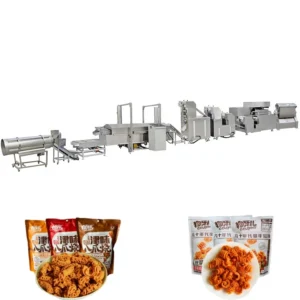
Puffed Octopus Snack Processing Line – Full-Automatic Fried Octopus Production Machinery
¥65.00 Select options This product has multiple variants. The options may be chosen on the product page -
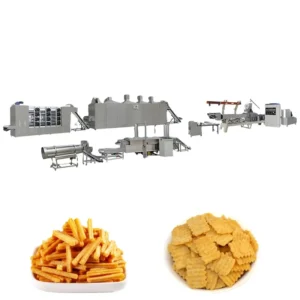
Fried Bugles Chips Production Line Fried Doritos Tortilla Snack Food Extruder
¥100.00 Select options This product has multiple variants. The options may be chosen on the product page