

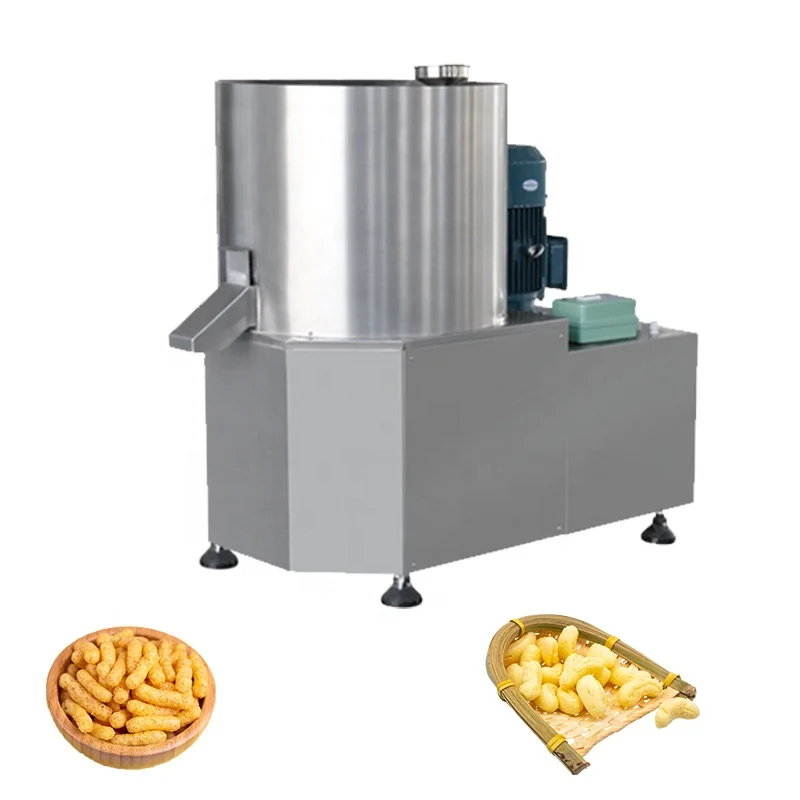
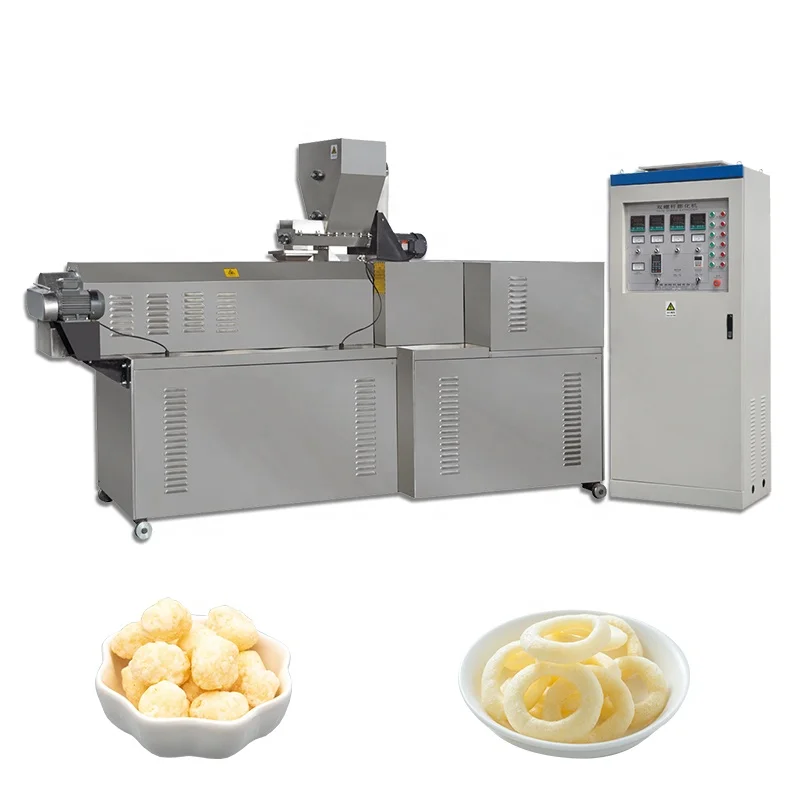
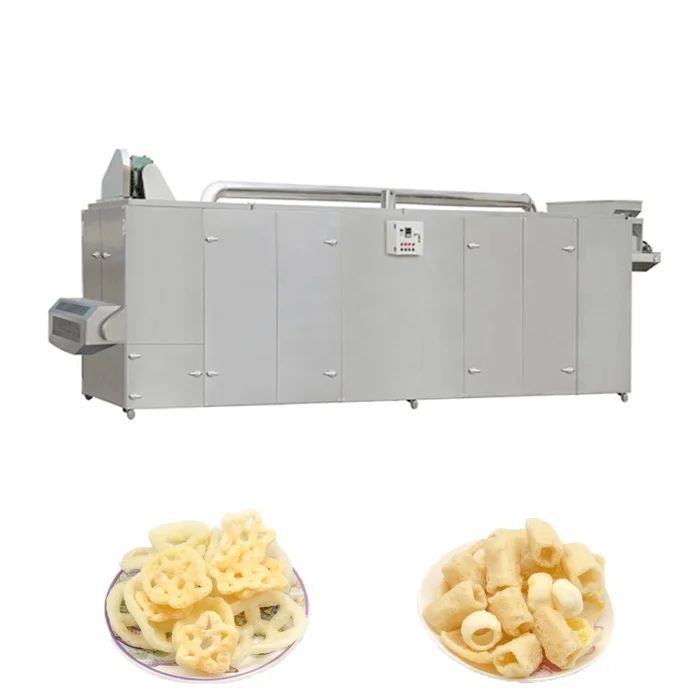
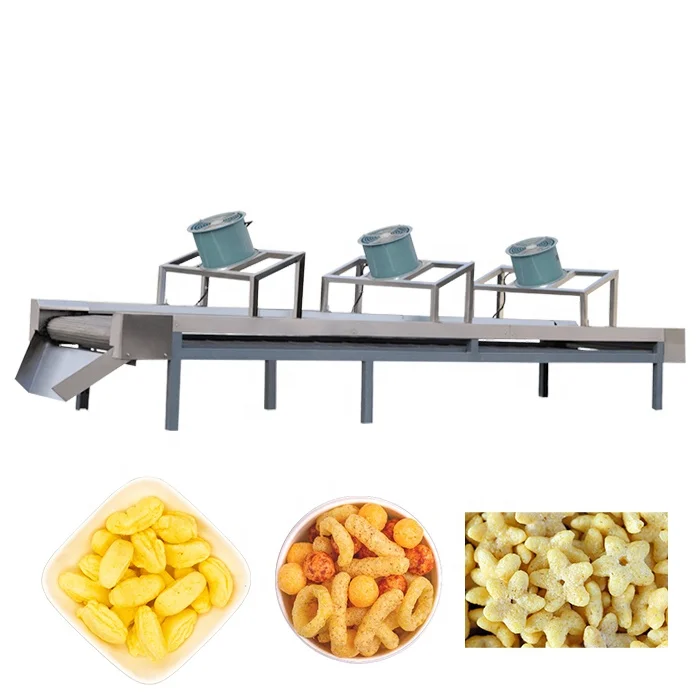
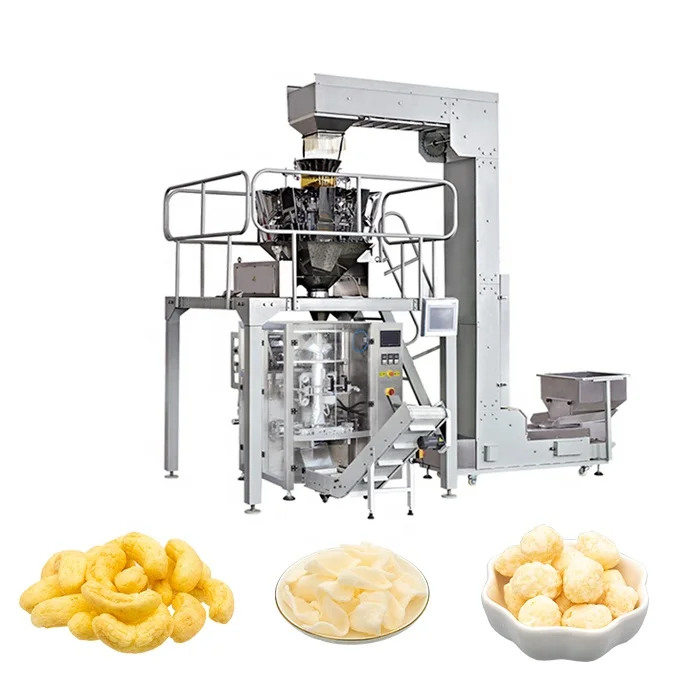
Twin Screw Puffed Snack Extruder, ~100 kW, 380V / 50Hz — engineered for maize, rice, millet and buckwheat cereals with screw configuration and die design matched to your target puff density and texture.
- Screw profile and barrel temperature profile set to cereal matrix for consistent expansion and crunch
- Dryer length and flavoring station throughput matched to extruder output, eliminating downstream bottlenecks
- Food-grade 201 / 304 stainless steel contact surfaces across all stations
- Energy options: electricity, gas, diesel or steam
Trial runs executed on your raw material in our testing workshop before shipment, with full line layout and capacity calculation documented.
Description
Screw and die design locked to your cereal blend — we run your actual maize, rice or millet flour in our testing workshop before the extruder leaves the factory, so puff density and expansion match what your market expects.
Technical Specifications
| Parameter | Value |
|---|---|
| Product Type | Twin Screw Food Extruder for Puffed Snacks |
| Screw Configuration | Twin screw (co-rotating, modular elements) |
| Barrel & Screw Material | Food-grade stainless steel 201 / 304 |
| Contact Surface Material | Food-grade stainless steel 201 / 304 |
| Main Drive Motor | Siemens (China-made) or equivalent top Chinese brand |
| Inverter | Delixi or Delta |
| Voltage & Frequency | 380 V / 50 Hz (3-phase); 220 V / 50 Hz (single-phase); configurable to buyer’s local supply |
| Energy Source Options | Electricity / gas / diesel / steam |
| Rated Power (Electrical Heating) | ~100 kW (basis to be confirmed per line configuration) |
| Rated Power (Gas / Diesel Heating) | ~50–60 kW (basis to be confirmed per line configuration) |
| Control System | PLC / MCC level to be confirmed with buyer |
| Line Stations | Mixer → Extruder → Vibrating cooler → Roasting machine → Packing machine |
| Dryer | Multi-layer belt dryer, length and layer count sized to extruder throughput |
| Flavoring System | Sugar / oil / powder seasoning, semi-automatic or fully automatic |
| Assembly State | Complete line from batching through packing |
Application Suitability
| Application | Material or Output |
|---|---|
| Corn puff and maize puff snack production | Maize grits, corn flour, blended cereal flours |
| Puffed rice snack production | Rice flour, brown rice flour, broken rice |
| Millet and buckwheat puffed snacks | Millet flour, buckwheat flour, multi-grain blends |
| Fortified and artificial rice pellets | Rice flour fortified with vitamins, proteins and minerals |
| Fried snack base pellets | Cereal flour blends processed through alternative die configuration |
Why Nominal Capacity Numbers Mislead Puffed Snack Buyers
A puffed snack extruder production line quoted at a round throughput figure often cannot sustain that output once your specific cereal blend enters the barrel. Real capacity depends on the starch composition, moisture level and particle size of the flour you actually feed in, not the benchmark material used in the brochure. I learned this the hard way in a West African snack factory: the line ran perfectly on standard maize grits during the factory test, but the customer’s real recipe mixed rice flour with cassava starch, and expansion collapsed entirely. The whole first batch was scrap. Since that job, I refuse to finalize screw elements or die geometry until the buyer’s true raw material has run through the extruder under controlled conditions [NEED_CITE: effect of starch amylose ratio on extrusion expansion]. When the flour blend changes, the residence time, shear profile and moisture injection window all shift, and no generic screw build compensates for that automatically.
Matching Screw Geometry to Cereal Starch Behaviour
Each cereal flour behaves differently inside the twin-screw barrel. Maize grits with high amylose content need a longer compression zone and higher shear to achieve full gelatinisation, while rice flour gelatinises earlier and requires gentler handling to prevent over-expansion at the die face. The screw elements on this puffed snack extruder production line are arranged in a modular sequence — feeding, compression, metering and high-shear kneading blocks — so the configuration can be rebuilt when the buyer switches between maize, rice, millet or buckwheat recipes. Getting the element order wrong produces snacks that are either dense and hard or hollow and fragile, neither of which survives the flavoring drum intact.
Sizing the Dryer and Flavoring Station to the Extruder
A twin-screw extruder that pushes product faster than the downstream dryer can handle creates a bottleneck that no amount of operator tweaking will fix. The multi-layer belt dryer supplied with this line is specified in length and layer count to match the extruder’s moisture removal requirement at target throughput. Energy source selection — electricity, gas, diesel or steam — is locked to the buyer’s available utility infrastructure before the dryer is built. Flavoring drums are offered in semi-automatic or fully automatic versions, handling sugar slurry, oil spray and dry powder seasoning so that coating uniformity holds across every shift [NEED_CITE: flavoring adhesion requirements for puffed cereal snacks]. When every station is throughput-balanced, the line runs continuously instead of stopping and starting to let the dryer catch up.
Reading the Specification Sheet Against Your Production Target
The rated power figures — roughly 100 kW for fully electrical heating and 50–60 kW when gas or diesel is used — tell you the utility headroom the line demands, not the energy cost per kilogram of finished snack. What matters more for daily production is the voltage and frequency confirmation: a 380 V / 50 Hz motor running on a 440 V / 60 Hz supply will overheat and trip inverters within hours. The Delixi or Delta inverters control screw speed and feeder rate, and their parameter tables must be loaded with values that correspond to the buyer’s cereal recipe before first run. Food-grade stainless steel 201 or 304 contact surfaces are specified across every product zone, which affects both sanitation protocol and corrosion resistance in humid processing environments where sugar-based flavoring is applied.
The Hidden Cost of Skipping the Trial Run
Buyers who accept shipment without witnessing a trial run on their own flour blend often discover problems only after installation, when the cost of correction includes idle factory workers, wasted raw material and missed market launch deadlines. A screw configuration copied from a generic build may produce corn puffs that are too dense for the local market’s texture expectation, forcing the producer to reformulate or re-tool months into production. Die geometry mismatches show up as inconsistent piece size across the conveyor, which makes automatic packing unreliable [NEED_CITE: die land length influence on extrudate diameter consistency]. Electrical panels built for the wrong voltage or with HMI text in a language the operators cannot read delay commissioning by weeks while replacement components are sourced.
Why Sourcing the Full Line from One Supplier Matters Here
Every station on this puffed snack extruder production line — mixer, extruder, vibrating cooler, roasting machine, dryer, flavoring drum and packing unit — is sized and specified under a single engineering responsibility, so throughput calculations are internally consistent rather than assembled from independent vendor quotes. Screw and die configurations are documented against the buyer’s specific cereal flour and target puff density before production begins. An in-house testing workshop allows trial runs on the customer’s actual raw material, generating a written report that travels with the shipment. Electrical schematics, voltage confirmation records and control language settings are finalized before the panel is wired, not after the container arrives. Wear parts lists for screws, dies and barrel liners are included so the first replacement cycle does not become an emergency sourcing exercise.
Documentation & Verification
- Line layout and throughput calculation showing balanced capacity across every station
- Screw and die configuration record matched to your cereal flour and target puff density
- Trial run report generated on your raw material in our testing workshop before dispatch
- Electrical schematic with confirmed voltage, frequency and HMI language before panel wiring
- CE declaration of conformity and ISO certificate for the complete line
- Operation and maintenance manual with wear parts replacement intervals
Installation, Commissioning & Support
- Foundation and floor space plan sized to the full line footprint including dryer length
- Dedicated power circuit specification for the ~100 kW electrical heating load or gas train for thermal oil
- Assembly sequence from shipping crate to first product run with phased mechanical and electrical milestones
- First-run parameter setting on your cereal flour, adjusting screw speed, barrel temperature and die clearance
- Operator training covering daily sanitation, screw element inspection and flavoring system calibration
- Wear parts list for screws, dies and barrel liners with recommended replacement intervals
What We Need Before Quoting Your Line
To specify a puffed snack extruder production line that actually delivers on your floor, we need to know the exact cereal flour or blend you will run, including moisture content and particle size distribution. Tell us the target daily output in finished kilograms and the puff density or texture your market expects. Confirm the voltage, frequency and phase available at your site, along with the preferred energy source for drying. If you are integrating this line into an existing factory, share the available floor area and ceiling height, and describe any upstream or downstream equipment already in place.
Frequently Asked Questions
Q: How is line capacity verified on my actual cereal blend?
A: We run your flour sample — maize, rice, millet or any blend — through the twin-screw extruder in our testing workshop before shipment. Screw speed, barrel temperature profile and die geometry are adjusted during the trial until puff density and expansion match your target specification. A written trial run report documents the parameters and output rate achieved on your material, and this report ships with the line.
Q: How are screw configuration and die design matched to my target puff texture?
A: The modular screw elements are arranged in a sequence — feeding, compression, metering, kneading — selected for your cereal’s starch gelatinisation behaviour. Die land length and orifice diameter are calculated to produce the expansion ratio and piece density your market expects. Both are recorded in the configuration document so the build can be replicated or adjusted when you introduce a new recipe.
Q: What voltage, frequency and HMI language will be confirmed before production?
A: Before the electrical panel is wired, we confirm your site supply — for example 380 V / 50 Hz three-phase or any local equivalent — and the preferred HMI language for operators. The Delixi or Delta inverter parameters are pre-loaded with values matching your cereal recipe. This confirmation step is documented in the electrical schematic that travels with the shipment.
Q: How is the dryer sized so it does not bottleneck the extruder?
A: The multi-layer belt dryer length and layer count are calculated from the extruder’s moisture removal requirement at the confirmed throughput. Energy source — electricity, gas, diesel or steam — is selected to match your available utilities. The result is a dryer that keeps pace with the extruder continuously, preventing the stop-start operation that degrades product consistency.
Q: What does on-site installation and commissioning include?
A: Our engineer follows a phased schedule covering mechanical assembly, electrical connection, dry run, wet run with your raw material and parameter fine-tuning. Operator training covers daily sanitation, screw element inspection and flavoring system calibration. A wear parts list with replacement intervals is handed over so the first maintenance cycle is planned rather than reactive.
Related products
-

Crunchy Puffed Snack Breakfast Cereal Corn Flakes Making Machine
¥1,000.00 Select options This product has multiple variants. The options may be chosen on the product page -

Stainless Steel Corn Puff Cake Making Machine Corn Snack Food Machines Top Selling Snacks Machine
¥8,560.00 Select options This product has multiple variants. The options may be chosen on the product page -

Twin Screw Corn Puffs Extruder Machine Small Corn Snack Food Extruder Machine
¥100.00 Select options This product has multiple variants. The options may be chosen on the product page -

New Puffed Snack Food Machine Production Line Corn Flake Puff Corn Making Machine Twin Screw Extruder 100-500kg/h Capacity Food
¥8,500.00 Select options This product has multiple variants. The options may be chosen on the product page


